Melatonin vs. Magnesium for Sleep: A Head-to-Head Comparison
Melatonin vs. Magnesium for Sleep: A Head-to-Head Comparison
You're standing in the supplement aisle, staring at two bottles. One says melatonin. The other says magnesium. The question of melatonin vs magnesium for sleep is one that millions of people face every week. Both promise better rest. Neither tells you which one actually works for your problem.
The melatonin vs magnesium for sleep debate isn't really a debate at all. These two supplements do completely different things inside your body. Picking the wrong one means spending money on something that won't fix the reason you're lying awake at 2 a.m.
Here's what the research actually says about melatonin vs magnesium for sleep, when to use each one, and whether there's a better option entirely.
Key Takeaways
- Melatonin is a hormone that resets your internal clock. It's best for jet lag, shift work, and circadian rhythm problems.
- Magnesium is a mineral that relaxes your nervous system. It's best for stress-related sleep issues and general sleep quality.
- In the melatonin vs magnesium for sleep comparison, melatonin has real dosing and quality control problems. Over 71% of supplements don't contain what their labels claim.
- A 2025 study presented at the American Heart Association found long-term melatonin use was linked to higher heart failure risk.
- Neither supplement addresses daytime cognitive performance, which is where the conversation gets interesting.
How Melatonin Works in the Melatonin vs Magnesium for Sleep Comparison
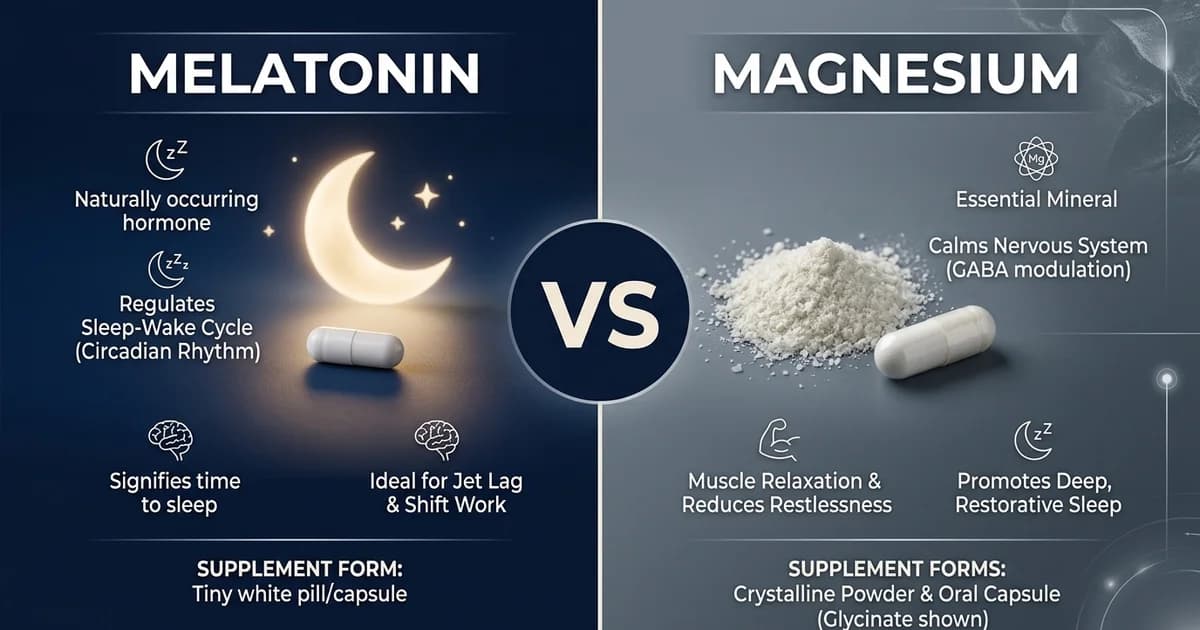
Your brain produces melatonin naturally when it gets dark. It's a timing signal, not a sedative. Melatonin tells your body when to sleep. It doesn't make you sleep harder or deeper.
That distinction matters for anyone weighing melatonin vs magnesium for sleep. If you're struggling to fall asleep because your circadian rhythm is off (you flew across three time zones, or you've been staring at screens until midnight), melatonin can help reset that internal clock. Research compiled by News-Medical.net confirms that melatonin is most effective for circadian rhythm disorders like jet lag, where it can reduce the time it takes to fall asleep.
But here's the problem: most people don't have a circadian rhythm disorder. They have stress. They have a racing mind. They have tension in their body. Melatonin doesn't touch any of that, which is why understanding melatonin vs magnesium for sleep matters before you buy.
The Dosing Problem
There's also the tolerance question. While melatonin doesn't create physical dependency the way sleeping pills do, your body can become less responsive to exogenous doses over time. This leads people to take more, which leads to more side effects, which leads to the conclusion that melatonin "stopped working." It didn't stop working. You just outpaced the biology.
And then there's the quality control issue, which borders on absurd. A study published in the Journal of Clinical Sleep Medicine found that over 71% of melatonin supplements didn't contain the amount listed on the label. The actual melatonin content ranged from 83% less to 478% more than what was advertised. Some products even contained unlisted serotonin.
That means when you take a "3 mg" melatonin gummy, you might be getting 0.5 mg. Or 14 mg. You genuinely don't know. This inconsistency is a major factor in the melatonin vs magnesium for sleep decision.
Dosing also runs counter to what most people assume. Trinity Health Michigan's Dr. Jeff Krupinski recommends adults start with just 3 to 5 mg taken 30 to 60 minutes before bed, noting that higher doses haven't been proven more effective. Yet walk into any pharmacy and you'll find 10 mg gummies marketed as standard.
Long-Term Safety Concerns
A large multinational study presented at the American Heart Association's 2025 Scientific Sessions reviewed five years of health records for more than 130,000 adults with insomnia. Those who used melatonin for at least a year were more likely to be diagnosed with heart failure, require hospitalization, or die from any cause compared to non-users. The researchers noted an 89% higher hazard of incident heart failure and a near-doubling of all-cause mortality.
This doesn't prove melatonin causes heart failure. The study couldn't establish causation. But for anyone evaluating melatonin vs magnesium for sleep as a long-term strategy, it's enough to make you think twice about popping melatonin every night for years.
How Magnesium Works for Sleep
Magnesium takes a completely different approach in the melatonin vs magnesium for sleep equation. It's a mineral involved in over 300 enzymatic reactions in your body, and roughly half of all Americans don't get enough of it through diet alone, according to Pharmacy Times.
For sleep specifically, magnesium works through your nervous system. It activates the parasympathetic nervous system (the "rest and digest" mode), regulates GABA receptors, and helps relax muscle tension. If you're the type who lies in bed physically tense with a brain that won't shut off, magnesium addresses the cause of your sleeplessness, not just the timing of it.
What Is Magnesium Glycinate Good for Sleep?
Not all magnesium is the same, and the magnesium glycinate vs threonate comparison shows just how different forms can be. So what is magnesium glycinate good for sleep specifically? Magnesium glycinate is the form most often recommended for rest, and for good reason. The glycinate part is itself an inhibitory neurotransmitter that promotes relaxation, and glycine as a sleep-supporting compound has its own research base worth understanding. So you're getting a two-for-one: the calming effects of magnesium plus the sleep-supporting effects of glycine.
A 2025 randomized, placebo-controlled trial published in PMC studied 155 adults with self-reported poor sleep and found that magnesium bisglycinate supplementation improved insomnia symptoms compared to placebo. Another randomized crossover trial found that the magnesium group showed improvements in sleep duration, deep sleep, and sleep efficiency.
If you're wondering whether magnesium glycinate is good for sleep, the short answer is yes, especially if you're among the roughly 50% of Americans who are already deficient. This is one of the strongest points in magnesium's favor in the melatonin vs magnesium for sleep discussion.
The Limitations
Magnesium isn't a knockout pill. The effects are subtle and cumulative. Sleep Cycle's analysis found that magnesium provided about 15 extra minutes of sleep on average, while melatonin provided about 21 minutes. Neither is going to turn a terrible sleeper into someone who's out cold in five minutes.
Magnesium can also cause digestive issues (particularly magnesium citrate and oxide forms) if you take too much, and magnesium form differences for rest extend to gluconate vs glycinate as well. Glycinate is the gentlest on the stomach, which is another reason magnesium glycinate is good for sleep and the preferred form for nighttime use.
Melatonin vs. Magnesium for Sleep: The Side-by-Side
| Factor | Melatonin | Magnesium (Glycinate) |
|---|---|---|
| What it does | Resets circadian rhythm | Relaxes nervous system and muscles |
| Best for | Jet lag, shift work, circadian issues | Stress-related insomnia, general sleep quality |
| Onset | 30-60 minutes | Cumulative (days to weeks) |
| Typical dose | 0.5-5 mg | 200-400 mg elemental magnesium |
| Side effects | Grogginess, vivid dreams, headaches | Digestive issues at high doses |
| Long-term safety | Concerns raised by 2025 AHA study | Generally well-tolerated |
| Quality control | Poor (71% of products mislabeled) | More consistent |
| Addresses daytime performance | No | No |
Notice that last row. When you compare melatonin vs magnesium for sleep, neither does anything for you during the hours you're actually awake and need to perform.
Can You Take Melatonin and Magnesium Together?
Yes. Since they work through completely different mechanisms, combining them is generally considered safe. Dr. Krupinski from Trinity Health Michigan notes that using both together "could give an extra benefit" because of their complementary pathways. For some people, the melatonin vs magnesium for sleep question doesn't have to be either/or.
That said, stacking two supplements doesn't fix the underlying issue if your sleep problems stem from something else entirely, like chronic stress, poor sleep hygiene, or too much caffeine late in the day. Supplements are a tool, not a substitute for fixing the habits that got you here.
The Bigger Question: What About Daytime Performance?
Sleep supplements solve one half of the equation. You optimize the night. But what about the 16 hours between waking up and going back to bed?
This is where the conversation shifts from melatonin vs magnesium for sleep to cognitive performance. The real goal isn't just sleeping better. It's functioning better, all day, without the crashes and dependency that come with most stimulants.
A study published in Nutritional Neuroscience found that combining L-theanine with 40 mg of caffeine improved cognitive performance and subjective alertness compared to placebo. That specific combination, a low dose of caffeine smoothed out by L-theanine's calming effect, delivers focus without the jittery edge of coffee or energy drinks.
That's the principle behind Roon, a zero-nicotine sublingual pouch built around caffeine, L-theanine, theacrine, and methylliberine. It's designed for sustained focus over 6 to 8 hours with no crash and no tolerance buildup. It's not a sleep supplement. It's what you reach for when you wake up and need to actually perform.
If you've settled the melatonin vs magnesium for sleep question but still drag through your afternoons, it might be time to optimize the other side of the clock. See how Roon compares.