Glycine vs. Magnesium Glycinate for Sleep
Roon Team
Glycine vs. Magnesium Glycinate for Sleep: Which One Actually Works?
You're standing in the supplement aisle (or, more likely, scrolling through Amazon at midnight) trying to figure out the difference between glycine vs magnesium glycinate for sleep. They sound almost identical. One is literally named after the other. But they do very different things in your body, and picking the wrong one means spending money on a supplement that won't fix the actual problem.
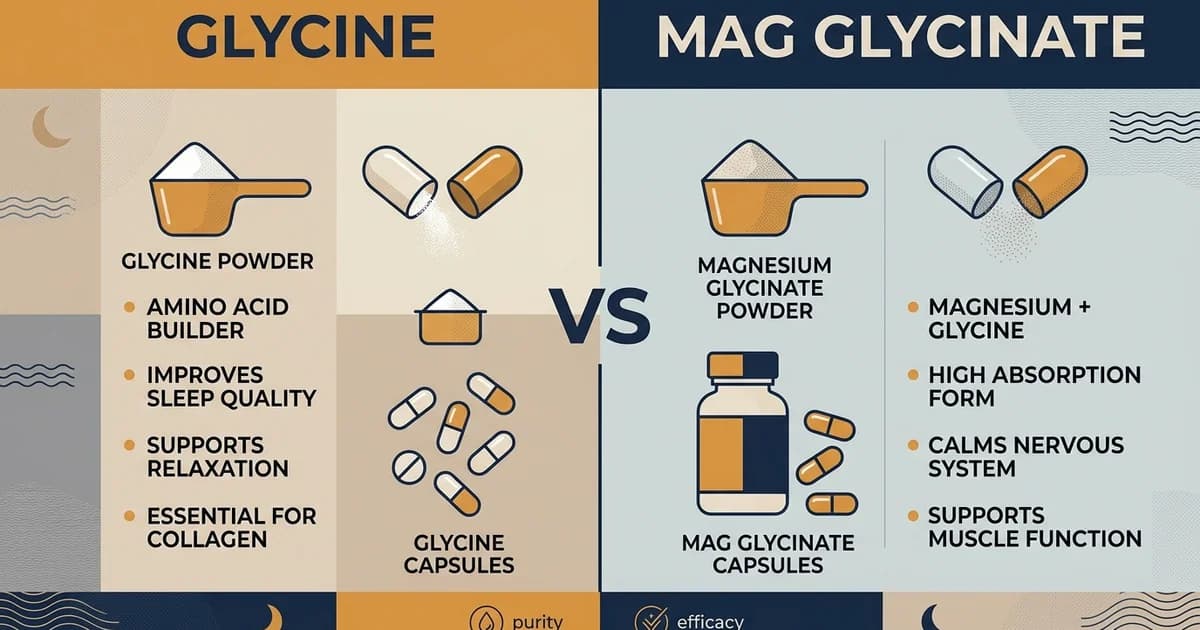
Here's the short version: glycine is an amino acid that directly promotes sleep. Magnesium glycinate is a mineral supplement that uses glycine as a carrier molecule. The glycine vs magnesium glycinate for sleep debate comes down to what your body is actually missing.
Key Takeaways:
- Glycine at 3g before bed lowers core body temperature and reduces sleep onset time, backed by polysomnographic data.
- Magnesium glycinate delivers magnesium (which supports sleep through muscle relaxation and nervous system regulation) with glycine as the bonding agent.
- A typical magnesium glycinate dose contains only 500–1,500mg of glycine, well below the 3,000mg dose studied for direct sleep benefits.
- If your sleep problem is falling asleep, glycine alone is likely the better pick. If you're deficient in magnesium, magnesium glycinate solves two problems at once, just not as potently for either. Understanding glycine vs magnesium glycinate for sleep helps you make the right call.
What Glycine Does for Sleep
Glycine is the smallest amino acid your body produces. It also doubles as an inhibitory neurotransmitter in the brain, which means it helps quiet neural activity when you need to wind down. To understand glycine vs magnesium glycinate for sleep, you first need to know how glycine works on its own.
The sleep mechanism is specific and well-documented. Research published in Neuropsychopharmacology found that glycine activates NMDA receptors in the suprachiasmatic nucleus (your brain's master clock), which triggers peripheral vasodilation. Blood flow increases to the skin, core body temperature drops, and this temperature shift signals your brain that it's time to sleep.
This isn't theoretical. A clinical trial with polysomnographic monitoring showed that 3g of glycine before bed improved sleep efficiency, shortened the time to fall asleep, and reduced latency to slow-wave sleep without altering overall sleep architecture. Participants didn't just sleep faster. They reached deep sleep faster.
A separate study on sleep-restricted volunteers confirmed that the same 3g dose improved next-day cognitive performance and reduced fatigue, even when subjects were only allowed limited sleep the night before. This direct sleep-promoting effect is what makes glycine a strong contender in the glycine vs magnesium glycinate for sleep comparison.
The Effective Dose
Every major glycine sleep study uses 3 grams (3,000mg) taken 30–60 minutes before bed. This is a well-established dose. Lower amounts haven't been reliably tested for sleep, so don't assume a 500mg capsule will do the same thing.
What Magnesium Glycinate Does for Sleep
Magnesium glycinate is a chelated form of magnesium, meaning each magnesium ion is bonded to two glycine molecules. The primary purpose of this compound is delivering magnesium. The glycine is the carrier, chosen because it makes the magnesium easier to absorb and gentler on the stomach than cheaper forms like magnesium oxide. This distinction matters in the glycine vs magnesium glycinate for sleep discussion.
Magnesium itself plays a role in sleep, and if you're weighing a melatonin vs magnesium comparison, it helps to know that magnesium regulates GABA receptors, supports melatonin production, and promotes muscle relaxation. A systematic review and meta-analysis found that magnesium supplementation reduced sleep onset latency by an average of 17.36 minutes compared to placebo in older adults with insomnia.
A 2025 randomized, placebo-controlled trial tested magnesium bisglycinate specifically (250mg elemental magnesium plus 1,523mg glycine per day) and found modest but statistically significant improvements in insomnia severity scores after 28 days.
The Glycine Dose Problem
Here's where most people get confused about glycine vs magnesium glycinate for sleep. Magnesium glycinate contains about 14.1% elemental magnesium by mass. The rest is glycine. But a standard dose of magnesium glycinate (providing 200–400mg of elemental magnesium) only delivers roughly 500–1,500mg of glycine, according to supplement analysis data from Cymbiotika.
That's half (or less) of the 3,000mg dose shown to produce direct sleep benefits. So while you're getting some glycine from magnesium glycinate, you're not getting enough to replicate the results from standalone glycine sleep studies. This glycine shortfall is the single biggest factor people overlook when comparing glycine vs magnesium glycinate for sleep.
Glycine vs. Magnesium Glycinate for Sleep: The Head-to-Head
| Factor | Glycine (Standalone) | Magnesium Glycinate |
|---|---|---|
| Primary function | Amino acid / neurotransmitter | Magnesium delivery |
| Sleep mechanism | Lowers core temperature via NMDA receptor activation | Supports GABA, melatonin, muscle relaxation |
| Studied dose for sleep | 3,000mg | 200–400mg elemental Mg (~500–1,500mg glycine) |
| Glycine content per dose | 3,000mg | 500–1,500mg |
| Best for | Difficulty falling asleep, poor sleep onset | Magnesium deficiency, general sleep support |
| Time to effect | Same night | 2–4 weeks for full effect |
| Side effects | Rare; mild GI discomfort at very high doses (15g+) | Rare; mild GI effects possible |
| Cost | Very affordable (bulk powder) | Moderate (capsules) |
When to Choose Glycine
Pick standalone glycine if your main issue is sleep onset. You lie in bed, your mind won't shut off, and it takes 30+ minutes to fall asleep. The temperature-lowering mechanism works quickly, often on the first night, and the 3g dose is well-tolerated with minimal side effects. In the glycine vs magnesium glycinate for sleep matchup, pure glycine wins on speed and directness.
Glycine also makes sense if you're already getting enough magnesium from your diet or another supplement. Stacking a magnesium glycinate product on top of adequate magnesium intake just to get the glycine is inefficient and expensive.
When to Choose Magnesium Glycinate
Go with magnesium glycinate if you suspect a magnesium deficiency is contributing to your sleep issues. Signs include muscle cramps, restless legs, tension headaches, and general restlessness at night. The glycinate form is one of the most bioavailable and least likely to cause the digestive issues associated with magnesium oxide or citrate forms.
If you're getting some benefit from the glycine component too, consider it a bonus rather than the main event. For many people weighing glycine vs magnesium glycinate for sleep, or even magnesium vs melatonin for sleep, the answer depends entirely on whether a mineral deficiency is part of the picture.
Can You Take Both?
Yes. There's no interaction concern, and this is actually one of the best ways to resolve the glycine vs magnesium glycinate for sleep question. Some people take 200–400mg of elemental magnesium (via glycinate) plus an additional 3g of standalone glycine powder before bed. This covers both the mineral deficiency angle and the direct neurotransmitter pathway. If you go this route, start with one and add the other after a week so you can tell what's actually helping.
What Neither Supplement Fixes
Whether you choose glycine or magnesium glycinate for sleep, both target the onset side of the equation. They help you fall asleep and, in some cases, reach deeper sleep stages more quickly. But neither one addresses what happens during your waking hours: the ability to sustain focus, maintain mental clarity, and avoid the afternoon crash that makes you reach for another coffee (or worse, a nicotine pouch).
Sleep quality and daytime cognitive performance are two halves of the same equation. Fixing one without addressing the other leaves you running at half capacity.
A Cleaner Approach to Daytime Focus
If you've dialed in your sleep stack but still feel foggy by 2 PM, the problem might not be your nights. It might be what you're using (or not using) during the day. Settling the glycine vs magnesium glycinate for sleep debate is only half the work.
Roon is a zero-nicotine sublingual pouch built around a different stack entirely: Caffeine (80mg), L-Theanine, Theacrine, and Methylliberine. No jitters, no crash, no tolerance buildup, and 6–8 hours of sustained focus. It's the daytime counterpart to a clean sleep protocol.
If you're already optimizing your nights with glycine or magnesium glycinate for sleep, it's worth looking at what you're putting into your body during the day too. See how Roon compares.