Magnesium Gluconate vs Glycinate for Sleep
Roon Team
Magnesium Gluconate vs. Glycinate for Sleep: A Head-to-Head Comparison
You're standing in the supplement aisle, staring at two bottles of magnesium. One says gluconate. The other says glycinate. Both claim to help with sleep. The price difference is real, and so is your confusion. Here's the thing: magnesium gluconate vs glycinate for sleep is not a coin flip. These two forms differ in absorption, mechanism, and clinical evidence, and the gap between them is wider than most people realize.
Roughly half of all Americans don't get enough magnesium from food, and that shortfall has direct consequences for sleep quality. Magnesium helps regulate GABA receptors and melatonin production, both of which your brain needs to wind down at night, and the debate over melatonin vs magnesium for sleep is a separate question worth unpacking. But the debate around magnesium gluconate vs glycinate for sleep comes down to one question: how much of what you swallow actually reaches those systems?
Key Takeaways:
- Magnesium glycinate delivers more elemental magnesium per dose and absorbs more efficiently than gluconate.
- Glycinate carries a bonus: glycine, an amino acid with its own sleep-promoting effects.
- A 2025 randomized controlled trial found magnesium bisglycinate reduced insomnia severity scores within four weeks.
- Gluconate isn't bad for general use, but it's not built for sleep.
What Makes These Two Forms Different in the Magnesium Gluconate vs Glycinate for Sleep Debate
Both magnesium gluconate and magnesium glycinate are organic salts, meaning the magnesium is bound to an organic compound for better absorption than cheap options like magnesium oxide. That's where the similarities end.
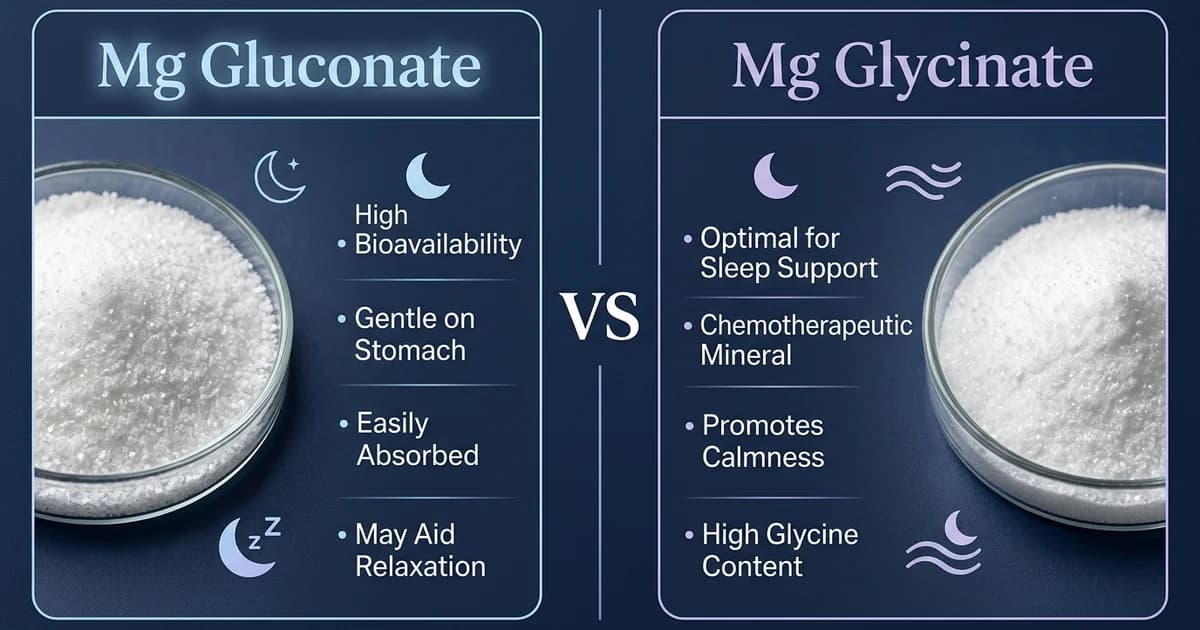
Magnesium gluconate pairs magnesium with gluconic acid, a sugar acid. It's gentle on the stomach and reasonably well absorbed for a magnesium salt. But it carries a low percentage of elemental magnesium. According to data published in Kidney International, magnesium gluconate contains only about 5.4% elemental magnesium with roughly 19% bioavailability. That means you need a lot of it to move the needle.
Magnesium glycinate (also called magnesium bisglycinate) binds magnesium to two molecules of the amino acid glycine. This chelated structure uses amino acid absorption pathways rather than standard mineral pathways, which gives it a bioavailability edge. Per 500mg dose, glycinate delivers roughly 70.5mg of elemental magnesium compared to gluconate's 27mg, according to Epocrates dietary reference data.
That's a 2.6x difference in elemental magnesium from the same weight of supplement, which is a major factor in the magnesium gluconate vs glycinate for sleep comparison.
Magnesium Gluconate vs Glycinate for Sleep: The Evidence
The Case for Glycinate
Magnesium glycinate has the stronger resume for sleep. The most direct evidence comes from a 2025 randomized, double-blind, placebo-controlled trial published in Nature and Science of Sleep. Researchers gave 155 adults with poor sleep quality either 250mg of elemental magnesium (as bisglycinate) or a placebo daily for eight weeks.
The results: the magnesium bisglycinate group showed a greater reduction in Insomnia Severity Index (ISI) scores compared to placebo by Week 4, with a statistically significant difference (p = 0.049). The benefits were especially pronounced in participants who had lower dietary magnesium intake at baseline.
This matters because it's not just a general "magnesium helps sleep" finding. It's specific to the glycinate/bisglycinate form, tested against placebo, in a well-designed trial. For anyone weighing magnesium gluconate vs glycinate for sleep, this study tips the scales decisively.
Beyond the magnesium itself, glycinate brings a second active player: glycine. Research published in the Journal of Pharmacological Sciences found that glycine taken before bedtime improved subjective sleep quality and reduced daytime sleepiness. The proposed mechanism involves glycine acting on NMDA receptors in the suprachiasmatic nucleus, which helps lower core body temperature, a known trigger for sleep onset.
So with magnesium glycinate, you're getting a two-for-one: magnesium for GABA receptor support and melatonin regulation, plus glycine for core temperature modulation and faster sleep onset. This dual mechanism is what separates the magnesium gluconate vs glycinate for sleep discussion from a simple bioavailability comparison.
The Case for Gluconate
Magnesium gluconate is not a sleep supplement. It's a general-purpose magnesium form primarily used to correct deficiency. MedlinePlus lists it as a treatment for low blood magnesium caused by GI disorders, prolonged vomiting or diarrhea, and kidney disease.
Its main advantage is GI tolerance. If other forms of magnesium give you digestive trouble, gluconate tends to be easier on the stomach. But that's a comfort feature, not a performance feature.
There are no published clinical trials testing magnesium gluconate specifically for sleep outcomes. The sleep benefits attributed to it in some supplement marketing come from general magnesium research, not gluconate-specific data. This absence of targeted evidence is one of the clearest takeaways in the magnesium gluconate vs glycinate for sleep comparison.
Side-by-Side Comparison: Magnesium Gluconate vs Glycinate for Sleep
| Feature | Magnesium Gluconate | Magnesium Glycinate |
|---|---|---|
| Bound to | Gluconic acid (sugar acid) | Glycine (amino acid) |
| Elemental Mg per 500mg | ~27mg | ~70.5mg |
| Bioavailability | Moderate (~19%) | High (amino acid pathway) |
| Sleep-specific research | None | Yes (2025 RCT) |
| Bonus compound | Gluconic acid (no sleep benefit) | Glycine (independent sleep benefits) |
| GI tolerance | Excellent | Very good |
| Best use case | Correcting deficiency, sensitive stomachs | Sleep support, anxiety, relaxation |
| Typical dose for sleep | Not established | 200-400mg elemental Mg before bed |
Why Bioavailability Matters More Than You Think
A supplement is only as good as the amount your body actually absorbs. You can swallow 500mg of a magnesium compound, but the real question in the magnesium gluconate vs glycinate for sleep equation is: how many milligrams of actual magnesium cross your intestinal wall and reach your bloodstream?
With gluconate, the answer is disappointing. Its low elemental magnesium content (roughly 5.4%) means that a standard 500mg tablet delivers only about 27mg of magnesium. Even with decent absorption rates, you'd need multiple large tablets to approach the 200-400mg range used in clinical sleep research.
Glycinate sidesteps this problem. Because it uses amino acid transport channels rather than competing for the same mineral absorption pathways, more of it gets through. And because each molecule carries a higher proportion of elemental magnesium, you reach a therapeutic dose with fewer capsules.
This is not a minor technical detail. It's the difference between a supplement that looks good on the label and one that actually works in your body. Anyone seriously evaluating magnesium gluconate vs glycinate for sleep should treat bioavailability as the deciding factor.
Who Should Choose Gluconate?
Gluconate makes sense if you have a diagnosed magnesium deficiency and a sensitive digestive system. It's a fine maintenance supplement. Your doctor might recommend it if other forms cause GI distress.
But if sleep is your primary goal, the magnesium gluconate vs glycinate for sleep question has a clear answer: gluconate is the wrong tool for the job. You'd need to take a large number of tablets to reach a therapeutic dose of elemental magnesium, and you'd still miss out on the glycine component that makes glycinate effective for sleep.
Who Should Choose Glycinate?
If you're supplementing specifically to improve sleep quality, glycinate is the clear pick. It delivers more magnesium per dose, absorbs through a more efficient pathway, and comes packaged with an amino acid that independently promotes better sleep. For anyone researching magnesium gluconate vs glycinate for sleep, glycinate wins on every metric that matters.
The 2025 trial data supports a dose of around 250mg of elemental magnesium (as bisglycinate), taken daily. Most clinical guidance suggests taking it 30 to 60 minutes before bed for best results.
A 2024 systematic review looking at magnesium supplementation and sleep found that five out of eight sleep-related studies reported improvements in sleep parameters. The review also noted improvements in self-reported anxiety in five out of seven anxiety-related studies, which is relevant because anxiety and poor sleep tend to travel together.
One note: if you're currently taking medications, check with your doctor before starting magnesium. It can interact with certain antibiotics, blood pressure medications, and diuretics.
The Bigger Picture: Sleep Support Beyond Magnesium Gluconate vs Glycinate for Sleep
Magnesium glycinate is a solid nighttime supplement. But sleep quality is only half the equation. What about the other 16 hours?
Most people reach for coffee to get through the day, then wonder why they can't fall asleep at night. That cycle, stimulant during the day, supplement at night, points to a deeper problem: the tools we use for daytime focus often sabotage our ability to rest. Once you've settled the magnesium gluconate vs glycinate for sleep question, the next step is fixing what happens before bedtime.
That's the thinking behind Roon, a zero-nicotine sublingual pouch built for sustained cognitive performance without the crash. It combines 80mg of caffeine (comparable to a cup of coffee) with L-theanine, methylliberine, and theacrine, a stack designed to deliver 6 to 8 hours of clean focus without jitters, crash, or tolerance buildup. The difference isn't a lower dose; it's the curve. L-theanine smooths the caffeine, while methylliberine and theacrine extend it, so you never hit that 3 PM wall that sends you reaching for another espresso that wrecks your sleep at midnight. No nicotine. No crash.
If you're already optimizing your nights with the right magnesium, it's worth asking whether your daytime performance stack is working just as hard. See how Roon compares.