Magnesium Glycinate vs Threonate for Sleep
Roon Team
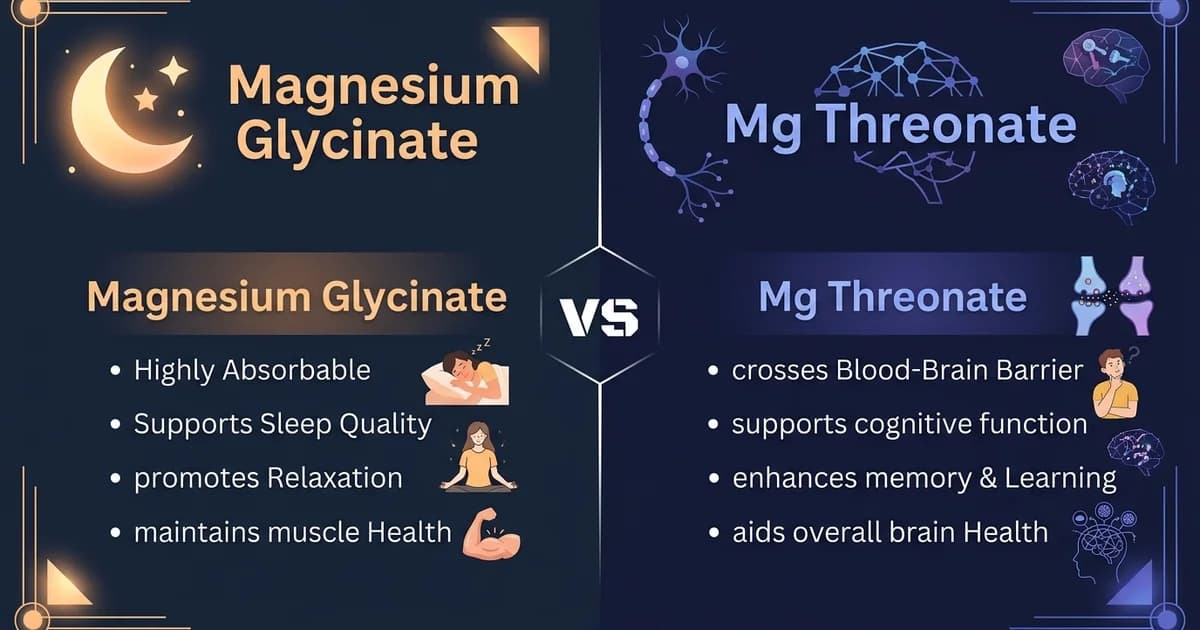
Magnesium Glycinate vs. Threonate for Sleep: A Head-to-Head Comparison
You're staring at two bottles on a shelf, the same choice anyone faces when weighing melatonin vs magnesium for sleep. One says magnesium glycinate. The other says magnesium L-threonate. Both promise better sleep, and the magnesium glycinate vs threonate for sleep debate has split the internet. So let's settle it with actual science instead of Reddit threads and influencer opinions.
Here's the short version: they work differently, they target different problems, and the right choice depends on why you can't sleep.
Key Takeaways
- Magnesium glycinate pairs magnesium with the amino acid glycine, promoting relaxation through GABA receptor activity and reduced cortisol.
- Magnesium L-threonate is the only form shown to raise magnesium levels in the brain, making it better suited for cognitive-related sleep issues.
- The typical magnesium threonate dose for sleep is 1,500 to 2,000 mg daily (providing roughly 144 mg of elemental magnesium), taken about two hours before bed.
- Both forms are well-tolerated, but the magnesium glycinate vs threonate for sleep distinction matters because they're solving different parts of the sleep equation, which is a separate question from magnesium versus melatonin for sleep.
What Each Form Actually Does
Magnesium Glycinate: The Relaxation Play
Magnesium glycinate (also called magnesium bisglycinate) is magnesium bonded to two molecules of glycine. This matters because glycine itself is an inhibitory neurotransmitter. It binds to glycine receptors in the brainstem and hypothalamus, helping to lower core body temperature and promote the onset of sleep.
The magnesium side of the equation supports GABA receptor function. GABA is your brain's primary "calm down" signal. When magnesium levels are adequate, GABA receptors work more efficiently, making it easier to transition from wakefulness to sleep. This is why glycinate shows up so often in the magnesium glycinate vs threonate for sleep conversation: its dual mechanism is hard to ignore.
A randomized, placebo-controlled trial published in PMC examined magnesium bisglycinate supplementation in healthy adults reporting poor sleep. The study noted that while various magnesium forms have similar intestinal absorption rates, magnesium bisglycinate has been shown to increase brain magnesium levels at high doses in animal models.
Typical dosing: 200 to 400 mg of elemental magnesium, taken 30 to 60 minutes before bed. According to the Sleep Foundation, forms with high absorption rates like magnesium glycinate tend to produce better outcomes for sleep quality.
Magnesium L-Threonate: The Brain-First Approach
Magnesium L-threonate (often sold under the brand name Magtein) takes a different route. Developed by researchers at MIT, this form was specifically designed to cross the blood-brain barrier more efficiently than other magnesium compounds. The result: higher magnesium concentrations in the brain, where it can directly influence synaptic density and neural signaling. This brain-penetrating ability is what makes magnesium glycinate vs threonate for sleep a real comparison rather than an apples-to-oranges exercise.
A 2024 randomized controlled trial published in PMC found that MgT improved both objective and subjective sleep quality in adults with self-reported sleep problems. Participants took 1 g per day of Magtein (two 500 mg capsules) about two hours before bedtime. The AJMC reported on the study, noting that MgT led to benefits in both objective and subjective measures, along with improved daytime functioning.
The standard magnesium threonate dose for sleep ranges from 1,500 to 2,000 mg per day, which delivers about 144 mg of elemental magnesium. That's less elemental magnesium than glycinate, but the delivery mechanism is what separates it.
Magnesium Glycinate vs Threonate for Sleep: The Comparison
Here's where the magnesium l-threonate vs glycinate for sleep decision gets clearer. They're not interchangeable. They address different bottlenecks.
| Feature | Magnesium Glycinate | Magnesium L-Threonate |
|---|---|---|
| Primary mechanism | GABA support + glycine-mediated relaxation | Raises brain magnesium levels directly |
| Best for | Physical tension, restlessness, trouble winding down | Racing thoughts, cognitive overstimulation, poor sleep architecture |
| Elemental Mg per dose | 200–400 mg | ~144 mg |
| Typical timing | 30–60 min before bed | 1–2 hours before bed |
| GI tolerance | Excellent (chelated form) | Excellent |
| Clinical sleep trials | Moderate (mostly general magnesium studies) | Strong (placebo-controlled, MgT-specific) |
| Cost | Lower ($0.15–0.40/day) | Higher ($0.50–1.00/day) |
When Glycinate Wins
If your sleep problem is physical, glycinate is the stronger pick in the magnesium glycinate vs threonate for sleep matchup. You're tense. Your muscles won't relax. You feel wired but tired. The glycine component actively lowers core body temperature, which is one of the strongest physiological triggers for sleep onset. It's also the gentler option on your stomach compared to cheaper forms like magnesium oxide or citrate.
Glycinate is also the better choice if you're simply trying to correct a general magnesium shortfall. Research from a 2024 crossover trial found that magnesium supplementation led to improvements in sleep duration, deep sleep, sleep efficiency, and heart rate variability readiness compared to placebo.
When Threonate Wins
If your sleep problem starts in your head, threonate has the edge. You lie down, and your brain won't stop running. You wake up at 3 AM with a to-do list playing on repeat. These are signs that the issue isn't muscular tension. It's neural. Choosing the right magnesium threonate dose for sleep becomes the priority here.
Threonate's ability to raise brain magnesium concentrations means it can influence synaptic plasticity and neuronal signaling in ways that other forms simply cannot. The 2024 PMC study showed improvements not just in subjective sleep quality but in objective measures, meaning the benefits showed up on tracking devices, not just in how people felt they slept.
For the magnesium threonate vs glycinate for sleep question, it comes down to this: threonate is the specialist, glycinate is the generalist.
If you've been searching for magnesium l-threonate vs glycinate for sleep and expecting one clear winner, that's the wrong framing. The winner depends on your specific sleep problem.
Can You Take Both?
Yes. Some people stack glycinate and threonate together, and there's no pharmacological conflict between them. The logic is straightforward: glycinate handles peripheral relaxation while threonate handles central nervous system support. This "both" approach is the underrated answer to the magnesium glycinate vs threonate for sleep question.
If you go this route, keep total elemental magnesium under 400 mg per day to avoid GI discomfort. A practical split might look like 200 mg elemental from glycinate and the standard magnesium threonate dose for sleep (1,500–2,000 mg of MgT, providing ~144 mg elemental).
One note on timing: take the glycinate closer to bedtime (30 to 60 minutes out) and the threonate earlier in the evening (one to two hours before bed). This staggers the absorption windows and lets each form do its job without competing for the same receptors at the same time.
What Neither Form Does
Both forms of magnesium support sleep quality. Neither one will knock you out like a pharmaceutical sleep aid. That's actually a feature, not a limitation. Whether you choose glycinate or threonate, magnesium works by restoring the conditions your body needs to fall asleep naturally, not by forcing sedation.
And neither form addresses daytime cognitive performance. The magnesium glycinate vs threonate for sleep discussion is about nighttime recovery. You might sleep better, but when you wake up and need four hours of sustained focus for deep work, magnesium isn't the tool for that job.
Who Should Skip Both (and What to Try Instead)
If your sleep is already solid and your real issue is dragging through the afternoon, the magnesium glycinate vs threonate for sleep debate isn't your problem. Magnesium corrects a deficiency. It restores baseline function. It doesn't push performance above baseline.
The same applies if you're reaching for magnesium because you heard it "helps with focus." Threonate has some cognitive data behind it, but its primary use case remains sleep and neural recovery, not sustained daytime output. Understanding magnesium threonate vs glycinate for sleep is useful, but only if sleep is actually the bottleneck.
When the Problem Isn't Sleep, It's Focus
The magnesium glycinate vs threonate for sleep conversation usually starts because someone is tired. But being tired and being unfocused aren't always the same problem. You can get a solid eight hours and still feel mentally sluggish by 10 AM.
That's a different category entirely, and it's where compounds like caffeine, L-theanine, theacrine, and methylliberine come in. These target alertness, attention, and sustained cognitive output without the crash cycle that coffee creates.
Roon combines all four of those compounds in a zero-nicotine sublingual pouch that delivers 6 to 8 hours of clean focus. No jitters, no tolerance buildup, no crash. If you've already dialed in your magnesium glycinate vs threonate for sleep stack and want to optimize what happens after you wake up, see how Roon compares.