Alpha GPC vs CDP Choline
Roon Team
Alpha GPC vs CDP Choline: Which Choline Source Actually Works Better?
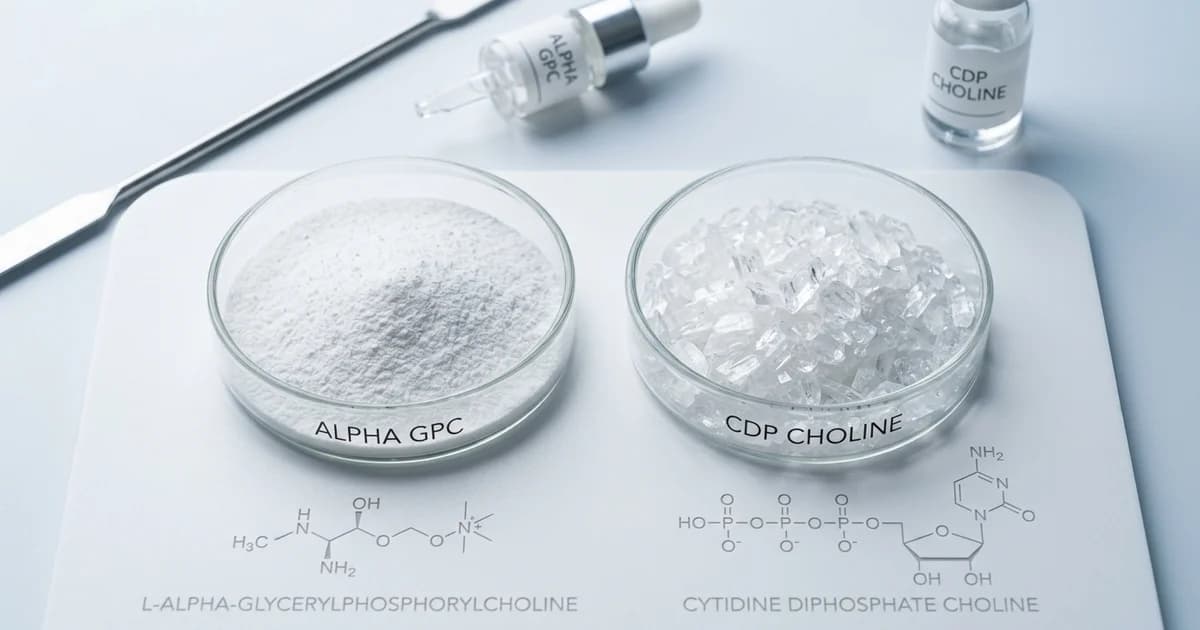
Alpha GPC delivers more raw choline per milligram (40% by weight vs. 18.5%), making it the stronger pick for same-day focus and processing speed. CDP Choline (citicoline) delivers less choline but also supplies uridine, a building block for neuronal membranes, giving it an edge for long-term brain health. The right choice in the alpha GPC vs CDP choline debate depends on whether you need an acute cognitive boost today or structural neuroprotection over months.
Both compounds raise acetylcholine levels in the brain, but they get there through different biochemical routes. That distinction shapes everything: onset speed, secondary benefits, side-effect profile, and how each one fits into a broader nootropic stack.
Here's what the research actually shows, and how to decide.
Quick Comparison: Alpha GPC vs CDP Choline
| Factor | Alpha GPC | CDP Choline (Citicoline) |
|---|---|---|
| Choline by weight | ~40% (Examine) | ~18.5% |
| Secondary compound | None | Uridine (via cytidine conversion) |
| Primary mechanism | Acetylcholine precursor | Acetylcholine + phospholipid synthesis |
| Onset | Acute; single-dose effects observed in 2024 RCT | Gradual; benefits build over 12+ weeks |
| Typical nootropic dose | 300–600 mg/day | 250–500 mg/day |
| Best for | Immediate focus, athletic performance | Long-term memory, neuroprotection |
| Hygroscopic? | Yes, highly (needs silica stabilizer) | No, shelf-stable |
| TMAO concern | Higher (more free choline per dose) | Lower |
| Rx status | Prescribed in Europe (Gliatilin, Delecit) | OTC supplement globally |
Key Takeaways
- Alpha GPC is roughly 40% choline by weight, crosses the blood-brain barrier efficiently, and produces measurable cognitive improvements from a single dose.
- CDP Choline (citicoline) is about 18.5% choline by weight but also provides uridine, which supports neuronal membrane repair via the Kennedy pathway.
- For raw choline delivery and short-term focus, Alpha GPC has the edge. For long-term brain health and neuroprotection, CDP Choline brings more to the table.
- Stacking both at moderate doses is common among experienced nootropic users, though total choline intake should stay within the NIH adequate intake range of 550 mg/day for adult men and 425 mg/day for adult women.
What Is Alpha GPC Choline, Exactly?
Alpha GPC (L-alpha-glycerylphosphorylcholine) is a phospholipid compound that your body produces naturally in small amounts. It also shows up in organ meats, dairy, and soy lecithin, though not in quantities that move the needle for cognitive performance.
What makes Alpha GPC interesting is its choline density. According to Examine.com, Alpha GPC is 40% choline by weight. A 1,000 mg dose delivers roughly 400 mg of free choline. That's a lot of raw material for acetylcholine synthesis, the neurotransmitter most directly tied to learning, memory, and muscle contraction.
Alpha GPC also crosses the blood-brain barrier with relative ease. This is why it shows up in clinical research on cognitive decline and, more recently, in studies on healthy young adults looking for a performance edge.
In several European countries, Alpha GPC has been prescribed as a pharmaceutical (under names like Gliatilin and Delecit) for cognitive disorders since the 1990s. In the U.S. and most other markets, it's sold as a dietary supplement. According to WebMD, Alpha GPC appears to increase levels of acetylcholine in the brain, the neurotransmitter most directly linked to memory and learning.
The 2024 Single-Dose Evidence
A 2024 randomized, double-blind, placebo-controlled study published in Nutrients tested a single dose of Alpha GPC on 20 healthy young men using the Stroop test, a standard measure of processing speed and cognitive interference. Both the high-dose (630 mg) and low-dose (315 mg) groups showed measurable improvements in total Stroop score and completion time compared to placebo. One dose. Same day.
That kind of acute effect is why Alpha GPC keeps showing up in pre-workout formulas and focus supplements. It's also why Alpha GPC pairs well with caffeine: you get the dopaminergic alertness from caffeine and the cholinergic sharpness from Alpha GPC working in parallel.
What Is CDP Choline in the Alpha GPC vs CDP Choline Debate?
CDP Choline, also called citicoline (cytidine 5'-diphosphocholine), takes a different route to your neurons. Your body naturally synthesizes CDP Choline as an intermediate step in building phosphatidylcholine, the primary phospholipid in cell membranes.
When you take CDP Choline orally, it breaks down into two components: choline and cytidine. The cytidine then converts into uridine in your bloodstream. This is why CDP Choline is only about 18.5% choline by weight. It's essentially a two-for-one compound.
The Uridine Advantage
That uridine component is not a throwaway. Uridine serves as a precursor for synaptic membrane components and supports the Kennedy pathway, the biochemical process your brain uses to build and repair neuronal membranes. Research from the Alzheimer's Drug Discovery Foundation confirms that choline and cytidine from CDP Choline are used in phospholipid synthesis via this pathway.
The 12-Week Memory Trial
A randomized, double-blind, placebo-controlled trial enrolled 100 healthy men and women aged 50 to 85 with age-associated memory impairment (AAMI). After 12 weeks of 500 mg/day citicoline supplementation, the treatment group showed improved overall memory performance, with the strongest effects on episodic memory. Specifically, paired associate test scores improved from a baseline of 3.92 to 4.04 (mean change 0.15 vs. 0.06 for placebo; p = 0.0025). The researchers concluded that regular citicoline intake may help protect against age-related memory decline.
Alpha GPC vs CDP Choline: The Head-to-Head Breakdown
So you're choosing between alpha GPC vs CDP choline for your stack. Here are the actual differences that matter.
Choline Delivery
Alpha GPC wins on pure volume. At 40% choline by weight versus CDP Choline's 18.5%, you get more than double the choline per milligram. If your primary goal is raising acetylcholine levels quickly, Alpha GPC is the more efficient vehicle. A standard 600 mg Alpha GPC dose delivers ~240 mg of choline; a standard 500 mg CDP Choline dose delivers ~93 mg.
The Uridine Factor
CDP Choline wins on versatility. That uridine byproduct supports phospholipid synthesis, which means CDP Choline isn't just feeding your neurotransmitter system. It's also contributing to the structural integrity of your brain cells. Alpha GPC doesn't do this.
Speed of Effect
Alpha GPC appears to work faster for acute cognitive tasks. The 2024 Nutrients study showed measurable Stroop test improvements from a single dose in healthy young men. CDP Choline research tends to show benefits over weeks of consistent use, like the 12-week memory trial in older adults with AAMI.
Formulation Practicalities
One detail that matters if you're a supplement maker (or just someone who's opened a bag of Alpha GPC powder and found it turned into a sticky brick): Alpha GPC is highly hygroscopic. It absorbs moisture from the air like a sponge. This is why most Alpha GPC supplements use a 50% silica blend to keep the powder stable. CDP Choline is far more forgiving in this regard, which makes it easier to formulate and store.
Side Effects and Safety
Both compounds are well tolerated at standard doses. The most common complaints are mild: headaches, digestive discomfort, and occasional insomnia if taken too late in the day.
One thing worth flagging: Examine.com notes that concerns have been raised about Alpha GPC's potential role in TMAO (trimethylamine N-oxide) production, a metabolite linked to cardiovascular risk. A large cohort study published in JAMA Network Open analyzed over 12 million Korean adults aged 50 and older. After matching for covariates, Alpha GPC users had a higher 10-year risk of total stroke (adjusted HR: 1.43; 95% CI: 1.41–1.46), ischemic stroke (aHR: 1.34), and hemorrhagic stroke (aHR: 1.37) compared to non-users.
This was an observational study, not a controlled trial. The population studied was primarily older adults already using Alpha GPC for cognitive complaints, so the baseline risk profile was different from a healthy 30-year-old taking 300 mg a day. Still, it's data worth knowing about if you're planning to take high doses for extended periods.
CDP Choline doesn't carry the same TMAO concern to the same degree, partly because it delivers less raw choline per dose.
Alpha GPC vs CDP Choline: Which One Should You Take?
This is where most articles give you a frustrating "it depends." So let's be more specific.
Choose Alpha GPC if:
- You want a noticeable effect on focus and processing speed within hours, not weeks.
- You're stacking it with other nootropics (caffeine, L-theanine) for a same-day performance boost.
- You care about choline density and want the most acetylcholine precursor per milligram.
Choose CDP Choline if:
- You're playing the long game on brain health and want the added benefit of uridine for membrane repair.
- You're concerned about TMAO and want a lower-choline-per-dose option.
- Memory retention and neuroprotection matter more to you than acute focus.
Stack both if:
- You want the acute choline hit from Alpha GPC combined with the structural support of CDP Choline. Many experienced nootropic users run both at moderate doses (e.g., 300 mg Alpha GPC + 250 mg CDP Choline). If you go this route, keep total choline intake reasonable and talk to a doctor first.
Beyond Alpha GPC vs CDP Choline: Choline Is Only Part of the Stack
Here's what gets lost in the alpha GPC vs CDP choline debate. Choline doesn't work in isolation. Acetylcholine production depends on a cascade of cofactors and neurotransmitter interactions. Pairing a choline source with compounds that complement its mechanism, like L-theanine for calm alertness or caffeine for dopaminergic drive, tends to produce better real-world results than choline alone.
A 2021 systematic review in Cureus found that the combination of caffeine and L-theanine improved attention, alertness, and task-switching accuracy compared to placebo across multiple randomized controlled trials. That's the same principle at work: single ingredients perform better when paired with complementary compounds.
This is the same reason why eating an egg (which contains choline, protein, B vitamins, and fats) does more for your brain than swallowing an equivalent amount of choline bitartrate. Context matters. Cofactors matter.
The best stacks pair a choline donor with agents that work on complementary neurotransmitter pathways, so you're not just boosting one signal but creating the conditions for sustained, clean output.
Frequently Asked Questions
Is Alpha GPC or CDP Choline better for focus?
Alpha GPC is the stronger pick for acute focus. Its 40% choline-by-weight density means more acetylcholine precursor per milligram, and a 2024 RCT showed single-dose improvements in processing speed in healthy young men. CDP Choline's benefits tend to build over weeks, making it better suited for long-term cognitive maintenance than same-day performance.
Can you take Alpha GPC and CDP Choline together?
Yes. Stacking both is common in nootropic communities. A typical combination is 300 mg Alpha GPC (for acute choline delivery) plus 250 mg CDP Choline (for uridine and membrane support). Keep total daily choline from all sources within the adequate intake range, 550 mg for men and 425 mg for women, and consult a healthcare provider before starting.
Does Alpha GPC raise TMAO levels?
Potentially. Alpha GPC delivers more free choline per dose, and gut bacteria can convert choline into trimethylamine, which the liver oxidizes to TMAO. A 2021 cohort study in JAMA Network Open found an association between long-term Alpha GPC use and higher stroke risk in adults over 50. This was observational, not causal, but it's worth discussing with your doctor if you plan high-dose, long-term use.
How much choline does 600 mg of Alpha GPC provide?
About 240 mg of free choline. Alpha GPC is approximately 40% choline by weight, so you multiply the dose by 0.4. By comparison, 500 mg of CDP Choline delivers roughly 93 mg of choline (18.5% by weight), plus cytidine that converts to uridine.
Is CDP Choline the same as citicoline?
Yes. CDP Choline (cytidine 5'-diphosphocholine) and citicoline are two names for the same compound. Cognizin is a branded, patented form of citicoline commonly used in clinical trials and commercial supplements. All three terms refer to the same molecule.
How long does it take for CDP Choline to work?
Most clinical evidence shows benefits after 4 to 12 weeks of daily use. The 12-week RCT using 500 mg/day of citicoline in older adults found measurable memory improvements at the study endpoint, with the strongest effects on episodic memory. Unlike Alpha GPC, CDP Choline is not typically used for same-day cognitive effects.
Which choline source is better for athletes?
Alpha GPC is the more popular choice in sports nutrition. Its fast-acting choline delivery supports acetylcholine production, which plays a role in muscle contraction and neuromuscular signaling. Several pre-workout formulas include 300 to 600 mg of Alpha GPC for this reason. CDP Choline is less common in athletic contexts because its benefits are gradual and structural rather than acute.
Are there food sources of Alpha GPC and CDP Choline?
Both occur naturally in small amounts. Alpha GPC is found in organ meats, dairy, and soy lecithin. CDP Choline is an endogenous intermediate your body synthesizes during phosphatidylcholine production. Neither food source provides enough to match supplemental doses (300–600 mg), which is why most people who want meaningful cognitive effects turn to capsules or powders.
The Choline Complement: Caffeine, L-Theanine, and the Full Stack
If you've read this far, you probably don't want to manage five separate supplement bottles and a pill organizer the size of a tackle box. That's a reasonable position.
Whether you land on Alpha GPC, CDP Choline, or both after weighing alpha GPC vs CDP choline, the next question is what to pair them with. Choline donors work best alongside compounds that act on complementary pathways. Caffeine provides dopaminergic drive. L-theanine promotes calm alertness and improves attention-switching accuracy. Methylliberine and theacrine extend the focus window without building tolerance the way caffeine alone does.
Roon built its sublingual pouch around exactly this principle. Each pouch pairs 80 mg caffeine with 60 mg L-theanine, 25 mg methylliberine (Dynamine), and 5 mg theacrine (TeaCrine) in a zero-nicotine format that absorbs through your gums in 5 to 10 minutes. No pills, no water, no waiting 45 minutes for a capsule to dissolve. The combination is designed to support 6 to 8 hours of sustained focus without jitters or crash.
Roon is not a choline supplement. It won't replace Alpha GPC or CDP Choline in your stack. But if you want a clean, complementary base of caffeine and L-theanine that pairs well with your choline source of choice, try Roon.
Written by Roon Team