Lucy Nicotine Pouches Ingredients: What's Actually in Them
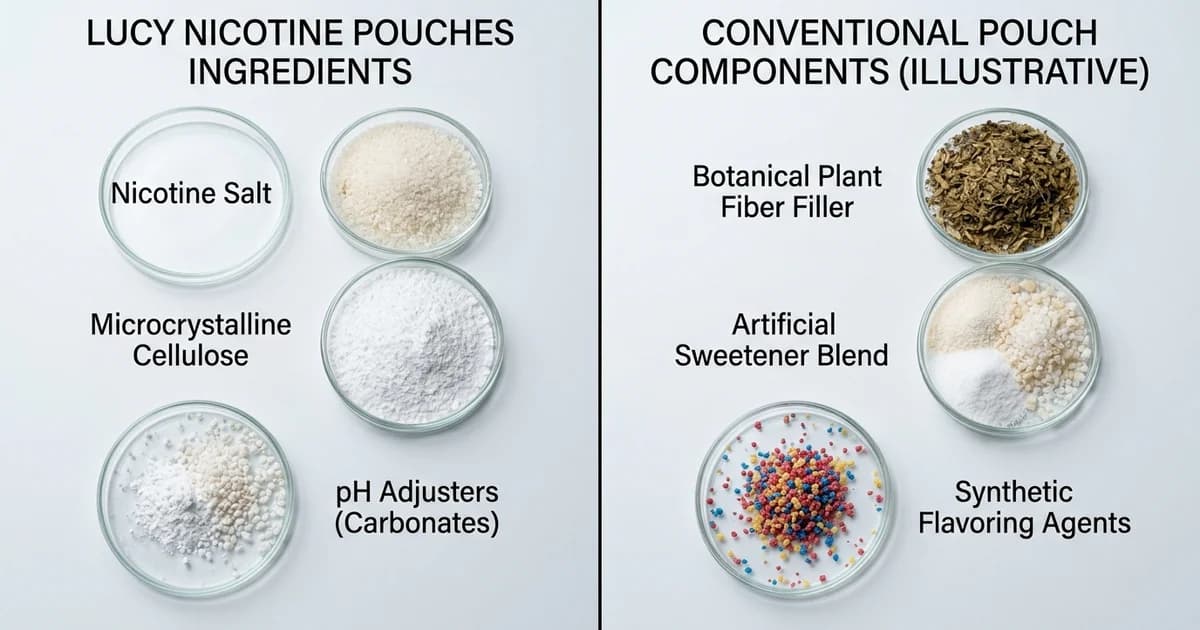
Lucy Nicotine Pouches Ingredients: What's Actually in Them (And Why It Matters)
You popped a Lucy pouch under your lip. The mint hit, the nicotine kicked in, and you moved on with your day. But have you ever actually read the lucy nicotine pouches ingredients list on the back of the can? Most people haven't. Understanding lucy nicotine pouches ingredients matters more than you think, because what you absorb through your gums enters your bloodstream fast, bypassing your digestive system entirely.
This isn't a scare piece, but for a full Lucy pouches assessment beyond ingredients, see our dedicated review. But "cleaner" and "harmless" aren't the same word. Here's a full breakdown of the lucy nicotine pouches ingredients, what each one does, and what the science says about it.
Key Takeaways
- Lucy pouches contain nine core ingredients beyond nicotine, including sweeteners, fillers, pH adjusters, and flavor carriers.
- The nicotine is synthetic (tobacco-free), which is chemically identical to tobacco-derived nicotine but avoids some of the harmful byproducts found in tobacco leaf.
- Some lucy nicotine pouches ingredients, like acesulfame potassium and propylene glycol, are FDA-approved for food use but carry open questions in newer research.
- Nicotine itself remains the biggest concern among all lucy pouches ingredients, given its well-documented addiction potential and tolerance buildup.
The Full Lucy Pouches Ingredients List
According to Lucy's official knowledge base, every pouch contains the following:
| Ingredient | Purpose |
|---|---|
| Maltitol | Sugar-free sweetener |
| Tobacco-free nicotine | Active stimulant (4mg, 8mg, or 12mg) |
| Cellulose fiber | Structural filler |
| Gum base | Pouch texture and body |
| Calcium lactate | pH buffer / mineral salt |
| MCT (Medium-Chain Triglycerides) | Carrier oil for flavor and nicotine delivery |
| Glycerol | Moisture retention |
| Food-grade flavors | Taste |
| Propylene glycol | Flavor solvent and humectant |
| Acesulfame potassium | Artificial sweetener |
| Microcrystalline cellulose | Additional filler / binding agent |
| Sodium carbonate | pH adjuster (alkalizing agent) |
The lucy pouches ingredients confirm these products are sugar-free and contain no tobacco leaf, dust, or stems. The nicotine strengths come in 4mg, 8mg, and 12mg options across multiple flavors.
Let's break down the lucy nicotine pouches ingredients that deserve a closer look.
Lucy Nicotine Pouches Ingredients: The Ones Worth Understanding
Tobacco-Free Nicotine
The most important entry on the lucy nicotine pouches ingredients list is synthetic nicotine, sometimes labeled "tobacco-free nicotine" or TFN. The molecule is chemically identical to what you'd find in a tobacco plant. Your brain can't tell the difference. It binds to the same nicotinic acetylcholine receptors, triggers the same dopamine release, and carries the same addiction risk.
The advantage of synthetic nicotine is what it doesn't contain: tobacco-specific nitrosamines (TSNAs), which are carcinogenic compounds present in tobacco leaf products. A 2023 study published in PMC compared harmful constituents in nicotine pouches versus traditional smokeless tobacco and found that modern pouches had lower levels of these harmful compounds.
One regulatory note: the FDA now regulates synthetic nicotine products under the same authority as tobacco-derived nicotine products. A federal law passed in 2022 closed the loophole that some manufacturers were using to avoid oversight. So "tobacco-free" doesn't mean "unregulated."
Maltitol
Among the lucy nicotine pouches ingredients, maltitol is a sugar alcohol used as a sweetener. It has about 75-90% of the sweetness of sucrose with fewer calories. It's common in sugar-free candy, gum, and protein bars. For most people, maltitol is harmless in small amounts. In larger quantities, sugar alcohols can cause digestive discomfort (bloating, gas), but the amount in a single pouch is minimal.
Acesulfame Potassium (Ace-K)
This is the lucy pouches ingredients entry that gets the most questions. Ace-K is FDA-approved and used in thousands of food products worldwide. But research has raised some flags.
A study in PMC found that acesulfame potassium affected gut microbiome composition and body weight gain in mice, with effects varying between males and females. A 2022 population study of over 100,000 adults in France, covered by Medical News Today, highlighted an association between Ace-K consumption and certain health concerns.
A 2025 review in ScienceDirect noted that while human studies generally confirm safety within the acceptable daily intake range, preclinical models have reported changes in gut microbiota, lipid metabolism, and inflammatory pathways, often at doses much higher than normal consumption.
The amount of Ace-K in a single nicotine pouch is tiny. But if you're using multiple pouches daily on top of diet sodas and sugar-free snacks, the cumulative exposure adds up. Anyone reviewing lucy nicotine pouches ingredients should keep this context in mind.
Propylene Glycol
Propylene glycol is another standard entry on the lucy nicotine pouches ingredients list. It serves as a solvent for flavoring and helps maintain moisture in the pouch. The FDA classifies it as GRAS (Generally Recognized as Safe) for food use. According to the NCBI Toxicological Profile, oral exposure to the small amounts found in food and drug products is unlikely to cause toxic effects.
This is one of the least concerning lucy nicotine pouches ingredients. It's in everything from salad dressings to pharmaceutical preparations.
Sodium Carbonate
Sodium carbonate is the pH adjuster. It makes the environment inside the pouch more alkaline, which is important because nicotine absorbs through mucous membranes more effectively at a higher pH. This is a deliberate design choice: the sodium carbonate makes the nicotine hit faster and harder.
Every nicotine pouch brand uses some form of pH modifier for this reason. It's not unique to Lucy, and you'll find it on nearly every brand's ingredient panel.
MCT and Glycerol
MCT (medium-chain triglycerides) acts as a carrier oil, helping dissolve and deliver both flavor compounds and nicotine. You'll find MCTs in coconut oil, coffee creamers, and dozens of supplement formulas. As lucy nicotine pouches ingredients go, the amount of MCT is negligible.
Glycerol keeps the pouch moist so it doesn't dry out in the can. It also contributes to the soft, slightly slick texture you feel when you first place the pouch under your lip. Both ingredients are widely used in food, cosmetics, and supplements with strong safety profiles.
The Real Ingredient to Watch: Nicotine Itself
The filler items on the lucy nicotine pouches ingredients list are, for the most part, standard food-grade compounds. The ingredient that demands the most attention is the one you're buying the product for: nicotine.
According to NCBI's StatPearls resource, the Surgeon General reports that nicotine addiction produces 480,000 fatalities each year in the United States, with more casualties than all other addictions combined. Most of those deaths are from smoking-related disease, not nicotine itself. But the addiction mechanism is identical whether the nicotine comes from a cigarette, a vape, or a pouch.
Tolerance builds fast. Research published in PubMed found that tolerance to nicotine's effects developed rapidly in animal models, with maximal changes occurring within 2-4 days of consistent exposure. That means the 4mg pouch that buzzed you on Monday might feel like nothing by Thursday. And that's how the escalation cycle starts: 4mg becomes 8mg, 8mg becomes 12mg.
Nicotine also affects cardiovascular function, raises blood pressure, and can disrupt sleep architecture. None of this is new information. But it's easy to forget when the delivery method feels so benign. No matter how clean the rest of the lucy pouches ingredients look, nicotine remains the primary risk factor.
How Lucy Nicotine Pouches Ingredients Compare to Other Brands
Lucy isn't the only brand on the shelf, and among major nicotine pouch brands, here's how the lucy nicotine pouches ingredients stack up against the competition:
| Feature | Lucy | ZYN | On! |
|---|---|---|---|
| Nicotine type | Synthetic (TFN) | Tobacco-derived | Tobacco-derived |
| Sweetener | Maltitol + Ace-K | Acesulfame K | Varies by flavor |
| pH adjuster | Sodium carbonate | Sodium carbonate | Sodium carbonate |
| Filler | Cellulose fiber + MCC | Plant-based fibers | Cellulose |
| Nicotine strengths | 4mg, 8mg, 12mg | 1.5mg, 3mg, 6mg, 8mg | Original line not verified on a primary source (on! PLUS: 6, 9, 12mg) |
| Format | Slim + Breakers | Slim | Mini dry |
The ingredient profiles across major brands are remarkably similar, much like the ingredients in competing pouches such as Rogue. The core formula of nicotine + cellulose filler + pH adjuster + sweetener + flavoring is industry standard. Lucy differentiates with its synthetic nicotine source and its Breakers line, which includes a burstable liquid flavor capsule inside the pouch.
The Lucy Breakers pouch format is unique to Lucy. You bite down on the capsule mid-use to release an extra burst of flavor and moisture. It doesn't change the nicotine content, but it does change the experience, making the pouch feel more interactive than a standard slim format. The lucy pouches ingredients in the Breakers line follow the same base formula listed above.
What If You Want the Focus Without the Nicotine?
This is the question more people are starting to ask after reviewing lucy nicotine pouches ingredients. Nicotine works as a stimulant. Nobody disputes that. But the tolerance curve, the dependency risk, and the cardiovascular load make it a blunt instrument for something as specific as cognitive performance.
There's a different approach: stacking compounds that target focus and alertness without triggering the same addiction pathways.
A study published in PubMed found that a combination of L-theanine and caffeine improved accuracy during task switching and increased self-reported alertness while reducing tiredness, all compared to placebo. Another peer-reviewed trial showed that combining caffeine with theacrine and methylliberine produced similar vigilance benefits to double the dose of caffeine alone, without the same blood pressure increase.
That's the exact stack inside Roon: 80mg caffeine, L-theanine, theacrine, and methylliberine in a sublingual pouch. Zero nicotine. No tolerance buildup. Six to eight hours of sustained focus without the jitters or the crash.
If you've been using nicotine pouches primarily for the mental edge, knowing the full lucy nicotine pouches ingredients list should prompt a simple question: is the edge worth the dependency? See how Roon compares.