Lithium Deficiency and Alzheimer's: The 2025 Nature Study
Roon Team
Lithium Deficiency and Alzheimer's: The 2025 Nature Study, Explained
A single mineral may help decide whether a brain ages quietly or slides into dementia. That is the headline from the lithium deficiency Alzheimer's study published in Nature in August 2025 by Bruce Yankner's lab at Harvard Medical School.
The finding reframes a debate that has stalled for decades. Instead of asking which protein clogs the brain first, the researchers asked what the brain runs out of. Their answer was lithium, a trace metal most people associate with bipolar medication, not with everyday neurology.
Here is what the study actually found, what it does not yet prove, and why it matters for how scientists think about brain aging.
Key Takeaways
- The 2025 Nature study identified lithium deficiency in the brain as one of the earliest measurable changes in Alzheimer's disease.
- In mice, cutting brain lithium by roughly half worsened amyloid plaques, tau tangles, inflammation, and memory loss.
- Amyloid plaques appear to trap, or sequester, lithium, starving surrounding neurons.
- A specific compound, lithium orotate, restored memory in Alzheimer mice because it dodges the plaques.
- The authors stress this is mouse data. No one should self-medicate with lithium based on it.
What the Lithium Deficiency Alzheimer's Study Actually Found
Lithium is not a foreign drug to your brain. It is already there, and it appears to keep brain cells working. The work, published in Nature, shows for the first time that lithium occurs naturally in the brain, shields it from neurodegeneration, and maintains the normal function of all major brain cell types.
To map this, the team measured trace metals in human tissue across the full arc of cognitive decline. Under the leadership of first author Liviu Aron, senior research associate in the Yankner Lab, the team used advanced mass spectroscopy to measure trace levels of about 30 metals in brain and blood samples from individuals who were cognitively healthy, those with mild cognitive impairment, and those with advanced Alzheimer's.
Of all those metals, one stood out. Lithium dropped early, even in people with only mild cognitive impairment, before full dementia set in. That timing is the whole point. A change that shows up early is a candidate cause, not just a late symptom.
This also helps explain a long-running puzzle. For years, neuroscientists have argued over what triggers Alzheimer's disease and why some with brain changes linked to the disease never develop dementia. Adequate brain lithium may be one reason some people carry plaques yet stay sharp.
The Mouse Experiment: Lithium Brain Aging in Action
The human data showed a correlation. The mouse work pushed toward cause. This is the part of the yankner lithium study that moved the needle for other scientists.
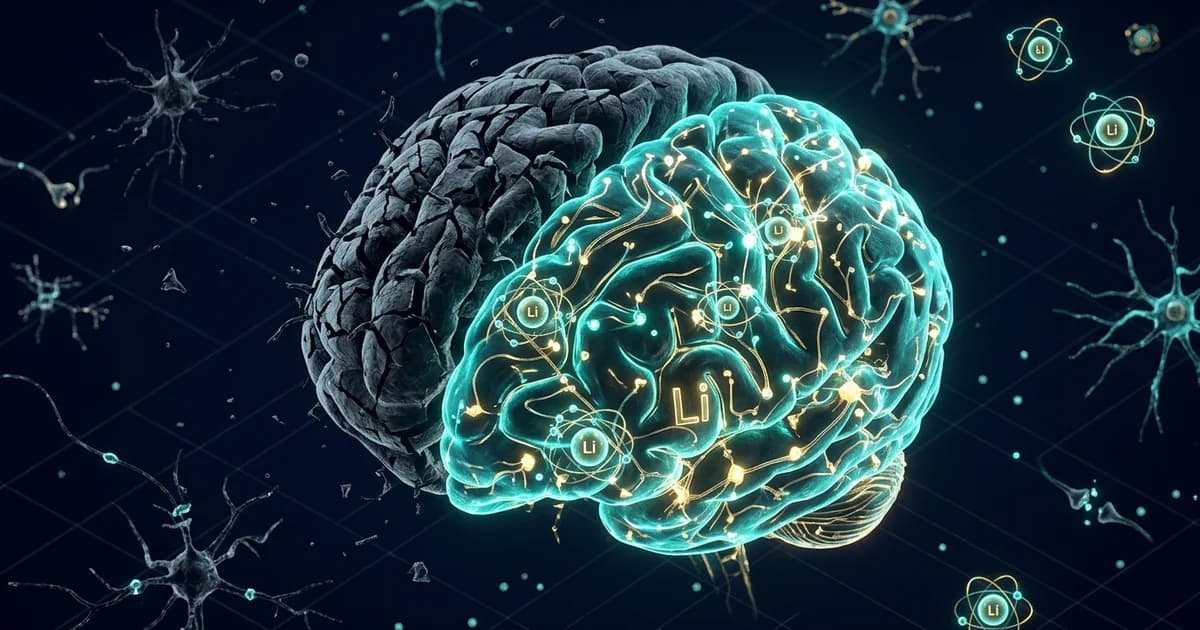
When the researchers lowered brain lithium in mice, the damage accelerated across the board. Reducing endogenous cortical Li by approximately 50% markedly increased the deposition of amyloid-β and the accumulation of phospho-tau, and led to pro-inflammatory microglial activation, the loss of synapses, axons and myelin, and accelerated cognitive decline.
That is a striking range of effects from a single deficiency. Plaques, tangles, inflammation, and physical loss of brain wiring all got worse.
The team also found a mechanism. These effects were mediated, at least in part, through activation of the kinase GSK3β. GSK3β is an enzyme lithium is known to restrain, which ties the biology together cleanly.
The visual contrast was stark. In a mouse model of Alzheimer's disease, lithium deficiency dramatically increased amyloid beta deposits in the brain compared with mice that had normal physiological levels of lithium, and the same was true for the Alzheimer's neurofibrillary tangle protein tau.
Why Amyloid Steals Lithium: The Lithium Amyloid Connection
The most clever insight in the paper is about theft. The plaques themselves appear to grab the lithium the brain needs.
The researchers found that lithium amyloid binding was the hidden problem. The data suggesting that amyloid beta plaques sequester lithium in Alzheimer's disease prompted Yankner and colleagues to search for lithium salts that may not easily bind to the plaques.
This solves an old failure. Earlier trials used lithium carbonate, the standard psychiatric form, and results were mixed. A few limited clinical trials of lithium for Alzheimer's disease have shown some efficacy, but the lithium compounds they used, such as the clinical standard lithium carbonate, can be toxic to aging people at the high doses normally used in the clinic.
Now there is a reason. The new research explains why: amyloid beta was sequestering these other lithium compounds before they could work. The plaques were eating the drug before it reached neurons.
Lithium Orotate in Alzheimer's Mice: Reversing the Damage
This is where lithium orotate alzheimer's mice results enter the story, and why the compound got so much attention.
Yankner's team went looking for a form of lithium that plaques could not trap. Of the lithium salts they analyzed, lithium orotate bonded to plaques at a markedly lesser degree in laboratory dishes than the standard lithium salt used clinically.
He explained the strategy plainly. Yankner questioned if lithium carbonate was the best drug to allow the beta-amyloid plaques to release the lithium they were sequestering, and turned to an organic lithium salt, lithium orotate, which had the ability to evade beta-amyloid plaques and still be therapeutically potent.
The payoff in mice was large. In trials on mice, researchers found they were able to reverse the disease, prevent brain cell damage and restore memory loss. This worked at low doses that mirror natural lithium levels, well below the high psychiatric doses that carry toxicity risk.
How This Fits With Older Lithium and Dementia Research
The Nature paper did not arrive in a vacuum. Population data had hinted at this link for years, which is part of why nature lithium dementia coverage spread so fast.
The standout example came from Denmark. A large 2017 study found that exposure to higher long-term lithium levels in drinking water may be associated with a lower incidence of dementia. That JAMA Psychiatry analysis covered hundreds of thousands of people.
The connection held up. Overall, the researchers confirmed the hypothesis that higher long-term lithium exposure from drinking water may be associated with a lower incidence of dementia, although the association was nonlinear.
The 2025 study gives those old water studies a plausible biological engine. The Harvard Gazette noted the alignment directly. The observation aligned with previous population studies showing that higher lithium levels in the environment, including in drinking water, tracked with lower rates of dementia.
A Comparison: Lithium Carbonate vs. Lithium Orotate in the Study
| Factor | Lithium carbonate | Lithium orotate |
|---|---|---|
| Common use | First-line psychiatric mood stabilizer | Sold as a low-dose dietary supplement |
| Binding to amyloid plaques | Higher; gets sequestered | Lower; evades plaques |
| Dose used in the study context | High clinical doses linked to toxicity in elderly | Low doses matching natural brain levels |
| Result in Alzheimer mice | Less effective in past trials | Restored memory, reduced damage |
| Status for Alzheimer's | Mixed past trial evidence | Promising mouse data, no human proof yet |
This table reflects the study's own logic. The form of lithium, and the dose, changed the outcome.
The Caution Every Headline Should Have Led With
This is mouse science with a clear human warning attached. The lead researcher said so himself.
Yankner was blunt about the limits. Yankner noted that his group tested lithium salts solely on mice and that people should not start taking lithium salts on a whim, and although lithium is approved for treatment of bipolar disorders, it can be toxic, particularly in older people.
The official Harvard summary echoed this. Yankner emphasises caution, as lithium is not yet proven safe or effective for preventing neurodegeneration in humans and people should not self-medicate.
Independent experts agreed on the timeline. Experts told PBS News that it's premature to conclude from the results that people should use lithium as a treatment or prophylactic for Alzheimer's disease.
The next steps are practical. Yankner said the next steps will be determining whether there is an effective dose of lithium orotate or another lithium compound for humans that treats Alzheimer's with minimal toxicity, as well as finding a diagnostic blood test.
The Bottom Line on Lithium and the Aging Brain
The 2025 Nature study makes a focused claim worth repeating clearly. Lithium has an essential role in the brain and is deficient early in Alzheimer's disease, which can be recapitulated in mice and treated with a novel lithium salt that restores the physiological level.
That is a meaningful shift in framing. For thirty years the field chased plaques and tangles as the prime movers. This work suggests a missing nutrient may sit upstream of both, with amyloid acting partly as a lithium trap rather than only a toxin.
The honest summary is that this is one strong study in mice plus suggestive human tissue and population data. It is a hypothesis with teeth, not a treatment. The path from here runs through human trials, dosing work, and a diagnostic blood test, and any of those could complicate the story.
What it should change today is how seriously researchers take trace metals in brain aging. What it should not change is your medicine cabinet.
Frequently Asked Questions
What did the 2025 lithium Alzheimer's study find?
It found that lithium occurs naturally in the brain and drops early in Alzheimer's disease. The work, published in Nature, shows for the first time that lithium occurs naturally in the brain, shields it from neurodegeneration, and maintains the normal function of all major brain cell types. In mice, lowering brain lithium worsened amyloid, tau, inflammation, and memory, while restoring it reversed damage. The human portion measured trace metals across cognitively healthy people, those with mild impairment, and those with advanced disease.
Who led the lithium deficiency study?
The study came from Bruce Yankner's lab at Harvard Medical School, with Liviu Aron as first author, and was published in Nature. Yankner is a notable name in this field because he was among the first to demonstrate amyloid beta toxicity in the 1990s. The team used advanced mass spectroscopy to measure trace levels of about 30 metals in brain and blood samples across the full range of cognitive health.
Why did the researchers use lithium orotate instead of lithium carbonate?
Because amyloid plaques trap lithium, and the two salts behave differently. Of the lithium salts they analyzed, lithium orotate bonded to plaques at a markedly lesser degree in laboratory dishes than the standard lithium salt used clinically. That let lithium orotate reach neurons at low doses. Lithium carbonate, the psychiatric standard, gets sequestered by plaques and requires high, potentially toxic doses in older people.
Does this mean I should take lithium supplements to prevent Alzheimer's?
No. The data is from mice, and the researchers are explicit about the risk. Lithium is not yet proven safe or effective for preventing neurodegeneration in humans and people should not self-medicate. Lithium can be toxic, especially for older adults, and proper dosing for brain health in humans has not been established. Talk to a physician before considering any lithium product.
How does this connect to older drinking water studies?
Population studies had already hinted at a link, and this study offers a mechanism. A large 2017 study found that exposure to higher long-term lithium levels in drinking water may be associated with a lower incidence of dementia. The new mouse and tissue work suggests why that correlation might exist: natural lithium appears to protect brain cells, and losing it accelerates Alzheimer-type damage.
What happens next?
Human research. Yankner said the next steps will be determining whether there is an effective dose of lithium orotate or another lithium compound for humans that treats Alzheimer's with minimal toxicity, as well as finding a diagnostic blood test. Until clinical trials run, the practical takeaway is scientific interest, not a self-treatment plan.
Where the Real Story Is: Evidence Over Hype
The lithium study is a reminder of how brain science actually moves. A careful mouse model, decades of population data, and a precise mechanism beat any single supplement headline. We cover landmark research like this because the gap between a promising Nature paper and a proven human therapy is where most of the truth lives.
That same caution applies to anything you put in your body for cognition. Roon is built on ingredients with established human evidence for short-term focus, not speculative mechanisms. Each sublingual pouch pairs 80 mg caffeine and 60 mg L-theanine with 25 mg methylliberine (Dynamine) and 5 mg theacrine (TeaCrine), formulated for a 5 to 10 minute onset and 6 to 8 hours of steady focus without the jitters or crash.
To be clear about what it is and isn't: Roon is a focus product, not a treatment for Alzheimer's, dementia, or any disease, and nothing here changes the study's caution about lithium. If you want sharper afternoons backed by well-studied ingredients, try Roon and keep watching the lithium trials unfold.
Written by Roon Team