Lion's Mane vs Cordyceps vs Reishi: Matching the Mushroom to Your Cognitive Goal
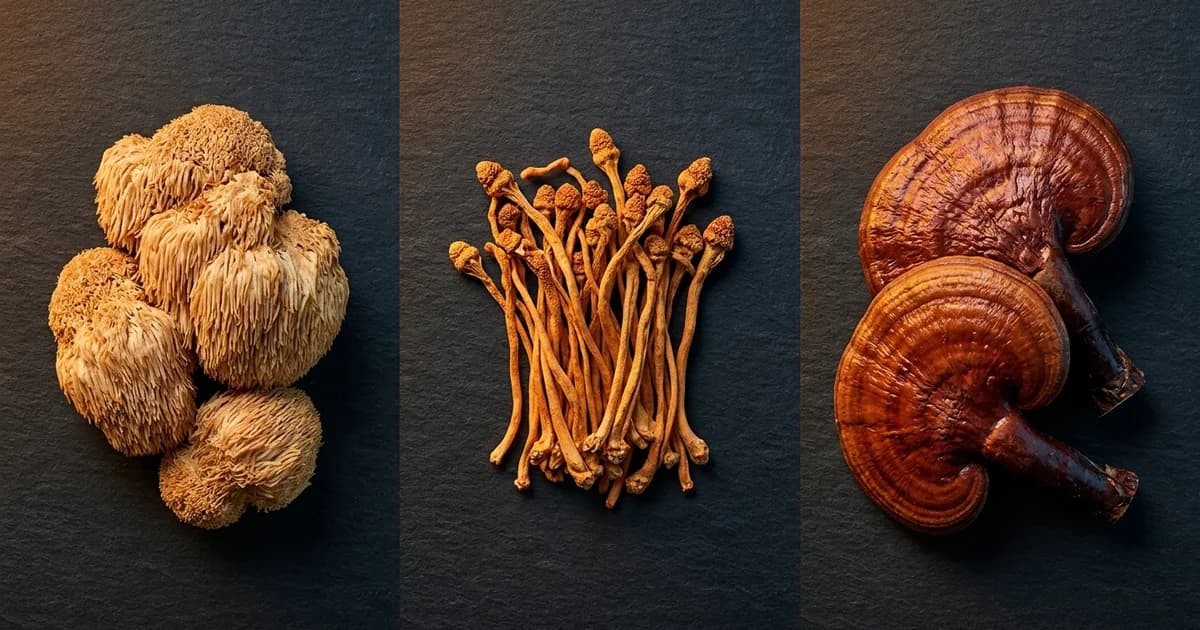
Three mushrooms dominate every wellness shelf, and people buy them as if they were interchangeable. They are not. The whole point of a lion's mane vs cordyceps vs reishi comparison is that each one targets a different system, on a different timeline, for a different kind of person.
Lion's mane works on the brain. Cordyceps works on energy and oxygen use. Reishi works on stress and recovery. Pick the wrong one and you will spend three months waiting for a result you were never going to get.
Here is how to match the mushroom to the actual goal, what the science supports, and where even the best functional mushroom comparison runs into a hard limit.
Key Takeaways
- Lion's mane is the brain mushroom. It supports nerve growth factor and is studied for memory and mental clarity, but results show up over weeks, not minutes.
- Cordyceps is the energy and endurance mushroom. It is studied for oxygen use and exercise tolerance, making it the best mushroom for energy among the three.
- Reishi is the stress and sleep mushroom. As an adaptogen, it is the best mushroom for stress and recovery, not for acute alertness.
- All three are slow, chronic tools. None of them sharpens your focus for the meeting starting in ten minutes.
The Core Difference: Three Mushrooms, Three Systems
If you only remember one thing, remember this. Lion's mane builds, cordyceps powers, and reishi calms. They rarely compete because they barely overlap.
The confusion comes from marketing that lumps them under one word: "functional." Functional just means the mushroom does something beyond nutrition. It says nothing about what.
So before you compare doses or brands, ask which system you are trying to support. The answer points to one mushroom, occasionally two, almost never all three at once.
| Goal | Best Match | Primary Mechanism | Timeline | Type of Benefit |
|---|---|---|---|---|
| Memory, mental clarity, long-term brain health | Lion's mane | Nerve growth factor support | 8–12 weeks | Structural, chronic |
| Endurance, stamina, oxygen efficiency | Cordyceps | ATP and oxygen utilization | Days to weeks | Metabolic, semi-acute |
| Stress resilience, sleep, recovery | Reishi | Adaptogenic, calming | 2–8 weeks | Restorative, chronic |
| Same-day focus for a task right now | None of the above | n/a | Minutes | Acute (see below) |
Lion's Mane: The Best Mushroom for the Brain
Lion's mane is the mushroom to choose when your goal is memory, mental clarity, or long-term brain health. It is the only one of the three with a direct line to neural tissue.
Its active compounds, hericenones and erinacines, are studied for their effect on nerve growth factor (NGF), a protein that helps neurons grow, connect, and survive. According to the Alzheimer's Drug Discovery Foundation, preclinical research suggests lion's mane may raise NGF levels, though human cognitive results have been mixed and based on small, short trials.
The most cited human data, summarized by the same Alzheimer's Drug Discovery Foundation review, comes from a Japanese trial in which older adults with mild cognitive impairment improved their scores while taking lion's mane, then declined after stopping. The signal was real. It was also slow and reversible.
That is the catch with which mushroom for the brain: lion's mane rewards patience. You judge it after 8 to 12 weeks of daily use, not after a single dose. If you want a brain mushroom and you can commit to a season of it, this is the one.
Who should pick lion's mane
- Knowledge workers wanting long-term cognitive support
- Anyone interested in healthy aging of memory and mood
- People who think in months, not minutes
Cordyceps: The Best Mushroom for Energy
Cordyceps is the mushroom to choose when your goal is physical energy, stamina, or endurance. It works on how your body produces and uses fuel, not on your neurons.
The mechanism centers on ATP production and oxygen utilization. Cordycepin, the signature compound, is linked to mitochondrial activity and adenosine pathways. In practice, that means it is studied as an endurance aid, not a focus aid.
A 2017 study in the Journal of Dietary Supplements found that Cordyceps militaris supplementation improved tolerance to high-intensity exercise in healthy adults, with the strongest effects appearing after about three weeks of consistent use. So while cordyceps acts faster than lion's mane, it still favors a loading period.
People reach for cordyceps as the best mushroom for energy because the "energy" it supports is metabolic and aerobic. Think a longer run or a harder set, not a sharper spreadsheet. If your bottleneck is your lungs and legs, this is your mushroom.
Who should pick cordyceps
- Endurance athletes and weekend runners
- Anyone chasing better stamina and oxygen efficiency
- People who feel physically gassed before they feel mentally foggy
Reishi: The Best Mushroom for Stress
Reishi is the mushroom to choose when your goal is calm, recovery, or better sleep. It is the odd one out, because it does not push you forward. It settles you down.
Reishi is classed as an adaptogen, a substance studied for helping the body manage stress. Traditional use and emerging research point to its role in relaxation, immune support, and sleep quality rather than alertness or output.
This is why reishi belongs nowhere near your morning routine if your aim is productivity. Taken when you want to wind down, it fits. Taken when you want to focus, it works against you.
As the best mushroom for stress, reishi pairs naturally with sleep and recovery goals. It is a nighttime tool wearing the same "functional mushroom" label as two daytime ones, which is exactly how shoppers end up buying the wrong jar.
Who should pick reishi
- People dealing with high stress loads and poor sleep
- Anyone who wants recovery support, not stimulation
- Evening users, not morning users
The Honest Gap in Every Functional Mushroom Comparison
Here is what no functional mushroom comparison wants to admit. All three of these mushrooms are slow. Every benefit above is chronic, built over days or weeks of daily use.
None of them does the one thing most people actually want from a "cognitive" product: sharpen your focus for the task in front of you, right now.
Lion's mane will not get you through a 2 p.m. deadline. Cordyceps will not carry a late-afternoon strategy session. Reishi will actively make you sleepier. If your real goal is acute, same-session focus, the mushroom shelf has nothing for you, and pretending otherwise is how people waste money.
That gap, fast onset and immediate clarity, is a different category of tool entirely. It is worth understanding before you decide a mushroom failed you when it was simply the wrong tool for the job.
Conclusion: Match the Tool to the Timeline
The smartest move is not picking a favorite mushroom. It is being honest about your goal and your timeline.
Want long-term brain support and you can wait a season? Lion's mane. Want endurance and aerobic stamina over a few weeks? Cordyceps. Want stress resilience and better sleep? Reishi.
But if you want focus you can feel in minutes that lasts through the afternoon, none of these three fits. That job belongs to a faster category of ingredient, and naming that gap clearly is the most useful thing a mushroom comparison can do.
Frequently Asked Questions
Can I take lion's mane, cordyceps, and reishi together?
Yes, and many blends combine them because their effects rarely overlap. Lion's mane targets the brain, cordyceps targets energy, and reishi targets stress and recovery. The practical issue is timing. Reishi is calming and suits evenings, while cordyceps suits training and daytime activity. Stacking all three is fine, but expect chronic, gradual support rather than any same-day jolt of focus or alertness.
Which mushroom is best for focus?
Of these three, none is a true focus tool. Lion's mane supports long-term cognition over weeks, not the acute concentration you feel during a single work session. Cordyceps targets physical energy, and reishi promotes calm. If your goal is sharp, same-day focus, you need a fast-acting ingredient category like caffeine paired with L-theanine, not a chronic mushroom that takes weeks to show effects.
How long until functional mushrooms work?
It depends on the mushroom and the goal. Cordyceps may support exercise tolerance within a few weeks of daily use. Lion's mane is best judged after 8 to 12 weeks, since its benefits are structural and gradual. Reishi's stress and sleep effects also build over weeks. None of these mushrooms produces a reliable acute effect, so consistency over a season matters far more than any single dose.
Is lion's mane or cordyceps better for energy?
Cordyceps is the better choice for physical energy. It supports ATP production and oxygen use, which links it to stamina and endurance. Lion's mane does not work on energy metabolism at all. It supports the brain through nerve growth factor pathways. If you feel physically drained, choose cordyceps. If you want long-term cognitive support, choose lion's mane. They solve different problems.
Does reishi help with stress and anxiety?
Reishi is studied as an adaptogen, meaning it may help the body manage stress, and it is associated with relaxation and better sleep quality. It is not a treatment for any diagnosed anxiety condition, and it is not a substitute for medical care. Think of reishi as a recovery and wind-down tool. It supports calm rather than alertness, which is why it suits evening use far better than mornings.
What is the best mushroom for the brain?
Lion's mane is the strongest candidate for brain-specific goals. Its compounds are studied for supporting nerve growth factor, which helps neurons grow and survive. Human trials are small and mixed, but the most cited study showed memory improvements in older adults that faded after they stopped taking it. It is a long-term, chronic brain tool, not a way to sharpen focus during a single task or workday.
Why don't mushrooms give me instant focus?
Because their mechanisms are slow by design. Lion's mane changes neural support pathways over weeks. Cordyceps adapts your energy metabolism over days to weeks. Reishi shifts your stress response gradually. None of them spikes alertness on contact the way caffeine does. Acute, same-session focus comes from fast-onset ingredients that act within minutes, which is a separate category from the chronic, foundational support functional mushrooms provide.
Where Mushrooms End and Roon Begins
Every mushroom above earns its place on a slow, chronic timeline. Lion's mane for the brain over a season, cordyceps for endurance over weeks, reishi for stress and sleep over time. They are foundational tools, and they are worth taking for what they actually do.
But none of them covers the gap this article keeps circling back to: focus you can feel in minutes and hold through the afternoon. That is exactly what Roon is built for. Each sublingual pouch pairs 80 mg caffeine and 60 mg L-theanine with 25 mg Dynamine (methylliberine) and 5 mg TeaCrine (theacrine), a combination studied for sharp attention without the jitters. The caffeine and L-theanine pairing in particular is backed by research on attention and mental clarity.
Roon is not a mushroom replacement, and it is not a sleep or endurance aid. It is the acute layer that sits on top of your foundation: 5 to 10 minute onset, 6 to 8 hours of steady focus, no crash, no tolerance creep. If your real problem is the task in front of you right now, try Roon for the job mushrooms were never meant to do.
Written by Roon Team