Lion's Mane vs Bacopa for Memory
Roon Team
Lion's Mane vs Bacopa for Memory: NGF Theory vs the Memory Herb
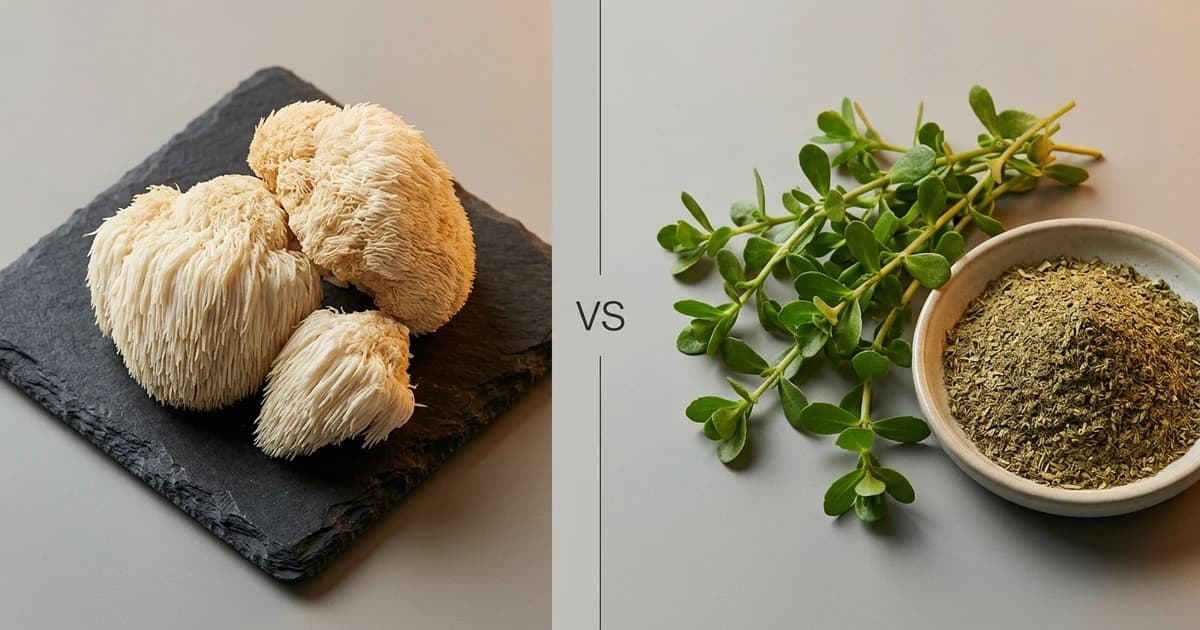
Two supplements dominate every conversation about memory, and they could not work more differently. The lions mane vs bacopa debate usually gets framed as mushroom versus herb. That misses the point. The real split is mechanism: one may help your brain build new connections, the other has decades of trials showing it helps you recall information faster.
If you want to know which one actually belongs in your cabinet, the answer depends on what kind of memory you are trying to support and how long you are willing to wait for results.
Here is the honest breakdown, based on what the research actually says.
Key Takeaways
- Bacopa monnieri has the stronger human evidence base for memory, especially delayed recall, but it takes 8 to 12 weeks of daily use to show effects.
- Lion's mane (Hericium erinaceus) works through a different theory: its compounds may stimulate nerve growth factor (NGF), though most strong evidence is preclinical or from small trials.
- Neither is a fast-acting focus aid. Both are slow, structural supplements.
- For acute alertness and same-day focus, you need a different tool entirely.
The Core Difference: NGF Theory vs the Memory Herb
Lion's mane and bacopa target memory through completely separate biology. Lion's mane may help your brain grow and repair neurons over time. Bacopa appears to improve how efficiently you encode and retrieve information.
Lion's mane is the "build it" supplement. The interest centers on two families of compounds, hericenones and erinacines, which lab studies suggest can stimulate the production of nerve growth factor. NGF is a protein your brain uses to keep neurons healthy and form new connections. The theory is appealing: support NGF, support long-term brain maintenance.
Bacopa is the "use it" supplement. It has been a staple of Ayurvedic medicine for memory for centuries, and modern trials have repeatedly tested it for one thing in particular: the ability to recall information you learned earlier.
These are not interchangeable. One is a bet on structural support. The other has a track record on functional recall.
Lion's Mane Memory Evidence: Promising but Thin
The strongest human trial on lion's mane and memory is small, old, and focused on cognitive decline rather than healthy users. That matters when you decide whether to spend money on it.
The most cited study is a Japanese trial from 2009. In it, 30 adults with mild cognitive impairment took lion's mane or placebo for 16 weeks. According to the Alzheimer's Drug Discovery Foundation's review, the supplement was well tolerated, with only mild stomach complaints reported in both groups.
The results were encouraging on paper. As summarized by Eureka Health, participants taking 3 grams daily improved their Mini-Mental State Examination scores by an average of 2.2 points after 16 weeks. The catch: cognitive scores dropped again once people stopped taking it.
Here is the problem for the average reader. Most of the hericium erinaceus cognition research is either preclinical (cells and rodents) or runs in people who already have measurable decline. We have limited evidence that a healthy 30-year-old will notice anything. Larger trials are underway, including an observational study registered on ClinicalTrials.gov, but the data is not in yet.
So lions mane memory support is a reasonable long-term bet. It is not a sure thing, and it is not fast.
Bacopa Monnieri Memory Evidence: Slow but Proven
Bacopa has more high-quality human trials for memory than almost any other natural nootropic, and the consistent finding is improved delayed recall. If your goal is remembering what you studied, this is the better-supported choice.
The active compounds are bacosides, plant molecules that researchers believe support communication between neurons and may protect them from oxidative stress. Multiple randomized, placebo-controlled trials have tested standardized bacopa extracts in healthy adults and older populations.
The pattern across that bacopa monnieri memory research is clear. Bacopa tends to improve the accuracy of delayed word recall, the kind of test where you learn a list and repeat it back later. Effects on raw processing speed are weaker and less consistent.
The cost is patience. Bacopa is not an acute supplement. The trials that show benefits run users on a standardized extract (commonly around 300 mg daily of a roughly 50 percent bacoside extract) for 8 to 12 weeks before measuring results. Some people also report mild digestive upset, which is why it is usually taken with food.
If you commit to it daily for three months, bacopa is the nootropic for memory with the deepest evidence file.
Lion's Mane vs Bacopa: Side-by-Side Comparison
| Factor | Lion's Mane (Hericium erinaceus) | Bacopa Monnieri |
|---|---|---|
| Primary theory | May stimulate nerve growth factor (NGF) | Bacosides support neuron signaling and recall |
| Best-supported benefit | Long-term neuronal support | Delayed memory recall |
| Strength of human evidence | Limited, mostly small or preclinical | Strong, multiple controlled trials |
| Time to effect | Weeks to months | 8 to 12 weeks |
| Typical dose in studies | ~3 g fruiting body powder | ~300 mg standardized extract |
| Acute focus benefit | No | No |
| Common downside | Thin data in healthy adults | Slow onset, mild GI upset |
Which One Should You Take?
Choose bacopa if your priority is recall and you can stay consistent for three months. Choose lion's mane if you are more interested in long-term brain maintenance and are comfortable with thinner evidence. Many people stack both, since their mechanisms do not overlap.
There is a third scenario the comparison usually ignores. Sometimes you do not have a memory problem. You have an attention problem. You can recall information fine, but you cannot stay locked in long enough to learn it in the first place.
That is a different tool. Caffeine, L-theanine, and related compounds act in minutes, not months, and they target alertness rather than memory encoding. Confusing the two is the most common mistake people make when shopping for the best supplement for memory.
Conclusion
Lion's mane and bacopa solve different problems on different timelines. Bacopa has the stronger human record, with repeated trials pointing to better delayed recall after a couple of months of daily use. Lion's mane rests on the NGF theory, an appealing idea with encouraging early data and not enough large human trials yet to call it settled.
Neither one works tomorrow. Both ask for weeks of consistency before they earn their place. If you want memory support and you are patient, bacopa is the safer evidence-based pick, with lion's mane as a longer-term complement. If what you actually want is to feel sharp this afternoon, you are shopping in the wrong aisle.
Frequently Asked Questions
Can I take lion's mane and bacopa together?
Yes, and the combination makes sense because they work through separate mechanisms. Lion's mane targets long-term neuronal support through the NGF theory, while bacopa has stronger human evidence for improving delayed recall. Stacking them does not create a known conflict. Just keep your expectations realistic, since both are slow supplements that need weeks of daily use before you can judge whether they help.
How long until bacopa improves memory?
Plan on 8 to 12 weeks of daily use. The controlled trials that show benefits for bacopa monnieri memory ran participants on a standardized extract for two to three months before testing recall. Bacopa is not an acute supplement, so taking it once before an exam will do nothing useful. Consistency over a full quarter is what the research is built on.
Is lion's mane proven to improve memory in healthy people?
Not strongly. The best human trial on lions mane memory studied adults with mild cognitive impairment, not healthy users, and most other evidence comes from cell and animal models. The mechanism is plausible, and early results are encouraging, but we lack large trials confirming benefits in people without measurable decline. Treat it as a promising long-term bet rather than a guarantee.
What is the NGF theory of lion's mane?
NGF stands for nerve growth factor, a protein your brain uses to maintain neurons and form new connections. Lab studies suggest two groups of compounds in lion's mane, hericenones and erinacines, may stimulate NGF production. The theory is that supporting NGF supports long-term brain health. It is the central reason hericium erinaceus cognition research draws so much interest, though human confirmation is still limited.
Which is the best supplement for memory?
For delayed recall in healthy adults, bacopa has the deepest evidence base, making it the most defensible nootropic for memory. Lion's mane is the better choice if your goal is long-term neuronal support rather than short-term recall. There is no single winner for everyone. The right pick depends on whether you want functional recall now or structural support over years.
Do these help with focus or alertness?
No. Both lion's mane and bacopa are slow, memory-oriented supplements with no meaningful same-day effect on alertness. If you want to feel focused within minutes, you need an acute stack built around compounds like caffeine and L-theanine, not a memory herb. Mixing up memory support and attention support is the most common reason people feel let down by these supplements.
Roon Does One Job, and It Is Not This One
If you read this far hoping a memory herb would help you focus this afternoon, here is the honest answer: it will not, and that is exactly the gap Roon was built for.
Roon is not a memory supplement, and it is not a replacement for bacopa or lion's mane. It does one thing well. It supports fast, clean alertness so you can actually sit down and do the work. Each sublingual pouch carries a 4-ingredient stack: 80 mg caffeine, 60 mg L-theanine, 25 mg methylliberine (Dynamine), and 5 mg theacrine (TeaCrine). It absorbs in 5 to 10 minutes and is designed for 6 to 8 hours of steady focus with no jitters, no crash, and no tolerance buildup.
Think of it as the attention layer, not the memory layer. Learn the material with patience and the right long-term support. If you want to understand how the caffeine and L-theanine pairing creates calm focus, start there, then try Roon on the days you need to lock in.
Written by Roon Team