Lion's Mane and Mood: The Neurotrophic Theory of Why a Mushroom Might Lift You
Most supplements that claim to improve your mood work on the same fast lever: serotonin, dopamine, or a quick hit of stimulation. Lion's mane does something stranger. The interest in lion's mane mood effects rests on a slower idea, that you can change how you feel by changing the physical structure of your brain over weeks, not minutes.
That theory has a name. It's called the neurotrophic hypothesis of depression, and it reframes low mood as a problem of brain maintenance rather than a simple chemical shortage.
This is the part most articles skip. So let's look at what the science actually says, where it holds up, and where it's still thin.
Key Takeaways
- The lion's mane mood story is built on neurotrophins, the proteins that help neurons grow, repair, and connect.
- Lion's mane contains compounds called hericenones and erinacines that stimulate Nerve Growth Factor (NGF) and appear linked to BDNF activity.
- A 2010 human trial found reduced depression and anxiety scores after four weeks; the evidence is promising but early.
- Lion's mane works slowly. It is not a same-day mood fix, and it does not treat any clinical condition.
What the Neurotrophic Theory Actually Claims
The neurotrophic theory says depression isn't only about too little serotonin. It's about the brain losing its ability to remodel itself.
The central character is brain-derived neurotrophic factor (BDNF), a protein that supports the survival of existing neurons and encourages new connections. Research on the biology of depression links BDNF to neuroplasticity and to the way depression develops and responds to treatment, as described in a review published in PMC (National Library of Medicine).
The pattern researchers keep finding is consistent. People in a depressive state tend to show lower BDNF, and many effective antidepressants raise it over time. That delay matters. It helps explain why standard antidepressants take weeks to work, the same lag you'd expect if the real job is rebuilding tissue, not topping up a chemical.
If that model is right, then anything that reliably raises neurotrophic activity becomes interesting for mood. That's where the mushroom enters.
How Lion's Mane Fits the Neurotrophic Picture
Lion's mane is unusual because it appears to act directly on the brain's growth machinery rather than on neurotransmitter levels.
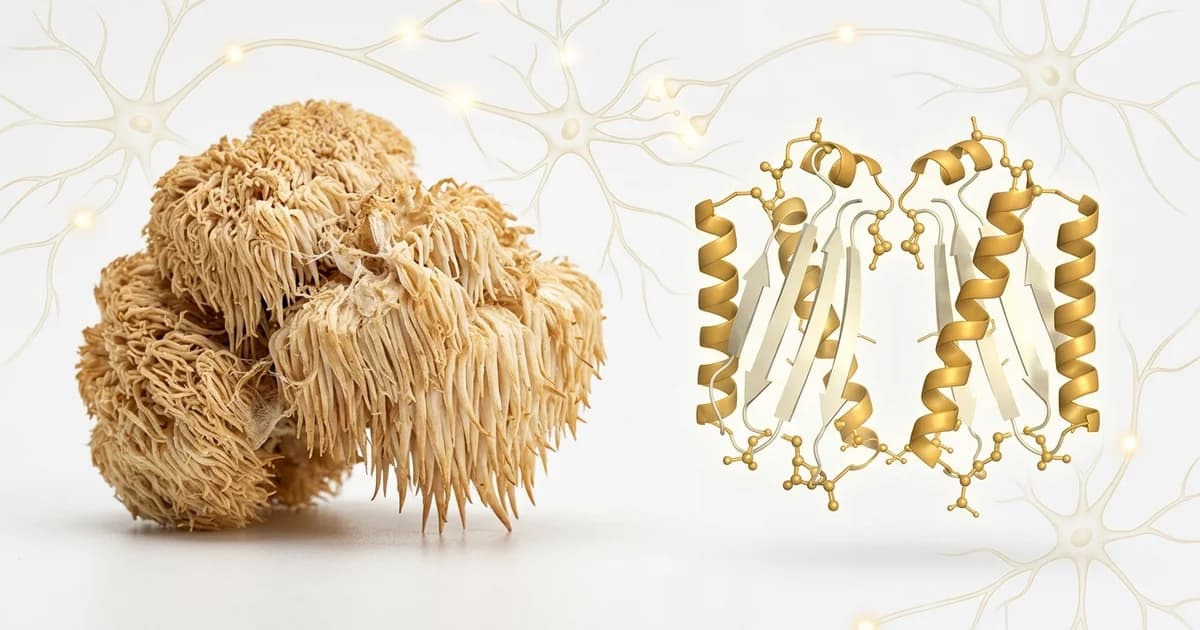
The mushroom produces two families of compounds found almost nowhere else in nature. Hericenones come from the fruiting body and erinacines from the mycelium, and a monograph from the Association for the Advancement of Restorative Medicine notes that both are low molecular weight compounds that may cross the blood-brain barrier.
Their main reported effect is on Nerve Growth Factor (NGF), a neurotrophin closely related to BDNF. Both compound families appear to stimulate NGF synthesis, with erinacines inducing more NGF than hericenones in lab studies.
This is the mechanistic backbone of the lion's mane BDNF mood argument. Boost neurotrophins, support neuroplasticity, and the theory predicts a slow lift in mood and resilience. The logic is clean. The question is whether it shows up in actual people.
The Human Evidence on Lion's Mane Depression and Anxiety
Direct human data on lion's mane depression and lion's mane anxiety is limited but encouraging.
The most cited trial is a 2010 study in menopausal women who ate cookies containing dried lion's mane powder for four weeks. The summary from the Center for Nutritional Psychology reports that depressive severity and the number of physical complaints dropped after four weeks of eating the lion's mane cookies, compared with baseline. The "concentration," "irritating," and "anxious" sub-scores trended lower in the mushroom group than in placebo.
More recent work points the same way on stress. A 2025 double-blind placebo-controlled study in Frontiers in Nutrition tested a standardised extract in healthy younger adults. The authors reported an improvement in self-reported stress following 28 days of daily lion's mane supplementation.
There's animal data too. A 2022 paper in Frontiers in Nutrition reported potential antidepressant effects from a lion's mane and chlorella complex in aged mice, with changes consistent with the neurotrophic model.
Add it up and you get a real but modest case. Small samples, short durations, and a mix of fruiting-body and extract forms. Promising signal, not settled science.
Why the Timeline Is the Whole Point
Here is the practical takeaway that gets lost in the hype: lion's mane is a slow tool.
If the mechanism is neurotrophic, the benefit depends on weeks of consistent intake while NGF and BDNF activity climbs and new connections form. The 2010 trial ran four weeks. The 2025 stress finding came after 28 days. You should not expect a noticeable mood change on day one.
This is the cleanest way to separate mushrooms for mood from fast-acting compounds. One rebuilds infrastructure. The other flips a switch. Both can matter, but they answer different questions.
Lion's Mane vs. Acute Mood and Focus Tools
These ingredients are not competitors so much as different time horizons. The table below shows where each one fits when you think about lion's mane stress support against faster options.
| Approach | Primary mechanism | Onset | Best for |
|---|---|---|---|
| Lion's Mane | NGF/BDNF neurotrophic support | Weeks (slow) | Long-term mood and brain maintenance |
| L-Theanine | Boosts alpha brain waves, calm alertness | 30-60 min | Acute calm-but-alert state |
| Caffeine + L-Theanine | Stimulation balanced by calm | 5-30 min | Sharp same-day focus |
| Roon pouch | 80mg caffeine, 60mg L-theanine, 25mg Dynamine, 5mg TeaCrine, sublingual | 5-10 min | 6-8 hrs of focus, no jitters, no crash |
The honest reading: lion's mane and an acute focus tool solve different problems. You might use one for the long game and the other for the next three hours.
What Lion's Mane Is Not
Lion's mane does not treat, cure, or prevent depression, anxiety, or any medical condition. The human trials are small and early, and a mushroom is not a substitute for therapy, medication, or a doctor's care.
Think of it as support for healthy brain function over time, not a clinical intervention. If you're managing a mood disorder, the mushroom is a question for your physician, not a replacement for one.
Conclusion
The reason lion's mane mood research is interesting has little to do with the mushroom being trendy. It's that lion's mane offers a clean test of the neurotrophic theory, the idea that mood reflects the brain's capacity to grow and repair itself.
The mechanism is plausible and well-described. Hericenones and erinacines stimulate NGF, NGF and BDNF support neuroplasticity, and a handful of human trials show modest reductions in depression, anxiety, and stress over several weeks. That's a coherent story backed by early data.
It is also slow, and it is not medicine. The smart position is patience: if you try it, judge it over a month of daily use, not an afternoon.
Frequently Asked Questions
Does lion's mane actually improve mood?
Early human evidence suggests it might, slowly. A 2010 trial in menopausal women found lower depression and anxiety scores after four weeks of daily lion's mane, and a 2025 study reported reduced stress after 28 days. The effect is modest and the studies are small. Lion's mane is not a same-day mood booster and does not treat any clinical condition.
How does lion's mane affect BDNF?
Lion's mane mainly stimulates Nerve Growth Factor (NGF), a neurotrophin closely related to BDNF. Both proteins support neuroplasticity, the brain's ability to form and maintain connections. The neurotrophic theory of mood links higher neurotrophin activity to better mood resilience over time, which is why the lion's mane BDNF mood connection draws so much research interest.
How long does lion's mane take to work for mood?
Weeks, not hours. Because the mechanism is neurotrophic rather than stimulant-based, benefits depend on consistent daily intake. The main human trials ran roughly four weeks before showing changes in mood, anxiety, or stress. If you try lion's mane, judge it over a month of steady use rather than a single dose.
Can lion's mane help with anxiety?
Some early data points that way. The 2010 menopausal study found that anxiety-related sub-scores trended lower in the lion's mane group than placebo. That said, the research on lion's mane anxiety is limited to small trials, and it is not a treatment for a clinical anxiety disorder. Speak with a doctor if anxiety is affecting your daily life.
Is lion's mane better than caffeine for focus?
They do different jobs. Lion's mane works slowly on brain maintenance and is not a same-day focus tool. Caffeine, especially paired with L-theanine, sharpens attention within minutes. If you want immediate focus, a caffeine plus L-theanine combination acts fast. If you want long-term support, lion's mane is the slower play.
Are mushrooms for mood backed by real science?
Partially. The mechanism behind mushrooms for mood is well-described, and a small number of human and animal studies show promising results for lion's mane specifically. But sample sizes are small and durations are short. The evidence supports cautious optimism, not strong claims, and no mushroom should replace medical care for a diagnosed condition.
The Fast Lever Lion's Mane Doesn't Pull
Lion's mane plays a long game. It supports the brain's growth machinery over weeks, and that slow neurotrophic effect is exactly what makes it interesting for mood. It is not built for the next three hours, and it is not a replacement for therapy or medication.
That slow timeline is why some people pair it with something that works on a different clock. The L-theanine in Roon supports a calm-but-alert state acutely, within minutes, which is a separate mechanism from lion's mane's gradual BDNF and NGF support. One reshapes the foundation. The other helps you settle into focus today.
Roon is a sublingual pouch with 80mg caffeine, 60mg L-theanine, 25mg methylliberine (Dynamine), and 5mg theacrine (TeaCrine), designed for 6 to 8 hours of focus with no jitters and no crash. It is a tool for acute focus, not a mood treatment and not a stand-in for a doctor. If you want clean, fast focus to sit alongside your longer-term brain habits, you can try Roon.
Written by Roon Team