Lemon Balm (Melissa officinalis): Calm and Cognition From a Garden Herb
Most people who grow lemon balm have no idea they're cultivating one of the most studied calming herbs in Europe. They pick a few leaves for tea, enjoy the bright citrus smell, and move on.
The lemon balm benefits that interest neuroscientists run deeper than a pleasant cup. This unassuming mint-family plant has been linked to lower self-rated stress, steadier mood, and measurable shifts in attention and memory. It does this through a specific mechanism in the brain, not vague "herbal vibes."
Here is what the research actually says, where the hype gets ahead of the data, and how to think about dosage if you want the calm without the fog.
Key Takeaways
- Lemon balm (Melissa officinalis) is a Mediterranean herb in the mint family, used for stress and sleep for over 2,000 years.
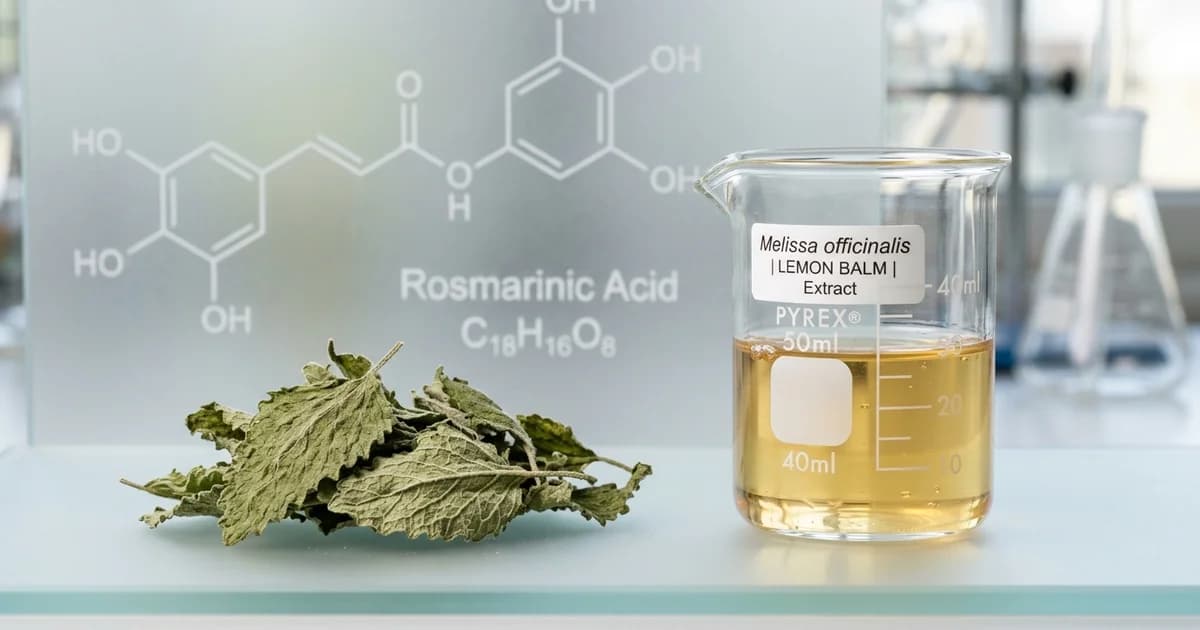
- Its main active compound, rosmarinic acid, appears to raise GABA, the brain's primary "slow down" signal.
- In human trials, a single dose produced a self-rated increase in calmness, with cognitive effects that depend heavily on the amount taken.
- Dose matters more than almost any other variable. Lower doses lean calm-and-alert; higher doses can blunt alertness.
- It pairs conceptually with L-theanine, the other classic "calm but sharp" compound.
What Is Lemon Balm (Melissa officinalis)?
Lemon balm is a perennial herb native to the Mediterranean and Western Asia, prized for centuries as a mild sedative and mood lifter. The Latin name Melissa comes from the Greek word for honey bee, since beekeepers planted it to keep hives calm and well-fed.
It belongs to the same botanical family as peppermint and spearmint, which explains the cooling, slightly minty edge under the lemon scent. The plant grows easily, sometimes too easily, in gardens across temperate climates.
Historically, herbalists used it for nervousness, indigestion, and poor sleep. In the 17th century the English writer Nicholas Culpeper claimed it could lift the spirits and sharpen thinking, which turns out to be a reasonable guess given what modern labs later found.
How Lemon Balm Works in the Brain
The most compelling explanation for lemon balm's calming reputation involves GABA, the main inhibitory neurotransmitter in your central nervous system. GABA is the brake pedal. When it rises, neural activity quiets, and you feel less wired.
Lemon balm appears to slow the breakdown of GABA. A lab study using a bioassay-guided approach found that lemon balm extract inhibits GABA transaminase, the enzyme that clears GABA away, and identified rosmarinic acid as a key active compound behind that effect. Block the enzyme that removes GABA, and more of it stays in circulation.
That is the rosmarinic acid GABA connection in plain terms. It is the same general target that many prescription anxiety medications aim at, though lemon balm's effect is far gentler and not a substitute for medical treatment.
There is a second, separate mechanism worth knowing. Some research suggests lemon balm interacts with the acetylcholine system, the network tied to memory and learning. Older work reported that the extract binds to nicotinic and muscarinic receptors and can inhibit acetylcholinesterase, the enzyme that breaks down acetylcholine. That gives a plausible biological route for the lemon balm cognition effects seen in some trials.
Lemon Balm for Anxiety and Stress
In controlled human trials, lemon balm has reduced the negative mood impact of stress while raising self-rated calmness. This is the most consistent finding across the literature.
In one well-known UK study, healthy volunteers took single doses of standardized extract, then ran a demanding 20-minute battery of cognitive stress tasks. The 600 mg dose blunted the negative mood normally triggered by the testing and increased self-rated calmness. Subjects felt steadier under pressure rather than sedated into uselessness.
Interest in lemon balm for anxiety has continued into recent research. A registered clinical trial listed on ClinicalTrials.gov is studying acute lemon balm supplementation for calmness and mood during cognitive demand in adults, which signals that researchers still see a real signal worth chasing.
A caveat keeps the picture honest. Some analyses note that very high amounts of rosmarinic acid have produced the opposite of calm in animal models, which is one more reason the dose conversation matters. More is not better here.
Lemon Balm Cognition: The Memory and Attention Data
Lemon balm's cognitive effects are real but dose-dependent, and they cut both ways. This is where popular summaries tend to oversell.
The clearest human data comes from acute dosing studies. In one trial, a 600 mg dose produced sustained improvement in accuracy of attention, a useful result for focus-related tasks. The same study found dose- and time-specific changes in memory measures, meaning the effect shifted depending on how much was taken and when it was measured.
The trade-off is the catch. In that work, the highest dose also reduced self-rated alertness at every time point. You can nudge attention accuracy up while feeling a touch more mellow, which is a fine trade for a tense afternoon and a poor one before a workout.
Lemon balm has also been examined in older adults with cognitive decline, with some trials reporting better outcomes on standard cognitive scales and reduced agitation over several months. That is a clinical population and a separate question from healthy daily use, so treat those findings as promising rather than settled.
Lemon Balm Dosage: What the Studies Used
Most human research used standardized extracts in the 300 to 600 mg range, taken as a single dose or split through the day. There is no single official dose, and form matters as much as the number.
Here is how the common formats compare.
| Form | Typical Amount Studied | Best For | Notes |
|---|---|---|---|
| Standardized extract (capsule) | 300–600 mg | Calm and attention | Standardized to rosmarinic acid for consistency |
| Dried leaf tea | 1.5–4.5 g steeped | Evening wind-down | Gentle, variable potency |
| Tincture | 2–4 mL | Quick calming use | Concentration varies by brand |
A few practical points on lemon balm dosage. Lower amounts tend to favor the calm-and-clear zone, while pushing the dose higher trades alertness for sedation. If you want focus, start low. If you want sleep support, an evening dose makes more sense.
Lemon balm is generally well tolerated, with mild drowsiness as the most common side effect. It can add to the effect of sedatives, so anyone on those medications, pregnant, or managing a thyroid condition should talk to a clinician first. None of this replaces medical advice.
Where Lemon Balm Fits Among Calming Compounds
Lemon balm sits in a small group of natural compounds known for taking the edge off without knocking you out. The most useful comparison is with L-theanine, the amino acid from green tea that pairs so well with caffeine.
| Compound | Primary Mechanism | Calm Without Sedation? | Best Known For |
|---|---|---|---|
| Lemon balm | Raises GABA via enzyme inhibition | Yes, at lower doses | Stress and mood under pressure |
| L-theanine | Boosts alpha brain waves, modulates glutamate | Yes | Smooth, alert calm; pairs with caffeine |
| Chamomile | Apigenin binds GABA receptors | More sedating | Sleep and evening relaxation |
| Ashwagandha | Lowers cortisol over time | Yes, but slow onset | Chronic stress, taken daily |
The pattern that connects lemon balm and L-theanine is the calm-but-sharp idea. Both can quiet the mental noise without dragging your alertness to the floor, which is exactly what you want during focused work. If that combination interests you, our breakdown of L-theanine and how it balances caffeine is worth a read.
Conclusion
Lemon balm earns its long reputation. The science points to a genuine calming herb that works mainly by supporting GABA through rosmarinic acid, with a secondary nudge to the memory-linked acetylcholine system.
The honest summary is that dose decides everything. At moderate amounts it can steady your mood under stress and sharpen attention accuracy, while higher amounts trade that alertness for sedation. Used with that nuance in mind, this garden herb is a quietly impressive tool for staying calm without checking out.
Frequently Asked Questions
Does lemon balm actually reduce anxiety?
In controlled studies, lemon balm reduced the negative mood normally triggered by stressful cognitive tasks and raised self-rated calmness, with a 600 mg dose showing the clearest effect. The leading explanation is that it supports GABA, the brain's calming neurotransmitter. It is a mild, supportive option and not a treatment for any diagnosed anxiety condition, so check with a clinician for clinical concerns.
What does lemon balm do for the brain?
Lemon balm appears to work on two systems. It slows the breakdown of GABA, which quiets overactive neural signaling, and it interacts with the acetylcholine system tied to memory and attention. Human trials have shown improved accuracy of attention at certain doses, though the cognitive effects vary with how much you take.
How much lemon balm should I take?
Most research used standardized extracts between 300 and 600 mg. Lower doses tend to favor calm-and-alert effects, while higher doses lean more sedating. Tea uses roughly 1.5 to 4.5 grams of dried leaf. Start low, see how you respond, and save larger evening doses for sleep support rather than daytime focus.
Is rosmarinic acid the active ingredient in lemon balm?
Rosmarinic acid is one of the most important active compounds. Lab work identified it as a key driver of lemon balm's ability to inhibit GABA transaminase, the enzyme that clears GABA away. Quality extracts are often standardized to rosmarinic acid so the dose stays consistent from batch to batch.
Can lemon balm help with focus?
It can, at the right dose. A single 600 mg dose produced sustained improvement in accuracy of attention in one trial, which is helpful for focus-heavy tasks. The same study found the highest dose reduced alertness, so the focus benefit is real but narrow. Lower, well-timed doses are the safer bet for daytime work.
Does lemon balm make you sleepy?
At higher doses, it can. Mild drowsiness is the most commonly reported side effect, and the data shows alertness drops as the dose climbs. That makes it a reasonable evening wind-down aid. For daytime use, keep the amount modest to stay in the calm-but-clear range.
Is lemon balm safe to take every day?
Lemon balm is generally well tolerated in studies. It can add to the effects of sedative medications and may not suit people who are pregnant or managing thyroid conditions, so those groups should consult a clinician. As with any supplement, daily use is best approached thoughtfully and is not a substitute for medical care.
The Calm-But-Sharp Idea, Without the Dose Guesswork
Lemon balm makes a clean point: the best calming compounds quiet your stress without dimming your focus. The catch with the herb itself is the dosing tightrope, where a little too much trades your alertness for sedation.
Roon is built around that same calm-but-sharp principle, using a compound with a wider margin. Each sublingual pouch pairs 60 mg of L-theanine with 80 mg of caffeine, plus 25 mg of methylliberine (Dynamine) and 5 mg of theacrine (TeaCrine), so the L-theanine smooths the caffeine into steady focus rather than jitters. It is designed to come on in 5 to 10 minutes and hold for 6 to 8 hours with no crash and no tolerance buildup.
To be clear, Roon is a focus tool, not a calming herb or a sleep aid, and it is not a replacement for managing stress at the source. If the calm-but-sharp idea behind lemon balm appeals to you, that is the exact feeling Roon is engineered to deliver during the hours you need to perform.
Written by Roon Team