L-Tryptophan: The Original Serotonin Precursor, and What the Human Evidence Actually Shows
Roon Team
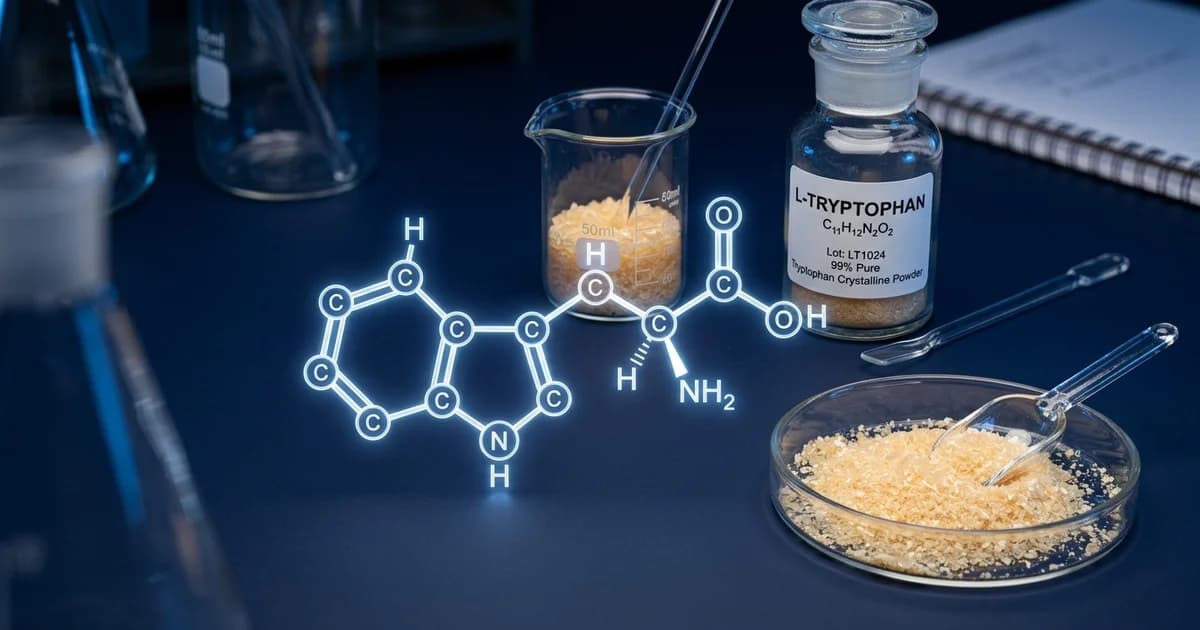
L-Tryptophan: The Original Serotonin Precursor, and What the Human Evidence Actually Shows
Your brain cannot make serotonin out of nothing. It needs a raw material, and that raw material is L-tryptophan, an essential amino acid you can only get from food. This is where most of the l-tryptophan benefits conversation starts and, unfortunately, where a lot of it stops being accurate.
Tryptophan has a real and well-documented job. It also has a reputation that runs well ahead of the human data. The gap between those two things is the entire point of this article.
So let's separate the biochemistry from the marketing, look at what controlled trials actually found, and figure out where a serotonin precursor fits, if it fits at all.
Key Takeaways
- Tryptophan is the sole precursor of serotonin, but only a tiny fraction of your dietary intake ever reaches the brain to make it.
- The strongest human evidence for tryptophan points toward sleep and mood support, not daytime focus or alertness.
- Acute tryptophan depletion studies show that lowering tryptophan does not reliably crash mood in healthy people who have never been depressed.
- In the l-tryptophan vs 5-htp debate, 5-HTP sits one chemical step closer to serotonin, while tryptophan acts more gradually.
- A 1989 contamination event tied to a single manufacturer is the reason tryptophan still carries a safety asterisk.
What L-Tryptophan Actually Does in the Body
L-tryptophan is one of the eight essential amino acids, meaning your body cannot synthesize it and must pull it from protein in your diet.
It is also the starting point for serotonin. As the sole precursor of serotonin, experimental research has shown that L-tryptophan's role in brain serotonin synthesis is an important factor involved in mood, behavior, and cognition.
Here is the part the supplement aisle tends to skip. Serotonin production is not the main thing your body does with tryptophan. After protein synthesis, the second most prevalent metabolic pathway of tryptophan is for the synthesis of kynurenine, which accounts for approximately 90% of tryptophan catabolism.
So when you eat tryptophan, most of it gets routed into protein-building and the kynurenine pathway. Serotonin synthesis is a side road, not the highway.
The Brain Barely Sees It
There is a second filter most people never hear about. The serotonin you imagine flooding your brain after a tryptophan-rich meal mostly is not in your brain at all.
According to the Proceedings of the Nutrition Society, only about 5% of endogenous serotonin is found in the brain; the remainder is in the gut (about 90%), principally released by enterochromaffin cells, and in peripheral tissue or in the blood, where it is taken up into blood platelets.
That same review confirms the core mechanism: serotonin synthesis rate depends on the availability of the precursor TRP. Availability is the operative word, and tryptophan availability to the brain is throttled at every step.
This is also why the Thanksgiving turkey story is mostly folklore. Tryptophan competes with other large amino acids for transport into the brain, and a protein-heavy meal floods the bloodstream with those competitors. The carbs and the food coma do more than the turkey.
Tryptophan and Serotonin: What the Mood Research Shows
The honest summary on tryptophan for mood is that the link is real but indirect, and weaker than the headlines suggest. Raising or lowering tryptophan changes serotonin synthesis. Whether that reliably changes how you feel is a separate question.
The cleanest way scientists test this is tryptophan depletion, a method where volunteers drink an amino acid mixture stripped of tryptophan, which sharply lowers it in the blood and brain. If the tryptophan serotonin mood theory were simple, depleting it should reliably make people feel worse.
It does not. In one controlled study, tryptophan depletion had no effect upon the mood state of healthy females on their first visit.
The researchers were direct about what that means. This supports the hypothesis that tryptophan depletion does not, in itself, cause negative mood. They added that it is now thought that any link between 5-HT and mood is likely to be indirect.
There is an important nuance. People with a personal or family history of depression often do respond to depletion, which is why this matters clinically. Tryptophan depletion did induce negative mood on the second visit of those who received both negative mood and ATD on their first visit, supporting the associative hypothesis of recurrence in depression.
The takeaway for a healthy person looking at a tryptophan tub on a shelf: topping up serotonin's raw material is not a reliable mood switch. The clinical signal lives in vulnerable populations, and that is a medical conversation, not a supplement one.
L-Tryptophan vs 5-HTP: Which Serotonin Precursor Wins?
The short answer on l-tryptophan vs 5-htp: they take different routes to the same destination, and neither is clearly superior for everyone. 5-HTP sits one chemical step closer to serotonin, which can make its effects feel more direct.
Your body converts tryptophan into 5-HTP, then 5-HTP into serotonin, then serotonin into melatonin. As Performance Lab puts it, L-tryptophan converts to 5-HTP, then serotonin, then melatonin; it's gradual and often gentler for sleep support.
5-HTP skips the first step. 5-HTP sits one step closer to serotonin, so effects can feel more direct; some people report more GI sensitivity.
| Feature | L-Tryptophan | 5-HTP |
|---|---|---|
| Position in pathway | Furthest from serotonin | One step closer |
| Onset feel | Gradual, gentler | More direct |
| Common use | Sleep and mood support | Targeted serotonin support |
| Competes for brain transport | Yes, with other amino acids | Less so |
| GI sensitivity reports | Lower | Higher in some users |
| Best paired with | Carbs, good sleep habits | Caution with serotonergic drugs |
Both carry the same hard rule. Neither should be combined with SSRIs, SNRIs, MAO inhibitors, or other serotonin-active medications without a doctor, because stacking serotonergic agents is how you risk serotonin syndrome.
Tryptophan Dosage: What the Sleep Data Says
For sleep, dose appears to matter, and small doses underperform. A systematic review of tryptophan dosage for sleep found that lower amounts did little.
According to BRC Recovery's summary of the research, a systematic review and meta-analysis found that doses under 1 gram had little effect, while doses of 1 gram or more showed more promise. The same source notes the typical dosage for sleep benefits ranges from 1-5 grams taken before bedtime.
Two things follow from that. First, the effective window is large and slow, which is consistent with everything we know about how little tryptophan reaches the brain. Second, this is a nighttime tool. As a precursor to serotonin, it plays a key role in regulating emotions, and serotonin's downstream product, melatonin, is a sleep signal.
Nobody takes a gram of tryptophan before a deadline to get sharper. That is not what the molecule does.
The Safety Asterisk Nobody Mentions
Tryptophan carries a real piece of history. L-tryptophan has been linked to a dangerous, even deadly condition called eosinophilia-myalgia syndrome (EMS), and the FDA recalled tryptophan supplements in 1989 after up to ten thousand people who took them became sick.
The cause appears to have been manufacturing, not the molecule. Per WebMD, some research suggests the sickness was due to contaminants that got into the supplements during manufacturing in a factory in Japan. The product later returned to the market.
Still, the episode is a useful reminder that supplement purity is not guaranteed and the category is lightly regulated. If you use tryptophan, source matters.
The Bigger Picture: Mood Lever, Not Focus Tool
Strip away the hype and tryptophan's role is consistent. It is a slow, food-dependent, supply-side input to a serotonin system whose effects on feeling are real but indirect.
Its best-supported uses point at night and at mood, not at the middle of a working afternoon. The pathway is gradual by design, most of what you take never reaches the brain, and the mood response in healthy people is muted.
That is not a knock on the molecule. It is a clarification of its job. If your goal is calm, alert daytime focus, a serotonin precursor is the wrong axis to pull on.
Frequently Asked Questions
Does L-tryptophan actually boost serotonin in the brain?
It can raise the supply of serotonin's building block, but the brain only ever uses a small slice of it. Most tryptophan goes to protein synthesis and the kynurenine pathway, and only about 5% of the body's serotonin sits in the brain at all. So tryptophan nudges the system rather than flooding it, which is why effects on mood are gradual and inconsistent in healthy people.
Is L-tryptophan or 5-HTP better?
It depends on your goal. 5-HTP is one chemical step closer to serotonin, so its effects can feel more direct, though some users report more stomach sensitivity. Tryptophan acts more gradually and is often used for gentle sleep support. Neither is universally better, and both should be kept away from serotonergic medications without medical supervision.
What is the right tryptophan dosage for sleep?
Research suggests doses under 1 gram do little, while 1 gram or more shows more promise, with a typical range of 1 to 5 grams before bed. Start low and increase slowly. Because tryptophan works gradually, take it well before bedtime rather than expecting an immediate effect.
Can tryptophan help with daytime focus?
No. Tryptophan is a serotonin precursor aimed at mood and sleep, and serotonin's downstream product is the sleep signal melatonin. Nothing about its mechanism supports sharper daytime alertness. If you want clean focus during the day, you are looking at a different category of ingredients entirely.
Why does tryptophan depletion not always lower mood?
Because the link between serotonin and mood is indirect. Controlled depletion studies found no mood drop in healthy people who had never been depressed. The clearer responses show up in people with a personal or family history of depression, which makes depletion a research and clinical tool rather than evidence that everyone's mood hinges on tryptophan.
Is L-tryptophan safe to take?
For most healthy adults it is generally considered safe at common doses, but the 1989 EMS outbreak, linked to a contaminated manufacturing batch, is a reminder that purity is not guaranteed. Avoid it entirely if you take SSRIs, SNRIs, MAO inhibitors, or other serotonin-active drugs, and talk to a doctor if you are pregnant or have liver concerns.
Does turkey make you sleepy because of tryptophan?
Mostly no. Turkey is not unusually high in tryptophan, and the protein in a big meal floods your blood with amino acids that compete with tryptophan for entry into the brain. The post-meal drowsiness owes more to the carbohydrates, portion size, and the overall meal than to the turkey itself.
Serotonin Precursors Are for Mood. Focus Is a Different Axis.
Everything above lands on one line: tryptophan is a slow, food-dependent lever for serotonin, pointed at sleep and mood, not at daytime sharpness. That is a useful tool for the right job. It is the wrong tool if what you need is to lock in for the next six hours.
Roon is built for that second problem. Instead of nudging the serotonin pathway, it targets calm, alert focus directly, pairing 80 mg caffeine with 60 mg L-theanine in a roughly 4:3 ratio, plus 25 mg methylliberine (Dynamine) and 5 mg theacrine (TeaCrine), in a sublingual pouch that kicks in within 5 to 10 minutes and holds for 6 to 8 hours with no jitters and no crash.
To be clear about what it is not: Roon is not a serotonin precursor, a sleep aid, or a substitute for the deeper, slower work tryptophan does on mood. Those are different goals on different timelines. If your aim is steady daytime focus rather than nighttime calm, try Roon for the axis it was actually designed to support.
Written by Roon Team