L-Theanine Supplements for Anxiety: What Actually Works
Roon Team
L-Theanine Supplements for Anxiety: What Actually Works
You're staring at a shelf (or a screen) full of l theanine supplements for anxiety, and every single one promises calm focus and stress relief. The labels blur together. Some say 100mg. Others say 400mg. Capsules, gummies, powders, pouches. The real question isn't whether l theanine supplements for anxiety work. There's solid clinical evidence that they do. The question is how L-theanine works, at what dose, and which delivery method actually gets the compound where it needs to go.
This is the guide that sorts the science from the marketing copy.
Key Takeaways
- L-theanine promotes relaxation without sedation by increasing alpha brain wave activity and modulating key neurotransmitters like GABA, dopamine, and serotonin.
- Clinical doses range from 200mg to 400mg per day, with most anxiety-related benefits observed at 200mg for acute stress and 400mg for longer-term use.
- Delivery method matters. Sublingual absorption bypasses the digestive system, getting active compounds into your bloodstream faster than capsules or tablets.
- L-theanine pairs exceptionally well with caffeine, smoothing out the jitters while preserving alertness and focus, which is why the best l theanine supplements for anxiety often include caffeine in their formulas.
What L-Theanine Actually Does in Your Brain
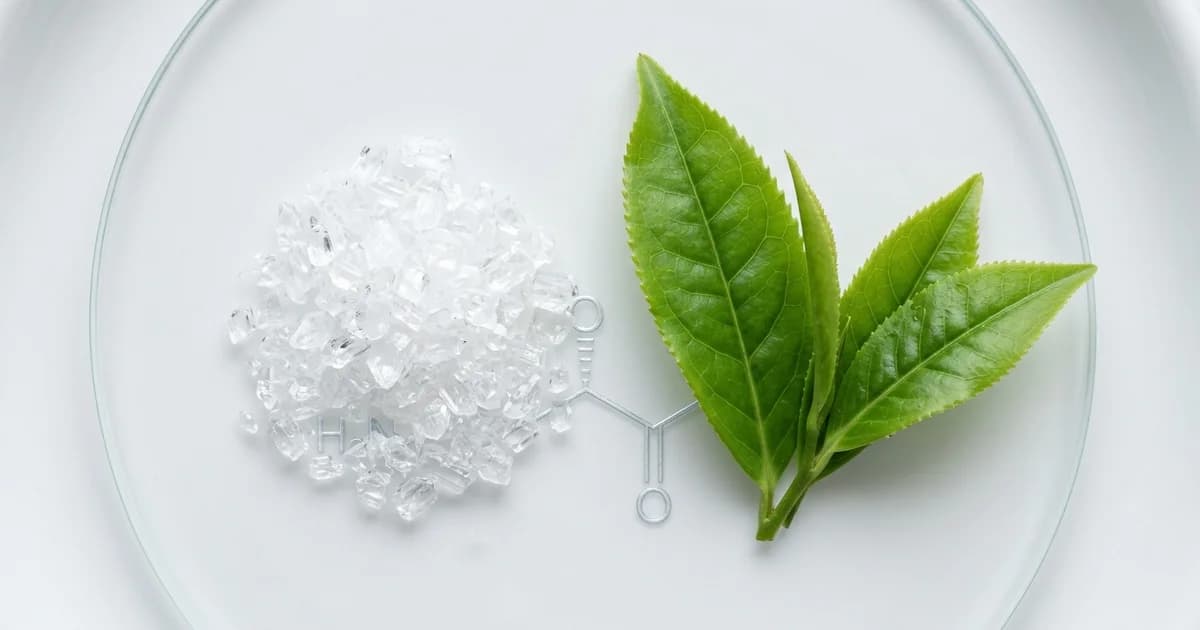
L-theanine is an amino acid found almost exclusively in tea leaves (Camellia sinensis). It's the reason a cup of green tea feels different from a shot of espresso, even when the caffeine content is similar. The calm alertness tea drinkers describe isn't placebo. It's pharmacology, and it's the foundation of why l theanine supplements for anxiety have gained so much attention.
Here's the mechanism. L-theanine crosses the blood-brain barrier within about 30 minutes of ingestion. Once there, it influences several neurotransmitter systems simultaneously.
First, it increases alpha brain wave activity. Alpha waves are the electrical signature of a relaxed but alert mind, the same pattern seen during meditation. A randomized, triple-blind, placebo-controlled study published on PubMed found that a single 200mg dose of L-theanine increased frontal alpha power compared to placebo during an acute stress challenge. The researchers described these changes as "indicative of relaxation in the brain."
Second, L-theanine modulates GABA, dopamine, and serotonin levels. According to WebMD's ingredient overview, theanine sometimes acts like glutamate in the body, but other times blocks glutamate's effects, while also affecting GABA, dopamine, and serotonin. This dual action is part of what makes l theanine supplements for anxiety useful without the sedation you'd get from a pure GABA-targeting compound like a benzodiazepine.
Third, and this is where it gets interesting for anyone who drinks coffee, L-theanine appears to counteract the negative side effects of caffeine while preserving its cognitive benefits.
The Clinical Evidence: Doses That Actually Move the Needle for L Theanine Supplements for Anxiety
Not all L-theanine studies are created equal. Some use tiny doses. Some have sample sizes that wouldn't fill a conference room. Here's what the well-designed trials actually found.
200mg: The Acute Stress Dose
A randomized, placebo-controlled, crossover trial published in Nutrients gave healthy adults 200mg of L-theanine daily for four weeks. The results were clear: State-Trait Anxiety Inventory scores dropped (p = 0.006), depression scale scores improved (p = 0.019), and sleep quality scores on the Pittsburgh Sleep Quality Index got better (p = 0.013). No significant side effects were reported.
The same study found improvements in verbal fluency and executive function, which suggests l theanine supplements for anxiety aren't just calming you down. They're helping your prefrontal cortex do its job.
400mg: The Sustained Protocol
A 2024 randomized, double-blind, placebo-controlled trial published in Neurology and Therapy tested 400mg of L-theanine daily for 28 days in adults with moderate stress. The participants showed reductions in perceived stress, improvements in sleep quality, and enhanced cognitive attention compared to placebo.
This aligns with what Drugs.com's clinical summary reports: L-theanine has been granted FDA GRAS (Generally Recognized As Safe) status at doses up to 250mg per serving, and clinical trials have not reported significant adverse effects at doses up to 400mg per day. For anyone evaluating l theanine supplements for anxiety, this dose range represents the upper end of what's been studied safely.
The Caffeine Combo: Where Things Get Powerful
If you're using l theanine supplements for anxiety only for their calming properties, you're leaving performance on the table.
A study indexed on PubMed tested the combination of 97mg L-theanine and 40mg caffeine against placebo. The combination improved accuracy during task switching and increased subjective alertness (both p < 0.01) while reducing self-reported tiredness (p < 0.05). Neither compound alone produced the same effect.
This is the finding that changed how serious formulators think about cognitive performance stacks. L-theanine doesn't just reduce anxiety. Paired with caffeine, it creates a state of focused calm that's qualitatively different from either compound in isolation.
How to Evaluate L Theanine Supplements for Anxiety
The supplement market is flooded with L-theanine products. Here's what separates the useful ones from the shelf-fillers.
Dose Per Serving
Any product offering less than 100mg per serving is underdosed for anxiety-related benefits. The clinical literature consistently uses 200mg as the minimum effective dose. If a product hides behind a "proprietary blend" without disclosing the exact L-theanine content, skip it.
Form: L-Theanine vs. D-Theanine
This matters more than most brands acknowledge. According to Innerbody's supplement analysis, L-theanine is much more bioavailable than D-theanine, and D-theanine degrades in plasma more quickly. Make sure the label specifies L-theanine, not just "theanine." This distinction is especially important when shopping for l theanine supplements for anxiety, since bioavailability directly affects how well the compound works.
Delivery Method
Here's where the real differences among l theanine supplements for anxiety emerge.
| Delivery Method | Onset Time | First-Pass Metabolism | Convenience |
|---|---|---|---|
| Capsules/Tablets | 30-60 min | Yes (liver processing) | High |
| Powder (mixed in liquid) | 20-45 min | Yes | Moderate |
| Sublingual (under tongue) | 10-20 min | Bypassed | High |
Sublingual delivery has a distinct pharmacokinetic advantage. According to research reviewed in the Asian Journal of Pharmaceutical Research, sublingual tablets achieve better bioavailability and rapid onset of action compared to conventional dosage forms because the active compound enters the bloodstream directly through the mucous membranes, bypassing first-pass metabolism in the liver.
For an amino acid like L-theanine, this means you feel the effect faster and potentially get more of the active compound into circulation.
What Else Is in the Formula
L-theanine alone is good. L-theanine combined with the right compounds is better. The clinical data on the caffeine-theanine pairing is strong, but newer research points to an even more complete picture when you add structurally related compounds.
Theacrine, a purine alkaloid found in kucha tea, has been studied for its ability to increase energy and focus without the jitteriness or tolerance buildup that caffeine causes over time. A study on PubMed found that a combination of caffeine, theacrine, and methylliberine improved cognitive performance and reaction time in adult participants without increasing self-reported anxiety or headaches.
Methylliberine works through similar pathways but with a faster onset, making it a useful complement to theacrine's longer duration. Together with caffeine and L-theanine, these four compounds cover different time windows and receptor targets, producing sustained focus without the crash. This multi-compound approach represents the next generation of l theanine supplements for anxiety and cognitive performance.
Safety and Side Effects: What the Data Says
L-theanine has one of the cleanest safety profiles in the supplement world. The Cleveland Clinic notes that L-theanine is generally considered safe for most people and that the FDA has classified it as generally safe. ScienceInsights reports that clinical trials have not reported significant adverse effects at doses up to 400mg per day, and that L-theanine does not cause drowsiness at typical doses.
That last point is worth emphasizing. Most compounds that reduce anxiety also make you sleepy. L theanine supplements for anxiety don't. They promote relaxation without sedation, which is why they're useful during working hours, not just before bed.
A few caveats. If you're pregnant or breastfeeding, the research is limited, so talk to your doctor. If you're on blood pressure medication, L-theanine may have additive effects. And as with any supplement, quality control matters. Look for third-party testing and transparent labeling.
Why Most People Get Their L Theanine Supplements for Anxiety Wrong
The typical approach to L-theanine supplementation goes like this: buy a bottle of 200mg capsules, take one in the morning, hope for the best. It works, sort of. But it's like buying a high-end speaker and playing music through your phone's built-in DAC. Technically functional. Missing the point.
The research consistently shows that L-theanine performs best as part of a multi-compound stack, particularly when paired with caffeine at a ratio that balances alertness with calm. The addition of theacrine and methylliberine extends the duration of effect and reduces the tolerance problem that plagues caffeine-only products.
The delivery method matters too. Swallowing a capsule and waiting 45 minutes for it to clear your stomach, survive your liver, and finally reach your brain is the slowest possible route. Sublingual delivery cuts that timeline and improves the amount of active compound that actually reaches your bloodstream. If you're serious about getting the most from l theanine supplements for anxiety, both the stack and the delivery format deserve your attention.
The Formula That Puts L Theanine Supplements for Anxiety All Together
This is exactly the thinking behind Roon. It's a zero-nicotine sublingual pouch built on the four compounds the research keeps pointing to: 80mg caffeine, L-theanine, theacrine, and methylliberine. The sublingual format means faster absorption. The stack means 6-8 hours of sustained focus without jitters, without a crash, and without the tolerance buildup that makes caffeine-only products less effective over time.
If you've been taking l theanine supplements for anxiety and wondering why the effect feels underwhelming, the answer probably isn't the ingredient. It's everything around it: the dose, the delivery, and the compounds it's paired with.