L-Theanine and Caffeine ADHD: The Science Behind the Stack
Roon Team
L-Theanine and Caffeine ADHD: The Science Behind the Stack
About 15.5 million American adults currently have an ADHD diagnosis, according to CHADD. Many of them are looking beyond prescriptions for ways to sharpen focus. The combination of l theanine and caffeine ADHD researchers keep studying shows up in clinical conversations for good reason: there's real data behind it. Not a replacement for medical treatment, but a pair of compounds that, together, do something neither can do alone.
Here's what the research actually says about l-theanine and caffeine for ADHD, what the limits are, and why the ratio between these two ingredients matters more than most people think.
Key Takeaways
- L theanine and caffeine ADHD research shows the combination improved sustained attention and total cognition scores in a randomized controlled trial involving children with ADHD.
- L-theanine promotes alpha brain wave activity and raises GABA, serotonin, and dopamine levels, creating calm focus instead of wired energy.
- The 2:1 ratio of L-theanine to caffeine is the most studied and consistently effective dose for cognitive performance.
- Adding compounds like theacrine and methylliberine to the l theanine and caffeine ADHD stack may extend the duration of focus and reduce caffeine's tolerance problem.
What L-Theanine Does to Your Brain
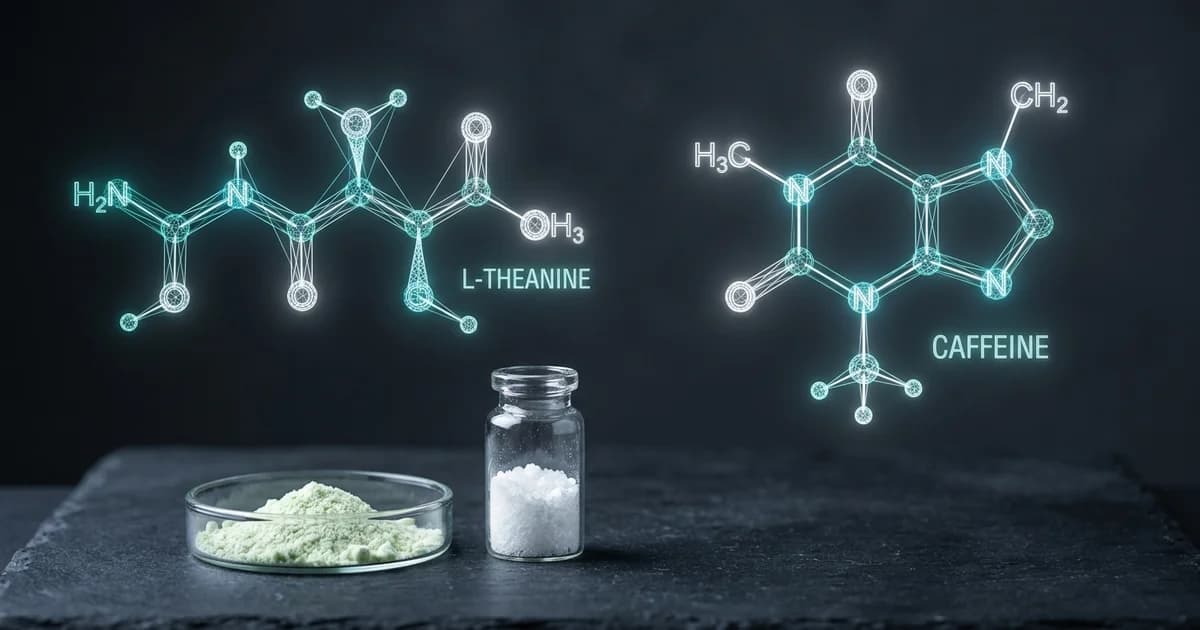
L-theanine is an amino acid found primarily in tea leaves. It crosses the blood-brain barrier and gets to work fast.
Its primary mechanism involves influencing brain chemicals like GABA, dopamine, and serotonin, the neurotransmitters responsible for mood regulation, focus, and stress response. Psychology Today reports that L-theanine elevates all three.
Then there's the effect on brain waves. Research published in Nutrition Reviews found that L-theanine at standard supplement dosages (50–250 mg) increased alpha waves in healthy people and promoted psychophysical relaxation. Alpha waves are the electrical signature of relaxed alertness, the state where you're focused but not tense. According to research compiled by the Alzheimer's Drug Discovery Foundation, L-theanine increases attention-related anticipatory alpha activity while decreasing background alpha activity, which may improve focus.
This is why L-theanine doesn't make you drowsy. It calms without sedating. That distinction matters enormously for anyone dealing with attention challenges, because the last thing you need when you're struggling to focus is a supplement that puts you to sleep. Understanding this calming mechanism is essential to understanding why l theanine and caffeine ADHD protocols work so well together.
What Caffeine Does (and Doesn't Do) for Attention
Caffeine is the world's most popular psychoactive substance. You already know it wakes you up. But its relationship with attention is more complicated than "drink coffee, focus better."
Caffeine blocks adenosine receptors, which reduces feelings of fatigue and increases dopamine signaling. That's the alertness boost. The problem is the side effects: jitteriness, anxiety, elevated heart rate, and the inevitable crash. For someone whose brain already struggles with impulse control and emotional regulation, those side effects can make things worse, not better.
There's also the tolerance issue. Your brain adapts to caffeine within days. The dose that gave you laser focus on Monday barely registers by Friday. You drink more. The side effects grow. The benefits shrink.
Caffeine alone is a blunt instrument. Useful, but imprecise. And for someone already managing attention difficulties, adding anxiety and a 2 PM crash to the mix is the opposite of helpful.
This is where the l theanine and caffeine ADHD pairing starts to make sense.
L Theanine and Caffeine ADHD Research: What the Studies Found
The most direct evidence for l-theanine and caffeine for ADHD comes from a 2020 proof-of-concept neuroimaging RCT published in Scientific Reports led by Chanaka Kahathuduwa at Texas Tech. The study administered L-theanine (2.5 mg/kg), caffeine (2.0 mg/kg), their combination, and a placebo to boys aged 8 to 15 with ADHD in a randomized four-way crossover design.
The results were specific:
- L-theanine alone improved total cognition composite scores on the NIH Cognition Toolbox (p = 0.040) versus placebo.
- The l theanine and caffeine ADHD combination improved hit rate on a continuous performance test (p < 0.001) and total cognition composite scores.
- Caffeine alone worsened inhibitory control, as measured by longer reaction times on a stop-signal task.
That last point is worth pausing on. Caffeine by itself actually made impulse control worse in these kids. L-theanine offset that effect. The l theanine and caffeine ADHD combination worked where neither ingredient worked alone.
Why the Combination Outperforms Either Ingredient Alone
The mechanism behind l theanine and caffeine ADHD benefits is straightforward. Caffeine provides the arousal and dopamine boost. L-theanine smooths the rough edges by promoting GABA activity and alpha wave production. You get alertness without the anxiety. Focus without the fidgeting.
A 2008 study published in Nutritional Neuroscience found that the L-theanine and caffeine combination improved both speed and accuracy on an attention-switching task at 60 minutes, and reduced susceptibility to distracting information in a memory task at both 60 and 90 minutes.
This isn't a vague "feel more focused" claim. These are measurable improvements in the exact cognitive functions that ADHD disrupts: sustained attention, task switching, and resistance to distraction. That's why l theanine and caffeine ADHD research continues to attract clinical interest.
The Ratio That Matters: Why L Theanine and Caffeine ADHD Dosing Isn't Random
Not all l theanine and caffeine ADHD products are created equal. The ratio between the two compounds changes the outcome.
Research reviewed by multiple sources confirms that the bodies of research finding beneficial properties generally incorporate a 2:1 ratio of L-theanine to caffeine. That means if you're taking 100 mg of caffeine, you pair it with 100 to 200 mg of L-theanine.
Too much caffeine relative to L-theanine, and you lose the calming effect. Too little caffeine, and you don't get enough arousal to move the needle on attention. The ratio is the formula, and it's what separates effective l-theanine and caffeine for ADHD support from random supplementation.
| Component | Role | Optimal Range |
|---|---|---|
| L-Theanine | Calms, promotes alpha waves, raises GABA | 100–200 mg |
| Caffeine | Blocks adenosine, increases dopamine and alertness | 40–100 mg |
| Ideal Ratio | L-Theanine to Caffeine | 2:1 |
Beyond the Basics: What Theacrine and Methylliberine Add
The l theanine and caffeine ADHD pairing is well-studied. But it has a ceiling. Caffeine's effects wear off in 3 to 5 hours, and tolerance builds rapidly. Two compounds from the same purine alkaloid family offer a solution.
Theacrine
Theacrine is structurally similar to caffeine but behaves differently in one critical way: it doesn't appear to cause tolerance. A study on tactical personnel published in PMC described theacrine as having "a longer half-life, less habituation, and fewer side effects" than caffeine. Early research noted by Journal of the International Society of Sports Nutrition found non-habituating effects, including increases in energy and focus.
That means the dose that works on day one still works on day thirty. For anyone who has watched their morning coffee slowly lose its effect, that's a meaningful difference, and it's why theacrine pairs so well with l theanine and caffeine ADHD stacks.
Methylliberine
Methylliberine (sold commercially as Dynamine) acts faster than theacrine and complements caffeine's onset. A study on male esports players found that a combination of caffeine, theacrine, and methylliberine improved cognitive performance and reaction time without increasing self-reported anxiety or headaches.
Another study on recreational gamers concluded that adding theacrine and methylliberine to caffeine may lessen some undesirable effects of isolated caffeine ingestion on cognitive control and jitters.
The Four-Compound Stack
When you combine all four, caffeine, L-theanine, theacrine, and methylliberine, each ingredient covers a different weakness:
| Ingredient | Primary Function | Addresses |
|---|---|---|
| Caffeine | Rapid alertness, dopamine boost | Low energy, slow processing |
| L-Theanine | Alpha waves, GABA elevation, calm focus | Jitters, anxiety, overstimulation |
| Theacrine | Sustained energy without tolerance | Caffeine habituation, afternoon fade |
| Methylliberine | Fast onset, mood and motivation | Slow ramp-up, mental fatigue |
This is the difference between a single-ingredient approach and stacking nootropic amino acids in a designed system. Each compound fills a gap left by the others. You're not just stacking stimulants. You're building a system where the calming agent, the activating agents, and the sustaining agents work in sequence.
A Note on What L Theanine and Caffeine ADHD Support Is (and Isn't)
L-theanine and caffeine are not ADHD medications. They don't replace stimulant prescriptions, behavioral therapy, or a diagnosis from a qualified professional. The research on l-theanine and caffeine for ADHD, while promising, involves small sample sizes. The Kahathuduwa study included five participants. More large-scale trials are needed.
What the data does support: l theanine and caffeine ADHD protocols can promote sustained attention, reduce mind wandering, and support cognitive performance in ways that align with the specific deficits seen in ADHD. For people who want to support their focus through the day, whether they have a formal diagnosis or just struggle to stay locked in during a long afternoon, the science points in a clear direction.
If you're considering any supplement for attention support, talk to your doctor first. That's not a disclaimer. It's practical advice. Supplements interact with medications, and dosing matters.