L-Theanine Benefits for ADHD: What Science Actually Shows
Roon Team
L-Theanine Benefits for ADHD: What Science Actually Shows
About 6% of American adults, roughly 15.5 million people, currently carry an ADHD diagnosis. That number keeps climbing. And so does the search for options beyond traditional stimulant medication. L theanine benefits ADHD research has become one of the most searched topics in cognitive health, with good reason: there's actual clinical data behind the interest, not just Reddit anecdotes.
But the research on l theanine benefits ADHD is more nuanced than most supplement blogs will tell you. Here's what the science actually says, where it falls short, and what the combination of caffeine and l theanine for ADHD looks like in controlled settings.
Key Takeaways
- L-theanine promotes alpha brain wave activity, which is linked to calm, focused attention, the exact mental state people with ADHD struggle to maintain.
- A 2020 randomized controlled trial found the caffeine and l theanine for ADHD combination improved cognition scores and reduced mind wandering in boys with ADHD.
- A separate RCT showed 400mg daily of L-theanine improved sleep quality in boys with ADHD, addressing one of the most common co-occurring problems.
- L-theanine is not a replacement for prescribed ADHD medication. The evidence supporting l theanine benefits ADHD is promising but still early-stage.
What L-Theanine Actually Does in Your Brain
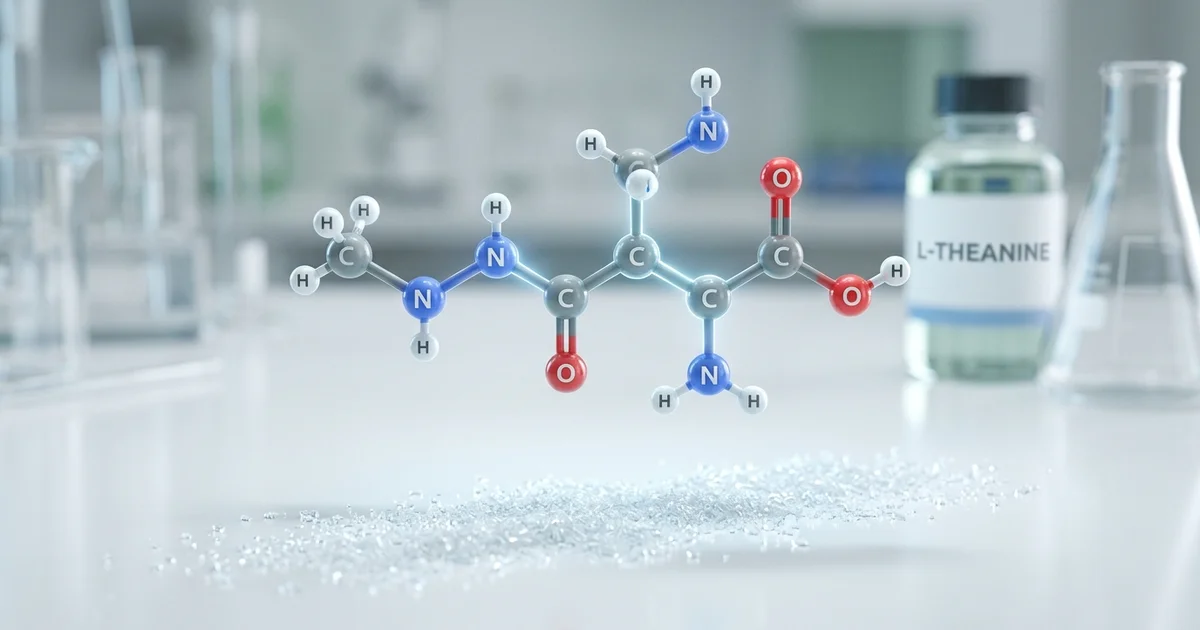
L-theanine is an amino acid found primarily in tea leaves. It crosses the blood-brain barrier within about 30 minutes of ingestion. Once there, it does a few things that matter for attention and focus, and that help explain l theanine benefits ADHD researchers have observed.
First, it modulates levels of GABA, serotonin, and dopamine. These are the same neurotransmitter systems that ADHD medications target, though L-theanine works through a much gentler mechanism. It doesn't flood your synapses with dopamine the way amphetamines do. It nudges.
Second, L-theanine increases the production of alpha brain waves, the electrical pattern your brain generates during states of relaxed alertness. Think of alpha waves as the neurological signature of being focused without being stressed. According to research reviewed on ScienceDirect, L-theanine's ability to boost alpha wave generation mirrors the effect of GABA administration itself.
This matters for understanding l theanine benefits ADHD because the condition is associated with dysregulated brain wave patterns. People with ADHD tend to have excess theta wave activity (associated with daydreaming) and reduced alpha and beta activity (associated with focus). L-theanine pushes the ratio in the right direction.
The ADHD-Specific Clinical Evidence
Let's look at the actual trials. There aren't dozens of them. But the ones that exist are well-designed and directly test l theanine benefits ADHD populations.
The Kahathuduwa 2020 RCT
The most relevant study is a 2020 proof-of-concept neuroimaging RCT published in Scientific Reports. Researchers at Texas Tech University gave boys diagnosed with ADHD either L-theanine alone, caffeine alone, a combination of both, or a placebo. The doses were weight-based: 2.5mg/kg of each compound.
The results were specific and measurable:
- L-theanine alone improved total cognition composite scores on the NIH Cognition Toolbox (p = 0.040 vs. placebo).
- The L-theanine and caffeine combination also improved cognition composite scores (p = 0.041) and improved d-prime scores on a Go/NoGo task (p = 0.033), a standard measure of sustained attention.
- The combination also decreased activity in the default mode network, the brain region responsible for mind wandering. Less default mode network reactivity during tasks means fewer moments of zoning out.
One critical finding that shapes our understanding of l theanine benefits ADHD: while L-theanine alone and caffeine alone both seemed to increase impulsivity, the combination actually decreased it. The two compounds together produced a different effect than either one in isolation.
The Lyon 2011 Sleep Trial
A randomized, double-blind, placebo-controlled trial published in Alternative Medicine Review studied 98 boys aged 8 to 12, all previously diagnosed with ADHD. They received 400mg of L-theanine daily (200mg twice daily) for six weeks.
The outcome: L-theanine improved sleep efficiency compared to placebo. This matters because sleep disruption is one of the most common co-occurring problems in ADHD, affecting up to 70% of children with the diagnosis. Poor sleep worsens every ADHD symptom: inattention, impulsivity, emotional regulation. Among l theanine benefits ADHD patients experience, better sleep may have the broadest downstream effects on daytime function.
The study did not measure core ADHD symptoms like inattention directly. But the connection between sleep quality and attention is well established enough that this counts as relevant evidence.
The Systematic Review Perspective
A 2022 systematic review published in Cureus pulled together the existing evidence on caffeine and l theanine for ADHD and cognitive performance more broadly. The review noted that improvements from the L-theanine-caffeine combination were shown on impairments related to ADHD, suggesting it "may be a potential therapeutic consideration."
That phrasing is deliberately cautious. And it should be.
L Theanine Benefits ADHD: What the Science Supports (and What It Doesn't)
Here's an honest breakdown:
| Claim | Evidence Level | Notes |
|---|---|---|
| L-theanine improves sustained attention in ADHD | Moderate | Shown in one RCT with small sample |
| Caffeine + L-theanine reduces mind wandering in ADHD | Moderate | Neuroimaging data supports this |
| L-theanine improves sleep in ADHD | Strong | Larger RCT (n=98), 6-week duration |
| L-theanine reduces hyperactivity | Weak | Not directly studied |
| L-theanine replaces ADHD medication | None | No evidence supports this claim |
The honest assessment: l theanine benefits ADHD research has documented include real promise for supporting attention and sleep quality. The combination with caffeine appears to work better than either compound alone, particularly for impulsivity and mind wandering. But the sample sizes are small, the studies are mostly in children, and no one has run a large-scale, long-duration trial in adults with ADHD.
This is early-stage clinical evidence. Promising, yes. Definitive, no.
Why Caffeine and L Theanine for ADHD Works Differently Than Either Alone
The Kahathuduwa study revealed something that most articles on this topic miss entirely. Caffeine alone made impulsivity worse. L-theanine alone made impulsivity worse. But together, they improved it.
This isn't random. Caffeine blocks adenosine receptors, which increases alertness and dopamine signaling. But it also increases arousal in a way that can tip into restlessness and impulsive behavior, especially in someone whose impulse control is already compromised.
L-theanine counteracts the jittery, anxiogenic side of caffeine by promoting alpha wave activity and modulating inhibitory neurotransmission through GABA. The net effect is alert focus without the overstimulation. You get the attentional benefits of caffeine without the cost. This is why caffeine and l theanine for ADHD performs better as a pair than as individual compounds.
For someone with ADHD, that balance between activation and calm is exactly the problem. Too much activation without enough inhibitory control is, in a simplified sense, the core neurological challenge. The l theanine benefits ADHD sufferers gain from this pairing come from addressing both sides of that equation simultaneously.
Dosing: What the Research Used
The clinical trials studying l theanine benefits ADHD used specific doses worth noting:
- Lyon 2011 sleep study: 400mg L-theanine daily (split into two 200mg doses)
- Kahathuduwa 2020 cognition study: 2.5mg/kg body weight of L-theanine combined with 2.5mg/kg caffeine
For an adult weighing 70kg (about 154 lbs), that weight-based dose translates to roughly 175mg of L-theanine and 175mg of caffeine. Most commercial supplements and performance products use L-theanine in the 100 to 200mg range, which falls within the studied window.
The caffeine and L-theanine ratio also matters, and most research on caffeine and l theanine for ADHD uses a roughly 1:1 or 1:2 caffeine-to-L-theanine ratio. Higher L-theanine relative to caffeine tends to produce more calm focus; more caffeine relative to L-theanine shifts the effect toward pure stimulation.
What the L Theanine Benefits ADHD Research Adds Up To
L-theanine isn't going to replace Adderall. No amino acid will. What the clinical literature actually contains is a small set of short trials, run mostly in boys, reporting effects on cognition composite scores, default mode network activity, and sleep efficiency.
Within that literature, the caffeine and l theanine for ADHD combination produced the more interesting results, and the single most useful finding is the one about direction: each compound alone worsened impulsivity, and only the pair improved it. That is a reason to be careful about reading results for one ingredient across to another.
The honest summary is the one the Cureus reviewers gave. This is a potential consideration under study, on small samples over short windows, with the large adult trial still unwritten. Anyone weighing it against a prescribed treatment is comparing a research question to a settled one.