How Long Does It Take a Caffeine Pouch to Kick In? (And How Long It Lasts)
Roon Team
How Long Does It Take a Caffeine Pouch to Kick In? (And How Long It Lasts)
You popped a pouch in, tucked it under your lip, and now you're watching the clock. So how long does caffeine take to kick in, and when does the lift actually arrive from a pouch versus a cup of coffee?
Short answer: a caffeine pouch usually starts working faster than coffee because some of the caffeine slips straight into your bloodstream through the tissue in your mouth. You'll often feel something in 10 to 20 minutes, with the full effect building over the next half hour. The duration is a different question, and it's where most products quietly fall short.
This guide breaks down the real timing, what the science says, how the popular pouches compare, and the gap almost none of them fill.
Key Takeaways
- Onset: Pouches can start working in 10 to 20 minutes via the mouth's tissue, faster than the 30 to 60 minutes coffee typically needs.
- Duration: Caffeine has a half-life of about 5 hours, so the felt effect from a single dose usually fades after 3 to 5 hours.
- The trade-off: Most caffeine pouches give you a fast hit but no ingredients to smooth the comedown, so you get jitters going up and a slump coming down.
- Do caffeine pouches work? Yes, for speed. The better question is what else is in the pouch.
How Long Does Caffeine Take to Kick In?
Caffeine starts entering your bloodstream within minutes, and blood levels typically peak 30 to 60 minutes after you consume it. That peak is when you feel the strongest effect: sharper attention, more drive, sometimes a buzz.
The exact timing has a wide range. According to the NCBI Pharmacology of Caffeine review, peak plasma concentrations occur between 15 and 120 minutes after oral ingestion. This wide variation in time may be due to variation in gastric emptying time and the presence of other dietary constituents, such as fiber.
So a coffee on an empty stomach hits sooner than one chased by a big breakfast. Food slows the whole thing down.
Why a Pouch Can Beat Coffee on Speed
A pouch changes the route. Instead of waiting on your stomach and gut to do the work, some of the caffeine absorbs directly through the lining of your mouth.
This is called buccal or sublingual absorption, and it skips the digestive lag. Research on buccal caffeine delivery published in the European Journal of Applied Physiology notes that buccal absorption of caffeine bypasses digestion, can elicit peak serum caffeine concentration within ~30 min of administration, and thereby may elicit cognitive benefits faster than ingesting caffeine. Studies on caffeinated gum show blood caffeine rising within minutes of chewing.
The honest caveat: the route mostly changes speed, not the total amount absorbed. One analysis from Nectr puts it plainly, noting the primary advantage over swallowed caffeine is speed of onset, not total absorption (which is comparable between routes). You're not getting more caffeine. You're getting it sooner.
How Long Do Caffeine Pouches Last?
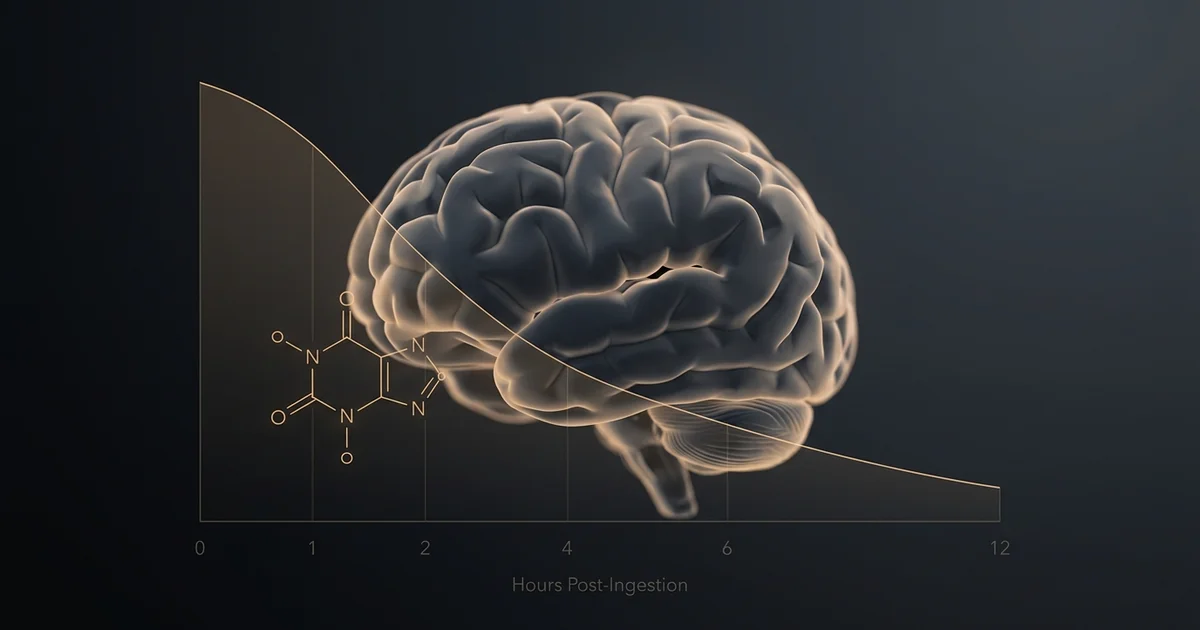
A single caffeine dose stays meaningfully active for roughly 3 to 5 hours, because caffeine's half-life averages about 5 hours. Half-life means the time it takes your body to clear half of what you took.
The range is personal. The StatPearls reference on caffeine via NCBI lists the mean half-life at around 5 hours, with the mean half-life of caffeine is approximately 5 hours, ranging from 1.5 to 9.5 hours depending on factors such as pregnancy, obesity, oral contraceptive use, smoking, and altitude. Fast metabolizers burn through it quickly. Slow metabolizers can still have a meaningful amount circulating at bedtime.
Here's the practical part. A pouch delivers the caffeine fast, but the felt energy from caffeine alone tends to spike and then drop. The same source notes that tolerance, particularly to stimulant effects, develops with repeated use, which is why your usual dose stops feeling like it used to.
Two questions matter, then. How fast does it hit, and how clean is the ride down? Most pouches answer the first and ignore the second.
Do Caffeine Pouches Work? The Honest Answer
Yes, caffeine pouches work for fast, discreet, smoke-free energy. They deliver caffeine through the mouth, they kick in faster than coffee, and there's no cup, no spill, and no nicotine in the zero-nicotine versions.
What they don't all do is control the experience. Caffeine on its own is a blunt tool. It blocks adenosine, the chemical that makes you feel tired, and it can leave some people wired, anxious, or crashing hard once it clears.
That's where the supporting cast matters. The most studied fix is pairing caffeine with L-theanine, an amino acid found in tea. Research summarized by Mind Lab Pro found the combination produced improvements on several cognitive measures (including simple reaction time, aspects of rapid visual information processing, and working-memory-related reaction time) and also improved certain mood ratings (such as higher alertness and lower tiredness). A 2025 study in the Journal of the International Society of Sports Nutrition treated caffeine plus L-theanine as a dual-action strategy, where L-theanine's calming, nootropic effects may work together with caffeine's stimulatory benefits to enhance cognitive performance.
So pouches work. The better ones do more than dump caffeine into your mouth.
How the Popular Caffeine Pouches Compare
Most caffeine pouches fall into a few buckets: coffee-based dip alternatives, vitamin-loaded energy pouches, and dedicated focus pouches. Here's an honest look at the common options and where Roon fits. Specs reflect each brand's general positioning, so always check the current label before buying.
| Product | Caffeine per pouch | Other active ingredients | Built for | Crash control |
|---|---|---|---|---|
| Grinds | ~25 mg (small-coffee equivalent per pouch) | B vitamins in some lines | Coffee/dip replacement, oral habit | None added |
| FRE | ~20 mg | Vitamins, taurine in some lines | Casual energy, flavor | None added |
| Sneak / energy-style pouches | ~50–100 mg | Vitamins, sometimes taurine | Gaming, quick energy | None added |
| Generic "energy" pouches | Varies widely | Often just caffeine + flavor | Cheap stimulation | None added |
| Roon | 80 mg | L-theanine 60 mg, methylliberine (Dynamine) 25 mg, theacrine (TeaCrine) 5 mg | Sustained cognitive focus | Designed in |
The pattern is clear once you line them up. Coffee-style pouches deliver a small caffeine dose and lean on the oral habit. Energy pouches push more caffeine and add vitamins. Almost none of them add anything to shape how the caffeine feels going up or coming down.
If you want to understand the format itself, our breakdown of how caffeine pouches work and whether they're worth it covers the mechanics in more depth.
What's Missing From Most Caffeine Pouches
After lining them up, three gaps show up again and again.
Gap 1: No jitter control. Most pouches are caffeine and flavor. Without L-theanine or a similar partner, a fast caffeine hit can feel like a jolt rather than focus, especially at higher doses.
Gap 2: No crash management. Caffeine alone spikes and fades. When it clears, you feel the drop. None of the standard pouches include ingredients that extend the smooth part of the curve, so you're back to baseline (or below it) in a few hours.
Gap 3: Thin or vitamin-padded formulas. Plenty of pouches pad the label with B vitamins or taurine, which look good on a panel but don't meaningfully change how locked-in you feel. The active focus story usually starts and ends with caffeine.
Put simply, most pouches solved speed and convenience, then stopped. The ride quality was never the point. For a deeper look at the comedown problem, see our guide on how to avoid a caffeine crash.
Conclusion: Speed Is Only Half the Equation
A caffeine pouch kicks in fast, often in 10 to 20 minutes, because the caffeine absorbs through your mouth instead of waiting on your stomach. That speed is real and it's the main reason pouches beat coffee for a quick lift.
But onset is only half the story. With caffeine's roughly 5-hour half-life and no supporting ingredients, a plain pouch gives you a sharp rise and an uncontrolled fall. The product that wins isn't the one with the most caffeine or the most vitamins on the label. It's the one engineered for the whole curve: fast up, steady through, gentle down.
Judge a pouch by how it feels at hour four, not just minute four.
Frequently Asked Questions
How fast does a caffeine pouch kick in compared to coffee?
A caffeine pouch often starts working in 10 to 20 minutes because some caffeine absorbs through the lining of your mouth, skipping digestion. Coffee usually takes 30 to 60 minutes to peak in your blood since it has to pass through your stomach and gut first. The pouch wins on speed, though the total caffeine your body absorbs is similar between the two routes.
How long do caffeine pouches last?
The felt effect from a caffeine pouch typically lasts 3 to 5 hours. Caffeine's half-life averages about 5 hours, meaning half of the dose is still in your system at that point. Your personal timing depends on genetics, smoking, medications, and metabolism. Pouches with only caffeine tend to spike and fade, while formulas with supporting ingredients can feel steadier for longer.
Do caffeine pouches actually work?
Yes. Caffeine pouches deliver caffeine through the mouth, kick in faster than coffee, and offer a discreet, smoke-free way to stay alert. The zero-nicotine versions contain no nicotine. The real difference between products is what else is in the pouch, since caffeine alone can cause jitters and a crash without supporting ingredients like L-theanine.
Why do some caffeine pouches give me jitters?
Jitters usually come from a fast, large caffeine hit with nothing to balance it. Caffeine blocks adenosine and ramps up stimulation, and on its own that can feel like anxiety or a racing heart. Pairing caffeine with L-theanine is the most studied way to smooth that edge, which is why plain caffeine-only pouches tend to feel rougher than balanced formulas.
How many caffeine pouches can I use in a day?
Most health authorities consider up to 400 mg of caffeine per day reasonable for healthy adults. How many pouches that equals depends on the caffeine per pouch, which ranges from about 20 mg to 100 mg. Count your full daily intake, including coffee and tea, and stop earlier in the day so the roughly 5-hour half-life doesn't disrupt your sleep.
Will a caffeine pouch keep me awake at night?
It can. With a half-life near 5 hours, an afternoon pouch can still leave a meaningful amount of caffeine in your system at bedtime, especially if you metabolize it slowly. A practical rule is to take your last pouch at least 6 to 8 hours before you want to sleep, then adjust based on how sensitive you are.
Does tolerance to caffeine pouches build over time?
Tolerance to caffeine's stimulant effects can build with regular use, which is why your usual dose may feel weaker over time. Cycling your intake or taking occasional breaks helps. Some formulas combine caffeine with longer-acting compounds to keep the experience consistent without simply piling on more caffeine.
The Pouch Built for Hour Four, Not Just Minute Four
If the gap across caffeine pouches is the ride, that's the exact problem Roon was designed around. It's a zero-nicotine sublingual pouch built for the whole curve, not just a fast hit.
Each pouch carries four active ingredients that work together: 80 mg caffeine for the lift, 60 mg L-theanine to take the edge off and keep the focus clean, plus 25 mg methylliberine (Dynamine) and 5 mg theacrine (TeaCrine), two compounds chosen to extend steady focus without the spike-and-drop of caffeine alone. The format means a 5 to 10 minute onset, and the stack is built for a 6 to 8 hour window with no jitters, no crash, and no tolerance buildup.
To be clear about what it isn't: Roon is a supplement, not a replacement for sleep, food, or training your attention. It won't fix a bad night. What it does is give you a faster, steadier version of the caffeine experience most pouches only half-deliver. If you've been judging pouches by how fast they hit, try Roon and judge it by how the fourth hour feels.
Written by Roon Team