Holy Basil (Tulsi): The Cortisol-Lowering Adaptogen With Real RCT Data
Roon Team
Holy Basil (Tulsi): The Cortisol-Lowering Adaptogen With Real RCT Data
Most adaptogens get sold on vibes. Holy basil is one of the few with a randomized controlled trial measuring cortisol in actual human hair, not a rat brain or a test tube. That single detail is why the holy basil stress benefits conversation deserves a closer look than the usual "ancient herb, modern wellness" pitch.
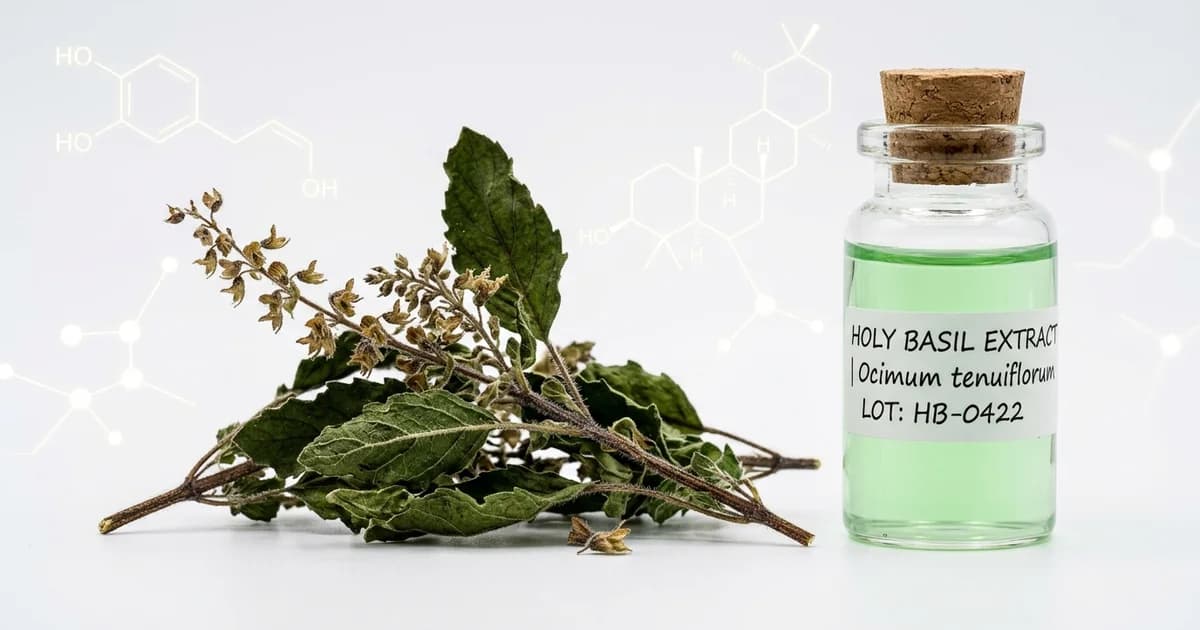
Known as tulsi in Ayurveda and Ocimum sanctum (also written Ocimum tenuiflorum) in the lab, this plant has been studied for stress, sleep, mood, and even reaction time. The data is small but unusually specific.
Here is what the science actually says, and where it stops.
Key Takeaways
- Holy basil (tulsi) is a clinically studied adaptogen with human RCT data on stress, not just animal models.
- In an 8-week trial, a standardized tulsi extract lowered hair cortisol and improved perceived stress and sleep versus placebo.
- Separate trials show tulsi adaptogen effects on generalized anxiety symptoms and specific cognitive tasks.
- Tulsi works slowly, over weeks. It is not a fast-acting focus tool.
- Doses in trials ranged from roughly 250 mg to 1,000 mg per day, often split into two servings.
What Holy Basil Actually Is
Tulsi is a fragrant herb in the mint family, native to the Indian subcontinent and treated as sacred in Hindu tradition. In Ayurvedic medicine it carries a heavy reputation. According to a systematic review by Jamshidi and Cohen, it has been valued for centuries and described in older texts as a plant tied to longevity and general wellbeing.
The reputation is old. The human evidence is newer, and that is the part worth examining.
That 2017 review was the first to pull together human clinical trials on ingested tulsi. The review found 24 articles that met their inclusion criteria, with most outcome measures relating to blood glucose levels, lipid profile, blood pressure, immune response, neurocognitive changes, fatigue and mood. The authors concluded that the reviewed studies reinforce traditional uses and point to tulsi as a supportive option for lifestyle-related chronic conditions including diabetes, metabolic syndrome, and psychological stress.
The word "adaptogen" gets thrown around loosely. With tulsi, it points to a real, measurable target: the stress response.
Holy Basil Stress Benefits: The Cortisol Data
The strongest evidence for ocimum sanctum cortisol effects comes from an 8-week randomized, double-blind, placebo-controlled trial published in Frontiers in Nutrition in 2022, using a standardized extract called Holixer.
This is the study that matters most, so the design is worth knowing. One hundred volunteers aged 18 to 65 received either 125 mg of Ocimum tenuiflorum twice daily or a placebo, with the Perceived Stress Scale as the primary outcome.
Then they did something most herbal trials skip. They measured cortisol in hair, which reflects long-term stress exposure rather than a single stressful morning.
The results held up. Compared to the placebo, Ocimum tenuiflorum supplementation was associated with greater improvements in Perceived Stress Scale and Athens Insomnia Scale scores, and at week 8, concentrations in hair cortisol were also lower. The authors summarized it plainly: 8 weeks of supplementation with the extract may reduce objective and subjective measures of stress, and improve subjective measures of sleep quality.
Lower cortisol, better perceived stress, better sleep. That is a clean, three-part result from a properly controlled trial, and it is rare in this category.
Tulsi and Anxiety: A Second Line of Evidence
Beyond cortisol, tulsi anxiety research points the same direction. A controlled trial led by Bhattacharyya, published in the Nepal Medical College Journal, looked at people diagnosed with generalized anxiety disorder.
The protocol was simple. Thirty-five subjects received 500 mg of Ocimum sanctum extract in capsules twice daily for 60 days, with assessments at baseline, day 30, and day 60.
The reported shift was sizable. According to a summary of the trial, the anxiety index decreased from a baseline average of 84.42 to 55.54, a 34.2% reduction, the stress index declined by 27.5%, and the depression index fell by 30.8%.
One caution: this was a small, open trial without the rigor of the Holixer study, and the population had a clinical diagnosis. It signals direction, not proof. To be clear, tulsi is not a treatment for anxiety disorders, and nothing here should replace medical care.
Holy Basil Cognition: Reaction Time and Focus
The holy basil cognition angle is more modest, but it exists in humans, not just animals.
A placebo-controlled study published in the Indian Journal of Physiology and Pharmacology tested an ethanolic leaf extract of Ocimum sanctum in healthy adults. The trial gave 300 mg per day of the extract or placebo over 30 days, after noting that holy basil has shown cognition-enhancing and stress-relieving effects in animal models but few human studies.
The findings were specific rather than sweeping. The extract group showed measurable improvements over placebo in reaction time and error rate on the Sternberg memory test, and reaction time on the neutral and interference tasks of the Stroop test.
Read that carefully. These are speed and accuracy gains on attention tasks, plausibly downstream of lower stress, not a stimulant-style jolt of energy. Tulsi does not make you faster in the moment. It may help you think more cleanly when chronic stress would otherwise drag you down.
How Tulsi Compares to Other Adaptogens and Focus Tools
Tulsi sits in a specific lane. It is a slow, stress-lowering adaptogen, which makes it a different animal from fast-acting focus ingredients. The table below is honest about that split, including where a fast-onset option fits.
| Ingredient | Main job | Onset | Best evidence | What it is not |
|---|---|---|---|---|
| Holy basil (tulsi) | Lower the stress signal, cortisol, sleep | Weeks | RCT: lower hair cortisol, better PSS and sleep | A same-day focus or energy tool |
| Ashwagandha | Lower cortisol, manage stress | Weeks | Multiple RCTs on perceived stress | An acute alertness booster |
| Rhodiola | Anti-fatigue under stress | Days to weeks | Trials on fatigue and burnout | A clean stimulant |
| L-theanine | Calm, smooth attention | 30 to 60 min | Pairs with caffeine for focus | A stress cure over time |
| Roon pouch | Raise the focus signal, fast | 5 to 10 min | Formula: caffeine, L-theanine, Dynamine, TeaCrine | A long-term cortisol fix |
The pattern is clear. Adaptogens like tulsi turn down the chronic stress dial over weeks. Tools built for focus turn up alertness in minutes. They answer different questions.
If you want to understand the fast side of that equation, our breakdowns of the caffeine and L-theanine combination for focus and how to avoid the afternoon caffeine crash cover it in detail.
How Much Tulsi, and How to Take It
Across the human trials, daily doses landed roughly between 250 mg and 1,000 mg of standardized extract, usually split into two servings. The Holixer cortisol study used 125 mg twice a day. The anxiety trial used 500 mg twice a day. The cognition study used 300 mg daily.
Two practical points follow from the data:
- Consistency beats intensity. Every positive result came from weeks of daily use, not a one-off dose.
- Standardized extracts were the ones tested. Loose tea and raw leaf may have different potency than the capsules used in trials.
Safety looked reassuring in the literature. Across the 24 studies in the systematic review, only one reported occasional nausea, in supplementation with obese patients. Still, if you are pregnant, on medication, or managing a health condition, talk to a clinician first.
Conclusion
Holy basil earns its adaptogen label in a way most do not. Human trials, including a placebo-controlled study that measured hair cortisol, point to a real effect on chronic stress, sleep, and even specific attention tasks.
The honest framing is about timing. Tulsi works on the slow loop, lowering the stress signal over weeks of steady use. It is not a fast fix, and it is not a substitute for treating diagnosed anxiety or sleep disorders. Used with realistic expectations, it is one of the better-supported stress adaptogens you can choose.
Frequently Asked Questions
Does holy basil really lower cortisol?
The strongest evidence says yes, over time. In an 8-week randomized, placebo-controlled trial using the Holixer extract, participants taking tulsi showed lower hair cortisol than placebo, along with better perceived stress and sleep scores. Hair cortisol reflects long-term stress, which makes the result more meaningful than a single blood draw. The effect built over weeks, not hours, so tulsi is a chronic-stress tool rather than an acute one.
How long does tulsi take to work?
Plan on weeks, not days. The cortisol trial ran 8 weeks, the anxiety trial ran 60 days, and the cognition trial ran 30 days. Every positive result in the human literature came from consistent daily use over a multi-week period. If you take it once and feel nothing, that is expected. Adaptogens like tulsi shift baseline stress physiology gradually rather than producing an immediate, felt change.
Is tulsi the same as the basil in my kitchen?
No. Culinary sweet basil is Ocimum basilicum, a different species used for cooking. Holy basil is Ocimum sanctum, also written Ocimum tenuiflorum, and it carries a distinct chemical profile tied to its adaptogenic effects. The clinical trials used standardized leaf extracts of holy basil specifically, often in capsule form. Eating pesto will not give you the stress benefits seen in the research.
Can holy basil help with anxiety?
Some early research is encouraging, but it is not a treatment. A small controlled trial in people with generalized anxiety disorder reported meaningful drops in anxiety, stress, and depression index scores over 60 days. That study was small and open-label, so it signals direction rather than proof. Tulsi may support a calmer stress response, but anxiety disorders need proper medical care, not a supplement on its own.
Does tulsi improve focus or memory?
In a modest way, likely through lower stress. A placebo-controlled study found tulsi improved reaction time and error rate on memory and attention tasks like the Sternberg and Stroop tests. These are real but small gains, and they look like the downstream benefit of a calmer nervous system rather than a stimulant effect. For same-day, fast focus, a caffeine-based tool is a better match than an adaptogen.
What dose of holy basil is used in studies?
Human trials used roughly 250 mg to 1,000 mg of standardized extract per day, usually split into two servings. The Holixer cortisol study used 125 mg twice daily, the anxiety trial used 500 mg twice daily, and the cognition study used 300 mg daily. Standardized extracts were what researchers tested, so capsules and standardized products track the evidence more closely than loose tea or raw leaf.
Is holy basil safe to take daily?
The clinical record looks reassuring. In the systematic review of 24 human studies, only one reported a side effect, occasional nausea in obese patients. Most trials ran for weeks with daily dosing and reported good tolerability. That said, safety data on long-term, high-dose use is still limited, and tulsi may not suit everyone. If you are pregnant, trying to conceive, on medication, or managing a condition, check with a clinician first.
Two Different Signals: Slow Stress Down, Fast Focus Up
Here is the distinction this article keeps circling back to. Tulsi lowers the stress signal, and it does so over weeks. That is a real job, backed by real RCT data, and it is exactly the kind of slow physiological shift a good adaptogen is supposed to deliver.
Roon does the opposite job on the opposite timeline. It raises the focus signal in minutes. The sublingual pouch carries 80 mg caffeine, 60 mg L-theanine, 25 mg methylliberine (Dynamine), and 5 mg theacrine (TeaCrine), built for 6 to 8 hours of steady focus with no jitters, no crash, and no tolerance buildup. Onset lands in 5 to 10 minutes.
These are complementary, not competing. Roon is not an adaptogen and will not lower your long-term cortisol, and tulsi will not sharpen your next two hours of deep work. If your stress runs chronically high, a tulsi protocol is worth a real trial. When you need focus on demand, try Roon for the fast side of the equation.
Written by Roon Team