EGCG: The Green-Tea Catechin Behind Calm, Focused Alertness
Roon Team
EGCG: The Green-Tea Catechin Behind Calm, Focused Alertness
Green tea doesn't make you feel wired the way a double espresso does. It makes you feel settled and switched on at the same time. A big part of that effect traces back to a single molecule, and most people have never heard its name.
That molecule is EGCG, short for epigallocatechin gallate. It's the most abundant catechin in green tea, and the egcg benefits worth caring about go well beyond antioxidant marketing copy. EGCG quietly shapes how green tea affects your brain, your blood flow, and your sense of calm focus.
Here's what the science actually says, where the hype outruns the data, and how EGCG fits alongside the other compounds in your cup.
Key Takeaways
- EGCG (epigallocatechin gallate) is the dominant catechin in green tea, accounting for a large share of its total polyphenol content.
- Human trials show EGCG can change cerebral blood flow and influence mood and brain activity, though effects on raw cognitive scores are modest.
- EGCG's appeal for the brain centers on neuroprotection: it's a strong antioxidant and metal chelator studied heavily in models of neurodegeneration.
- EGCG works as part of green tea's chemistry, sharing the stage with L-theanine and caffeine, which drive the classic calm-alert state.
- Bioavailability is the catch. EGCG is poorly absorbed, which is why dose, timing, and food all matter.
What EGCG Actually Is
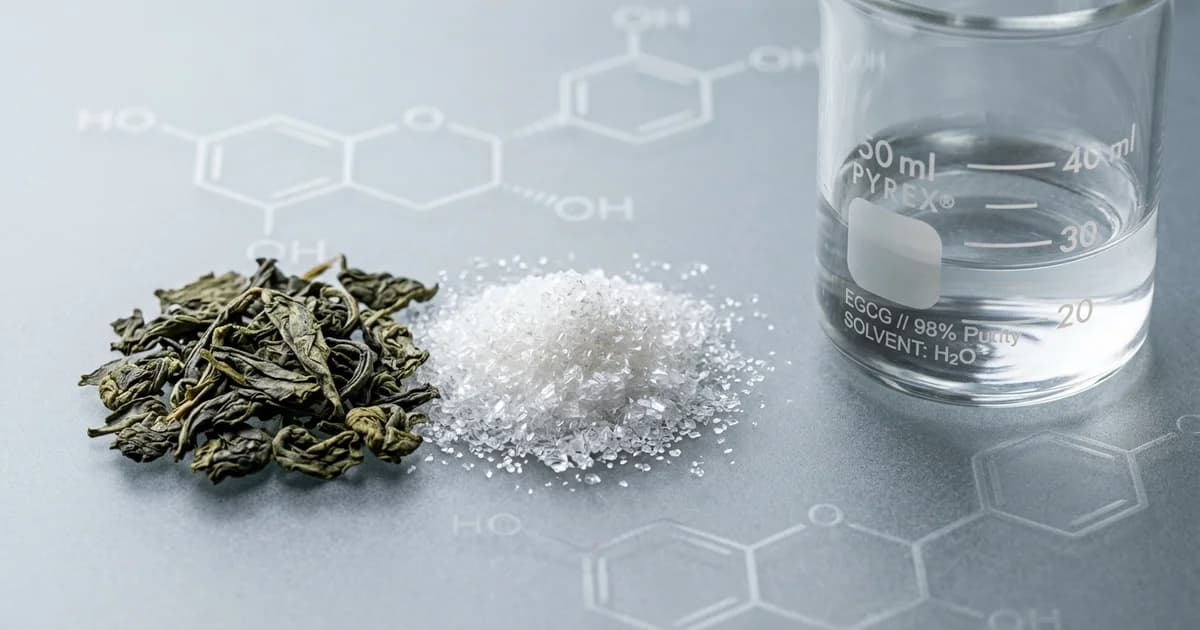
EGCG is a plant compound from the flavonoid family, specifically a catechin. Green tea is its richest dietary source, and within green tea it's the most plentiful of the four main catechins.
The "(-)-epigallocatechin-3-gallate" you'll see in research papers is the same thing, just written in full. It belongs to the same broad green tea catechin group studied for cardiovascular and metabolic effects, but EGCG gets the most attention because it's both the most abundant and the most biologically active.
A typical brewed cup of green tea delivers a variable amount of EGCG depending on the leaf, water temperature, and steep time. That variability is one reason research uses standardized extracts rather than relying on "a cup of tea" as a dose.
EGCG Benefits for the Brain: What the Research Shows
The strongest human evidence for EGCG and the brain involves blood flow and mood, not dramatic gains on memory tests. This is an important distinction, because supplement marketing tends to promise the second while the data supports the first.
In one double-blind, placebo-controlled, crossover trial in healthy adults, researchers measured how EGCG affected cerebral blood flow, cognition, and mood. The study, published in a peer-reviewed paper indexed on PubMed, examined changes in brain blood flow parameters after EGCG, which points to a real vascular mechanism rather than a placebo story.
A separate acute trial looked at the neurocognitive and brain-activity effects of EGCG. That work, also indexed on PubMed, explored changes in self-reported calmness and brain wave activity after a single dose, supporting the idea that EGCG nudges your state toward relaxed alertness.
So when people talk about egcg calm, they aren't inventing it. The molecule does appear to shift mood and brain activity toward a steadier baseline. The effect is real but subtle, and you should treat anyone promising overnight genius with suspicion.
EGCG and Cognition
On egcg cognition specifically, the honest summary is mixed. Acute single doses haven't reliably boosted scores on standard attention or memory tasks in healthy young adults.
The more interesting signal comes from longer-term and protective angles, which is where the next section comes in. Think of EGCG less as an on-demand focus switch and more as a background contributor to brain health.
EGCG Neuroprotection: The Mechanism That Drives the Hype
EGCG's biggest research story is neuroprotection, driven by its antioxidant activity and its ability to bind metal ions. This is the area where the molecule has been studied most intensively, mostly in cell and animal models.
A detailed review of green tea catechins in the brain on PubMed Central describes how EGCG and its metabolites reach the brain and act on multiple pathways tied to oxidative stress and cell survival. The picture that emerges is a compound that supports neurons under stress rather than one that supercharges a healthy brain.
In animal models of Alzheimer-like pathology, EGCG has reduced markers of damage and supported memory performance. Work summarized by the Alzheimer's Drug Discovery Foundation's Cognitive Vitality program catalogs studies where EGCG improved reference and working memory in animals and lowered oxidative markers.
Two honest caveats. First, animal results don't automatically transfer to humans. Second, the doses used in many studies far exceed what a few cups of tea provide.
That said, the consistency across models is why egcg neuroprotection remains one of the more credible long-game arguments for green tea consumption.
Why EGCG Alone Isn't the Whole Green-Tea Story
EGCG never works in isolation in your cup. Green tea's signature calm-alert feeling comes from a small team of compounds working together, and EGCG is one player on it.
The two compounds most responsible for the focus sensation are L-theanine and caffeine. L-theanine is an amino acid that promotes a relaxed, alert state, while caffeine provides the stimulation. EGCG adds antioxidant and vascular support around that core pairing.
This is why reducing green tea to "EGCG benefits" misses the point. The experience you feel when you sip matcha or sencha is mostly the caffeine-theanine partnership, with catechins like EGCG playing a supporting, longer-horizon role.
Green Tea's Active Compounds at a Glance
| Compound | Type | Primary Role | Feel |
|---|---|---|---|
| Caffeine | Methylxanthine | Stimulation, alertness | Fast, energizing |
| L-theanine | Amino acid | Calm, relaxed focus | Smooth, steadying |
| EGCG | Catechin (flavonoid) | Antioxidant, neuroprotection, blood flow | Subtle, background |
| Other catechins (EC, EGC, ECG) | Catechins | Antioxidant support | Subtle, background |
How Much EGCG, and Is It Safe?
EGCG is generally safe from brewed tea, but concentrated extracts carry a liver-related caution at high doses. The difference between drinking tea and taking a high-dose pill matters here.
The European Food Safety Authority reviewed green tea catechins and flagged a potential link between high doses of EGCG from supplements and liver effects. Their scientific opinion published in the EFSA Journal concluded that EGCG from brewed green tea is generally safe, while high-dose extracts warranted concern around liver enzymes.
The other practical issue is bioavailability. EGCG is poorly absorbed, and a review on ScienceDirect details the inconsistencies in how much actually reaches your bloodstream. Taking it on an empty stomach, the form of the extract, and individual differences all shift absorption.
The takeaway is simple. Modest green tea intake delivers EGCG with a clean safety record. Mega-dose extract capsules are a different conversation, and worth discussing with a clinician.
Conclusion
EGCG is the molecule that gives green tea much of its identity, but it's not a focus pill. The honest read on the evidence is that EGCG supports brain health through antioxidant activity, metal chelation, and effects on cerebral blood flow, with the strongest case sitting in neuroprotection research.
The calm, alert feeling you get from a good cup of tea is mostly the work of L-theanine and caffeine, with EGCG contributing in the background. Understanding that division of labor is the difference between buying into hype and using green tea's chemistry well.
If you want EGCG, drink green tea and skip the mega-dose extracts. If you want the calm-alert focus state, the lever to pull is the caffeine-theanine pairing.
Frequently Asked Questions
What are the main EGCG benefits for the brain?
The most credible egcg benefits for the brain involve antioxidant protection, effects on cerebral blood flow, and a modest shift toward calm, relaxed alertness. Human trials have measured changes in brain blood flow and mood after EGCG, while neuroprotective effects show up most consistently in animal and cell models. EGCG is better understood as a background contributor to brain health than as an on-demand cognitive booster you'd feel within minutes.
Does EGCG make you calm or alert?
A bit of both, indirectly. Research on egcg calm has measured shifts in mood and brain activity toward a steadier, more relaxed state after a single dose. That said, the pronounced calm-alert feeling people associate with green tea comes mainly from L-theanine and caffeine working together, not from EGCG on its own. EGCG plays a quieter, supporting role in that overall experience.
How is EGCG different from L-theanine?
They're different classes of compound with different jobs. EGCG (epigallocatechin gallate) is a catechin, a type of flavonoid prized for antioxidant and neuroprotective activity. L-theanine is an amino acid that promotes relaxed focus and pairs famously with caffeine. Both occur in green tea, but L-theanine drives the felt sense of calm focus while EGCG works more on long-term cellular protection and blood flow.
How much EGCG is in a cup of green tea?
It varies widely. The EGCG content of a brewed cup depends on the tea variety, water temperature, and steep time, which is exactly why research uses standardized extracts instead of "a cup" as a unit. Higher temperatures and longer steeps generally pull more catechins into the water. If your goal is steady EGCG intake, consistent brewing habits matter more than chasing a single number.
Is EGCG safe to take as a supplement?
EGCG from brewed green tea has a clean safety record at normal intakes. The caution applies to concentrated, high-dose extract supplements. The European Food Safety Authority flagged a possible link between high-dose EGCG extracts and liver enzyme changes, while concluding that EGCG from tea is generally safe. If you're considering a high-dose capsule, especially on an empty stomach, talk to a clinician first.
Does EGCG actually improve memory or focus?
Not reliably in healthy young adults from a single dose. Acute trials haven't shown consistent gains on standard attention or memory tests. The stronger evidence for egcg cognition sits in long-term and protective contexts, mostly in animal models studying neurodegeneration. Treat EGCG as a brain-health ally rather than a fast-acting focus aid, and look to the caffeine-theanine pairing if immediate focus is the goal.
Why is EGCG hard for the body to absorb?
EGCG has poor bioavailability, meaning only a fraction of what you ingest reaches your bloodstream. Reviews of EGCG absorption describe wide inconsistencies driven by stomach conditions, the form of the extract, and individual metabolism. Taking it with or without food changes the result. This is one reason lab studies often use higher doses than a few cups of tea would ever provide.
Where the Calm-Alert Feeling Actually Comes From
If you read this far hoping EGCG was the secret to calm, focused alertness, here's the honest correction: it's a contributor, not the engine. The engine is the caffeine and L-theanine pairing that green tea is built around. EGCG rides alongside it, doing slower antioxidant and neuroprotective work.
That's the principle behind Roon. Roon is a zero-nicotine sublingual pouch built around the same calm-alert chemistry green tea is famous for, using 80 mg caffeine and 60 mg L-theanine, plus 25 mg methylliberine (Dynamine) and 5 mg theacrine (TeaCrine) for a smoother, longer curve. It's designed for a 5 to 10 minute onset and 6 to 8 hours of sustained focus with no jitters, no crash, and no tolerance buildup.
To be clear about what it isn't: Roon doesn't contain EGCG, and it isn't a green tea substitute or a source of catechin antioxidants. If you want EGCG's neuroprotective profile, drink green tea. If you want the calm-alert focus state on demand, that's what Roon is built for. Want to go deeper on the partner molecule? Read our breakdown of L-theanine and the wider story on dietary flavonoids and the brain.
Written by Roon Team