Does Caffeine Help Memory? The Research Says Mostly No
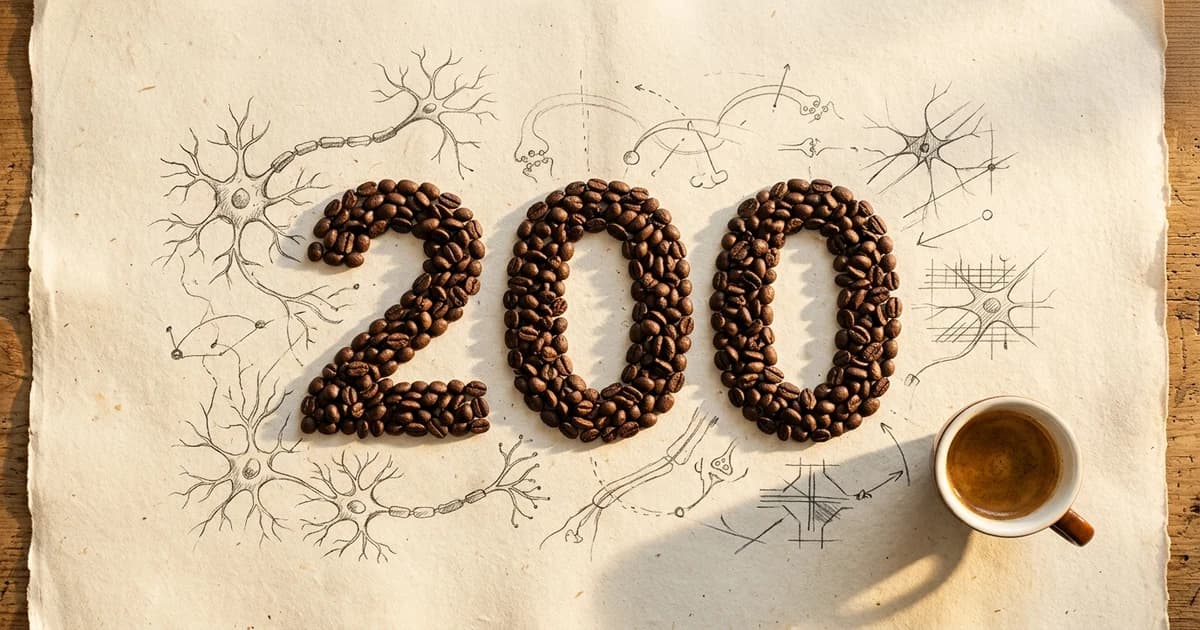
Does caffeine help memory? Not reliably. One 2014 study found that 200 mg taken after learning improved a specific discrimination task the next day, but 100 mg did nothing. A 2020 follow-up failed to replicate the result. A 2025 trial found that 200 mg of post-learning caffeine actually increased false alarms in face recognition. Two major reviews call the evidence for caffeine and memory "limited" beyond faster reaction times.
The headline from 2014 is still circulating, which means students and professionals are working off incomplete information. Here is the full picture.
Key takeaways:
- The only positive memory result used 200 mg after studying, not before. A replication attempt found the effect was "at best small" and may reflect withdrawal reversal.
- A 2025 face-recognition trial found post-study caffeine worsened the ability to tell seen faces from similar unseen ones.
- What caffeine reliably does is sharpen attention and reaction time, not recall. Two meta-analyses confirm this. Attention matters for forming memories, but that is not the same as a memory claim.
- Sleep is when learning gets consolidated. Caffeine late in the day can cost more than it buys.
The 2014 Study Everyone Still Cites
In 2014, Daniel Borota and colleagues at Johns Hopkins gave caffeine-naive participants a visual object task and then administered caffeine after the study session. The study, published in Nature Neuroscience, found that 200 mg improved "lure discrimination" 24 hours later, the ability to tell a similar item from one actually seen. That is a specific test of pattern separation, not general recall.
The dose curve was inverted-U: 100 mg produced no effect. 300 mg was not better than 200 mg. The caffeine came after studying, so the proposed mechanism was consolidation, the process by which a fresh memory gets stabilized. To understand how caffeine works in the brain, it helps to know it blocks adenosine receptors, which can modulate hippocampal signaling.
That single result generated years of headlines. The lab's own summary page still features the finding. A corrigendum later corrected degrees of freedom and P values, though the core result stood.
| Study | Year | Dose | Timing | Memory outcome |
|---|---|---|---|---|
| Borota et al., Nature Neuroscience | 2014 | 200 mg (100, 300 also tested) | Post-learning | Improved lure discrimination at 200 mg only |
| Aust & Stahl, Memory | 2020 | 200 mg | Post-learning | No effect detected |
| Leon et al., Scientific Reports | 2025 | 200 mg | Post-encoding | Higher false alarm rate; worse accuracy |
| Sherman et al., Frontiers in Psychology | 2016 | ~180 mg (coffee) | Pre-task, morning | Improved explicit memory at non-optimal time only |
| Zhang & Madan, Neuroscience and Biobehavioral Reviews | 2021 | Review (all doses) | Review | "Limited evidence" beyond reaction time |
| Nehlig 2010 | 2010 | Review (all doses) | Review | "Does not usually affect performance in learning and memory tasks" |
What Happened When Someone Tried to Repeat It
Aust and Stahl published a follow-up in Memory in 2020, using the same 200 mg post-learning protocol. The key design difference: they did not restrict habitual caffeine intake beforehand and statistically adjusted for it.
They detected no effects of caffeine. Nonsuperiority testing ruled out medium and large effects. Their conclusion was direct: the original effect is "at best small" and "may reflect an offset of performance-impairing withdrawal symptoms rather than genuinely enhanced consolidation."
That withdrawal-reversal explanation matters. If you deprive habitual caffeine users before the test, a dose at the end might be restoring normal function, not enhancing anything.
The 2025 Study That Went the Other Way
Leon and colleagues published a randomized, double-blind trial in Scientific Reports in 2025 (n = 97), giving 200 mg of caffeine immediately after a face-encoding session. Participants returned the next day for recognition.
The caffeine group performed worse. They had a lower hit rate (correctly identifying a seen face) and a higher false alarm rate (saying they recognized a face they never saw) compared to the placebo group.
The authors concluded that post-encoding caffeine "disrupts rather than enhances the consolidation of face memory representations." This is one study using faces, not objects, so it does not prove caffeine damages memory in general. But it directly contradicts the idea that 200 mg after studying is a reliable memory strategy.
What Two Major Reviews Found
Zhang and Madan (2021) reviewed the literature in Neuroscience and Biobehavioral Reviews and found "limited evidence that caffeine affects performance in memory tasks beyond improved reaction times." A dose-response relationship may exist, but findings are inconsistent, and past studies often lacked diet, sleep, and withdrawal controls.
Nehlig (2010) reached a similar conclusion: caffeine "does not usually affect performance in learning and memory tasks." It facilitates low-load working memory to a limited extent but hinders performance on high-load tasks.
Working Memory Is Not the Exception
You might have seen claims that caffeine "boosts working memory." The data do not support this. Klaassen and colleagues (2013) gave participants 100 mg and measured brain activity during a working-memory task. Caffeine changed prefrontal and thalamic activation patterns, but behavior did not improve, and accuracy was worse on the hardest trials. A 2022 daily-caffeine RCT found the same: brain-activity changes without behavioral gains. The brain lights up differently on caffeine. That is not the same as performing better.
The One Positive Coffee Result, and Why It Is Narrower Than It Sounds
Sherman and colleagues (2016) found that roughly 180 mg of caffeine via coffee improved explicit memory in young adults tested in the early morning, their non-optimal time of day. There was no effect in the afternoon. The most accurate interpretation: coffee rescued performance during a circadian low, not a general enhancement. If you are already alert, the same dose does not add a memory benefit.
What Caffeine Reliably Does Instead
Caffeine's consistent territory is attention and reaction time. A 2025 meta-analysis by Kløve and Petersen in Psychopharmacology pooled 31 trials (n = 1,455) and found caffeine improved attention accuracy (g = 0.27) and reaction time (g = 0.28). The EFSA approved the health claim for caffeine and attention at 75 mg or more per serving. A 2014 petition for 40 mg was rejected: in the 40 to 74 mg range, no effect was found on the majority of reaction-time outcomes.
A 2025 Nutrition Reviews meta-analysis examined L-theanine plus caffeine (50 RCTs reviewed, 15 pooled; median doses: 82 mg theanine, 88.7 mg caffeine). The combination improved attention-switching accuracy (SMD 0.33 at hour 2) and digit vigilance (SMD 0.20), with a moderate choice-reaction-time effect (SMD −0.48, 95% CI −1.01 to 0.05). Confidence intervals often included no effect, and half the studies carried high risk of bias. The meta-analysis reported no memory outcomes.
Attention Is the Front Door to Memory
Dividing attention at encoding sharply reduces later memory; dividing attention at retrieval barely does. Naveh-Benjamin and Craik demonstrated this asymmetry across multiple experiments. Encoding is attention-hungry. If your attention is fragmented while studying, the memory trace is weaker from the start.
Caffeine's attention benefit therefore has downstream relevance for forming memories. But this is a statement about how memory works, not a claim that a caffeine product improves memory. It does not mean caffeine is a memory enhancer, and no product containing caffeine should be marketed as one.
The Sleep Tax
Sleep is when the day's learning actually gets consolidated, and caffeine taken too close to bedtime pushes that process back. A 2023 systematic review found that coffee at a 107 mg dose should be consumed at least 8.8 hours before bedtime to avoid measurable reductions in total sleep time. Higher doses require an even longer buffer.
If you drink coffee at 9 PM to cram, you may encode more material while awake but consolidate less of it while asleep. The practical answer for exam prep is not more caffeine; it is better study technique and earlier timing.
Conclusion
Caffeine is a real attention and reaction-time enhancer at 75 mg and above. It is not a memory enhancer. The one consolidation study that found a benefit at 200 mg has not been reliably replicated, and a newer study using the same protocol found the opposite result. Reviews describe the memory evidence as limited. Working-memory data show brain changes without behavioral gains. Anyone considering caffeine before studying should weigh the attention benefit against the sleep cost and time the dose accordingly.
Frequently Asked Questions
Does caffeine improve memory?
Mostly no. A 2014 study found 200 mg taken after learning improved a discrimination task, but a 2020 follow-up found the effect was "at best small" and possibly a withdrawal artifact. A 2025 trial found the same dose worsened face-recognition accuracy. Reviews describe the evidence as limited beyond faster reaction times.
How much caffeine do you need for memory?
There is no established dose. The only positive consolidation result used 200 mg, but it has not been replicated, and the same dose produced a negative result in a 2025 trial. 100 mg produced no memory effect in the original study.
Is it better to have caffeine before or after studying?
The 2014 Borota study tested caffeine after studying and proposed consolidation as the mechanism. Sherman et al. (2016) found a benefit with coffee before a morning task, but only at a non-optimal time of day. No clear evidence supports either timing for a reliable memory benefit.
Does coffee help you remember things?
Coffee's consistent benefit is attention and alertness, not recall. Better attention while studying can improve what you encode, which matters for later memory, but that is an indirect pathway. The EFSA approved caffeine's attention claim at 75 mg or more, not a memory claim.
Does caffeine hurt memory?
Not in general. One 2025 trial found 200 mg after encoding increased false alarms in face recognition, but this is a single study with one type of material. Nehlig (2010) noted caffeine can hinder high-load working memory. The effects are inconsistent and task-dependent, not broadly harmful.
Does L-theanine help memory?
No meta-analysis has reported a memory outcome for L-theanine. The 2025 Nutrition Reviews meta-analysis of 50 RCTs on L-theanine plus caffeine found effects on attention switching, vigilance, and reaction time, but no memory outcomes were measured.
Why This Site Does Not Sell a Memory Product
Roon is a caffeine and L-theanine pouch. The brand makes no memory claim because the evidence does not support one.
An Attention Product, Not a Memory Product, and Why That Distinction Matters
Borota's 200 mg consolidation result has not replicated. The 2025 trial at the same dose raised false alarms. At 80 mg, caffeine has never produced a memory effect in any published trial. Roon carries 80 mg caffeine precisely because its claim is attention, not recall. The EFSA approved caffeine for attention at 75 mg or more; no authority has approved it for memory at any dose. Roon pairs that caffeine with 60 mg L-theanine to smooth the response, 25 mg methylliberine (Dynamine) to extend the window, and 5 mg theacrine (TeaCrine) in a sublingual pouch. Dynamine slows caffeine clearance: a randomized double-blind crossover PK study (n=12) found methylliberine cut oral clearance from 41.9 to 17.1 L/hr and extended half-life from 7.2 to 15 hours, though that study used 100 mg methylliberine and 150 mg caffeine (roughly 4x the methylliberine and 1.9x the caffeine Roon carries), so the mechanism is directionally the same and the study did not measure Roon. The practical result is 6 to 8 hours of sustained focus. The trade-off: stop at least 8 hours before bed.
Roon is not a substitute for evidence-based memory interventions like adequate sleep, exercise, or clinical evaluation of cognitive concerns. But if what you actually need during a study session is sustained attention, not a memory molecule that does not yet exist at consumer doses, zero sugar pouches start from $9.16 per tin. Try Roon for the part of learning that caffeine actually supports.
Written by Roon Team