How Caffeine Actually Works in Your Brain
Roon Team
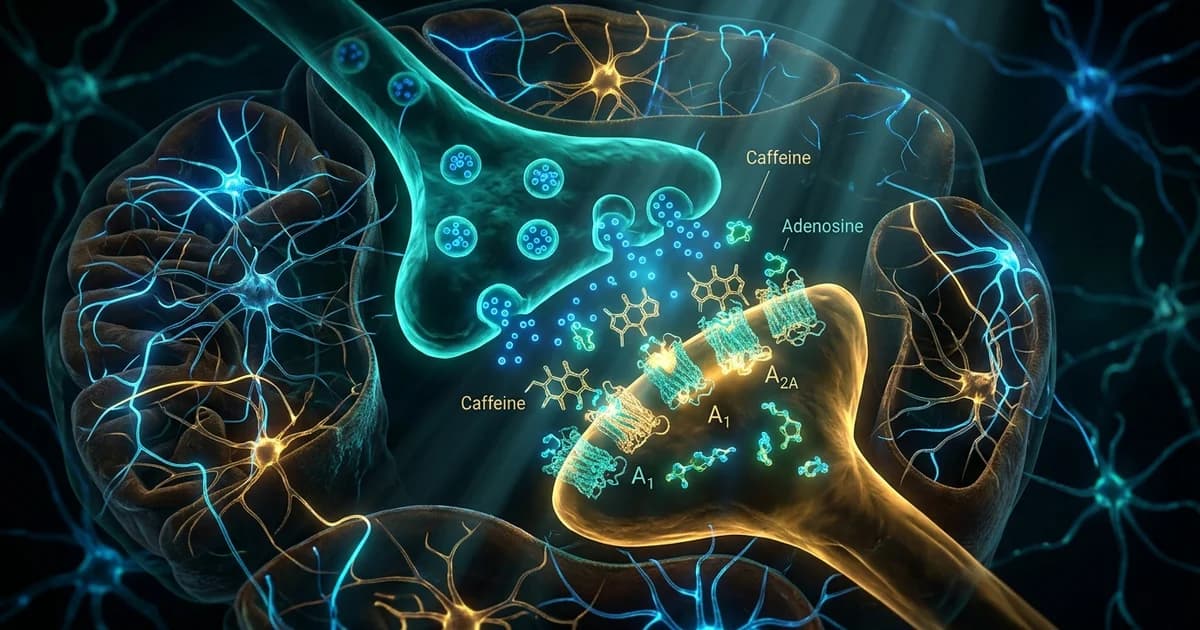
How Caffeine Actually Works in Your Brain: The Adenosine Receptor Story
You drink coffee. Twenty minutes later, the fog lifts. Most people assume caffeine is pumping energy into your system, like topping up a battery.
That is not what happens. To understand how caffeine works in the brain, you have to flip the logic. Caffeine does not give you energy. It hides the fact that you are tired. The whole effect comes down to one molecule, one set of receptors, and a clever case of mistaken identity at the cellular level.
Here is the real story.
Key Takeaways
- Caffeine works by blocking adenosine, a molecule that builds up while you are awake and signals your brain to slow down.
- It fits into adenosine A1 and A2A receptors without activating them, so the "you're tired" message never gets through.
- This is why caffeine keeps you awake: it masks sleep pressure rather than removing it.
- The adenosine keeps accumulating behind the blockade, which explains the crash and the slow build of tolerance.
- Delivery speed matters. How fast caffeine reaches your brain depends on how it gets into your blood.
What Adenosine Does Before Caffeine Shows Up
Adenosine is your brain's fatigue accountant. Every hour you stay awake, it tallies the bill.
As your neurons burn through fuel during the day, adenosine accumulates in the brain as a byproduct. It binds to specific receptors and dials neural activity down, which is what you feel as drowsiness. Researchers describe this buildup as "sleep pressure," and it is the reason a 16-hour day leaves you foggy. According to a review in the journal Sleep Medicine Reviews on PMC, adenosine accumulation during waking is a core signal in sleep-wake regulation.
The longer you are up, the more adenosine collects. Work summarized by Dr. Kumar Discovery notes that adenosine levels rise steadily during wakefulness and roughly double after 12 to 16 hours awake, concentrating in brain regions that govern sleep. During deep sleep, those levels fall back toward baseline, which is part of why rest feels restorative.
So adenosine is not the enemy. It is an honest signal. Caffeine just intercepts the message.
How Does Caffeine Work in the Brain? The Receptor Swap
Caffeine works by impersonating adenosine and parking itself in adenosine's receptors without switching them on.
This is the caffeine mechanism of action in one sentence. Caffeine and adenosine have a similar molecular shape, similar enough that caffeine slots neatly into the same docking sites. But it is an antagonist, not an agonist. It occupies the receptor and blocks it, yet sends no "slow down" instruction.
The result: adenosine is still floating around your brain, but it has nowhere to dock. The fatigue signal goes silent. You feel alert, not because alertness was added, but because drowsiness was muted.
The A1 and A2A Receptor Split
The two receptors that matter most for caffeine are A1 and A2A.
Researchers have narrowed caffeine's behavioral effects to these two subtypes. A paper on the central action of caffeine in PMC concluded that blockade of A1 and A2A adenosine receptors is the primary molecular site of action behind caffeine's effects on behavior. A separate study in PMC describes the primary action of caffeine as blocking A1 and A2A receptors, which then ripples out to many other neurotransmitter systems.
Here is the rough division of labor:
| Receptor | Where it concentrates | What blocking it does |
|---|---|---|
| A1 | Spread across nearly the entire brain | Lifts the brake on neuron excitability, raising baseline alertness |
| A2A | Dense in the striatum, tied to dopamine pathways | Linked to caffeine's effects on motivation, mood, and motor drive |
When caffeine blocks A1 receptors, neurons that adenosine would have quieted stay active. When it blocks A2A receptors, it indirectly influences dopamine signaling, which is part of why a coffee can lift your mood and your drive, not just your wakefulness.
This is the adenosine A1 A2A receptor story in practice. One molecule, two receptor types, a cascade of downstream effects.
Why Caffeine Keeps You Awake (and Why the Crash Hits)
Caffeine keeps you awake by hiding sleep pressure, not deleting it. That distinction explains almost everything frustrating about caffeine.
While caffeine sits on your receptors, your body keeps producing adenosine. The bill keeps growing; you just stop seeing the total. Health resources like Ubie describe caffeine as temporarily blocking the receptors to boost alertness without eliminating adenosine, so tiredness returns once it wears off.
Then the caffeine clears. The blockade lifts. And all that backed-up adenosine floods receptors at once.
That sudden rush is the crash. It is not a fuel shortage. It is the fatigue you postponed, arriving with interest.
The Tolerance Problem
Tolerance follows the same logic. When your brain notices adenosine cannot dock as often, it adapts by building more receptors.
More receptors means more open docks for adenosine, so your old dose covers less of them. You need more caffeine to get the same quiet. Animal research showing that chronic caffeine increases the density of adenosine receptors in the brain points to the kind of adaptation thought to underlie why tolerance develops with regular use. This is also why a few days off caffeine can reset your sensitivity.
How Fast Caffeine Reaches Your Brain
Caffeine cannot block a single receptor until it crosses from your blood into your brain, and the route it takes sets the timing.
Swallow a coffee or a pill and the caffeine has to travel through your stomach and gut first. It gets absorbed into the bloodstream, passes through the liver, and only then circulates to the brain. With standard oral intake, blood caffeine typically peaks somewhere between 30 and 120 minutes after you drink it. Caffeine then has a half-life of around five hours in most healthy adults, which is why an afternoon cup can still be in your system at bedtime.
Caffeine itself is small and fat-soluble, so once it is in your blood it crosses the blood-brain barrier easily. The slow part is the gut, not the brain.
That gap between intake and effect is purely a delivery problem. The molecule is the same whether it arrives in 10 minutes or 60. What changes is the road it travels.
Smoothing the Blockade with L-Theanine
Raw caffeine blockade can feel sharp. That edge has a name most people call jitters.
This is where L-theanine, an amino acid found in tea, earns its place. Paired with caffeine, it is associated with steadier attention and a calmer quality of focus, which is why the caffeine plus L-theanine combination is one of the most reliable pairings in cognitive research. The caffeine still does the adenosine blocking. The L-theanine softens how that blockade feels. If you want the deeper breakdown, see our guide on why L-theanine and caffeine work better together.
Conclusion
Caffeine does not manufacture energy. It works by sliding into your adenosine A1 and A2A receptors and blocking the fatigue signal that builds up across your waking hours. You feel alert because the brain's "slow down" message has been temporarily silenced, not because anything was added to the tank.
That single mechanism explains the whole arc. The lift when it kicks in, the crash when adenosine floods back, the creeping tolerance as your brain grows more receptors. Once you see caffeine as a receptor blocker rather than a battery charger, the experience stops being mysterious.
The molecule is settled science. The interesting questions left are about delivery: how fast it arrives, how smoothly it lands, and how long it holds.
Frequently Asked Questions
Does caffeine actually give you energy?
No. Caffeine adds no energy to your body. It blocks adenosine, the molecule that signals tiredness, so your existing alertness is no longer suppressed. The feeling of energy is really the absence of drowsiness. This is why caffeine cannot replace sleep. The underlying fatigue is still there, just hidden behind the receptor blockade until the caffeine clears.
What is the difference between A1 and A2A adenosine receptors?
Both are docking sites for adenosine, but they sit in different places and do different jobs. A1 receptors are spread across nearly the whole brain and help suppress neuron activity, so blocking them raises general alertness. A2A receptors cluster in regions tied to dopamine and are linked to motivation, mood, and motor drive. Caffeine blocks both, which is why it affects wakefulness and mood at the same time.
Why does caffeine cause a crash?
While caffeine occupies your receptors, your body keeps producing adenosine that has nowhere to bind. When the caffeine wears off, that accumulated adenosine docks all at once. The sudden return of suppressed fatigue is the crash. It is not low blood sugar or an energy deficit. It is the sleep pressure you delayed, hitting in a single wave once the blockade lifts.
Why does caffeine stop working as well over time?
Your brain adapts. When adenosine repeatedly cannot dock, the brain builds extra receptors to compensate. With more receptors available, your usual caffeine dose covers a smaller fraction, so the same cup does less. This is tolerance. Taking a short break from caffeine lets receptor numbers drift back down, which is why a few days off can restore your old sensitivity.
How long does caffeine take to work?
That depends on how it enters your blood. Swallowed coffee or pills pass through the gut and liver first, with blood levels usually peaking between 30 and 120 minutes. Caffeine that absorbs through tissue in the mouth can reach the bloodstream and brain faster, because it skips digestion. Once caffeine is in your blood, it crosses into the brain quickly since it is small and fat-soluble.
Does L-theanine change how caffeine works?
L-theanine does not change caffeine's mechanism. Caffeine still blocks adenosine receptors the same way. What L-theanine appears to do is smooth the experience, supporting steadier focus and a calmer feel alongside the caffeine. That is why the two are so often paired. You get the alertness from blocking adenosine with less of the sharp, jittery edge that high-dose caffeine alone can produce.
Same Molecule, a Faster and Smoother Delivery
Everything above points to one practical truth: the adenosine blockade is fixed chemistry, but how you deliver caffeine is a choice. Swallowing it means waiting on your gut. There is a quicker road.
Roon puts 80 mg of caffeine in a sublingual pouch, so the same adenosine-blocking molecule absorbs through the tissue in your mouth and reaches your brain in roughly 5 to 10 minutes, skipping much of the digestive delay. It pairs that caffeine with 60 mg of L-theanine, plus 25 mg of methylliberine (Dynamine) and 5 mg of theacrine (TeaCrine), a four-ingredient stack built for 6 to 8 hours of steady focus without the jitters or the hard crash.
Roon is not a substitute for sleep, and nothing can be. The adenosine you skip today still has to be paid down with rest. What a sublingual pouch changes is the delivery: same mechanism your brain already runs on, a faster start and a smoother landing. If you want to feel the difference between drinking caffeine and absorbing it, try Roon.
Written by Roon Team