Do Adaptogens Actually Work? An Evidence-Grade Reality Check
Roon Team
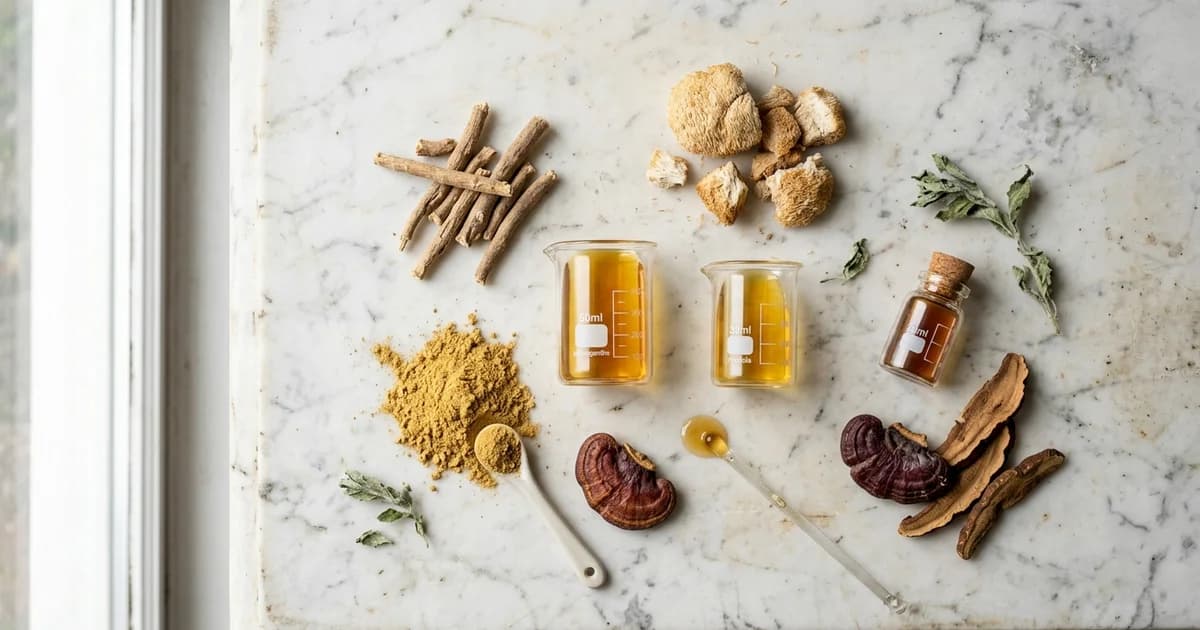
Do Adaptogens Actually Work? An Evidence-Grade Reality Check
Walk into any health store and you will find ashwagandha gummies, rhodiola capsules, and ginseng tonics promising calm, focus, and resilience. The category sells well. The science is messier than the packaging suggests.
So, do adaptogens work? The honest answer is "sometimes, for some things, and rarely as well as the label implies." A few have real human data behind them. Most are riding on tradition, animal studies, and marketing. This piece sorts the adaptogens evidence into what holds up and what does not.
This is not a takedown. It is a reality check, applying the same standard a researcher would use on any compound.
Key Takeaways
- "Adaptogen" is a functional category, not a guarantee of efficacy. The term describes a proposed effect, not proof that any given herb delivers it.
- Ashwagandha has the strongest data, mostly for lowering cortisol, though its effect on how stressed you actually feel is less clear.
- Rhodiola and Panax ginseng show promise for fatigue and cognition, but trials are small and inconsistent.
- The category is huge and largely unregulated, which means dose, extract quality, and standardization vary wildly between products.
What "Adaptogen" Actually Means
An adaptogen is a plant compound proposed to help your body resist stress in a nonspecific way, meaning it should raise general resilience rather than fix one narrow problem.
The concept traces back to Soviet research in the late 1950s. The term adaptogen was coined by I.I. Brekhman, and according to him, an adaptogen has four general properties: it is harmless to the host, it has a nonspecific action, and it has a normalizing action. An earlier 1958 definition framed them as compounds that increase the "state of non-specific resistance" in stress.
Here is the catch. "Nonspecific resistance" is hard to measure and harder to prove in a clinical trial. A drug that lowers blood pressure has a clean endpoint. An herb that supposedly makes you generally more stress-resilient does not. That ambiguity is exactly why the adaptogen science is so uneven.
This matters because the category is enormous. The global adaptogens market size was valued at USD 11.92 billion in 2025 and is projected to grow to USD 22.46 billion by 2034. A lot of money is chasing claims that have not all been tested to the same standard.
Do Adaptogens Work? Grading the Evidence Herb by Herb
Asking "are adaptogens legit" or "do adaptogens work" as one question is the wrong frame. Each herb has its own evidence base, and the quality ranges from solid to nearly nonexistent. Here is how the best-researched ones stack up.
Ashwagandha: The Strongest Case
Ashwagandha (Withania somnifera) has the most human trial data of any adaptogen, and the signal is real but narrower than the marketing.
A 2025 systematic review and meta-analysis in BJPsych Open looked at its effect on stress markers in adults. Withania somnifera, known as ashwagandha, is a key herb in the Indian system of medicine, and the review searched trials from inception through September 2024.
The biology shows up in the bloodwork. A separate meta-analysis on PubMed found a real split in results, captured in its own title: marked cortisol reduction but no effects on perceived stress. In plain terms, it can lower the stress hormone in your blood without reliably changing how stressed you feel. The same review noted that evidence supporting its efficacy remains inconsistent.
That is the most important sentence in this whole article. A measurable biomarker change does not automatically translate to a better day.
Rhodiola Rosea: Promising, Underpowered
Rhodiola rosea is the go-to adaptogen for fatigue, and the early data is encouraging without being conclusive.
Most trials test it for mental and physical exhaustion, and several report reduced fatigue and better stamina under stress. The problem is study quality. Sample sizes tend to be small, dosing protocols vary, and many studies were not designed tightly enough to rule out placebo effects.
If you want a fatigue-fighter and you tolerate it well, rhodiola is a reasonable thing to test on yourself. Just treat the evidence as "suggestive," not "settled."
Panax Ginseng: Real Cognitive Signal, Modest Size
Panax ginseng has decades of use and a respectable pile of cognition studies behind it.
Some randomized trials report short-term improvements in attention, working memory, and subjective energy in healthy adults. The effects are usually modest, and results do not always replicate across studies using different extracts. Ginseng quality and ginsenoside content vary enormously between products, which muddies the picture.
For cognition specifically, it earns a spot among the best researched adaptogens. It is not a sharp, reliable nootropic, though.
Holy Basil, Cordyceps, and the Rest
The further you get from ashwagandha, the thinner the human data becomes.
Holy basil (tulsi), cordyceps, eleuthero, and schisandra all carry traditional reputations and some preliminary research. Most of that research is in animals, small pilot studies, or in vitro work. None of it clears the bar you would want before calling a benefit proven in humans.
Adaptogens Evidence at a Glance
This table grades the adaptogens for stress evidence honestly. "Human trial quality" reflects how much rigorous clinical data exists, not how popular the herb is.
| Compound | Best-Supported Use | Human Trial Quality | Honest Verdict |
|---|---|---|---|
| Ashwagandha | Lowering cortisol | Moderate, growing | Best data; cortisol effect clearer than "feeling" effect |
| Rhodiola rosea | Fatigue, stamina | Small, mixed | Promising, underpowered |
| Panax ginseng | Attention, energy | Moderate, variable | Modest cognitive signal |
| Holy basil / Cordyceps | Stress, vitality | Preliminary | Mostly tradition and early studies |
| Caffeine + L-theanine | Focus, calm alertness | Strong, replicated | Not an adaptogen, but the best-studied focus pairing |
I added caffeine and L-theanine on purpose. They are not classic adaptogens, but if your real goal is steady focus, they have far more replicated human data than most herbs on this list. We cover how that pairing works in caffeine and L-theanine for focus.
Why "Adaptogen" Studies Are So Hard to Trust
Even the better adaptogen studies share a set of recurring weaknesses. Knowing them makes you a smarter buyer.
Small samples. Many trials enroll 40 to 80 people. That is enough to spot a large effect, not a subtle one.
Extract chaos. "Ashwagandha" on a label could mean a standardized root extract used in a trial or a cheap, undosed powder that resembles nothing tested. The clinical result does not transfer to a different product.
Soft endpoints. Stress, mood, and energy are measured with self-report questionnaires. Those are useful but noisy, and they respond strongly to placebo.
Publication bias. Positive results get published and promoted. Null results often sit in a drawer, which makes the overall picture look rosier than reality.
None of this means adaptogens are fake. It means you should match your confidence to the evidence, and the evidence is uneven.
How to Use Adaptogens Without Fooling Yourself
If you want to experiment, do it like a scientist running a small trial on one subject: you.
- Pick one herb with real data. Start with ashwagandha for stress markers or rhodiola for fatigue, not a 12-ingredient blend.
- Match the studied dose and extract. Look for the standardization used in published trials, not just total milligrams.
- Run it for a few weeks and track something specific. Sleep, resting heart rate, or a daily energy rating beats a vague "I feel better."
- Watch for placebo. If the effect is dramatic and instant for a slow-acting herb, be skeptical.
This approach respects both the promise and the limits. You are testing a hypothesis, not buying a miracle.
The Bigger Question: What Are You Actually Trying to Fix?
Most people reach for adaptogens because they are tired, scattered, or stressed. Those are three different problems, and the same herb rarely solves all three.
If your target is stress physiology over weeks, ashwagandha has the strongest case. If your target is acute, on-demand focus for a work block or a study session, the herbal adaptogen aisle is the wrong place to look. The better-studied tools for that are caffeine paired with L-theanine, which deliver alertness without the same jitter profile as caffeine alone.
Clarity about the goal saves you money and disappointment. Decide what you want, then pick the compound with data for that specific outcome.
The Honest Bottom Line on Adaptogens
Adaptogens are neither a scam nor a sure thing. The category is a spectrum. Ashwagandha sits at the credible end with a measurable effect on cortisol, ginseng and rhodiola occupy a "promising but unproven" middle, and a long tail of trendy herbs rests mostly on tradition.
The single best habit you can build here is to ask one question of every supplement: what does the human evidence actually show, and how good is it? When you hold adaptogens to that standard, the picture gets clearer and your shopping cart gets smaller. That is not cynicism. That is just reading the data the way the data deserves to be read.
Frequently Asked Questions
Do adaptogens work for stress?
Some do, partially. Ashwagandha has the strongest adaptogens for stress evidence, with a 2025 meta-analysis finding it can lower cortisol. The same analysis found it did not reliably reduce how stressed people reported feeling, and called the overall evidence inconsistent. So the biology can shift even when the subjective experience does not. Effects also depend heavily on dose and extract quality.
What is the most researched adaptogen?
Ashwagandha. It has the largest body of human trials among the best researched adaptogens, mostly focused on stress hormones and anxiety markers. Panax ginseng follows, with a moderate evidence base for short-term cognition and energy. Rhodiola rosea has promising fatigue data but smaller, more variable studies. Everything beyond those three leans heavily on tradition and preliminary research rather than rigorous clinical trials.
Are adaptogens legit or just marketing?
Both exist in the same aisle. A few adaptogens have legitimate human data, which answers "are adaptogens legit" with a qualified yes for specific herbs and specific uses. The marketing problem is that the credibility of ashwagandha gets borrowed to sell herbs with almost no human evidence. Judge each compound on its own trials, not on the category label.
How long do adaptogens take to work?
Most herbal adaptogens are slow-acting and studied over weeks, not minutes. Ashwagandha trials typically run four to twelve weeks before measuring cortisol or stress outcomes. If a product promises an instant, dramatic shift from a traditional adaptogen, treat that claim with suspicion. Fast, on-demand effects are more associated with stimulants like caffeine than with classic adaptogenic herbs.
Is caffeine an adaptogen?
No. Caffeine is a stimulant, not an adaptogen, and the same goes for L-theanine. They earned a place in this article because if your goal is focus rather than long-term stress resilience, the caffeine and L-theanine pairing has stronger and more replicated human data than most herbs marketed as adaptogens.
Why do adaptogen results vary so much between products?
Because the category is loosely regulated and extracts differ enormously. Two bottles labeled "rhodiola" can contain different plant parts, different active-compound concentrations, and different doses. Clinical results only apply to the specific extract and dose tested. Always match the standardization used in published studies rather than trusting the herb name alone.
The Same Standard, Applied to a Focus Pouch
The point of this article was a method: ask what the human evidence shows, then match your expectations to it. We hold Roon to that exact standard.
Roon is not an adaptogen and does not pretend to be a long-term stress remedy. It is a sublingual cognitive performance pouch built for acute, on-demand focus. The formula is four ingredients chosen for their human research: 80 mg caffeine, 60 mg L-theanine, 25 mg methylliberine (Dynamine), and 5 mg theacrine (TeaCrine). The caffeine and L-theanine pairing is among the best-studied combinations for calm, jitter-free alertness, which is why it anchors the stack.
What Roon is for: a 5 to 10 minute onset and a 6 to 8 hour window of focus with no jitters, no crash, and no tolerance buildup. What it is not: a substitute for sleep, for managing chronic stress, or for the slow-acting herbs covered above. If you want focus you can feel quickly, with the evidence and the limits stated plainly, try Roon.
Written by Roon Team