Are You Getting Enough Choline? Dietary Intake, Memory, and the Deficiency Problem
Roon Team
Are You Getting Enough Choline? Dietary Intake, Memory, and the Deficiency Problem
Most people have never tracked their choline. That is a problem, because your brain runs on it, and the data suggests you are probably falling short. Dietary choline deficiency is one of the quietest nutritional gaps in the modern diet, and it touches the exact systems you rely on for memory and clear thinking.
Choline is an essential nutrient. Your body makes a little on its own, but not enough, so the rest has to come from food. Skip the foods that contain it and the deficit adds up week after week.
What stands out is how common the shortfall is. According to research published in Nutrition Today, only about 10% of Americans and 8% of pregnant women currently meet their gender- and life-stage-specific adequate intake for choline. Ninety percent of us are under the line.
Key Takeaways
- Choline is an essential nutrient your brain uses to build a key memory neurotransmitter and to maintain cell membranes.
- Roughly 90% of Americans fall below the recommended intake, making dietary choline deficiency widespread but rarely discussed.
- The recommended adequate intake is 550 mg per day for adult men and 425 mg per day for adult women.
- Whole eggs and beef liver are the densest choline foods, with one large egg supplying about 147 mg.
- Population research links higher choline intake to better memory scores, though food is a long-term foundation, not an instant focus switch.
What Choline Actually Does in Your Brain
Choline builds the raw material your brain uses to think and remember. It is the precursor to acetylcholine, the neurotransmitter most tied to learning, attention, and memory recall. Low choline means less raw material for that system.
It does a second job too. Choline is a building block of phosphatidylcholine, a fat that forms the membranes wrapping every neuron. Healthy membranes keep signals moving cleanly between cells.
So the connection between choline intake and the brain is not abstract. It feeds two of the systems that decide how well you encode a name, hold a phone number, or recall where you parked.
The Deficiency Problem Nobody Talks About
The gap between what we eat and what we need is large. The same Nutrition Today review estimated usual choline intakes in the United States to be just over 300 mg per day for nonpregnant, nonlactating individuals. Compare that to the targets below and the shortfall is obvious.
Part of the issue is awareness. Choline was only formally recognized as an essential nutrient in 1998, decades after vitamins like C and D entered the public vocabulary. It rarely shows up on a nutrition label, and most multivitamins include little or none.
The other part is diet trends. The richest sources are eggs and organ meats, foods that decades of cholesterol fear pushed off many plates. Cut those, and your dietary choline deficiency risk climbs fast.
How Much Choline Do You Actually Need?
The choline daily requirement is set as an Adequate Intake, since there is not enough data to set a full RDA. Here are the targets from the National Institutes of Health.
| Group | Adequate Intake (mg/day) |
|---|---|
| Adult men (19+) | 550 |
| Adult women (19+) | 425 |
| Pregnant women | 450 |
| Breastfeeding women | 550 |
| Teens (14-18, male) | 550 |
| Teens (14-18, female) | 400 |
The NIH consumer fact sheet confirms 425 mg for women, 450 mg for pregnant teens and women, and 550 mg for breastfeeding teens and women. Pregnancy and breastfeeding raise the need because choline is heavily used in fetal and infant brain development.
Choline and Memory: What the Research Shows
Higher choline intake tracks with better memory in large population studies. The most cited example comes from the Framingham Offspring Cohort, a long-running study that examined diet and cognition in thousands of adults.
Researchers looked at the relation between dietary choline and cognitive performance, including verbal memory and brain imaging markers. The work was published in the American Journal of Clinical Nutrition and indexed on PubMed, and it found that people with higher choline intake tended to perform better on memory tests.
A separate analysis from the Framingham Heart Study examined whether choline intake related to dementia and Alzheimer's disease risk, adding to the picture that long-term choline status matters for the aging brain.
One caution. These are observational studies, so they show association, not proof of cause. They make a strong case for food-first habits, not for treating choline as a same-day memory pill.
The Best Choline Foods, Ranked
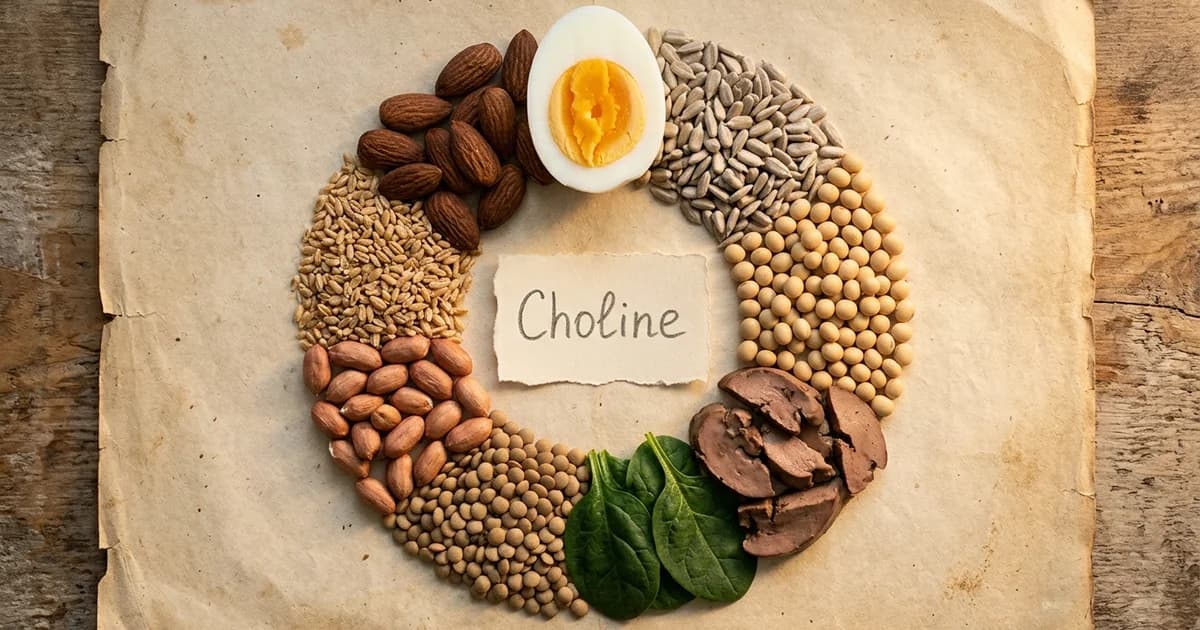
You can close the gap with food, and a short list does most of the work. The densest sources are eggs and organ meats, with the choline concentrated where the fat is.
| Food | Serving | Choline (mg) |
|---|---|---|
| Beef liver | 3 oz cooked | ~356 |
| Chicken liver | 3 oz cooked | ~247 |
| Whole egg | 1 large | ~147 |
| Roasted turkey | 1 cup chopped | ~94 |
| Lean ground beef (90%) | 3 oz | ~71 |
| Salmon, soybeans, broccoli | varies | moderate |
Per a WebMD review of food data, beef liver delivers over 356 milligrams per 3-ounce serving, chicken liver contains 247 milligrams, and one large egg contains 147 milligrams concentrated in the yolk.
The egg point is worth sitting with. The story of eggs, choline, and cognition is really a story about the yolk. One large egg yolk provides approximately 147 mg of choline, with virtually all of the egg's choline concentrated in the yolk, so two eggs at breakfast deliver roughly 294 mg.
That single breakfast covers most of an adult woman's daily target and well over half of a man's. If you eat eggs, you are likely closer to adequate than the average person who skips them.
A Simple Way to Hit Your Target
You do not need to count milligrams forever. You need a few reliable habits.
- Eat whole eggs, yolk included, several mornings a week.
- Add liver or another organ meat once a week if you tolerate it.
- Keep beef, poultry, fish, soybeans, and cruciferous vegetables in rotation.
- If you eat little animal protein, look at fortified foods or talk to a clinician about a supplement.
Vegans and people on very low-egg diets carry the highest dietary choline deficiency risk, since plant sources are real but less dense. Planning matters more for them.
Conclusion
Choline is an essential nutrient, your brain uses it to build a core memory neurotransmitter and to maintain healthy cell membranes, and most people are not getting enough. The shortfall is widespread, quiet, and fixable.
The fix is mostly on your plate. Whole eggs, beef and liver, fish, soybeans, and cruciferous vegetables move you toward the 425 to 550 mg daily target without much effort. Eat the yolk.
The research connecting higher choline intake to stronger memory is observational, so treat food as a long-term foundation for cognitive health, not a same-day performance lever. Build the base first. The brain you are protecting is the one you will be using in thirty years.
Frequently Asked Questions
What are the symptoms of dietary choline deficiency?
Severe choline deficiency is uncommon in healthy people, but low intake has been linked to fatigue and, in research settings, to liver and muscle stress. The bigger concern for most people is chronic low intake that quietly undercuts the systems supporting memory and brain cell health over years rather than producing dramatic short-term symptoms.
How much choline do I need per day?
The adequate intake is 550 mg per day for adult men and 425 mg per day for adult women, with higher targets during pregnancy and breastfeeding. These are Adequate Intake values rather than a full RDA, because the data is not complete enough to set one. Most adults currently fall well below these numbers.
Which foods have the most choline?
Beef liver and chicken liver are the densest sources, followed by whole eggs, which deliver about 147 mg each in the yolk. Beef, turkey, fish, soybeans, and cruciferous vegetables like broccoli round out a solid choline intake. Eating eggs regularly is one of the easiest ways to close the gap.
Does choline really improve memory?
Population studies, including the Framingham Offspring Cohort, link higher dietary choline to better memory test scores. These are observational findings, so they show a strong association rather than proof that choline alone improves memory. The practical takeaway is to keep your intake adequate over the long term rather than expecting an immediate boost.
Can I get enough choline on a vegan diet?
It is possible but takes planning, since the densest sources are animal foods. Soybeans, cruciferous vegetables, beans, nuts, seeds, and whole grains all contribute, and fortified foods or supplements can fill the rest. People who eat little or no egg and animal protein face the highest deficiency risk and benefit most from tracking intake.
Is choline the same as a focus supplement?
No. Choline is a dietary nutrient that supports long-term brain health and memory systems. It is not a stimulant and will not sharpen your attention in minutes. Acute focus and daily nutrition are two separate jobs, and treating choline as a fast-acting performance aid sets the wrong expectation.
Food-First Foundations Versus Acute Focus
This article is about a long game. Choline is something you eat for years to support the memory and cell systems you will rely on decades from now. No pouch, pill, or powder replaces a diet that includes eggs, fish, and the occasional liver.
Acute focus is a different problem with a different tool. When you need clean attention for the next several hours, that calls for something precise and fast, not a nutrient you stockpile over time. Roon is built for that second job. It is a zero-nicotine sublingual pouch with a four-ingredient stack: 80 mg caffeine, 60 mg L-theanine, 25 mg methylliberine (Dynamine), and 5 mg theacrine (TeaCrine), designed for a 5 to 10 minute onset and 6 to 8 hours of focus with no jitters, no crash, and no tolerance buildup.
To be clear, Roon is not a substitute for choline or a balanced diet, and it makes no memory claims. Build your nutritional foundation first, then reach for a focus tool when the work demands it. If you want sharp attention for a specific block of hours, that is the gap Roon is made to fill.
Written by Roon Team