The Default Mode Network: The Brain Circuit Behind Mind-Wandering and Focus
Roon Team
The Default Mode Network: The Brain Circuit Behind Mind-Wandering and Focus
You sit down to write one email. Twenty minutes later you are replaying an argument from 2014, planning dinner, and wondering whether you locked the front door. You never decided to think about any of that. It just happened.
That drift has a physical address in your brain. The default mode network is the circuit that switches on when your attention lets go of the outside world, and it explains why your mind wanders the moment a task gets boring. Understanding it is the closest thing we have to a map of where your focus goes when you lose it.
This is not a flaw in your wiring. It is a feature that runs a little too well.
Key Takeaways
- The default mode network (DMN) is a set of connected brain regions most active when you are not focused on an external task.
- It was identified by neuroscientist Marcus Raichle, who noticed certain regions got quieter, not busier, during demanding tasks.
- Mind-wandering is largely DMN activity, and people spend roughly 47% of waking hours doing it.
- The DMN and the brain's "task-positive" attention network tend to work against each other, which is why deep focus feels like switching gears.
What Is the Default Mode Network?
The default mode network is a group of brain regions that activate when your mind turns inward, toward memory, daydreaming, and thinking about yourself and other people. It is the brain's idle setting, the mode it falls into the second a task stops demanding your attention.
The discovery was almost accidental. It was discovered by Marcus Raichle and colleagues at Washington University. Across years of brain imaging, Raichle kept seeing the same odd pattern. Certain regions did not light up during hard tasks. They dimmed.
That was the surprise. Researchers expected the brain to go quiet at rest and ramp up during work. Instead, a specific network got more active when subjects were doing nothing in particular, and switched off when they concentrated.
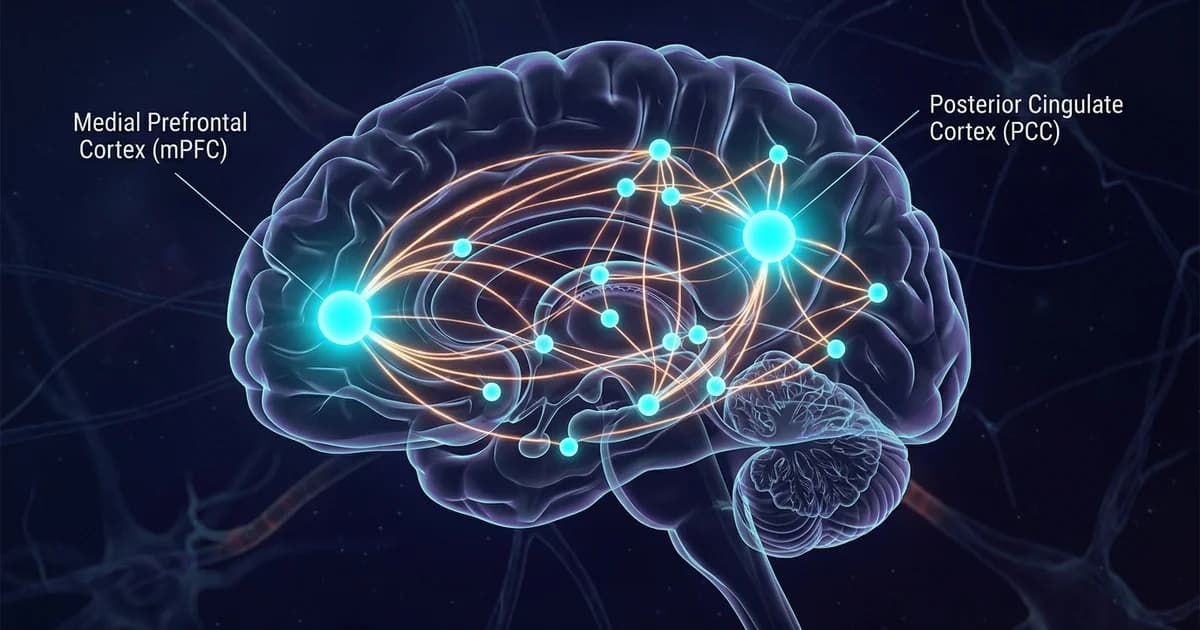
A few regions do most of the heavy lifting here. Key regions include the medial prefrontal cortex (mPFC), the posterior cingulate cortex (PCC), the angular gyrus, and the medial temporal lobes including the hippocampus. Together they handle the inner narration that runs almost constantly in the background of your day.
DMN and Mind-Wandering: Why Your Brain Drifts
Mind-wandering is the default mode network doing its job. When you stop steering your attention, this circuit takes the wheel and pulls you into memories, plans, and imagined conversations.
And it happens far more than most people guess. People spend 46.9 percent of their waking hours thinking about something other than what they're doing, and this mind-wandering typically makes them unhappy. That figure comes from a Harvard study by Matthew Killingsworth and Daniel Gilbert that tracked thousands of people in real time through a phone app.
Nearly half your conscious life, spent somewhere other than the present. The daydreaming brain is not a glitch. It is the baseline.
There is an upside. The same inward turn that derails your inbox is also where a lot of creativity, autobiographical memory, and social reasoning come from. The default mode network (DMN) is a set of interconnected brain regions that become most active when you are not focused on the outside world. Shower thoughts, sudden solutions, the plot of a story you are writing in your head: that is DMN territory.
The problem is timing. The network does not check whether you wanted to drift before it starts.
The DMN vs. the Task-Positive Network
Focus is, in large part, the brain quieting the default mode network and handing control to a different system. Neuroscientists call that other system the task-positive network, and the two tend to run on a seesaw.
When you lock into a demanding task, attention and control networks ramp up while the DMN powers down. External tasks evoke characteristic fMRI BOLD signal deactivations in the default mode network (DMN). In plain terms, engaging with the world turns the daydreaming circuit down.
This relationship is often described as an anticorrelation. There is a well-established anticorrelation between DMN and attention/control networks during rest. When one goes up, the other tends to go down.
That seesaw is why concentration feels like effort. You are not just "trying harder." You are physically shifting which network has the floor, suppressing one circuit so another can run.
Here is how the two systems compare.
| Feature | Default Mode Network (DMN) | Task-Positive Network |
|---|---|---|
| When it's active | At rest, idle, mind-wandering | During focused, goal-directed tasks |
| What it does | Self-reflection, memory, daydreaming, social thinking | Attention, working memory, problem-solving |
| Subjective feeling | Drifting, rumination, "autopilot" | Locked in, present, engaged |
| Key regions | mPFC, posterior cingulate cortex, angular gyrus, hippocampus | Dorsolateral prefrontal cortex, parietal attention areas |
| Relationship | Tends to quiet down when you focus | Tends to quiet the DMN when it activates |
Neither network is the "good" one. A healthy brain moves fluidly between them. Trouble shows up when the switching gets stuck, either trapped in rumination or unable to settle.
Can You Train the DMN?
You can change how loudly the default mode network runs, and meditation is the most studied way to do it. Experienced meditators show reduced activity in core DMN regions, along with a steadier ability to notice when their mind has drifted and pull it back.
That second skill matters more than silencing the network entirely. The goal is not a blank mind. It is faster recovery when attention slips, so a wander lasts seconds instead of twenty minutes.
A few approaches reliably influence DMN activity and the focus that depends on it:
- Focused-attention meditation. Repeatedly returning to a single anchor, like the breath, trains the catch-and-redirect reflex.
- Single-tasking. Removing competing inputs reduces the openings the DMN uses to take over.
- Sleep. Poor sleep weakens the attention networks that normally keep the DMN in check.
- Managing stimulation. The calmer your baseline arousal, the easier it is to hold the task-positive state.
There is also a chemistry layer. The neurochemicals that govern alertness and calm influence how cleanly you move from the daydreaming brain into task engagement, which is where caffeine and the amino acid L-theanine enter the picture.
How Alertness Chemistry Shifts the Balance
Getting into a focused state is partly about arousal: too little and you drift, too much and you get scattered and jittery. The sweet spot is calm alertness, awake enough to engage but settled enough not to bounce between thoughts.
Caffeine raises arousal by blocking adenosine, the molecule that builds up and makes you sleepy. On its own, that lift can tip into restlessness, the wired feeling that makes deep focus harder rather than easier.
L-theanine, found naturally in tea, pulls in the other direction. Research on L-theanine links it to increased alpha brain wave activity, an electrical pattern associated with a relaxed but alert and attentive state. Paired with caffeine, it tends to smooth out the edge while keeping the alertness.
Together they support the exact transition this whole article is about: stepping out of low-engagement mind-wandering and into steady, present attention. If you want the deeper breakdown, see our explainer on how caffeine and L-theanine work together for calm focus and our guide to the neuroscience of attention.
Conclusion
The default mode network is the reason your mind has a mind of its own. It runs your inner world when nothing external is pulling at your attention, and it claims roughly half your waking hours through mind-wandering and daydreaming.
Focus is not about having a quiet brain. It is about moving cleanly between two systems: the inward DMN and the outward, task-positive network that quiets it. The people who concentrate best are not the ones who never drift. They are the ones who notice the drift and switch back fast.
Treat that switch as a skill and a state you can influence, through how you train your attention, how you sleep, and how you manage the chemistry of alertness. Your mind will always wander. The win is getting it back.
Frequently Asked Questions
What is the default mode network in simple terms?
The default mode network is the brain's "idle mode," a group of connected regions that turn on when you stop focusing on the outside world. It runs your daydreams, memories, future plans, and thoughts about yourself and other people. It quiets down when you concentrate on a demanding task and ramps back up the moment you let go, which is why your attention drifts so easily during boring or repetitive work.
Is the default mode network bad for focus?
No. The DMN is not the enemy of focus, it is simply the system that competes with it. The same network that pulls you off-task also powers creativity, memory, and social understanding. The issue is timing, not the network itself. Good focus comes from being able to quiet the DMN on demand and switch into your attention networks, then move back when you are done.
How much time does the mind actually spend wandering?
According to research from Harvard psychologists Killingsworth and Gilbert, people spend about 47% of their waking hours thinking about something other than what they are doing. Their study tracked thousands of people in real time and also found that this mind-wandering tended to make people less happy, even when the wandering thoughts were pleasant.
What is the difference between the DMN and the task-positive network?
The DMN is most active when your mind is idle or turned inward. The task-positive network activates when you focus on a goal, solve a problem, or pay attention to something external. The two tend to work against each other, an arrangement researchers call anticorrelation. When you lock into a task, your DMN quiets; when you drift, it takes over again.
Can you train or calm the default mode network?
Yes, at least indirectly. Meditation is the most studied method, and experienced meditators show reduced activity in core DMN regions and faster recovery when their attention wanders. Single-tasking, quality sleep, and managing your overall stimulation also help keep the DMN in check, mostly by strengthening the attention networks that normally hold it down.
Does caffeine affect the default mode network?
Caffeine does not target the DMN directly, but it raises overall alertness by blocking adenosine, which shifts the balance toward your task-positive attention networks. Too much can tip into jitteriness, which makes focus harder. This is why caffeine is often paired with L-theanine, an amino acid linked to alpha brain wave activity and a calmer, more attentive state.
Quieting the Drift, Not the Mind
This article landed on a simple idea: focus is the brain shifting out of the default mode network and into task engagement. That shift runs partly on chemistry, and the cleaner your alertness, the easier it is to make.
That is the state Roon is built around. Each sublingual pouch pairs 80 mg of caffeine with 60 mg of L-theanine, the combination tied to higher attention-related alpha activity, plus 25 mg of methylliberine (Dynamine) and 5 mg of theacrine (TeaCrine) for a longer, steadier lift. It absorbs in 5 to 10 minutes and is designed for 6 to 8 hours of focus with no jitters, no crash, and no tolerance buildup.
To be clear about what it is not: a pouch will not train your attention the way meditation or good sleep can, and it will not stop your mind from wandering. What it can do is support that calm-alert baseline where the switch back into focus comes a little easier. Try Roon when you need to settle in and get back to the task in front of you.
Written by Roon Team