Curcumin for Cognition: BDNF, Working Memory
Roon Team
Curcumin for Cognition: BDNF, Working Memory, and the Bioavailability Problem
Turmeric has been in your spice cabinet for years. The question worth asking is whether the yellow pigment inside it actually does anything for your brain, or whether it just stains your countertop. The case for curcumin for cognition is more interesting than the wellness aisle lets on, and also more frustrating, because the molecule that shows promise in a petri dish barely survives the trip through your gut.
Here is the honest version. Curcumin influences pathways tied to memory and mood, and a handful of well-run human trials back that up. But the dose your brain receives from a standard turmeric capsule is close to nothing.
This article walks through what the research actually shows, why absorption is the whole game, and how the smarter formulations get around it.
Key Takeaways
- Curcumin is the main active compound in turmeric, and it acts on brain pathways linked to memory, including BDNF signaling.
- A 12-week trial using a lipid-based curcumin (Longvida) found working memory gains in healthy older adults.
- Plain curcumin is poorly absorbed and broken down fast, which is why most cheap turmeric supplements do little.
- Curcumin is a slow, daily, brain-maintenance ingredient. It is not an acute focus tool.
Why Curcumin for Cognition Got Researchers' Attention
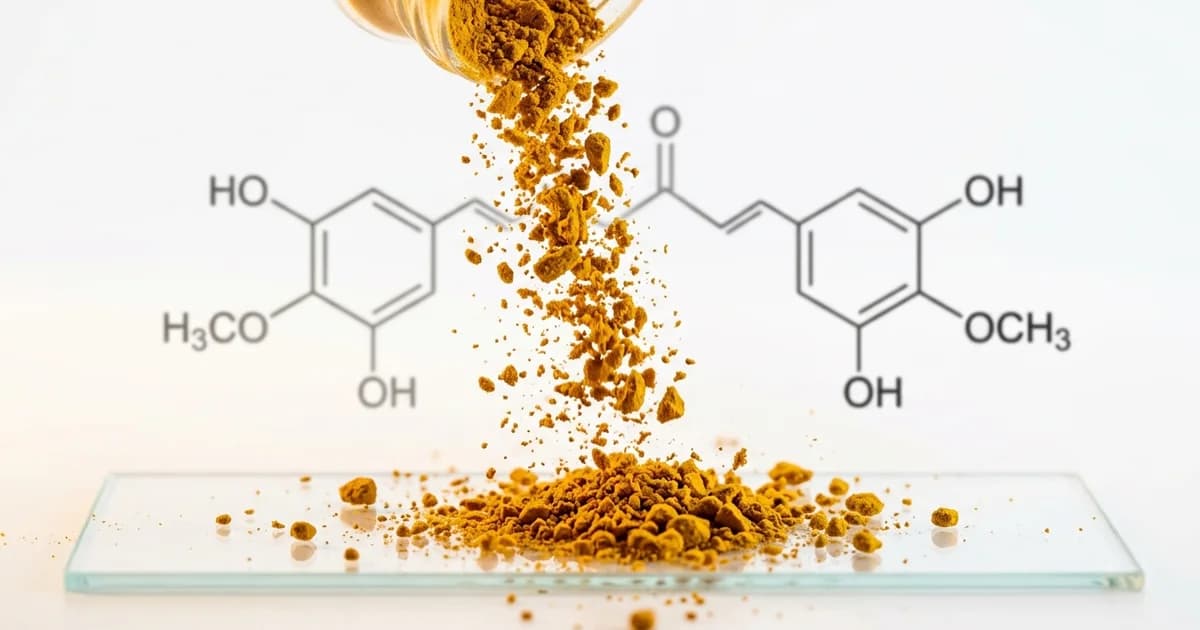
Curcumin is the bright orange-yellow polyphenol that gives turmeric its color. It makes up only a small fraction of the root by weight, but it accounts for most of the compound's studied biological activity.
The reason neuroscientists care comes down to two properties. Curcumin acts as an antioxidant and an anti-inflammatory agent inside the body, and chronic low-grade inflammation in the brain is one of the mechanisms tied to age-related cognitive decline. A molecule that calms that process is worth a close look.
That is the theory. The trials are where it gets concrete.
What the Working Memory Research Actually Found
The strongest human evidence for curcumin memory benefits comes from a research group at Swinburne University in Australia, led by Professor Andrew Scholey. They ran two placebo-controlled trials using a lipid-based curcumin called Longvida.
In the 12-week partial replication study published in Nutrients (2020), 80 healthy adults aged 50 to 80 were randomized to either 400 mg of Longvida daily (delivering 80 mg of curcumin) or a matching placebo. The curcumin group showed better working memory on tasks like Serial Threes, Serial Sevens, and a virtual Morris Water Maze at the 12-week mark.
The same trial also recorded lower fatigue scores on the Profile of Mood States scale at both 4 and 12 weeks. According to the researchers, reported in Current Developments in Nutrition, the pattern of results lined up with improved hippocampal function, the brain region central to memory.
Their earlier trial found something faster. It recorded acute improvements to working memory at 1 and 3 hours after a single dose, with effects that held at 28 days. That said, the bulk of the cognitive payoff in this research shows up over weeks, not minutes. Curcumin behaves like a maintenance compound, not a stimulant.
Curcumin and BDNF: The Mechanism That Makes Sense
BDNF, or brain-derived neurotrophic factor, is a protein that helps neurons grow, survive, and form new connections. Think of it as fertilizer for the brain. Higher BDNF is associated with better learning and memory, and low BDNF shows up in studies of depression and cognitive decline.
This is where curcumin BDNF research gets its footing. A systematic review and dose-response meta-analysis published in the Journal of Nutritional Biochemistry found that short-term curcumin supplementation raised serum BDNF in adults across the trials analyzed.
That single finding ties the whole story together. If curcumin nudges BDNF upward, then the working memory and mood results from the human trials have a plausible biological route, rather than being statistical noise.
One caveat worth stating plainly. Serum BDNF is a blood marker, and a rise in the blood does not perfectly map onto what happens inside the brain. The mechanism is supported, not proven beyond doubt.
The Bioavailability Problem Nobody Mentions on the Label
Here is the catch that undercuts most turmeric products on the shelf. Plain curcumin is one of the worst-absorbed compounds in the supplement world.
Three things work against it. Curcumin dissolves poorly in water, your gut absorbs very little of what you swallow, and your liver chemically alters most of the fraction that does get in before it ever reaches circulation. That last step, first-pass metabolism, is the silent killer of oral curcumin.
The result is that a standard turmeric capsule can leave almost nothing measurable in your blood. You can take a gram of it and feel confident you did something healthy, while your brain sees a rounding error. This is the curcumin bioavailability problem, and it explains why so many turmeric studies come back flat.
How Formulations Try to Fix It
The supplement industry has built several workarounds. Each attacks absorption from a different angle.
| Approach | How it works | Trade-off |
|---|---|---|
| Plain curcumin / turmeric | Standard powder, no enhancement | Very low absorption; little reaches the brain |
| Black pepper (piperine) | Slows curcumin breakdown in the liver | Helps blood levels; relies on a separate compound |
| Longvida (solid lipid particle) | Wraps curcumin in a lipid carrier to survive the gut | The format used in the working memory trials |
| Phytosome / liposomal | Binds curcumin to phospholipids or fat spheres | Better absorption than plain; varies by product |
The lesson is simple. When you read about turmeric brain benefits, the absorption format matters more than the milligram count on the front of the tin. Longvida curcumin was specifically the version used in the Swinburne working memory trials, which is why it keeps appearing in serious cognition research rather than the generic powders.
How to Think About Adding Curcumin
Curcumin is a long-game ingredient. Set expectations accordingly.
- Pick an absorption-enhanced form. A lipid-based, phospholipid-bound, or piperine-paired product beats raw turmeric powder by a wide margin.
- Be patient. The clearest cognitive results showed up at 12 weeks, not on day one.
- Take it with fat. Curcumin is fat-soluble, so a meal containing fat helps the compounds you do absorb.
- Treat it as maintenance. It supports brain health over time. It will not give you a sharp lift before a meeting.
If you want the sharp lift before the meeting, that is a different category of ingredient entirely, and it is worth understanding why.
Conclusion
Curcumin earns its place in the cognition conversation, but for a narrow and specific reason. It works on the slow machinery of brain health, supporting BDNF signaling and showing measurable working memory gains over weeks in well-run trials. The evidence is real, and it is also conditional. Without an absorption-enhanced form, you are mostly paying for a yellow stain.
So the right mental model is a maintenance ingredient, not a performance switch. Curcumin is something you take daily, for months, to support the brain you will have at 70. It is not something you reach for when you need to focus in the next ten minutes. Those two jobs are different, and the smartest approach respects the difference.
Frequently Asked Questions
Does curcumin actually improve memory?
In healthy older adults, a lipid-based curcumin (Longvida) improved working memory over 12 weeks in a placebo-controlled trial at Swinburne University. The effect was modest and built up over weeks rather than appearing immediately. Evidence is strongest for absorption-enhanced forms in aging populations, and weaker for plain turmeric powder, which is barely absorbed.
What is the link between curcumin and BDNF?
BDNF is a protein that supports neuron growth and memory. A meta-analysis in the Journal of Nutritional Biochemistry found short-term curcumin supplementation raised serum BDNF in adults. That mechanism offers a plausible explanation for curcumin's effects on memory and mood, though a rise in blood BDNF does not perfectly reflect changes inside the brain itself.
Why is curcumin so poorly absorbed?
Three factors stack against it. Curcumin barely dissolves in water, the gut absorbs little of it, and the liver chemically breaks down most of what does get through before it reaches the bloodstream. This combination means a standard turmeric capsule can leave almost nothing measurable in your blood, which is why specialized formulations exist.
Does black pepper really help curcumin work?
Yes, to a degree. Piperine, the active compound in black pepper, slows the liver's breakdown of curcumin, which raises blood levels of the compound. It is a genuine absorption aid. That said, it relies on a separate molecule doing the work, and lipid-based or phospholipid-bound formats take a more direct route to improving uptake.
How long does curcumin take to work for the brain?
Plan on weeks, not minutes. The clearest cognitive results in human trials showed up at the 12-week mark, with some working memory effects noted earlier. Curcumin acts on slow processes like inflammation and BDNF signaling, so it behaves like a daily maintenance supplement. It is not an acute focus or energy tool.
What is the best form of curcumin for cognition?
For brain research specifically, Longvida, a solid lipid particle formulation, is the version used in the Swinburne working memory trials. Phytosome and liposomal forms also improve absorption over plain powder. The key takeaway is that the delivery format matters more than the raw milligram count, because plain turmeric simply does not reach the brain in meaningful amounts.
Is curcumin a stimulant?
No. Curcumin contains no caffeine and produces no acute stimulant effect. It will not sharpen your focus in the moment or boost alertness before a task. Its value is in long-term brain maintenance through anti-inflammatory and antioxidant activity, which is a completely different mechanism from the fast-acting focus ingredients people use for immediate performance.
Curcumin Builds the Brain You'll Have Later. Roon Sharpens the One You Have Now.
If this article makes one thing clear, it is that curcumin and acute focus are two separate jobs. Curcumin is the slow daily work of brain maintenance. It does nothing for the next two hours of deep work, and it was never meant to.
That gap is exactly where Roon lives. Roon is a sublingual cognitive performance pouch built for acute focus, with four ingredients per pouch: 80 mg caffeine, 60 mg L-theanine, 25 mg methylliberine (Dynamine), and 5 mg theacrine (TeaCrine). It is designed for a 5 to 10 minute onset and 6 to 8 hours of steady focus, with no jitters, no crash, and no tolerance buildup.
There is a neat overlap worth naming. The thing that hobbles oral curcumin is first-pass metabolism in the gut and liver. A sublingual pouch routes its actives through the tissue under your tongue, which sidesteps that same bottleneck. Roon is not a replacement for a long-term curcumin habit, and it is not a substitute for sleep or a real diet. Think of curcumin as the foundation and Roon as the focus you switch on when the work is in front of you. Try Roon when you need the brain you have today to perform.
Written by Roon Team