Cordyceps for Energy and Mental Stamina: The ATP
Roon Team
Cordyceps for Energy and Mental Stamina: The ATP and Oxygen Science
Cordyceps for energy is one of the oldest claims in traditional medicine and one of the few that modern exercise labs have actually tested. The pitch sounds almost too clean: a high-altitude fungus that helps your cells make more usable energy and pull more from every breath of oxygen. Caterpillar fungus as a pre-workout.
So is it real, or is it mushroom marketing dressed up in lab coats?
The honest answer sits in the middle. The mechanism is plausible, the human data is the best in the functional mushroom category, and the effect is slow. This is a mitochondrial play, not a stimulant. If you understand the difference, you can decide whether cordyceps belongs in your stack.
Key Takeaways
- Cordyceps works on cellular energy (ATP), not your nervous system. It does not feel like caffeine and it does not hit in minutes.
- The active compounds are cordycepin and adenosine, found mostly in Cordyceps militaris and the lab-grown Cs-4 strain.
- Human trials show modest VO2 max and endurance gains after 1 to 3 weeks of daily dosing, mainly in recreational and older adults.
- The trade-off is speed. Cordyceps builds slowly over weeks. For acute focus on demand, a fast-onset stack is a different tool.
What Cordyceps Actually Is
Cordyceps is a genus of parasitic fungi that grows on insects in high-altitude regions of Asia. Two species dominate the research and the supplement aisle. Cordyceps sinensis, the wild caterpillar fungus, is rare and expensive, so most products use a lab-grown mycelial strain called Cs-4. Cordyceps militaris is the other workhorse, prized because it produces more cordycepin, the compound most tied to energy metabolism.
That distinction matters when you read a label. The fruiting-body crowd argues Cordyceps militaris gives you more cordycepin gram for gram. The clinical-evidence crowd points out that the strongest human endurance trials used Cs-4 mycelium. Both can be right.
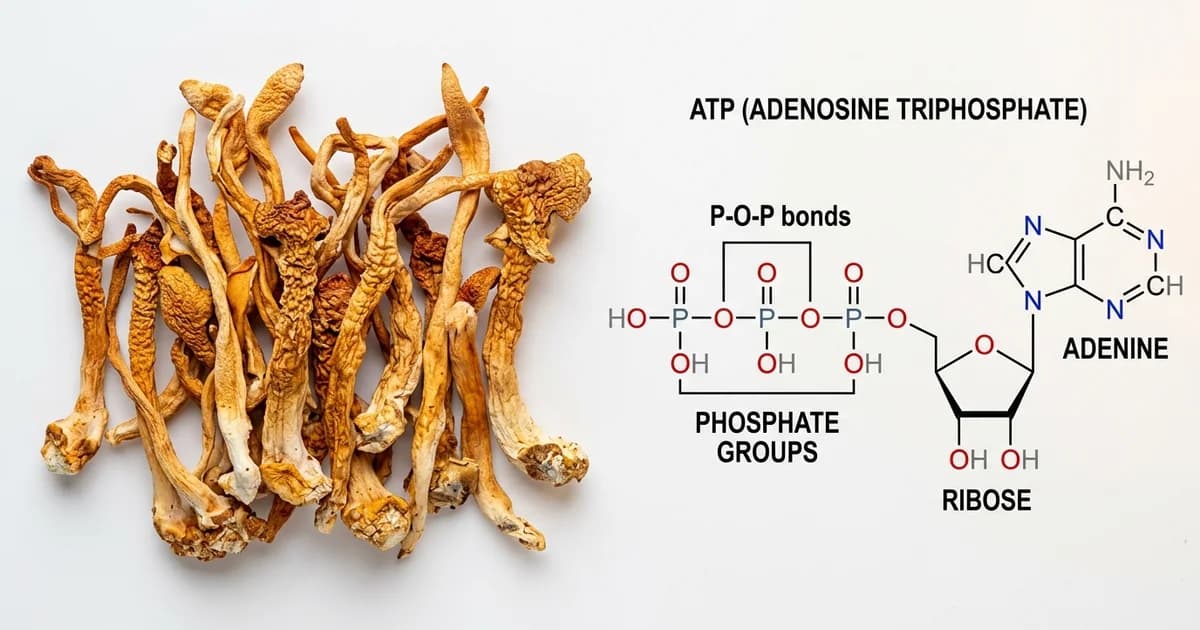
The molecules to know are cordycepin (3'-deoxyadenosine) and adenosine. Their structures look almost identical to the building blocks your body uses to make ATP. That structural mimicry is the heart of the whole story.
How Cordyceps Supports Energy: The ATP and Oxygen Mechanism
Cordyceps supports energy by helping cells produce and use ATP more efficiently, not by stimulating your nervous system like caffeine does. ATP, adenosine triphosphate, is the molecule your cells spend to do everything from contracting a muscle to firing a neuron. More efficient ATP turnover means more available energy and less fatigue.
There are two threads to the mechanism, and they reinforce each other.
The ATP Angle
Cordycepin and adenosine are close chemical cousins of the adenine nucleotides that form ATP. The working theory is that they feed into the same pathways, supporting the rate at which mitochondria regenerate ATP under load. Several reviews note that cordyceps appears to raise ATP availability rather than just dumping in raw stimulant energy.
Animal work backs this up. A 2020 study in the journal Mycobiology found that Cordyceps militaris extract improved exercise performance in mice through mechanisms tied to cellular energy production rather than brute force, with the authors crediting enhanced energy metabolism over changes in muscle size.
The Oxygen Angle
The second thread is oxygen efficiency. If your cells extract more energy per unit of oxygen, you fatigue later at the same workload. This is where the human endurance data lives.
A double-blind, placebo-controlled trial by Chen and colleagues (2010) gave healthy older adults Cs-4 for 12 weeks and measured a meaningful rise in metabolic and ventilatory thresholds, the points at which the body shifts toward less efficient anaerobic energy. In plain terms, subjects could work harder before hitting the wall. Other analyses link cordyceps to better lactate clearance, another sign of cleaner aerobic energy use.
What the Human Research Actually Shows
The headline trial on cordyceps for energy is Hirsch and colleagues (2017), a randomized, double-blind, placebo-controlled study. After three weeks of a Cordyceps militaris containing mushroom blend, recreationally active adults improved VO2 max by 4.8 ml/kg/min and extended their time to exhaustion by nearly 70 seconds versus placebo. Those are real humans, not petri dishes.
But good science includes the misses. A 2004 trial by Parcell and colleagues gave endurance-trained male cyclists Cs-4 for five weeks and found no improvement in aerobic capacity or performance. The pattern across studies is consistent: cordyceps tends to help recreational exercisers and older adults more than it helps already-elite athletes. There is more room to improve when you start lower.
Here is roughly where the evidence sits today.
| Outcome | Strength of evidence | Who benefits most |
|---|---|---|
| VO2 max / aerobic capacity | Moderate (mixed but positive in non-elite groups) | Recreational exercisers, older adults |
| Time to exhaustion / endurance | Moderate | Recreational exercisers |
| Lactate threshold / fatigue resistance | Moderate | Older and sedentary adults |
| Explosive power / sprint performance | Weak to none | Limited support |
| Acute "feel it now" energy | Weak | Not a stimulant |
Cordyceps and the Brain: Mental Stamina, Not a Buzz
Cordyceps may support mental stamina indirectly, by improving the energy supply and oxidative resilience of brain cells, but the human evidence here is thinner than the exercise data. Your brain is metabolically expensive. It runs on a steady ATP supply, and mental fatigue tracks closely with how well neurons stay fueled.
The proposed cordyceps brain benefits come from the same ATP logic plus its antioxidant and anti-inflammatory activity. A 2024 review in Frontiers in Pharmacology discusses how cordycepin engages pathways tied to cellular energy metabolism and oxidative stress, the same systems that influence neuronal health.
Read that as supportive, not conclusive. Most of the cordyceps brain work is preclinical. If you want clean, dependable mental focus you can feel during a work session, cordyceps is the wrong tool for the immediate job, even if it quietly supports the metabolic floor underneath.
How to Use Cordyceps (and What to Expect)
Set your expectations to "weeks, not minutes." The human trials that showed benefit dosed daily for one to twelve weeks, and reviews of real-world use report most people notice changes in roughly one to three weeks of consistent intake. Cordyceps fatigue support is a build, not a switch.
A few practical notes:
- Dose consistently. Trials commonly used multiple grams per day of extract. Skipping days undercuts the mechanism.
- Pick your strain on purpose. Cordyceps militaris fruiting body for cordycepin density, Cs-4 for the strain with the most endurance trials behind it.
- Match it to your starting point. If you are recreationally active or returning to training, you have the most to gain.
- It is not a pre-workout. Cordyceps will not give you a 10-minute lift before a meeting or a lift.
Conclusion
Cordyceps earns its reputation as an energy supplement, but only if you understand what kind of energy it provides. It works at the level of the mitochondria, supporting ATP turnover and oxygen efficiency so you fatigue later at the same effort. The best human evidence shows modest, real gains in VO2 max and endurance for recreational exercisers and older adults, with weaker support for elite performance and a more speculative case for the brain.
The catch is time. This is a slow, cumulative compound that asks for weeks of daily dosing before it pays out. That makes it a foundation ingredient, the kind you take to raise your baseline, not the kind you reach for when you need to be sharp in the next ten minutes. Knowing which problem you are solving is the whole game.
Frequently Asked Questions
Does cordyceps actually boost energy, or is it a placebo?
Cordyceps has the strongest human evidence of any functional mushroom for energy and endurance. Randomized, placebo-controlled trials like Hirsch (2017) showed real VO2 max and time-to-exhaustion gains after three weeks. The effect is modest and clearest in recreational exercisers and older adults, and some trials in elite athletes found nothing. It is plausible and measured, not magic.
How long does cordyceps take to work?
Plan on one to three weeks of consistent daily dosing before you notice anything, and up to twelve weeks for the larger endurance effects seen in trials. Cordyceps works by supporting cellular energy metabolism over time, so it builds gradually. It is not an acute stimulant, and a single dose will not feel like a cup of coffee.
What is the difference between Cordyceps militaris and Cs-4?
Cordyceps militaris is a species often grown for its fruiting body and prized for higher cordycepin content, the compound most tied to energy metabolism. Cs-4 is a lab-grown mycelial strain of Cordyceps sinensis used in many of the strongest human endurance trials, including Chen (2010). Both appear in quality supplements, and each camp has a fair argument.
Does cordyceps help with mental focus or brain fog?
The case for cordyceps brain benefits is real in theory but thin in humans. By supporting ATP supply and reducing oxidative stress, it may help the metabolic environment neurons rely on. Most of that evidence is preclinical, though. For dependable focus you can feel during a work session, a fast-acting option is a better fit.
Is cordyceps a stimulant like caffeine?
No. Caffeine blocks adenosine receptors in your nervous system to create acute alertness within minutes. Cordyceps works on the opposite end, supplying adenosine-like compounds that support ATP production at the cellular level over weeks. One is a fast, felt jolt. The other is a slow infrastructure upgrade. They are not interchangeable.
Who benefits most from cordyceps for energy?
The research points to recreational exercisers, people returning to training, and older or sedentary adults. These groups tend to show the largest VO2 max and endurance improvements because they start with more room to gain. Highly trained athletes show smaller or no benefits in several trials, likely because their aerobic systems are already near ceiling.
Can I take cordyceps every day?
Daily use is exactly how the clinical trials dosed it, since the mechanism depends on consistent intake. As with any supplement, talk to your healthcare provider first, especially if you are pregnant, nursing, on medication, or managing a health condition. Quality and potency vary widely between brands, so the source matters.
When You Need the Energy Now, Not in a Month
Cordyceps is a baseline play. You take it for weeks to slowly raise your aerobic and metabolic floor, and the science supports that use. What it cannot do is sharpen you on demand. There is no version of caterpillar fungus that turns a foggy afternoon into a focused one in ten minutes.
That is a different problem, and it needs a different mechanism. Roon is a sublingual pouch built for acute, fast-onset focus, using 80 mg caffeine, 60 mg L-theanine, 25 mg methylliberine (Dynamine), and 5 mg theacrine (TeaCrine). The caffeine and theanine pairing supports clean alertness without the jitters, and the format is designed to come on in 5 to 10 minutes and hold for 6 to 8 hours with no crash.
Roon is not a mitochondrial supplement and it will not replace the slow benefits of cordyceps. Think of them as two layers: cordyceps for the long-term baseline, Roon for the moment you actually need to perform. If your problem is right now, that is the layer to reach for.
Written by Roon Team