Caffeine-Pterostilbene Cocrystal (Purenergy)
Roon Team
Caffeine-Pterostilbene Cocrystal (Purenergy): The Science of "More Caffeine, Longer"
Most caffeine peaks fast and leaves faster. You feel it in 30 minutes, ride a sharp curve, and hit the dip by mid-afternoon. The caffeine pterostilbene cocrystal, sold as Purenergy, was engineered to flatten that curve so the same dose lasts longer and lands softer.
The chemistry is genuinely clever. The marketing around it is sometimes louder than the data. This piece separates the two.
By the end, you'll understand what a cocrystal actually does, what the human study really showed, and where this single-molecule approach to duration runs into its limits.
Key Takeaways
- A caffeine pterostilbene cocrystal binds caffeine to pterostilbene in one solid crystal structure, which slows how fast caffeine releases into your blood.
- In a human crossover study, Purenergy delivered roughly 30% more caffeine into the blood and absorbed about 30% slower, leading to an estimated 25% longer effect versus plain caffeine.
- A rat study reported a caffeine half-life of 8 hours from Purenergy versus 3 hours for ordinary caffeine, though human half-life data is thinner.
- Pterostilbene is a blueberry-derived antioxidant and a more bioavailable cousin of resveratrol, so you get a second active compound along for the ride.
- Slowing one molecule is one duration strategy. Stacking compounds with different half-lives is another.
What Is a Caffeine Pterostilbene Cocrystal?
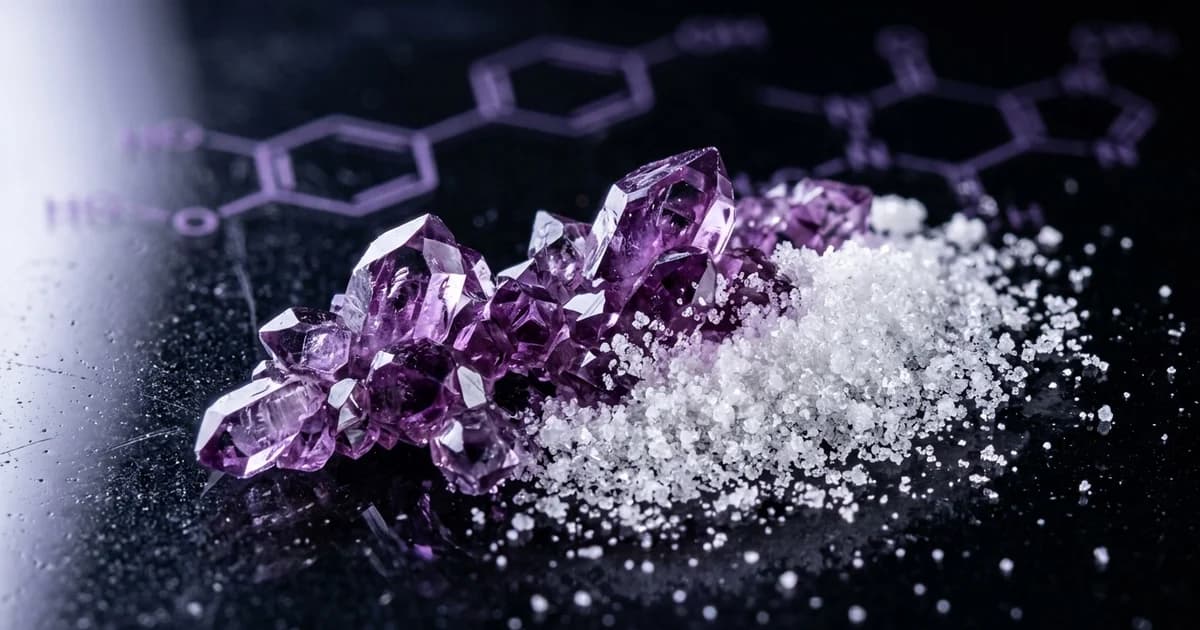
A cocrystal is a single solid built from two different molecules locked together in a repeating lattice. Cocrystals are solid structures composed of two or more different molecules, typically non-ionically bonded together, and they are engineered to improve the solubility, stability, and bioavailability of active pharmaceutical ingredients.
This is not a blend. You can mix caffeine powder and pterostilbene powder in a bowl and you still have two separate powders. A cocrystal forms a new crystalline structure where both molecules sit in fixed positions, held by weak non-covalent bonds.
That structural change is the whole point. Cocrystallization of a drug substance with a coformer is a promising approach to improve the performance of pharmaceuticals, such as solubility, dissolution profile, pharmacokinetics and stability. When you change how a crystal dissolves, you change how fast the body absorbs what's inside it.
In Purenergy, caffeine is the active you care about and pterostilbene is the coformer. Purenergy is a patented combination of caffeine and the branded antioxidant pTeroPure pterostilbene, made by ChromaDex; it is protected by U.S. patent 8399712, which describes combining caffeine and pterostilbene in a cocrystal form either by grinding the two solids together or by dissolving one in a solvent, mixing it with the other, and isolating the solid crystals.
The Pterostilbene Half: More Than a Carrier
Pterostilbene isn't an inert filler. It's a bioactive compound in its own right. Pterostilbene is a compound most abundantly found in blueberries and is a natural analog of resveratrol; while resveratrol has been studied extensively for its antioxidant properties, pterostilbene shows better intestinal absorption and raised hepatic stability than resveratrol.
That bioavailability gap matters. Pterostilbene, a methoxylated analog of resveratrol, is gaining importance owing to its higher lipophilicity, bioavailability and biological activity than resveratrol. So the cocrystal delivers a useful second molecule, not just a chemical handle for slowing caffeine down.
How the Cocrystal Slows Caffeine Down
The cocrystal dissolves more gradually than plain caffeine, so caffeine trickles into your bloodstream instead of flooding it. That slower release is what produces the longer, flatter response people describe.
Here is what the human work actually found. In a four-week, single-blind, crossover human study comparing 232 mg of Purenergy, which provides 99.76 mg of caffeine, against 100 mg of ordinary caffeine, Purenergy delivered almost 30% more caffeine into the blood than ordinary caffeine. The absorption rate of the caffeine from Purenergy was slower by approximately 30% compared to ordinary caffeine.
The study also tracked the pterostilbene side. In that human study, Purenergy delivered approximately 50% more total pterostilbene into the blood than pTeroPure pterostilbene given alone.
The headline summary from a review of the same data: a human study showed that Purenergy increases blood caffeine levels by 30% more than ordinary caffeine and has a 30% slower rate of caffeine absorption, leading to 25% longer effects. The same review is honest about the limits, noting you cannot draw firm conclusions from a single study.
The Half-Life Question: What "Slow Release" Really Means
The most quoted stat for caffeine pterostilbene half life comes from animal data, not humans. In a rat study, the half-life of caffeine from Purenergy was eight hours, while that of ordinary caffeine was just three hours.
Read that carefully. Rat pharmacokinetics don't map one-to-one onto human pharmacokinetics, and the human study measured absorption rate and blood levels rather than reporting a clean human half-life figure. So "8-hour half-life" is a rat number, not a confirmed human one. Treat it as directional, not literal.
The practical translation is more grounded. A slow release caffeine supplement built on this cocrystal raises caffeine more gradually and keeps it raised longer, which is why formulators can use less total caffeine. Based on the clinical evaluation, PURENERGY provides formulators the ability to reduce the total amount of caffeine in their products by as much as 50% without sacrificing what consumers expect; the cross-over evaluation was designed to determine the relative bioavailability, pharmacokinetics and safety of PURENERGY.
The study was run by a named team, which is worth knowing for credibility. The clinical evaluation was conducted by scientists from Miami Research Associates in Miami, FL, led by principal investigator Dr. Diane R. Krieger, and it compared the co-crystallized caffeine in PURENERGY with ordinary caffeine.
Two Ways to Make Caffeine Last Longer
There are really only two strategies for extending a stimulant's reach. You can chemically slow a single molecule, or you can stack several molecules with different half-lives so something is always active. The cocrystal is strategy one. A multi-compound stack is strategy two.
The table below compares the common approaches, including how Roon handles duration.
| Approach | How it extends duration | What you actually take | Tradeoffs |
|---|---|---|---|
| Caffeine pterostilbene cocrystal (Purenergy) | Slows release of one caffeine molecule via crystal structure | ~232 mg Purenergy ≈ 100 mg caffeine + pterostilbene | Elegant single-ingredient fix; human half-life data is thin, mostly rat-based |
| Extended-release caffeine capsule | Coating or matrix delays dissolution | Coated/beadlet caffeine | Depends on capsule passing through digestion; absorption can be variable |
| Plain caffeine + L-theanine | Theanine smooths the edge, doesn't extend duration much | 100 mg caffeine + 200 mg L-theanine | Calmer focus, but the caffeine curve still peaks and dips |
| Multi-compound stack (Roon) | Layers compounds with different half-lives | 80 mg caffeine, 60 mg L-theanine, 25 mg methylliberine, 5 mg theacrine | Staggered onset and tail; more ingredients to dose correctly |
Both strategies aim at the same enemy: the caffeine crash. They just attack it from different angles.
Why Different Half-Lives Matter
Stacking works because each compound clocks in at a different time. Methylliberine, sold as Dynamine, is a fast-acting purine alkaloid related to caffeine with an ultra-short half-life of about one hour, and research suggests it improves subjective energy, mood, and motivation without the jitters, crashes, or sleep disruption.
Theacrine sits at the other end. Theacrine tends to have a longer half-life than caffeine, providing a more sustained energy boost over time without the sudden crash. Put fast and slow compounds together and you get a relay.
In a layered profile, methylliberine kicks in first and starts fading as caffeine hits its stride, while theacrine provides a long, smooth tail of sustained alertness. That is duration by sequencing rather than by chemistry on one molecule.
If you want to go deeper on those purine alkaloids, our breakdowns of how theacrine sustains energy without a crash and why methylliberine acts so fast cover the mechanisms in detail.
Conclusion
The caffeine pterostilbene cocrystal is real chemistry doing real work. Binding caffeine to pterostilbene in a single crystal slows its release, raises blood levels, and stretches the effect, while delivering a bioactive antioxidant on the side. The human evidence points in a consistent direction, even if the dramatic "8-hour half-life" figure comes from rats and the human dataset is still small.
The deeper lesson is about strategy. Slowing one molecule and stacking several molecules are two valid routes to the same goal, which is energy that lasts without the cliff at the end. One is elegant in its simplicity. The other is flexible because each ingredient can be dialed in for a specific job.
Neither approach makes caffeine magic. They just make it behave.
Frequently Asked Questions
What is Purenergy made of?
Purenergy is a patented caffeine pterostilbene cocrystal from ChromaDex. It combines caffeine with the branded antioxidant pTeroPure pterostilbene in a cocrystal form. Caffeine makes up roughly 43% by weight and pterostilbene about 57%, so a 232 mg dose provides close to 100 mg of caffeine plus a meaningful amount of pterostilbene. The pterostilbene functions both as the structural coformer and as a bioactive antioxidant.
Does the caffeine pterostilbene cocrystal really last longer?
The data supports a longer, gentler effect. A human study showed Purenergy increased blood caffeine levels by 30% more than ordinary caffeine, with a 30% slower absorption rate that led to roughly 25% longer effects. The often-cited 8-hour half-life, however, comes from a rat study, not a confirmed human measurement, so treat the longer-lasting claim as well-supported in direction but modest in the size of its human evidence base.
What is the caffeine pterostilbene half life in humans?
There is no clean confirmed human half-life number for the cocrystal. The widely quoted 8-hour figure came from a rat study, compared with 3 hours for ordinary caffeine in the same animals. Human work measured slower absorption and higher blood levels rather than a precise half-life. So the honest answer is that the human pharmacokinetics suggest a longer effect, but a specific human half-life remains undetermined from the published consumer-facing data.
Is pterostilbene safe and what does it do?
Pterostilbene is a naturally occurring compound studied for its antioxidant activity. It is found most abundantly in blueberries, is a natural analog of resveratrol, and shows better intestinal absorption and higher hepatic stability than resveratrol. In the cocrystal it acts as both the coformer that slows caffeine and a second active you absorb. As with any supplement, dosing and individual tolerance matter, and this is not medical advice.
How is this different from extended-release caffeine capsules?
An extended-release capsule relies on a coating or matrix to delay when caffeine dissolves, so its performance depends on how the capsule moves through digestion. The cocrystal builds the slow release into the molecule's crystal structure itself. Both aim to flatten the caffeine curve, but they engineer the delay at different stages, one in the capsule and one in the chemistry.
Can you stack caffeine pterostilbene with L-theanine?
Yes. L-theanine pairs well with most caffeine sources because it smooths the stimulant edge without blunting focus. The cocrystal still delivers caffeine, just more gradually, so adding L-theanine works the same way it would with plain caffeine. Many cognitive formulas combine the two, often near a 1:2 caffeine-to-theanine ratio, to support calm, steady focus.
Why would a brand use a multi-compound stack instead of a cocrystal?
Flexibility. A cocrystal is one elegant molecule with a fixed behavior. A stack lets each ingredient do a separate job, with methylliberine kicking in first and fading as caffeine peaks, while theacrine carries a long, smooth tail. That lets a formulator tune onset and duration independently rather than accepting whatever single profile one cocrystal provides.
Duration by Sequencing, Not Just by Chemistry
If the cocrystal taught you anything, it's that the fight against the caffeine crash is really a fight about timing. Roon takes the second route. Instead of chemically slowing one molecule, it layers four compounds with different half-lives so the handoff happens inside you.
Each sublingual pouch carries 80 mg caffeine, 60 mg L-theanine, 25 mg methylliberine (Dynamine), and 5 mg theacrine (TeaCrine). Methylliberine moves fast, caffeine and theanine cover the middle, and theacrine carries the long tail, which is how the format targets 6 to 8 hours of steady focus with no jitters and no crash. Sublingual delivery also means onset in about 5 to 10 minutes, faster than waiting on a capsule to dissolve in your gut.
To be clear about what it isn't: Roon is not a Purenergy product, not a substitute for sleep, and not a medical treatment for anything. It's a different answer to the same duration problem. If you've been chasing longer focus by drinking more coffee, it's worth trying the sequencing approach instead.
Written by Roon Team