Caffeine Citrate: The Fast-Onset Form Hospitals Use
Roon Team
Caffeine Citrate: The Fast-Onset Form Hospitals Use (and What It Teaches Us)
Walk into a neonatal intensive care unit and you will find caffeine in the drug cabinet. Not the coffee kind. Caffeine citrate, a specific salt form prescribed to premature babies who forget to breathe. It is one of the most-used medications in newborn medicine, and the reason it gets chosen over plain caffeine has a lot to teach anyone who cares about how fast a stimulant actually works.
This is not really a story about babies. It is a story about chemistry, absorption, and a marketing claim you have probably seen on a pre-workout label.
Here is the short version. Caffeine citrate is caffeine bonded with citric acid to make it dissolve faster, and faster dissolving can mean faster absorption. But the form comes with a catch most labels never mention.
Key Takeaways
- Caffeine citrate is roughly 50% actual caffeine by weight. A 100 mg dose delivers about 50 mg of caffeine base, according to the molecular math behind the compound.
- Hospitals use it for apnea of prematurity, where its solubility and reliable dosing matter more than for a healthy adult.
- The speed advantage comes from solubility, not a different drug. Once dissolved, citrate and anhydrous caffeine behave identically in your bloodstream.
- If onset speed is the goal, how you deliver caffeine matters as much as which salt you pick.
What Is Caffeine Citrate?
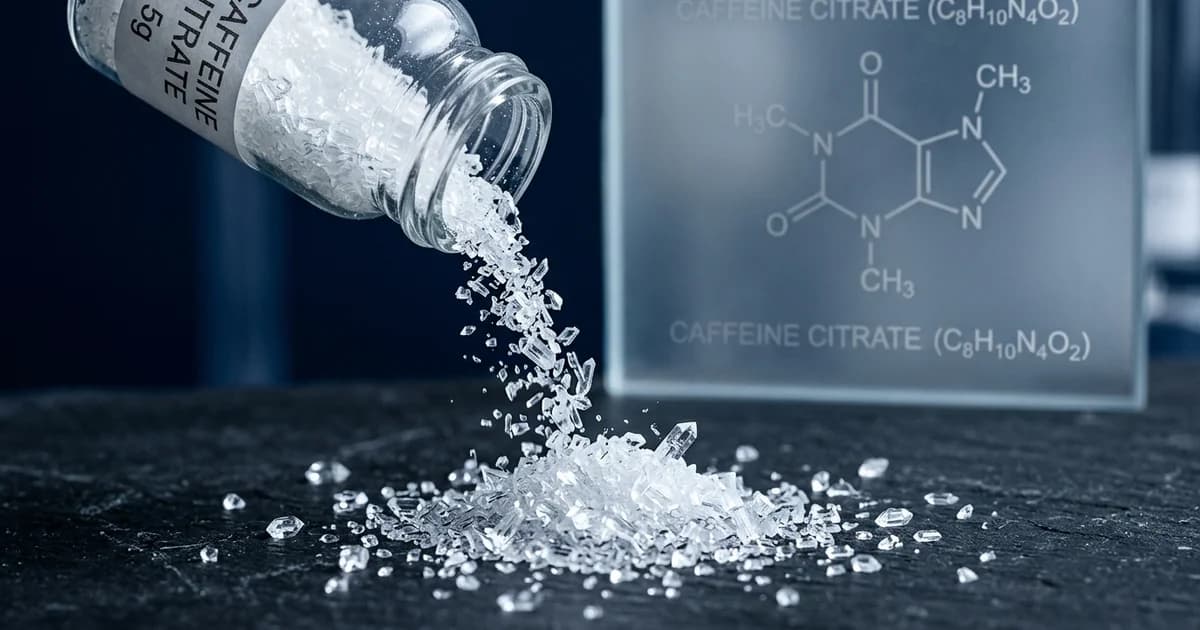
Caffeine citrate is caffeine combined with citric acid and sodium citrate into a single salt that dissolves more readily in water than raw caffeine powder. That is the whole trick.
The molecule pairs the active stimulant with an acid carrier. The percentage of caffeine in caffeine citrate is about 50% (MW ratio: 194.19/386.3 = 50.3%); it is important to confirm whether the prescribed dosage calls for caffeine or for caffeine citrate. So when a label lists "200 mg caffeine citrate," only about 100 mg of that is caffeine doing the work.
The form earned its reputation in hospitals, not gyms. Caffeine citrate contains anhydrous citric acid and 50% anhydrous caffeine base. Pharmacists like it because it dissolves cleanly into a stable oral liquid, which makes precise dosing easier for tiny patients.
Why Hospitals Use Caffeine Citrate
Caffeine citrate is the standard treatment for apnea of prematurity, a condition where premature infants pause their breathing. The drug stimulates the respiratory center in the brain and keeps them breathing on a schedule.
The dosing is exact because the patients are fragile. Per the FDA label for CAFCIT, a 1 mL/kg (20 mg/kg caffeine citrate providing 10 mg/kg as caffeine base) loading dose is administered intravenously, followed by a 0.25 mL/kg (5 mg/kg caffeine citrate providing 2.5 mg/kg of caffeine base) daily maintenance dose. Notice the language. Every dose is written twice, once as citrate and once as base, because confusing the two could double or halve the real amount of caffeine.
That distinction is the entire point. The dose of caffeine base is one-half the dose when expressed as caffeine citrate (e.g., 20 mg of caffeine citrate is equivalent to 10 mg of caffeine base). Hospitals build their whole protocol around not getting that conversion wrong.
The solubility helps here too. A salt that dissolves fast and predictably gives clinicians tight control over what reaches the bloodstream, which matters far more when your patient weighs two pounds than when a healthy adult downs a pre-workout.
Caffeine Citrate vs Anhydrous: The Real Difference
Once dissolved, caffeine citrate and caffeine anhydrous deliver the exact same molecule to your bloodstream. The body does not see "citrate caffeine" versus "anhydrous caffeine." It sees caffeine. The only variable is how quickly the dose dissolves and gets absorbed.
Caffeine anhydrous is simply dehydrated, concentrated caffeine powder. "Caffeine" and "caffeine anhydrous" are the terms that appear most often on dietary supplement labels, but they're basically the same thing. It is cheap, potent, and the default in most energy products.
Citrate's pitch is speed through solubility. This mixture increases the solubility and absorption speed of the caffeine in your body. It is commonly used in medical settings, especially in treating premature infants for apnea, because it acts more rapidly than anhydrous caffeine. The faster a compound dissolves, the faster it can cross into circulation.
Here is the part the labels skip. For a healthy adult swallowing a pill, regular caffeine is already absorbed almost completely. A 2018 review of caffeine pharmacokinetics reports that caffeine is about 99 percent absorbed within 45 minutes of ingestion, with peak plasma concentrations occurring between 15 and 120 minutes after oral intake. When absorption is already near-total and reasonably quick, a faster-dissolving salt buys you minutes at the margin, not a different category of effect.
Caffeine Citrate Dosage and the Conversion Trap
The single most useful thing to know about caffeine citrate dosage is the 50% rule. Whatever number you see on the label, cut it in half to find the real caffeine content.
This trips people up constantly. A supplement boasting "300 mg caffeine citrate" is giving you about 150 mg of caffeine, which is roughly a strong cup of coffee, not a megadose. Read the panel before you assume you are getting more than you are.
Caffeine Forms Compared
Here is how the common forms stack up on the variables that actually matter: real caffeine content, onset speed, and delivery method.
| Caffeine Form | Approx. Caffeine by Weight | Onset Driver | Typical Use |
|---|---|---|---|
| Caffeine anhydrous | ~100% | Standard digestion | Most pre-workouts, energy products |
| Caffeine citrate | ~50% | Faster dissolving | Hospital apnea treatment, some pre-workouts |
| Caffeine (coffee) | Varies by brew | Standard digestion, plus food in gut | Everyday consumption |
| Roon (sublingual pouch) | 80 mg caffeine per pouch | Absorption across cheek and gum | Sustained focus, no-crash window |
Two takeaways. First, citrate's "fast" claim is real but modest for healthy adults. Second, the delivery route can move onset more than the salt ever will, which is where sublingual absorption enters the picture.
Is Fast Acting Caffeine Worth Chasing?
For most people, the obsession with fast acting caffeine is misplaced. The difference between caffeine that peaks at 30 minutes and 45 minutes rarely changes your day.
What actually wrecks people is not slow onset. It is the spike and crash. A fast, sharp peak from a big dose often means a steeper drop a few hours later, plus jitters on the way up.
So the smarter question is not "how do I feel it faster," but "how do I feel it cleanly and for longer." That is a formulation problem, not a salt problem. It depends on the dose, the pairing ingredients like L-theanine, and the route of delivery.
If you want to go deeper on the smoothing partner that takes the edge off caffeine, our breakdown of the caffeine and L-theanine combination for focus covers why the pairing beats caffeine alone.
The Conclusion: Speed Is About Delivery, Not Just Chemistry
Caffeine citrate earned its place in hospitals for good reasons. It dissolves fast, doses predictably, and keeps premature infants breathing. Those are real strengths in a clinical setting where precision is everything.
For a healthy adult, the lesson is more subtle. Citrate is half caffeine by weight, and its speed edge is small once you account for how completely your body already absorbs ordinary caffeine. The salt is not magic. It is solubility chemistry with a hospital pedigree.
The more interesting variable is the route. Swallowing means your dose has to survive the stomach and the liver before it works. Skip that path, and onset changes far more than swapping one powder for another ever could.
Frequently Asked Questions
What is caffeine citrate?
Caffeine citrate is caffeine bonded with citric acid and sodium citrate to form a salt that dissolves more easily in water than plain caffeine. It is about 50% caffeine by weight, with the rest being the acid carrier. Hospitals use it most, especially to treat apnea of prematurity in newborns, because its solubility allows clean, precise dosing in an oral liquid.
How fast does caffeine citrate work?
Caffeine citrate's onset advantage comes from dissolving faster, which can speed absorption slightly. For healthy adults this matters less than it sounds, because ordinary caffeine is already roughly 99% absorbed within 45 minutes, with peak plasma levels between 15 and 120 minutes. The form helps most in clinical settings where reliable, rapid dosing is the priority.
Is caffeine citrate stronger than caffeine anhydrous?
No. Once dissolved, both deliver the identical caffeine molecule to your bloodstream. Caffeine anhydrous is close to 100% caffeine by weight, while caffeine citrate is about 50%. So a milligram of citrate on a label is half the caffeine of a milligram of anhydrous. The difference is dissolving speed, not potency.
How do I read caffeine citrate dosage on a label?
Cut the listed number roughly in half. The dose of caffeine base is one-half the dose expressed as caffeine citrate, so 200 mg of caffeine citrate provides about 100 mg of actual caffeine. Always check whether a product lists the citrate amount or the caffeine base amount before judging the strength.
Why do hospitals use caffeine citrate for premature babies?
Caffeine citrate stimulates the brain's respiratory center, helping premature infants who pause their breathing. A standard regimen uses a 20 mg/kg loading dose of caffeine citrate (10 mg/kg as caffeine base), then a smaller daily maintenance dose. Its predictable solubility and precise dosing make it well suited to fragile newborns.
Is caffeine citrate used in supplements and pre-workouts?
Yes. Some pre-workouts include caffeine citrate alongside anhydrous caffeine, marketing it as a fast-acting component. The claim has a basis in solubility, but remember the 50% rule. A large-looking citrate number on the label translates to roughly half that much actual caffeine.
Where the Speed Question Actually Gets Solved
Caffeine citrate sells one thing above all: faster onset through faster dissolving. The catch is that you pay for it with a diluted, half-caffeine salt, and the real-world speed gain for a healthy adult is small once you account for how well your body already absorbs ordinary caffeine.
Roon gets to fast onset from a different direction. Instead of changing the salt, it changes the route. The pouch sits between your lip and gum, so caffeine absorbs directly across the cheek and under the tongue, which starts working in roughly 5 to 10 minutes without doubling the dose or relying on a citrate carrier. Each pouch pairs 80 mg caffeine with 60 mg L-theanine, 25 mg methylliberine (Dynamine), and 5 mg theacrine (TeaCrine), built for 6 to 8 hours of steady focus with no jitters, no crash, and no tolerance buildup.
To be clear, Roon is not a medication and is not a replacement for caffeine citrate's clinical role. It is a cognitive performance pouch for adults who want clean, fast, lasting focus. If the speed claim on your pre-workout is what drew you in, try Roon and judge the onset for yourself.
Written by Roon Team