Brain Fog Exercises: The Complete Guide to Clearing Mental Haze
You're staring at your screen. The words blur together. You read the same sentence three times and retain nothing. That thick, sluggish feeling between your ears isn't laziness, and there are neuroscience-backed ways of clearing mental haze fast. It's brain fog, and it responds remarkably well to the right kind of physical and mental exercise.
Brain fog exercises range from a simple 20-minute walk to structured resistance training, breathwork, and mindfulness practices. Each one targets a different mechanism behind cognitive cloudiness, from poor cerebral blood flow to elevated cortisol to depleted neurotransmitters. This guide breaks down the specific brain fog exercises that research supports, explains why they work at the neurological level, and gives you a practical routine you can start today.
Key Takeaways:
- Aerobic brain fog exercises increase BDNF (brain-derived neurotrophic factor), a protein directly linked to memory and mental clarity.
- Resistance training improves executive function, including attention control and working memory.
- Mindfulness meditation produces measurable gains in sustained attention and cognitive flexibility across 111 randomized controlled trials.
- Combining physical movement with targeted breathwork creates the fastest path out of a fog state.
Why Brain Fog Happens (And Why Brain Fog Exercises Fix It)
Brain fog isn't a clinical diagnosis. It's a cluster of symptoms: poor concentration, slow processing speed, difficulty finding words, and a general sense that your brain is running at 40% capacity. The underlying causes usually fall into a few categories.
Chronic stress floods your prefrontal cortex with cortisol, the same brain region responsible for focus and decision-making. Over time, elevated cortisol impairs working memory and shrinks hippocampal volume.
Poor sleep disrupts your glymphatic system, the brain's waste-clearance mechanism that operates primarily during deep sleep. Skip enough quality rest and metabolic waste accumulates, literally gunking up neural signaling.
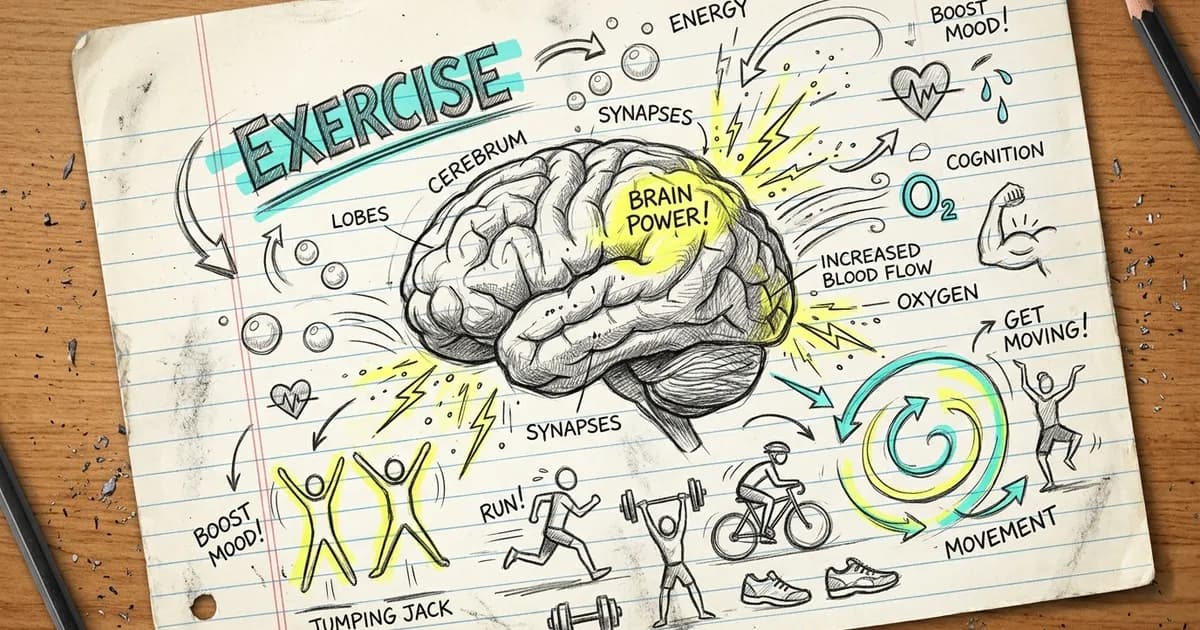
Sedentary behavior reduces cerebral blood flow. Your brain consumes roughly 20% of your body's oxygen despite being only 2% of your body weight. Sit at a desk for eight hours and you're starving it of fuel.
Brain fog exercises attack all three problems simultaneously. They lower cortisol, improve sleep architecture, and increase blood flow to the brain within minutes of starting. But the type of exercise matters.
Aerobic Brain Fog Exercises: The Most Studied Fix
A 2025 umbrella review published in the British Journal of Sports Medicine analyzed decades of research and found that regular exercise improves general cognition, memory, and executive function in both healthy individuals and those with clinical conditions. This wasn't a small finding. It was the largest review of its kind, synthesizing data from multiple meta-analyses.
The key mechanism is BDNF (brain-derived neurotrophic factor). Think of BDNF as fertilizer for neurons. It promotes the growth of new brain cells, strengthens existing synaptic connections, and protects against neurodegeneration. A 2025 review in Frontiers in Neurology confirmed that recent studies indicate an increase in BDNF levels following physical activity, particularly in young adults.
What Counts as Aerobic Brain Fog Exercises?
You don't need to run a marathon. The threshold is lower than most people think:
- Brisk walking (15-30 minutes) increases cerebral blood flow and triggers BDNF release.
- Jogging or cycling at moderate intensity (where you can hold a conversation but feel slightly winded) appears to be the sweet spot for cognitive benefits.
- Swimming combines rhythmic breathing with full-body movement, addressing both oxygenation and stress reduction.
The minimum effective dose appears to be around 150 minutes per week of moderate aerobic activity, which lines up with WHO recommendations. But even a single 20-minute walk can produce acute improvements in attention and processing speed.
A Simple Aerobic Protocol for Brain Fog
If you're currently sedentary, start here:
| Week | Activity | Duration | Frequency |
|---|---|---|---|
| 1-2 | Brisk walking | 15 min | 5x/week |
| 3-4 | Brisk walking | 25 min | 5x/week |
| 5-6 | Walk/jog intervals | 25 min | 4x/week |
| 7-8 | Steady jogging or cycling | 30 min | 4x/week |
The goal isn't athletic performance. It's consistent cerebral blood flow and BDNF production.
Resistance Training: Overlooked Brain Fog Exercises
Most brain fog advice focuses on cardio. That's incomplete. A 2025 systematic review and meta-analysis in Frontiers in Psychiatry found that resistance training improved overall cognitive function, working memory, verbal learning and memory, and spatial memory span, with measurable effect sizes across all four domains.
The mechanism differs from aerobic exercise. Resistance training increases levels of IGF-1 (insulin-like growth factor 1), which crosses the blood-brain barrier and supports neuronal health. It also reduces systemic inflammation, a known contributor to brain fog.
Best Resistance Brain Fog Exercises for Mental Clarity
You don't need a gym membership. Bodyweight brain fog exercises work:
- Squats (3 sets of 10-15 reps): Large muscle group activation drives the biggest hormonal response.
- Push-ups (3 sets of 8-12 reps): Upper body compound movement that raises heart rate and IGF-1.
- Deadlifts or hip hinges (3 sets of 8-10 reps): Posterior chain engagement with high neural demand.
- Farmer's carries (3 sets of 30-second holds): Grip strength plus full-body stabilization forces your brain to coordinate multiple systems at once.
Two to three sessions per week is enough to see cognitive benefits. The Pacific Neuroscience Institute notes that resistance training improves executive function, which includes abilities such as attention control, working memory, and cognitive flexibility.
Mindfulness and Meditation: Brain Fog Exercises That Train Your Mind Directly
Physical exercise changes the brain's hardware. Mindfulness changes the software. Both matter for clearing brain fog.
A 2024 meta-analysis of 111 randomized controlled trials found that mindfulness-based interventions had small-to-moderate significant effects on global cognition, executive attention, working memory accuracy, inhibition accuracy, shifting accuracy, sustained attention, and subjective cognitive functioning. That's not a marginal benefit. That's improvement across nearly every cognitive domain that brain fog disrupts.
Practical Mindfulness Brain Fog Exercises
1. Focused Attention Meditation (10 minutes) Sit comfortably. Close your eyes. Focus on the sensation of breathing at your nostrils. When your mind wanders (it will, constantly), gently return attention to the breath. That act of noticing the wandering and redirecting, that is the exercise. Each repetition strengthens your attentional control the same way a bicep curl strengthens your arm.
2. Body Scan (15 minutes) Lie down. Starting at the top of your head, slowly move your attention through each body part, noticing sensations without trying to change them. This practice reduces the mental "noise" that contributes to foggy thinking by training your brain to observe rather than react.
3. Box Breathing (5 minutes) Inhale for 4 counts. Hold for 4 counts. Exhale for 4 counts. Hold for 4 counts. Repeat. This activates the parasympathetic nervous system, lowering cortisol and calming the prefrontal cortex so it can do its actual job: helping you think clearly.
Box breathing works as an acute intervention. Feeling foggy before a meeting? Five minutes of box breathing can shift your nervous system state faster than almost anything else.
Brain Fog Exercises You Can Do at Your Desk
Not every foggy moment allows for a full workout. Here are brain fog exercises that take less than five minutes and require zero equipment:
Neck and shoulder rolls. Tension in the cervical spine restricts blood flow to the brain. Thirty seconds of slow, deliberate neck circles can provide surprising relief.
Standing calf raises. Stand up, rise onto your toes, lower back down. Repeat 20 times. This activates the "second heart" (your calf muscles), which pumps blood back toward your brain. Simple. Effective.
Eye exercises. The 20-20-20 rule: every 20 minutes, look at something 20 feet away for 20 seconds. Digital eye strain contributes to the feeling of brain fog more than most people realize.
Cold water on the wrists. Run cold water over the insides of your wrists for 30 seconds. The sudden temperature change triggers a mild sympathetic nervous system response that increases alertness.
Building a Daily Brain Fog Exercise Routine
Isolated brain fog exercises help. A consistent routine changes your baseline. Here's a practical daily framework:
Morning (20-30 minutes):
- 5 minutes of box breathing or focused attention meditation
- 20 minutes of brisk walking, jogging, or cycling
Midday (5-10 minutes):
- Desk brain fog exercises: neck rolls, calf raises, 20-20-20 rule
- 5 minutes of box breathing if stress is high
Afternoon (20-30 minutes, 3x/week):
- Resistance training: squats, push-ups, hip hinges, farmer's carries
- 10-minute body scan meditation before bed (improves sleep quality, which prevents tomorrow's brain fog)
This routine totals about 45-60 minutes on training days and 30 minutes on rest days. The compounding effect is real. After two to three weeks of consistent brain fog exercises, most people report a noticeable shift in baseline mental clarity.
When Brain Fog Exercises Alone Aren't Enough
Brain fog exercises are the foundation. But some days, your brain needs more direct support, especially during high-demand periods where sleep is short and stress is high.
That's where targeted nootropic ingredients come in, and Roon's nootropic pouches are formulated for exactly these high-demand moments. The same neuroscience that explains why brain fog exercises clear mental haze also explains why compounds like L-Theanine promote calm focus, why caffeine (in the right dose) sharpens attention, and why newer compounds like Theacrine and Methylliberine extend mental energy without the crash or tolerance buildup that coffee creates.
Roon combines all four of these ingredients in a sublingual pouch designed for exactly these moments: the midafternoon fog that a morning workout couldn't fully prevent, the post-lunch haze before a critical meeting, the days when your routine gets disrupted. It's not a replacement for the brain fog exercises in this guide. It's what fills the gaps when your biology needs a faster assist.
If brain fog is something you deal with regularly, build the exercise habits first. Then see what Roon can do on top of that foundation.