Brain Fog Celiac: Why Gluten Wrecks Your Thinking and What to Do About It
Roon Team
Brain Fog Celiac: Why Gluten Wrecks Your Thinking and What to Do About It
You just ate a sandwich, and if you've ever experienced brain fog after eating, you know what comes next: two hours later, you can't remember your coworker's name. Your thoughts feel like they're moving through wet cement. Words that should come easily get stuck somewhere between your brain and your mouth.
If you have celiac disease, this isn't just a bad day. Brain fog celiac is a recognized cognitive symptom that affects up to 90% of people with the condition, according to a Beyond Celiac survey. And unlike the gut symptoms most doctors focus on, brain fog celiac symptoms can persist even when you think you're doing everything right.
This guide breaks down what's actually happening in your brain, why a gluten-free diet only solves part of the problem, and what else you can do to get your mental clarity back.
Key Takeaways
- Brain fog celiac symptoms include difficulty concentrating, forgetfulness, grogginess, and a feeling of mental detachment.
- The root causes go beyond gluten exposure: systemic inflammation, nutrient deficiencies, and gut-brain axis disruption all play a role.
- A strict gluten-free diet improves cognitive function, but recovery can take up to 12 months for full improvement.
- Targeted nutritional support and specific nootropic compounds can help fill the gaps while your gut heals.
What Brain Fog Celiac Actually Feels Like
Brain fog isn't a clinical diagnosis. It's a patient-reported experience, and for years, the medical establishment didn't take brain fog celiac seriously. That changed in 2024, when researchers published the first validated Brain Fog Assessment and Severity Scale (BFASS) specifically for celiac disease in the journal Alimentary Pharmacology and Therapeutics.
The most commonly reported symptoms, according to the AAFP, are difficulty concentrating, forgetfulness, and grogginess, followed by a feeling of detachment. More than half of survey participants said brain fog celiac episodes lasted one to two days or longer after gluten exposure.
This isn't subtle. People describe brain fog celiac as feeling like they're thinking through a wall. Reading a paragraph three times and retaining nothing. Walking into a room and forgetting why.
It's Not "Just" a Gut Disease
Celiac disease gets filed under gastroenterology, and that framing does patients a disservice. The Celiac Disease Foundation describes it plainly: celiac disease has a wide variety of symptoms that affect other parts of the body, including the mind. Problems with staying focused, paying attention, and lapses in short-term memory are all part of the brain fog celiac picture.
A 2017 review published in the Journal of Gastroenterology and Hepatology confirmed that subjective reports of brain fog are backed by measurable deficits in processing speed and visual-spatial memory. Brain fog celiac isn't imagined. It shows up on cognitive tests.
Why Celiac Disease Causes Brain Fog: Three Mechanisms
The connection between your gut and your brain isn't metaphorical. There are at least three distinct pathways through which celiac disease degrades cognitive function.
1. Systemic Inflammation and Cytokines
Untreated celiac disease triggers a chronic immune response. Your body produces antibodies against gluten proteins, but the collateral damage extends far beyond the intestinal lining. According to the Celiac Disease Foundation, systemic inflammation caused by untreated celiac disease leads to high levels of circulating cytokines. These inflammatory molecules cross the blood-brain barrier and interfere with neurotransmitter function, driving brain fog celiac symptoms.
A 2022 review in PMC detailed how anti-tissue transglutaminase antibodies (ATG2A) can initiate an inflammatory response at the blood-brain barrier itself. Brain endothelial cells normally express TG2, and when antibodies bind to them, the result is direct neuroinflammation.
Think of it this way: your immune system is so busy fighting gluten that it starts picking fights with your brain's infrastructure.
2. Nutrient Deficiencies That Starve the Brain
Celiac disease destroys the villi in your small intestine, the finger-like projections responsible for absorbing nutrients. When those are damaged, your brain loses access to the raw materials it needs to function, worsening brain fog celiac.
A Mayo Clinic study found that micronutrient deficiencies are common at the time of celiac diagnosis. Zinc deficiency was the most frequent, affecting 59.4% of patients. Other common deficiencies included iron, vitamin D, copper, vitamin B12, and folate.
Every single one of those nutrients plays a direct role in cognitive function:
| Nutrient | Role in Brain Function | Deficiency Prevalence in Celiac |
|---|---|---|
| Zinc | Neurotransmitter regulation, synaptic plasticity | 59.4% |
| Iron | Oxygen transport to brain tissue | Common |
| Vitamin B12 | Myelin sheath maintenance, nerve signaling | Common |
| Folate | DNA synthesis, neurotransmitter production | Common |
| Vitamin D | Neuroprotection, mood regulation | Common |
As Birmingham Gastroenterology Associates notes, low folate levels can contribute to cognitive decline and depression. B12 deficiency leads to neurological issues. These aren't minor inconveniences. They're direct hits to your brain's operating system, and they explain why brain fog celiac persists even on a gluten-free diet.
3. The Gut-Brain Axis
Your gut and brain communicate constantly through the vagus nerve, the immune system, and the microbiome. When celiac disease damages the gut lining, that communication breaks down.
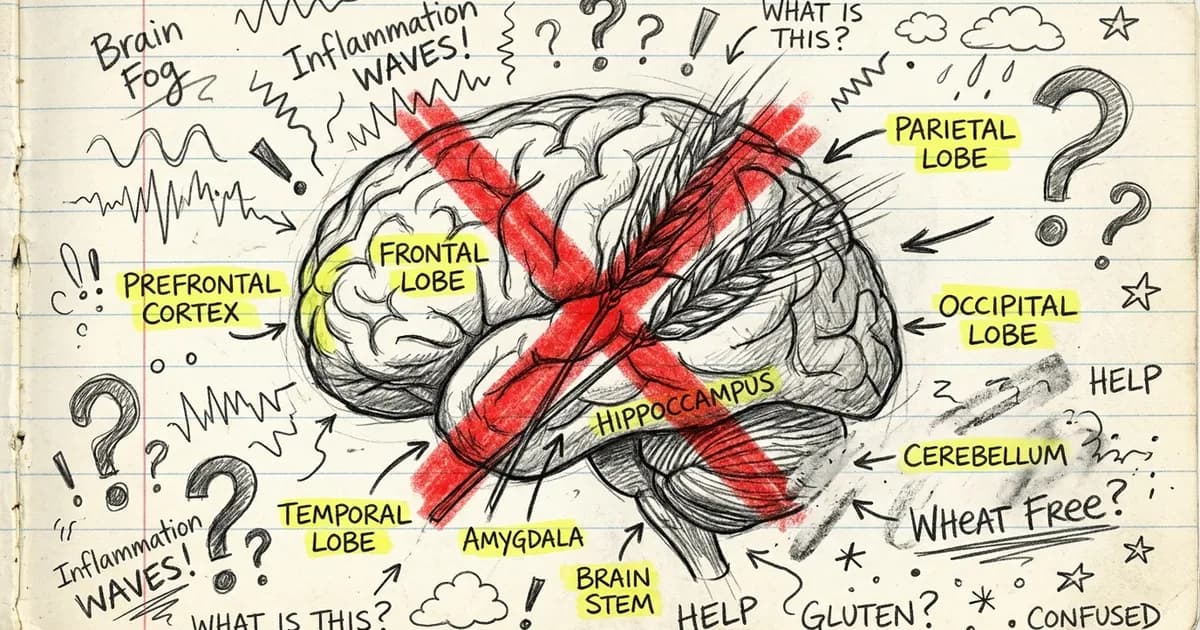
Research from Kresser Institute explains that gluten-triggered inflammation in the gut can instigate inflammation in the brain through the gut-brain axis. The microbiome, which is disrupted in celiac disease, directly influences neurotransmitter production, including serotonin, dopamine, and GABA.
When your gut is inflamed, your brain gets bad signals. And bad signals produce brain fog celiac.
The Gluten-Free Diet: Necessary but Not Sufficient for Brain Fog Celiac
Here's the good news: going strictly gluten-free does improve brain fog. A pilot study published in Alimentary Pharmacology and Therapeutics found that cognitive impairment in celiac patients improved on a gluten-free diet and correlated with histological and serological markers of disease severity. As the gut healed, the brain followed.
The Journal of Gastroenterology and Hepatology review reported that cognitive deficits improve over the first 12 months of gluten-free diet therapy.
Here's the less good news: 12 months is a long time to feel like you're thinking through fog. And the improvement correlates with mucosal healing, which happens gradually. Your villi don't regenerate overnight.
There are also practical realities. Accidental gluten exposure happens. Cross-contamination at restaurants, hidden gluten in sauces and seasonings, shared kitchen surfaces. Research from Gluten Free Society found that after accidental exposure, it took approximately 48 hours on average for brain fog celiac symptoms to resolve.
So the gluten-free diet is the foundation. But if you're looking for sharper thinking while your body heals, you need to address the problem from multiple angles.
Brain Fog Celiac: Strategies Beyond the Gluten-Free Diet
Fix the Nutritional Gaps
Get your levels tested. Specifically, ask your doctor to check zinc, iron, ferritin, vitamin B12, folate, and vitamin D. Don't guess. Mayo Clinic research makes it clear that these deficiencies should be addressed at the time of diagnosis.
Supplementation can help, but absorption is the challenge. With damaged villi, oral supplements may not be fully absorbed. Work with a dietitian who understands celiac disease to find forms and doses that actually get into your system.
Reduce Inflammation Proactively
Beyond avoiding gluten, anti-inflammatory strategies can help calm the immune response that's clouding your cognition. Omega-3 fatty acids, adequate sleep, and regular exercise all reduce systemic inflammation. These aren't optional lifestyle add-ons. For someone managing brain fog celiac, they're cognitive necessities.
Support Focus Directly
While your gut heals and your nutrient levels normalize (a process that takes months to over a year), your brain still needs to perform. Work deadlines don't pause for mucosal healing. Exams don't reschedule because your villi are regenerating.
This is where targeted cognitive support becomes practical. Specific compounds have strong evidence for supporting focus and attention without relying on high-dose stimulants.
Caffeine and L-Theanine are the most studied pairing. A study published on PubMed found that 97 mg of L-theanine combined with 40 mg of caffeine helped participants focus attention during demanding cognitive tasks. L-theanine smooths out the jittery edge of caffeine while preserving the alertness. It's the reason green tea feels different from coffee.
Theacrine and Methylliberine extend this effect. A study published in Cureus found that combining caffeine, theacrine (TeaCrine), and methylliberine (Dynamine) improved cognitive performance and reaction time without negatively affecting mood. Research published in the Journal of the International Society of Sports Nutrition suggested that co-ingestion of these compounds can improve cognitive performance over a longer period compared to caffeine alone.
The key insight: low-dose caffeine paired with complementary compounds outperforms high-dose caffeine on its own, with fewer side effects and no crash.
Getting Your Mind Back from Brain Fog Celiac
Brain fog from celiac disease is real, measurable, and treatable. The gluten-free diet is non-negotiable, and it works. But healing takes time, and your brain shouldn't have to run on empty while it waits.
Address the nutrient deficiencies. Reduce inflammation. And give your brain direct support with compounds that actually have evidence behind them.
Roon was built around exactly this principle. It combines 80 mg of caffeine with L-Theanine, Theacrine, and Methylliberine in a zero-nicotine sublingual pouch, delivering 6 to 8 hours of sustained focus without jitters, crashes, or tolerance buildup. For anyone managing brain fog celiac or the daily grind of modern cognitive demands, it's a clean, practical tool for staying sharp while your body does the longer work of healing.