Study Breakdown: The Ashwagandha Trial That Cut Cortisol 27.9%
Roon Team
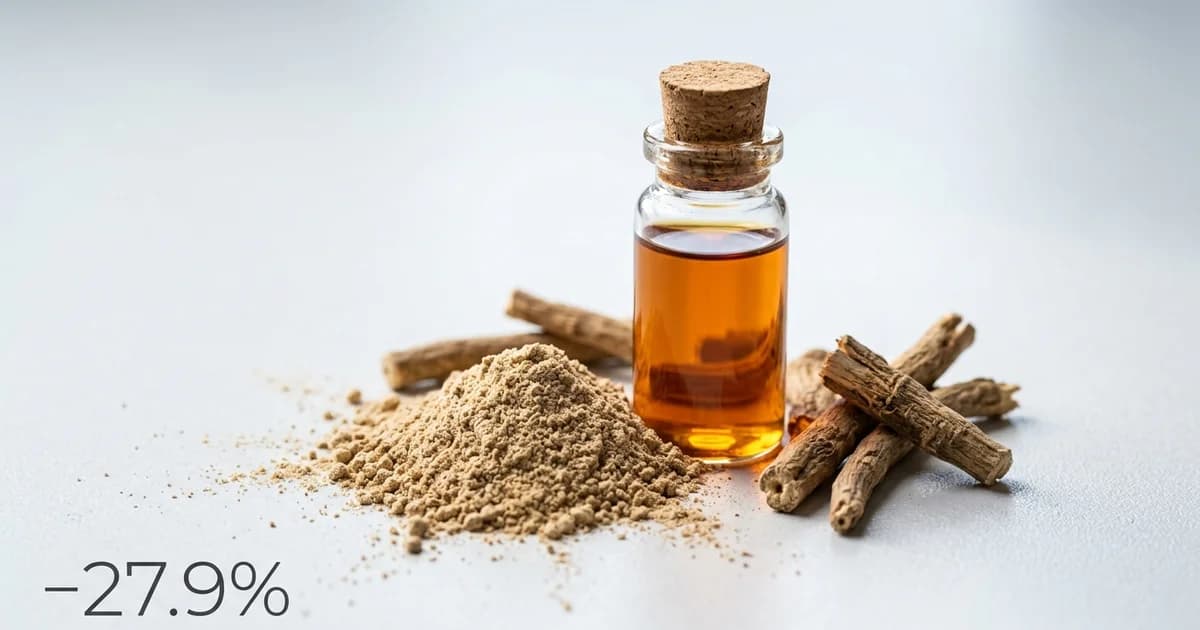
Study Breakdown: The Ashwagandha Trial That Cut Cortisol 27.9%
You have seen the number on a hundred supplement labels. "Clinically shown to reduce cortisol by 27.9%." It comes from one place: a 2012 trial run in India and published in the Indian Journal of Psychological Medicine.
That single ashwagandha cortisol study is the reason ashwagandha became the default stress supplement of the last decade. So it is worth actually reading it, instead of trusting the marketing copy that paraphrases it.
Here is what the trial did, what it found, and where the limits are.
Key Takeaways
- The chandrasekhar ashwagandha trial gave 300 mg of KSM-66 extract twice daily to chronically stressed adults for 60 days.
- Serum cortisol dropped 27.9% in the ashwagandha group versus 7.9% in placebo.
- Stress-scale scores fell sharply, with strong statistical significance.
- It was a single-center study of 64 people, so the result is promising but not the final word.
- A 2025 meta-analysis confirms the cortisol drop while questioning how much "perceived stress" actually changes.
What the Ashwagandha Cortisol Study Actually Measured
The trial was a prospective, randomized, double-blind, placebo-controlled study. That is the design researchers trust most, because neither the participants nor the staff handing out capsules knew who got the real extract.
The study was conducted in India and recruited 64 adults between the ages of 18 and 54 who self-reported experiencing chronic stress. Participants were randomly assigned to receive either 300 mg of the ashwagandha extract or a placebo. The dose was taken twice daily for 60 days.
The extract was KSM-66, a high-concentration full-spectrum root extract. If you have read a ksm-66 study before, this is the trial most of them trace back to.
Researchers tracked two kinds of data. First, blood: serum cortisol, the stress hormone. Second, questionnaires: validated stress scales including the Perceived Stress Scale and the Depression Anxiety Stress Scale.
The 27.9% Cortisol Result, in Plain Numbers
The headline holds up. Serum cortisol levels were reduced by 27.9% from baseline, compared to a mere 7.9% reduction in the placebo group. That gap is the whole story behind the ashwagandha cortisol reduction claim you see online.
The result was not a fluke of small numbers, either. The serum cortisol levels were substantially reduced (P=0.0006) in the Ashwagandha group, relative to the placebo group. A p-value that small means the difference is very unlikely to be random noise.
The stress questionnaires moved too. The treatment group that was given the high-concentration full-spectrum Ashwagandha root extract exhibited a marked reduction (P<0.0001) in scores on all the stress-assessment scales on Day 60, relative to the placebo group.
And safety looked clean. The adverse effects were mild in nature and were comparable in both the groups.
Why Cortisol Is the Right Thing to Track
Cortisol is not the villain people make it out to be. You need it. When you face stress, your adrenal glands release extra cortisol to give you a burst of energy, sharpen your focus and help you respond.
The problem is when it never switches off. Cortisol, the primary stress hormone, increases sugar, also called glucose, in the bloodstream, enhances the brain's use of glucose and increases the availability of substances in the body that repair tissues. Useful in a sprint. Corrosive over months.
This is why a 28% reduction matters more than it sounds. The trial was not chasing a mood that lasts an afternoon. It was targeting the chemical that stays raised when stress becomes the baseline, which is the withania somnifera cortisol mechanism every adaptogen brand leans on.
Where the Study Gets Oversold
One trial is a starting point, not proof. The chandrasekhar trial had 64 participants at a single center in one country. Strong signal, narrow lens.
The bigger caveat showed up years later. A 2025 systematic review and meta-analysis in Nutrition and Health pooled multiple trials and found a split result. In this meta-analysis of 8 randomized controlled trials in 488 adults in India, ashwagandha reduced cortisol levels but did not reduce ratings of perceived stress in comparison with a placebo.
Read that again. The cortisol drop replicates. The feeling of being less stressed does not always follow.
The same review was direct about why. The disconnect between cortisol and PSS outcomes highlights the need for longer treatment duration and broader demographic inclusion. Your blood chemistry can improve while your subjective stress barely budges, and that is a real limit worth knowing before you buy.
How This Compares to Other Stress Tools
Ashwagandha is one lever among several. Here is how the major options stack up on what they actually do.
| Approach | Primary target | Onset | Best for |
|---|---|---|---|
| KSM-66 ashwagandha | Lowers baseline cortisol | 2 to 8 weeks of daily use | Chronic, ongoing stress load |
| L-theanine | Calm alertness, smooths stimulants | 30 to 60 minutes | Acute tension, focus support |
| Magnesium glycinate | Nervous-system relaxation, sleep | Days to weeks | Sleep quality, muscle tension |
| Rhodiola rosea | Fatigue resistance under stress | 1 to 3 weeks | Burnout, mental fatigue |
| Roon focus pouch | Acute focus and alertness | 5 to 10 minutes | Sharp, sustained work sessions |
Notice the split. Ashwagandha plays a slow game against a hormone. Roon and L-theanine play a fast game against the next two hours. Different jobs entirely.
The Honest Verdict on the Trial
The chandrasekhar ashwagandha stress trial is real, well-designed for its size, and replicable on the cortisol number. The 27.9% figure is earned.
But treat it as one data point. The dose matters (300 mg KSM-66, twice daily). The timeline matters (60 days, not 60 minutes). And the gap between lower cortisol and feeling calmer is real, so manage your expectations accordingly.
If chronic stress is your problem, the evidence supports a trial run. Just give it weeks, not an afternoon.
Frequently Asked Questions
How much did ashwagandha lower cortisol in the study?
The 2012 chandrasekhar trial reported a 27.9% reduction in serum cortisol in the ashwagandha group after 60 days, compared to a 7.9% reduction in the placebo group. The difference was statistically strong (P=0.0006). It used 300 mg of KSM-66 full-spectrum root extract taken twice daily in 64 chronically stressed adults.
What dose did the ashwagandha cortisol study use?
Participants took 300 mg of high-concentration KSM-66 ashwagandha root extract twice daily, for a total of 600 mg per day, over 60 days. This dose has become the most-referenced standard in later ashwagandha cortisol reduction research, though individual products and protocols vary.
How long does ashwagandha take to work?
Ashwagandha is a slow tool. The landmark trial measured outcomes at 60 days, and most users report noticeable changes within two to four weeks of consistent daily use. It works by gradually lowering baseline cortisol, so it does not produce an immediate, same-day effect the way a stimulant does.
Does ashwagandha actually reduce stress, or just cortisol?
This is the honest gap. A 2025 meta-analysis of 8 trials found ashwagandha reliably lowered cortisol but did not consistently reduce self-reported perceived stress. Your blood chemistry can improve while your subjective sense of stress changes less. The cortisol benefit is well-supported; the "I feel calmer" benefit is more variable.
Is the chandrasekhar ashwagandha study reliable?
It was a well-run, double-blind, placebo-controlled trial, which is the gold-standard design. The limits are size and scope: 64 participants at a single center in India. The cortisol finding has since replicated across other trials, which strengthens confidence, but no single study should be treated as final proof.
Does caffeine raise cortisol?
Acute caffeine intake can temporarily raise cortisol, especially in people who do not consume it regularly. Research on adrenocortical cells found caffeine stimulated cortisol production in a dose-dependent way. This is a short-term, acute response and differs entirely from the chronic, raised cortisol that adaptogens like ashwagandha aim to bring down over weeks.
Can I take ashwagandha and a focus supplement together?
They target different things, so people often do. Ashwagandha works on long-term cortisol, while focus ingredients like caffeine and L-theanine work on short-term alertness. There is no inherent conflict, but if you have a medical condition or take prescription medication, check with a clinician first.
Two Different Questions, Two Different Tools
The ashwagandha trial answers one question: can you lower a stress hormone over weeks? The answer is a qualified yes. What it does not answer is how to stay sharp during the four hours you actually have to perform today.
That is a different question, and it needs a different tool. Roon is a sublingual cognitive performance pouch built for acute focus, not for slow hormonal change. Each pouch pairs 80 mg caffeine, 60 mg L-theanine, 25 mg methylliberine (Dynamine), and 5 mg theacrine (TeaCrine), with onset in 5 to 10 minutes and a window of 6 to 8 hours with no jitters, no crash, and no tolerance buildup.
Roon is not an adaptogen and not a substitute for managing chronic stress, sleep, or the kind of baseline cortisol the chandrasekhar trial studied. If your goal is steady, clear focus for the work in front of you, try Roon for that, and treat ashwagandha as the separate, slower lever it actually is.
Written by Roon Team