Ashwagandha (KSM-66 vs Sensoril)
Roon Team
Ashwagandha (KSM-66 vs Sensoril): The Complete Science on Doses, Forms, and What It Actually Does
Most people buy ashwagandha because a friend said it "helps with stress." Then they grab whatever tin is cheapest, take it for a week, feel nothing, and quit.
That is the wrong way to use it. The ashwagandha benefits that show up in clinical trials depend on three things almost nobody checks: which extract you bought, how much active compound it contains, and how many weeks you stay consistent. Get those right and the herb does real work. Get them wrong and you are eating expensive root powder.
This is the science on Withania somnifera, broken down by extract type, dose, and outcome. No mysticism. Just what the trials actually measured.
Key Takeaways
- Ashwagandha is a slow-acting adaptogen. It lowers your stress baseline over 4 to 12 weeks, not in an afternoon.
- The two extracts you will see most are KSM-66 (root-only, higher daily dose) and Sensoril (root and leaf, more concentrated, lower dose). They are not interchangeable.
- The active molecules are withanolides, steroidal lactones that drive most of the studied effects.
- The strongest evidence sits in three areas: stress and cortisol, sleep quality, and cognition.
- Dose matters more than brand loyalty. Match the milligrams of standardized extract to the outcome you want.
What Ashwagandha Actually Is
Ashwagandha is the root of Withania somnifera, a shrub used in Ayurvedic medicine for centuries. The modern interest is not in the raw root. It is in the standardized extracts that concentrate the plant's active chemistry into a measurable dose.
Those active compounds are withanolides. Ashwagandha is rich in phytochemicals, including steroidal lactones (known as withanolides) and alkaloids, and while withanolides are believed to be responsible for many of ashwagandha's proposed effects, evidence from preclinical studies suggests that other, non-withanolide components may also be involved. So when you compare two products, the withanolide percentage on the label is the number that counts, not the total milligrams of "extract."
Ashwagandha is classed as an adaptogen. The label means it helps your body regulate its stress response rather than spiking or sedating you directly. According to the NIH Office of Dietary Supplements, research suggests that ashwagandha extracts may lower stress, anxiety, and cortisol levels.
KSM-66 vs Sensoril: The Comparison That Actually Matters
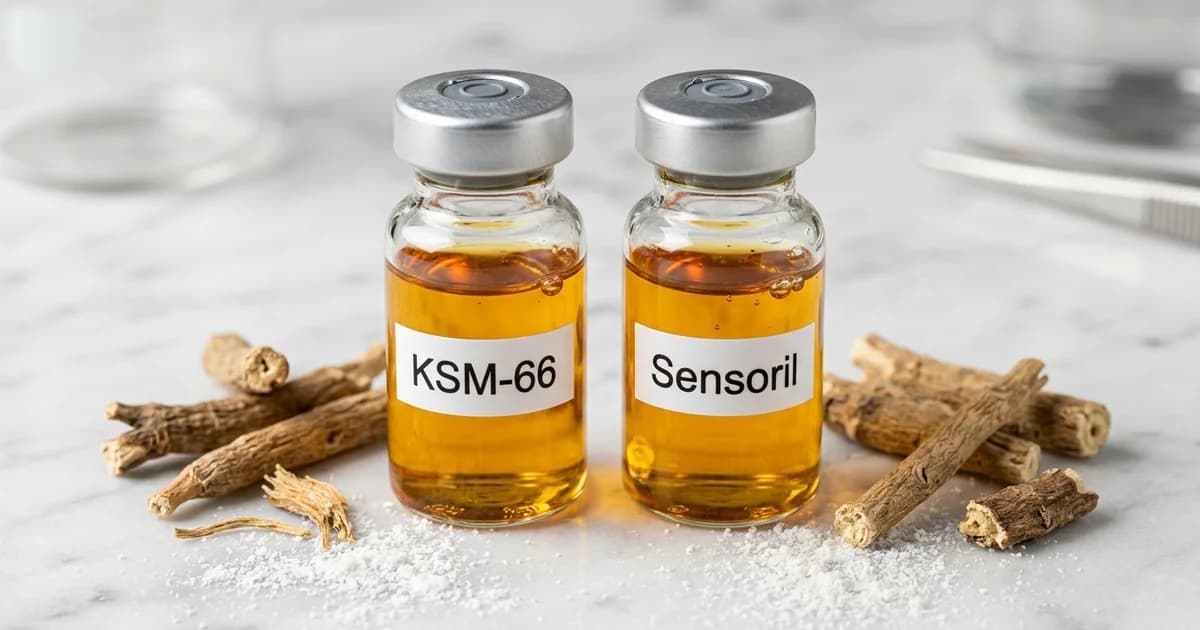
KSM-66 and Sensoril are the two branded ashwagandha extracts behind most clinical research, and they differ in source material, withanolide concentration, and effective dose. Picking between them is the single most useful decision you can make, so start here.
KSM-66 is a root-only extract standardized to a lower withanolide percentage, dosed higher per day. It is the extract behind much of the stress, strength, and cognition research. Sensoril uses both root and leaf, standardizes to a higher withanolide percentage, and works at a smaller daily dose, with research leaning toward sleep and stress relief.
Here is the practical breakdown.
| Feature | KSM-66 | Sensoril |
|---|---|---|
| Plant part used | Root only | Root and leaf |
| Withanolide standardization | Lower percentage, higher total dose | Higher percentage, lower dose |
| Typical daily dose | 300 to 600 mg | 125 to 250 mg |
| Research skew | Stress, cortisol, strength, cognition | Sleep, stress, anxiety |
| Taste and feel | Milder | Stronger, more sedating for some |
Neither is "better" in the abstract. KSM-66 is the safer default for daytime stress support and cognitive studies. Sensoril, with its higher withanolide load and mild sedating tendency, suits people who care most about evening calm and sleep. Read the label for the brand name and the withanolide percentage. If a product lists neither, you cannot dose it intelligently.
Ashwagandha Dosage: Match the Milligrams to the Goal
For most adults, the evidence-backed ashwagandha dosage is 300 to 600 mg per day of a root extract, taken consistently for at least 8 weeks. That is the range used in the trials that produced the headline results.
The most cited stress study makes the point. A double-blind, placebo-controlled trial used 300 mg of KSM-66 extract, often dosed twice daily, in adults with chronic stress. In the 60-day, double-blind, randomized, placebo-controlled trial, 64 subjects with a history of chronic stress were given either a placebo or one capsule containing 300 mg of KSM-66 extract, and the KSM-66 group demonstrated a 27.9% reduction in serum cortisol levels.
A few dosing rules that hold up across the research:
- Split the dose if you can. Morning and evening tends to track the trials better than one large hit.
- Take it with food. It reduces the mild stomach upset some people get.
- Give it weeks, not days. The benefits build. One dose does almost nothing you can feel.
- Sensoril runs lower. If you switch to Sensoril, drop to roughly 125 to 250 mg because the withanolide concentration is higher.
Do not chase a bigger dose for a bigger effect. The trials capped out in the 300 to 600 mg range for a reason.
Ashwagandha for Sleep
Ashwagandha modestly improves sleep quality, and the effect is strongest in people who are already struggling to sleep. It is not a sedative you take to knock yourself out. It works by lowering the stress signal that keeps you wired at night.
A systematic review and meta-analysis in PLOS One pooled multiple randomized trials and found ashwagandha produced a small but real improvement in overall sleep, with larger gains in people diagnosed with insomnia and at doses around 600 mg per day taken for eight weeks or more.
This is where Sensoril's profile earns its place. The higher withanolide concentration and mild sedating quality suit an evening routine. If sleep is your only goal, dose it at night. If stress is the bigger problem and better sleep is a bonus, either extract works.
One honest caveat. The sleep effect is meaningful but moderate. Ashwagandha helps you wind down. It does not override caffeine, blue light at midnight, or a chaotic schedule.
Ashwagandha and Cognition
Ashwagandha shows early but promising support for memory and attention, likely as a downstream benefit of lower stress rather than a direct nootropic kick. Chronic stress impairs working memory and focus. Bring the stress signal down and cognition often follows.
A randomized, double-blind study in the Journal of Dietary Supplements tested ashwagandha root extract on memory and cognitive function and reported improvements in measures of memory, attention, and information-processing speed versus placebo over eight weeks.
More recent work is pushing into harder questions. A 2025 randomized, placebo-controlled trial examined a specialized ashwagandha extract for memory in adults with mild cognitive impairment, adding to the case that the herb supports cognition rather than just mood.
Set expectations correctly. Ashwagandha cognition effects are real but slow and indirect. You will not feel sharper an hour after a capsule. You may notice, weeks in, that you are less frazzled and that focus comes easier because the background stress is quieter.
Is Ashwagandha Safe?
Ashwagandha is well tolerated for short-term use, with mild and uncommon side effects in the clinical record. The data here is reassuring within a defined window.
Per the NIH review, in the human studies and many other clinical trials, ashwagandha has been well tolerated by participants for up to about 3 months of use, with common side effects being mild and including stomach upset, loose stools, nausea, and drowsiness.
Two real cautions. Long-term safety beyond a few months is not well mapped, so cycling off periodically is sensible. And there have been rare reports of liver issues, which is why quality and brand matter. Pregnant people, those on thyroid or sedative medication, and anyone with a medical condition should talk to a doctor first. This article is education, not medical advice.
How Ashwagandha Compares to Other Calm-and-Focus Ingredients
Ashwagandha is one tool. It is worth seeing where it sits next to the other common ingredients people reach for, because they do genuinely different jobs.
| Ingredient | Primary job | Onset | Best for |
|---|---|---|---|
| Ashwagandha (KSM-66 / Sensoril) | Lowers stress baseline, cortisol | Weeks | Chronic stress, sleep, resilience |
| L-theanine | Boosts attention accuracy, calm focus | 30 to 60 min | Sharpening caffeine's focus benefits |
| Caffeine | Raises alertness and drive | 5 to 45 min | Acute energy and focus |
| Magnesium | Supports relaxation, sleep | Days to weeks | Sleep, muscle, stress recovery |
| Rhodiola | Anti-fatigue adaptogen | Days to weeks | Stress-related tiredness |
The pattern is clear. Adaptogens like ashwagandha and rhodiola work on a timescale of weeks and lower the floor. Stimulants and amino acids like caffeine and L-theanine work in minutes and raise the ceiling. You can read more about the fast-acting side in our breakdowns of the caffeine and L-theanine combination and how onset speed shapes a focus product.
Conclusion
Ashwagandha is not a quick fix, and the people disappointed by it almost always used it like one. The clinical wins are clear once you respect the mechanics. Pick the right extract, KSM-66 for daytime stress and cognition or Sensoril for sleep-leaning calm. Dose it in the studied 300 to 600 mg range. Stay consistent for at least eight weeks.
Do that and you get a measured drop in cortisol, better sleep in people who need it, and a slow lift in cognition that rides on the back of lower stress. What you will never get is a sudden hit of focus an hour after a capsule. That is not what an adaptogen does, and judging it by that standard is the most common mistake people make.
Frequently Asked Questions
How long does ashwagandha take to work?
Plan on weeks, not hours. Most clinical trials run 8 to 12 weeks, and the stress, sleep, and cognition benefits build over that window. Some people notice calmer evenings within two to three weeks, but the cortisol and resilience changes that show up in studies need consistent daily dosing across at least a couple of months. If you take it once and feel nothing, that is expected behavior for an adaptogen.
Is KSM-66 or Sensoril better?
It depends on your goal. KSM-66 is a root-only extract dosed higher and studied heavily for daytime stress, cortisol, and cognition. Sensoril uses root and leaf, concentrates more withanolides, works at a lower dose, and leans toward sleep and calm because of a mild sedating quality. For general stress and focus, KSM-66 is the safer default. For evening wind-down, Sensoril fits better.
What is the right ashwagandha dosage?
For root extracts like KSM-66, the evidence-backed range is 300 to 600 mg per day, often split into two doses. For Sensoril, the higher withanolide concentration means a smaller dose of roughly 125 to 250 mg per day. Take it with food, stay consistent, and do not assume more is better. The trials that produced the headline results stayed inside these ranges.
Does ashwagandha actually lower cortisol?
Yes, the evidence here is among the strongest. A 60-day double-blind, placebo-controlled trial using 300 mg of KSM-66 found a 27.9% reduction in serum cortisol versus placebo in chronically stressed adults. Cortisol is the body's main stress hormone, and bringing it down is the mechanism behind most of ashwagandha's calming and sleep benefits.
Can I take ashwagandha for sleep?
You can, and the data supports it, though the effect is moderate. A meta-analysis in PLOS One found ashwagandha improved sleep quality, with the biggest gains in people with insomnia at doses around 600 mg daily. It works by lowering the stress that keeps you wired, not by sedating you like a sleeping pill. Take it in the evening if sleep is your main target.
Is ashwagandha safe to take every day?
For up to about three months, the clinical record shows it is well tolerated, with mild and uncommon side effects like stomach upset or drowsiness. Long-term safety past that window is less studied, so cycling off periodically is reasonable. There are rare reports of liver concerns, which is why extract quality matters. Pregnant people and anyone on thyroid or sedative medication should check with a doctor first.
Will ashwagandha make me sharper or more focused right away?
No. Any cognition benefit is slow and indirect, riding on the back of lower stress over weeks. Ashwagandha does not deliver an acute hit of alertness the way caffeine does. If you want focus you can feel within minutes, you are describing a stimulant effect, which is a different tool entirely.
The Stress Dial and the Focus Dial Are Two Different Knobs
Here is the cleanest way to think about it. Ashwagandha turns the stress dial down, slowly, over weeks. It is excellent at that and bad at everything else fast. If your problem is a high baseline of stress wrecking your sleep and focus, it is one of the best-studied tools you can reach for.
Roon does the opposite job. It is a sublingual pouch built to raise the focus dial in 5 to 10 minutes, using a four-ingredient stack of 80 mg caffeine, 60 mg L-theanine, 25 mg methylliberine (Dynamine), and 5 mg theacrine (TeaCrine), tuned for 6 to 8 hours of clean focus with no jitters and no crash.
To be clear about what Roon is not: it is not an adaptogen, it contains no ashwagandha, and it will not lower your cortisol baseline over time. Those are ashwagandha's strengths, and we are not pretending otherwise. The two work on opposite timescales and opposite signals. If you want calmer weeks, ashwagandha. If you want a sharper next few hours, try Roon.
Written by Roon Team