You like the energy coffee gives you. You just don't love everything that comes with it: the acid stomach at 9 a.m., the jitters by 10, the crash before lunch, the cold half-cup you forgot on your desk. If you have been searching for a coffee alternative, you have probably noticed that most of them solve your problem by removing the one thing that actually worked. Mushroom blends, chicory, adaptogens, decaf. Less caffeine, less energy, less point.
There is another way to think about this. What if you kept the caffeine and dropped the cup?
That is the question this page answers: how a controlled dose of caffeine, delivered through the lining of your mouth instead of your gut, can give you what coffee gives you (alertness, focus, drive) without what coffee takes from you (the jitters, the acidity, the variable dosing, the 3 p.m. fadeout). The comparison is not theoretical. Every number below is sourced, and a full side-by-side table is further down.
Key takeaways
- Most products marketed as coffee alternatives remove or reduce caffeine. A better approach for many people is to keep the caffeine and change the delivery method, the dose precision, and the supporting ingredients.
- An oral pouch absorbs through the mouth lining, bypassing the stomach entirely. That eliminates coffee's acidity issue, reduces onset time compared to swallowing a liquid, and removes the variability of a brewed cup.
- Adding L-theanine to caffeine refines the response: you keep alertness but reduce the jittery, scattered edge. This is well-supported by controlled trials in healthy adults.
- Dynamine® slows caffeine's clearance without raising its peak. Roon pairs 25 mg Dynamine® with 80 mg caffeine; the company's reported felt window is 6 to 8 hours per pouch.
Why you want to quit coffee (and why you keep not doing it)
Coffee is not unhealthy. Moderate consumption is linked to several positive outcomes, and no honest page should tell you otherwise. The problem is not coffee itself. The problem is the specific side effects that make a daily coffee habit annoying, expensive, or physically uncomfortable for a large number of people.
The acidity. Coffee is naturally acidic, with a pH typically between 4.85 and 5.13. It stimulates gastric acid secretion, and for people with sensitive stomachs, reflux, or functional dyspepsia, that means discomfort after every cup. A narrative review in Nutrients noted that coffee's effect on gastric acid and lower esophageal sphincter function is a persistent clinical concern, even though the overall evidence linking coffee to chronic GI disease is mixed. The point is not that coffee wrecks your stomach. The point is that if yours is already sensitive, coffee makes mornings worse.
The dose roulette. A standard 8-ounce cup of brewed coffee contains roughly 95 to 200 mg of caffeine, a range wide enough to mean the difference between "barely awake" and "hands shaking." Bean variety, roast level, grind size, brew method, water temperature, and steep time all shift the number. You do not actually know how much caffeine you are consuming when you pour a cup. Most people learn to tolerate that variance. But tolerance is not the same as optimization.
The speed and the crash. Caffeine from coffee is absorbed through the gastrointestinal tract. According to NCBI's pharmacology reference, 99% is absorbed within 45 minutes of ingestion, with peak plasma concentrations arriving between 15 and 120 minutes after you swallow. That is a wide window, and it depends heavily on stomach contents and individual variation. Once peak hits, the mean half-life in healthy adults is about 5 hours, though it can range from 1.5 to 9.5 hours depending on individual metabolism. So the morning cup that peaked around 9:30 is half-gone by mid-afternoon. Most people respond by drinking a second cup, which stacks doses, pushes caffeine into the evening, and chips away at sleep quality.
The ritual tax. A cafe coffee runs around $3.50 for a regular brewed cup at the national median in 2025. Even home-brewed coffee, when you account for beans, filters, water, and equipment, costs roughly $0.75 to $1.10 per cup. Add the time to brew, the cleanup, the inability to use it anywhere without a mug, and you have a delivery system that demands a surprising amount of daily friction for what is ultimately just a caffeine vehicle.
None of this makes coffee bad. It makes coffee imperfect for a specific, common set of complaints. And the standard alternatives answer those complaints by taking away the caffeine, which means taking away the reason you drank coffee in the first place.
How caffeine delivery actually works (and why format matters more than dose)
The core argument for a coffee alternative that still contains caffeine comes down to pharmacokinetics: how fast a substance gets into your blood, how high it peaks, and how long it stays. Change the delivery route, and you change all three.
The gut route vs. the mouth lining
Coffee delivers caffeine through the stomach and small intestine. The molecule itself absorbs quickly, but it has to survive the trip: peak plasma concentration from oral ingestion takes 30 to 60 minutes on average, with some people not peaking for up to two hours depending on what else is in their stomach.
An oral pouch, placed between the lip and gum, delivers caffeine through the buccal mucosa, the thin tissue lining the mouth. This tissue is highly vascularized and feeds directly into the bloodstream, bypassing the stomach and first-pass liver metabolism almost entirely. Research on caffeinated chewing gum supports a faster rate of absorption through the oral mucosa: a study by Kamimori et al. found that caffeine delivered via gum reached peak plasma concentration significantly faster than the same dose in capsule form (mean Tmax of 44 to 80 minutes for gum vs. 84 to 120 minutes for capsules), with equivalent total bioavailability. A pouch held against the gum for 20 to 30 minutes gives caffeine sustained contact time with the oral mucosa, and Roon reports a felt onset of 5 to 10 minutes. No liquid, no acid, no stomach involvement at all.
Refining the signal with L-theanine
Raw caffeine produces alertness, but it also produces jitter, a scattered attentional quality, and for some people, a noticeable edge of unease. L-theanine, an amino acid found naturally in tea leaves, addresses that directly.
A 2008 controlled study comparing 50 mg caffeine alone vs. 50 mg caffeine plus 100 mg L-theanine found that the combination improved both speed and accuracy on an attention-switching task, and reduced susceptibility to distracting information. The key finding: L-theanine does not cancel caffeine. It refines it. You keep the alertness and lose the scattered feeling. That is why the two appear together in nearly every serious nootropic formulation, and it is why tea feels different from coffee despite both containing caffeine.
Extending duration without increasing dose
Here is the part most coffee-alternative pages miss entirely. The problem with coffee is not just the side effects. It is the duration. A cup of coffee gives you a few hours of peak energy before the decline sets in. Most people drink two or three cups to cover a workday, stacking doses and pushing total intake past 300 mg.
Dynamine® changes the math. In a randomized, double-blind, crossover pharmacokinetic study (n=12, 4x4 Latin Square), co-administration of 100 mg Dynamine® with 150 mg caffeine cut caffeine's oral clearance from 41.9 to 17.1 L/hr and extended its half-life from 7.2 to 15 hours, with no increase in peak concentration. Same peak, slower decline. That is not "more stimulation." It is the same stimulation, lasting longer. Roon's pouch contains 25 mg Dynamine® with 80 mg caffeine, roughly one-quarter the Dynamine® dose and half the caffeine dose used in that study, so the magnitude of the clearance interaction at Roon's dose has not been independently measured. The underlying mechanism, Dynamine® slowing caffeine's metabolism, is the same; the felt duration of 6 to 8 hours per pouch is the company's own reported figure rather than a direct study endpoint.
A 15-hour half-life is not 15 hours of felt energy. Half-life measures clearance, not perception. At Roon's lower dose of Dynamine®, the half-life extension would be smaller than what the study measured. The practical felt window Roon reports is 6 to 8 hours: roughly a full working day from a single dose. That is what replaces coffee's second and third cup.
The comparison, side by side
| Factor | Brewed coffee (8 oz) | Caffeine pouch (80 mg) |
|---|---|---|
| Caffeine per serving | 95 to 200 mg (variable) | 80 mg (fixed) |
| Onset to felt effect | 20 to 45 minutes | 5 to 10 minutes |
| Felt duration | 3 to 5 hours | 6 to 8 hours (with Dynamine®) |
| Acidity / stomach load | Moderate to high | None |
| Portability | Requires mug and liquid | Pocket-sized, no liquid |
| Cost per serving (home) | $0.75 to $1.10 | As little as $0.61 |
| Cost per serving (cafe) | $3.50+ | N/A |
| Brewing required | Yes | No |
| Sugar / calories | Depends on additions | Zero |
Home-brewed coffee is comparable in price to a Roon pouch. On a 12-tin subscription, the per-pouch cost drops to $0.61, which undercuts even a home-brewed cup. The one-time 4-tin bundle comes to $1.00 per pouch for those who do not want a subscription. The honest cost comparison: if you make drip coffee at home and drink it black, the prices are close. If you buy from a cafe, a pouch wins by a wide margin. And neither column captures the time cost of brewing, or the fact that a single pouch replaces two to three cups across a day.
What Roon actually puts in the pouch
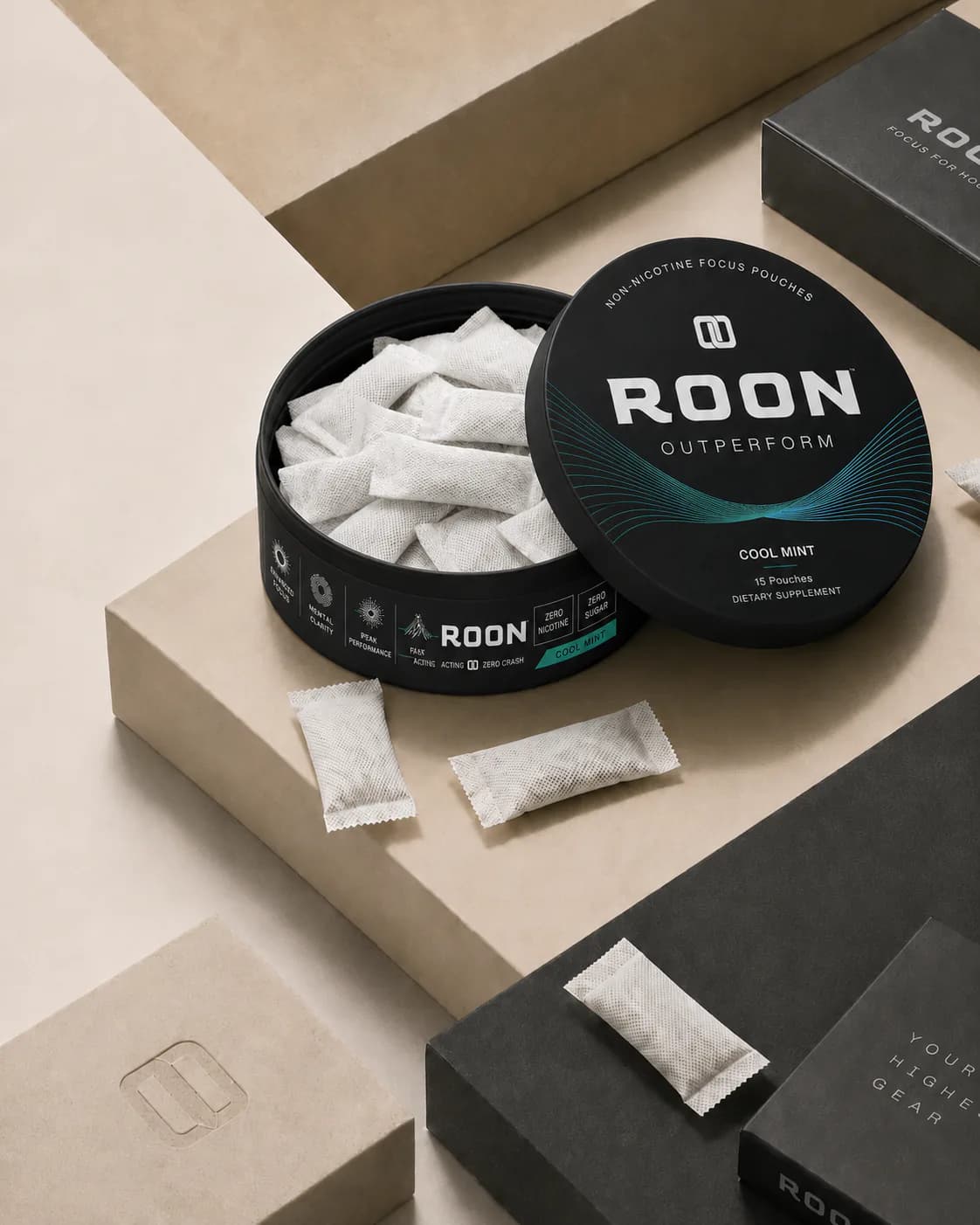
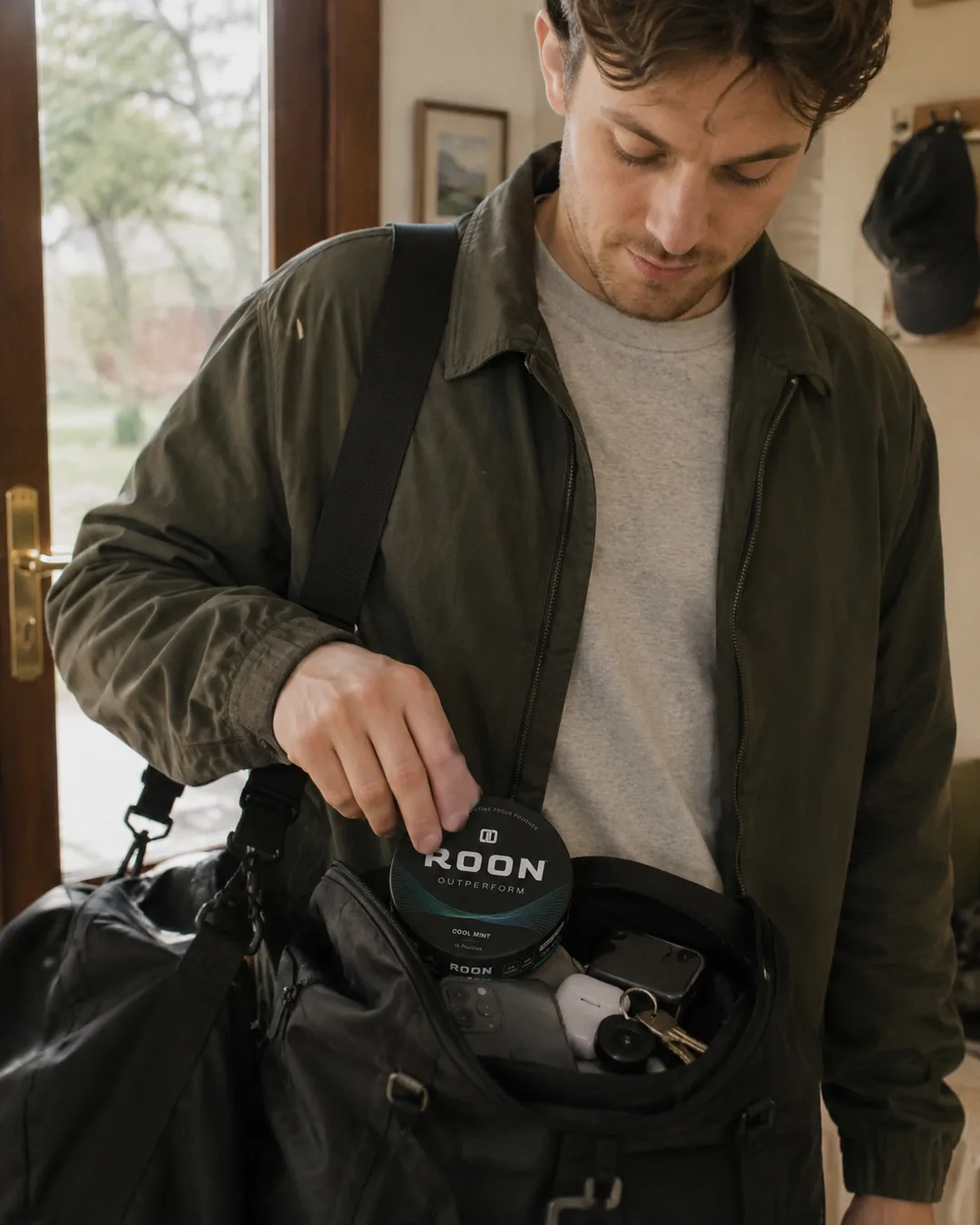
The comparison table above is generic: any caffeine pouch could theoretically fill the "pouch" column. Roon is the specific product that fills it with a four-ingredient nootropic stack designed to make 80 mg of caffeine do more than 80 mg of caffeine normally does.
The full formula, per pouch:
- 80 mg caffeine. Roughly the amount in one small cup of coffee. This is a deliberate choice: enough to produce real alertness, low enough that the supporting ingredients can extend and refine it without overcooking the total stimulation.
- 60 mg L-theanine. Smooths out caffeine's rough edges. You get the focus without the jitter or the scattered feeling.
- 25 mg Dynamine®. The clearance extender. By the same mechanism shown in the study above (at a higher dose), this slows caffeine's metabolism, stretching the felt window to 6 to 8 hours without raising the peak.
- 5 mg TeaCrine®, from material standardized to 40%. TeaCrine® specifically does not build tolerance the way caffeine does, which is a useful property in a daily-use product. Its role in this stack is additive alertness support.
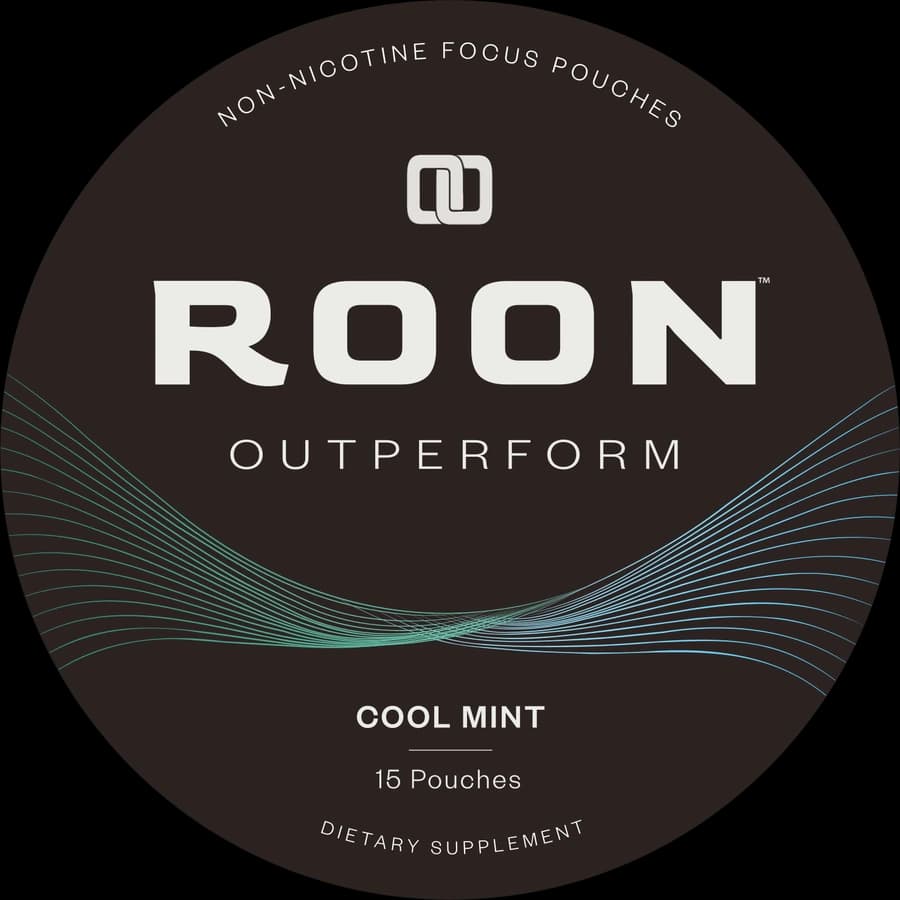
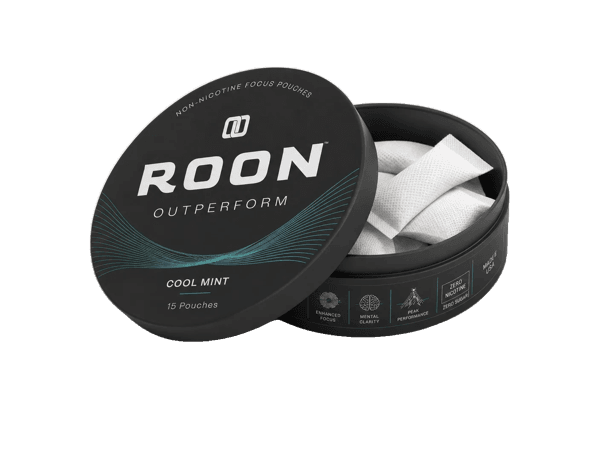
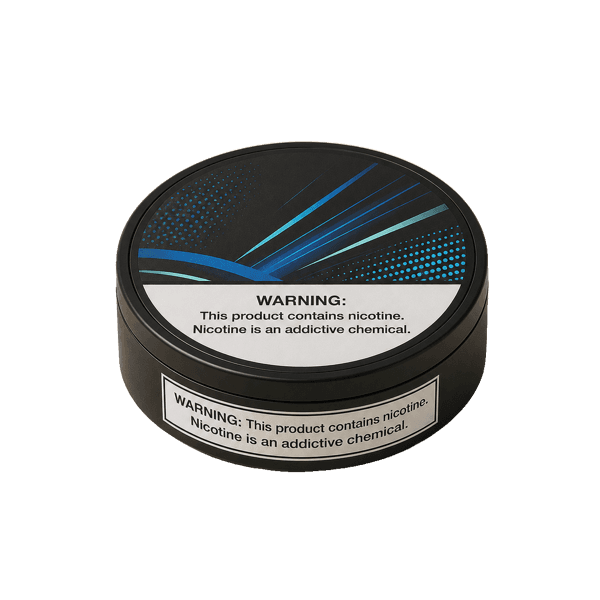
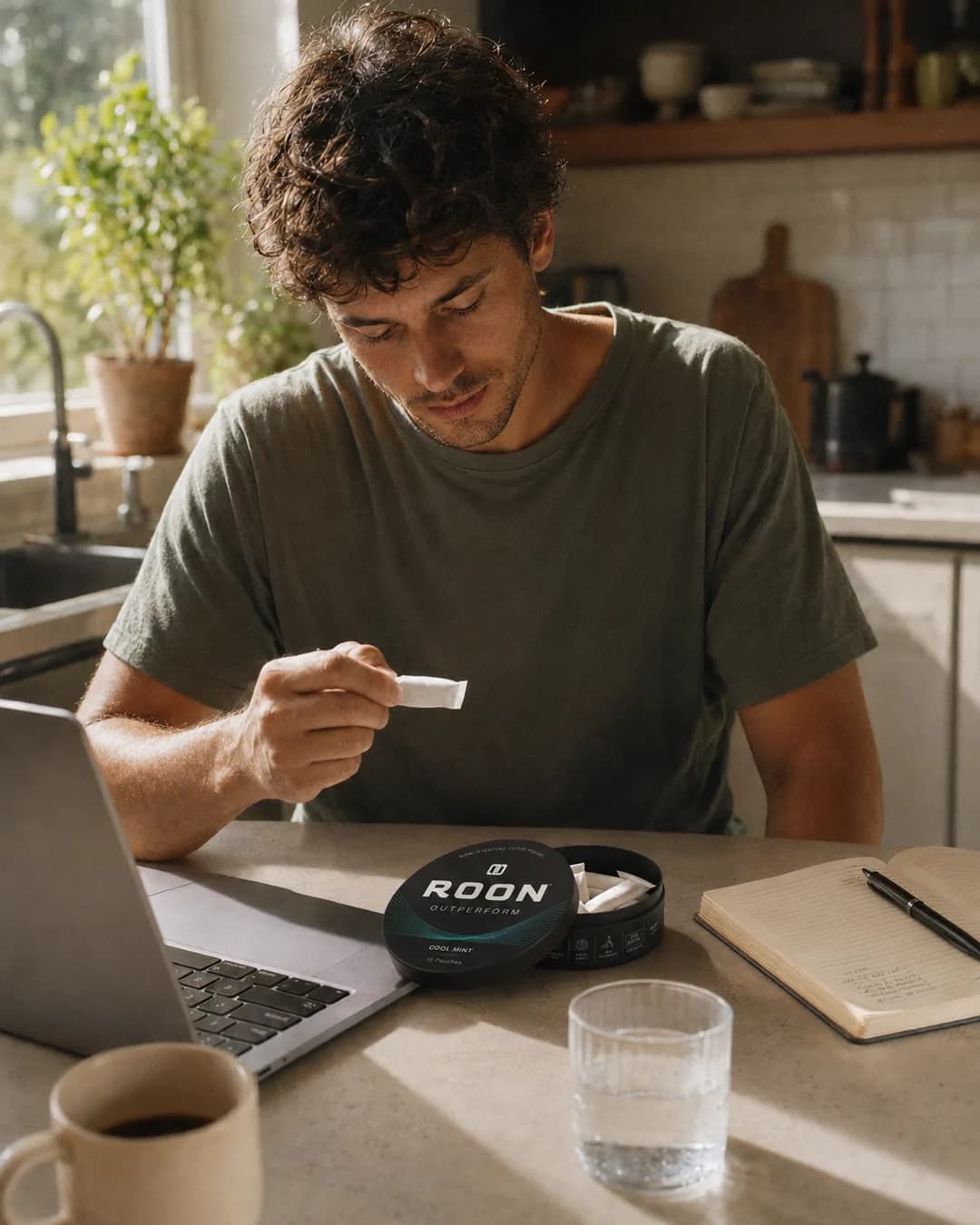
The format: a zero-nicotine, zero-tobacco oral pouch. Cool Mint flavor, 15 pouches per tin. You place it between your lip and gum, leave it for 20 to 30 minutes, and discard it. No liquid, no brewing, no sugar, no calories. Onset in 5 to 10 minutes. Peak around 30 to 60 minutes. The felt effect lasts 6 to 8 hours, tapering gradually rather than crashing.
Be clear about what Roon replaces and what it does not. Roon replaces the cup, not the fundamentals. Sleep, food, and medical care still do what they do; a caffeine pouch does not fill those roles. And because it contains 80 mg of caffeine, it produces tolerance over time like any caffeine source. Roon's own guidance: do not use it within 8 hours of bedtime, because the extended half-life from Dynamine® means the caffeine clears more slowly than a standard cup.
Pricing: from $9.16 per tin ($0.61 per pouch) on the 12-tin subscription. The one-time 4-tin bundle is $15.00 per tin ($1.00 per pouch) for those who prefer not to subscribe. A single tin is $19.99. The live pricing and subscription options are in the buy box below this article.
About 6,000 people have switched to Roon across all sales channels. That number is current as of mid-2025 and covers the full customer base, not just the website. For a deeper look at why these users specifically chose it over coffee, see 6 Reasons This Nootropic Pouch is the Ultimate Coffee Alternative for Energy.
What you lose in the swap. Be honest about this: you lose the taste of coffee, the warmth of a hot mug, the morning ritual, and the social object. Coffee is a sensory experience, not just a caffeine vehicle, and no pouch replaces that. What you gain is control: a fixed dose, a faster onset, a longer window, no acidity, a gradual taper instead of a sharp crash, and a format that works in a meeting, on a trail, or in the middle of a commute without spilling anything. Whether that trade is worth it depends entirely on whether coffee's side effects bother you more than its pleasures satisfy you.
For more on how sublingual caffeine absorption works at the pharmacokinetic level, Roon's own deep dive covers the research in detail.