Who Owns Rogue Nicotine Pouches
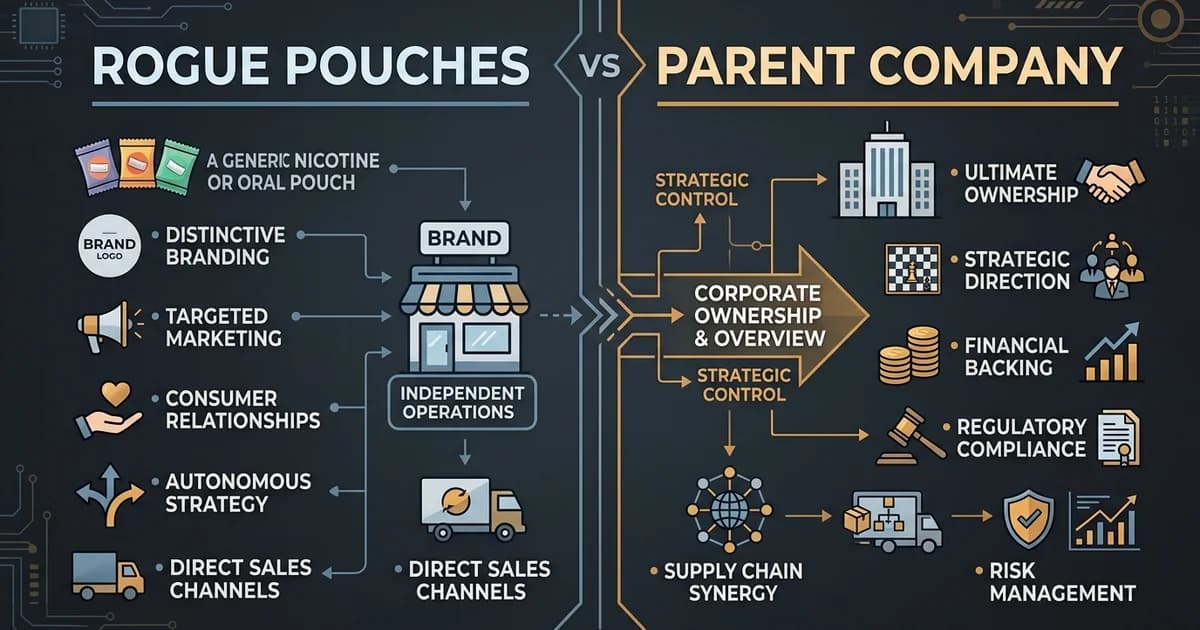
Who Owns Rogue Nicotine Pouches: The Full Story Behind the Brand
If you've picked up a can of Rogue nicotine pouches at a gas station or ordered them online, you've probably noticed they don't scream "Big Tobacco" on the label. So who owns Rogue nicotine pouches, exactly? The answer involves a 160-year-old cigar company, a separately named holding company, and a calculated bet on the future of nicotine delivery.
Here's the full breakdown of who owns Rogue nicotine pouches, how the brand fits into the broader nicotine pouch market, and what it all means for you as a consumer.
Key Takeaways
- Rogue nicotine pouches are owned by Rogue Holdings, LLC, the entity named in the copyright line on roguenicotine.com, whose privacy and opt-out links point to Swisher.
- Swisher International, the company behind Swisher Sweets cigars, is the dominant parent entity.
- Rogue pouches are tobacco leaf-free and manufactured in the United States.
- The nicotine pouch market is growing fast, with ZYN currently leading in market share and FDA authorization.
Who Owns Rogue Nicotine Pouches? Meet Rogue Holdings, LLC
Rogue nicotine pouches are produced by a company called Rogue Holdings, LLC. That is the entity in the copyright line on roguenicotine.com, and the site's privacy and opt-out links point to privacy.swisher.com, which ties the brand to Swisher International, Inc.
Secondary write-ups name a pharmaceutical joint-venture partner alongside Swisher, and different write-ups name different partners. Rogue's own site names none, so this article does not either. What the brand does publish is the Swisher connection and a product built for the tobacco-free nicotine space without relying on a traditional tobacco leaf product.
The brand first hit the market in 2018, according to the Smokeless Tobacco Wiki, initially offering nicotine pouches, lozenges, gum, and tablets. That's a wider product line than most competitors launched with, and it signals a pharmaceutical influence on the formulation side of the business.
Swisher International: The Real Power Behind Who Owns Rogue Nicotine Pouches
If you know Swisher Sweets, you know Swisher International. The company was founded in 1861 by David Swisher in Newark, Ohio, originally as a small cigar business he received as settlement for a debt. Today, the company is headquartered in Jacksonville, Florida, and operates manufacturing facilities in the Dominican Republic and West Virginia.
Swisher is the largest manufacturer and marketer of cigars in the world, according to Encyclopedia.com. But cigars are a mature market. The move into nicotine pouches through Rogue represents Swisher's play to stay relevant as consumer preferences shift away from combustible tobacco. That context is essential for anyone researching who owns Rogue nicotine pouches.
In 2024, Swisher rebranded its smokeless tobacco portfolio under the historic Helme name, a brand that had been part of the Swisher family since 1986. That restructuring shows the company is actively reorganizing its brands to compete across multiple nicotine categories.
Why a Joint Venture?
Most Big Tobacco companies entering the pouch space did so by acquiring existing brands or building in-house. Philip Morris bought Swedish Match to get ZYN. Altria developed On! through its own R&D pipeline. British American Tobacco built Velo internally.
Swisher took a different route, and that choice is central to the story of who owns Rogue nicotine pouches. Rogue arrived through a separate holding company rather than an in-house program, and it positions itself on pharma-grade quality standards rather than as another tobacco company side project. The pharmaceutical angle also gave Rogue access to nicotine polacrilex formulation expertise, the same type of nicotine delivery system used in FDA-approved cessation products like Nicorette.
According to Jade Pouch, Rogue emphasizes that all its products are manufactured in the United States, a detail the brand uses to differentiate itself from competitors with overseas production. For a market where consumers are reading ingredient labels more carefully than ever, that's a real selling point.
What's Actually in a Rogue Pouch?
Now that you know who owns Rogue nicotine pouches, the next question is what is inside a Rogue pouch. Rogue pouches are 100% tobacco leaf-free. The nicotine comes from nicotine polacrilex, a pharmaceutical-grade nicotine compound also used in nicotine gums and lozenges you'd find at a pharmacy.
According to Nicokick, Rogue pouches are made from plant-based fibers, nicotine polacrilex, flavoring agents, moisture regulators, and sugar-free sweeteners like acesulfame K. The brand uses a dry-fill format, which tends to produce less drip than wetter pouch styles.
Here's a quick look at the Rogue product lineup:
| Feature | Details |
|---|---|
| Nicotine Strengths | 3mg and 6mg |
| Flavors Available | 10+ (including Peppermint, Wintergreen, Spearmint, Mango, Citrus) |
| Tobacco Leaf | None |
| Nicotine Source | Nicotine Polacrilex |
| Manufacturing | United States |
| Format | Dry-fill, sublingual pouch |
The 3mg and 6mg strengths place Rogue on the lower end of the nicotine spectrum compared to some competitors. ZYN, for instance, offers similar strengths, while brands like On! go up to 8mg per pouch.
How Rogue Fits Into the Nicotine Pouch Market
Knowing who owns Rogue nicotine pouches helps explain the brand's market position. The nicotine pouch category has exploded, making a nicotine pouch market overview worth reading before comparing options. According to the IMARC Group, the FDA authorized ZYN nicotine pouches in January 2025, making it the first and only nicotine pouch to receive that designation in the U.S. That's a big deal for Swedish Match (ZYN's manufacturer, owned by Philip Morris International) and sets a regulatory benchmark the rest of the industry will need to meet.
The U.S. accounts for the dominant share of the global nicotine pouch market, according to Stellar Market Research, with tobacco-derived nicotine pouches holding roughly 96% of the market. ZYN, Velo, and On! are the current top three by market share.
Rogue occupies a mid-tier position. It doesn't have ZYN's market dominance or Velo's backing from British American Tobacco. But the ownership structure behind who owns Rogue nicotine pouches, specifically the pharma-grade manufacturing angle and U.S.-made positioning, gives the brand a niche among consumers who care about ingredient sourcing and production standards.
The real challenge for Rogue is differentiation. In a market where every brand claims to be "tobacco-free" and "clean," the distinctions between products start to blur. Rogue flavor lineup details show 10+ options, but the nicotine delivery mechanism is fundamentally the same across all these brands. They're all delivering nicotine through a pouch placed between the lip and gum. The differences come down to nicotine source, pouch moisture, flavor quality, and price point.
The Competition at a Glance
| Brand | Parent Company | Nicotine Source | Strengths Available | FDA Authorized? |
|---|---|---|---|---|
| ZYN | Swedish Match / Philip Morris International | Tobacco-derived | 3mg, 6mg | Yes (Jan 2025) |
| Velo (original line) | British American Tobacco | Tobacco-derived | 2mg, 4mg, 7mg | No |
| Velo Plus | British American Tobacco | Synthetic, non-tobacco derived | 3mg, 6mg, 9mg | No |
| On! | Altria | Tobacco-derived | 2mg, 4mg, 8mg | No |
| Rogue | Rogue Holdings, LLC (Swisher-linked) | Nicotine Polacrilex | 3mg, 6mg | No |
| Roon | Roon | Zero nicotine | N/A (caffeine + nootropics) | N/A |
The Nicotine Question Nobody's Asking
Here's what gets lost in the "who owns Rogue nicotine pouches" conversation: every brand in the table above, except one, delivers nicotine. And nicotine, regardless of how cleanly it's delivered, comes with a specific set of concerns.
The CDC states plainly that nicotine is highly addictive, harmful to brain development in people under 25, and toxic to developing fetuses. The agency notes there are no safe tobacco products, including nicotine pouches.
A 2025 scoping review published in Nicotine & Tobacco Research examined the public health impact of oral nicotine pouches and found that while they may present lower risk than combustible tobacco, the long-term health data simply doesn't exist yet. These products are too new.
And MD Anderson Cancer Center points out that nicotine pouches are now the second most used tobacco product among high school students, according to the 2024 National Youth Tobacco Survey. That's a trend worth watching closely.
None of this means nicotine pouches are equivalent to cigarettes. They're not. The absence of combustion, tar, and thousands of tobacco smoke chemicals is a genuine improvement. But the "tobacco-free" label on products like Rogue can create a false sense of safety. The pouch is tobacco-free. The nicotine inside it is still nicotine, and your brain doesn't care about the label on the can. Whether you're researching who owns Rogue nicotine pouches or comparing brands, the underlying substance remains the same.
For people who already use nicotine and are switching from cigarettes or dip, learning about Rogue pouches before you buy is a step in a better direction. For people who've never used nicotine and are picking up pouches for focus or stress relief, the calculus is different. You're introducing an addictive substance to solve a problem that might have non-addictive solutions.
What If You Want the Pouch Format Without the Nicotine?
This is where the market gets interesting. Once you've answered who owns Rogue nicotine pouches and understand what's inside them, the next logical question is whether nicotine is the only compound worth delivering this way. The pouch format works. It's discreet, fast-acting, and fits into a workday without requiring a smoke break or a vape cloud.
It isn't the only option.
Roon takes the same sublingual pouch format and fills it with a different stack entirely: 80mg of caffeine, L-Theanine, Theacrine, and Methylliberine. No nicotine. No tobacco. No tolerance buildup. The combination is designed to support 6 to 8 hours of sustained focus without the jitters or crash that come from coffee or energy drinks.
If you've been using nicotine pouches primarily for the cognitive boost (the focus, the alertness, the "locked in" feeling), Roon delivers that effect through a nootropic pathway instead of a nicotine pathway. That means no nicotine and no nicotine withdrawal when you stop.
It's a different product for a different goal. But if your goal was always focus and not nicotine itself, it's worth a look. See how Roon compares.