Tremella (Snow Mushroom) for Memory: BDNF, Neurite Outgrowth
Roon Team
Tremella (Snow Mushroom) for Memory: BDNF, Neurite Outgrowth, and a Human Trial
Most "brain mushrooms" get attention for one reason: lion's mane. Tremella fuciformis sits quietly in the background, better known as a skincare ingredient than a nootropic. That reputation is outdated.
The case for tremella fuciformis brain support rests on something rare in the supplement world: an actual human trial, backed by cell and animal work showing the mushroom nudges neurons to grow. This is the gelatinous, translucent fungus you may know as snow mushroom or snow fungus, prized in Chinese cuisine for centuries. The research on its cognitive side is younger, smaller, and more interesting than its beauty-aisle fame suggests.
Here is what the science actually says, where it gets exciting, and where it stops short.
Key Takeaways
- A randomized, placebo-controlled human trial found tremella improved memory complaints and executive performance in adults with mild, self-reported cognitive decline.
- In lab studies, tremella triggers neurite outgrowth, the process where neurons sprout new connection points.
- The proposed mechanism runs through BDNF, NGF-like signaling, and the CREB pathway, the same growth machinery behind learning and memory.
- Evidence is early. One human trial does not equal a treatment, and tremella is not a substitute for sleep, exercise, or medical care.
What Is Tremella Fuciformis?
Tremella fuciformis is an edible jelly fungus that grows on hardwood across Asia. It holds water like a sponge, which is why the cosmetics industry loves it, and why traditional medicine has used it for skin, lung, and "yin-nourishing" purposes for over 1,000 years.
The compound that interests neuroscientists is the tremella polysaccharide, a complex sugar that makes up most of the mushroom's dry weight. Polysaccharides from tremella are the focus of nearly all the bioactivity research, including antioxidant, immune, and neurological effects. A 2021 review in the journal International Journal of Immunopathology and Pharmacology catalogs how widely these polysaccharides have been studied for structure and function.
So when people talk about snow mushroom benefits for the brain, they are really talking about what these polysaccharides appear to do to neurons.
Tremella Fuciformis Brain Effects: What the Human Trial Found
The strongest evidence for tremella memory support comes from a randomized controlled trial published in the Journal of Medicinal Food.
Researchers enrolled 75 adults with subjective cognitive impairment, meaning people who notice their memory slipping but do not have a dementia diagnosis. The design was solid for a supplement study: an 8-week, randomized, double-blind, placebo-controlled trial testing 600 mg/day, 1,200 mg/day, or placebo.
The results favored tremella. Participants taking the mushroom reported greater improvement on a memory complaint questionnaire than the placebo group, and the higher 1,200 mg dose showed better short-term memory and executive performance. The team also used brain imaging to look at structure, not just self-report.
Two caveats keep this honest. The trial lasted only eight weeks, and it studied people with mild self-reported complaints, not diagnosed disease. It is one promising signal, not a verdict.
How Tremella Supports Neurons: BDNF and Neurite Outgrowth
Good human outcomes usually sit on top of a believable mechanism. Tremella has one, and it shows up consistently in the lab.
Neurite Outgrowth in Neuron-Like Cells
A neurite is the projection a neuron extends to reach and talk to other neurons. More neurites means more potential connections, which is the physical basis of learning.
In a 2007 study in Biological and Pharmaceutical Bulletin, tremella fuciformis extract increased neurite outgrowth in PC12 cells, a standard model for studying nerve growth, and improved memory in rats. The mushroom did not just keep neurons alive. It pushed them to build.
The CREB and Cholinergic Pathway
A follow-up study went deeper into how. Published in Behavioural Brain Research in 2012, it showed tremella enhanced neurite outgrowth in PC12 cells and reversed trimethyltin-induced memory damage in rats by activating CREB transcription and the cholinergic system.
CREB is a master switch for forming long-term memories. The cholinergic system runs on acetylcholine, the neurotransmitter most tied to attention and recall, and the one that fails in Alzheimer's disease. Tremella appears to support both.
Where BDNF Fits
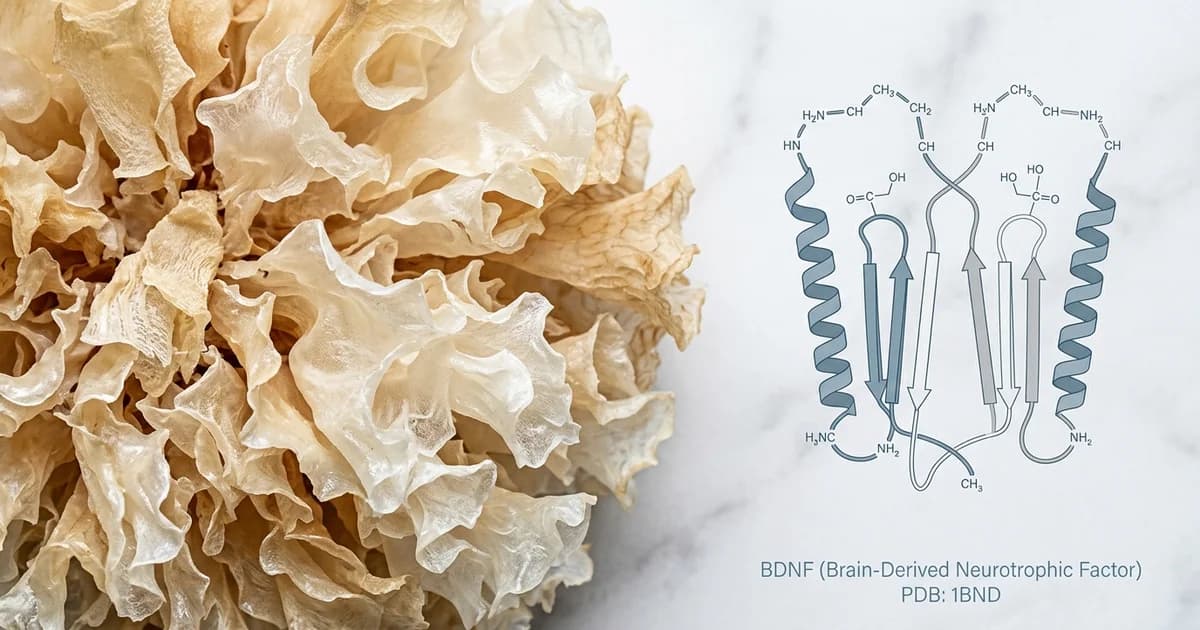
BDNF, brain-derived neurotrophic factor, is the protein that tells neurons to survive, grow, and form new connections. It is downstream of CREB activation, which links the rat findings to the same plasticity machinery exercise and learning rely on. The growth-factor signaling tremella triggers is functionally similar to what nerve growth factor does, which is why tremella fuciformis cognition research keeps circling back to neurotrophic effects.
Tremella Polysaccharide and Neuroprotection
Beyond growth, tremella shows defensive effects on brain tissue, which is the second half of tremella neuroprotection.
A 2025 study in Molecular Neurobiology reported that tremella fuciformis polysaccharides reduced early brain injury in an experimental model of subarachnoid hemorrhage by dampening an inflammatory signaling pathway. Inflammation and oxidative stress drive much of the neuronal damage in aging and injury, and tremella polysaccharides act on both fronts.
Growth on one side, protection on the other. That combination is what makes the mushroom worth a closer look.
How Tremella Compares to Other Cognitive Mushrooms and Ingredients
Tremella is not the only natural compound studied for memory and focus. Here is an honest snapshot of where it sits.
| Ingredient | Primary mechanism | Human evidence | Best understood role |
|---|---|---|---|
| Tremella fuciformis | Neurite outgrowth, CREB, anti-inflammatory polysaccharides | One 8-week RCT in mild cognitive complaints | Long-term memory and neuroprotection support |
| Lion's mane | NGF stimulation, nerve regeneration | Small human trials | Nerve growth, mood, recovery |
| Caffeine | Adenosine receptor blockade | Extensive human evidence | Fast, acute alertness |
| L-theanine | Alpha-wave activity, glutamate modulation | Strong human evidence | Calm, focused attention (often paired with caffeine) |
A useful way to read this table: tremella and lion's mane work slowly, over weeks, on the brain's hardware. Caffeine and L-theanine work in minutes on its day-to-day performance. They answer different questions. If you want to understand the fast side of that equation, our breakdown of why caffeine and L-theanine work better together covers the most studied focus pairing in the field.
How to Use Tremella (and Realistic Expectations)
The human trial used 600 to 1,200 mg per day of tremella fuciformis, with the higher dose producing the clearer cognitive results. Most commercial extracts are standardized for polysaccharide content, which is the active fraction to look for on a label.
Set your expectations to the right timescale. Tremella is not a same-day focus tool. The trial ran eight weeks, the mechanisms involve slow structural changes in neurons, and any benefit builds gradually. Think of it as a long-game ingredient, closer to a fitness habit than a pre-workout.
It also pairs logically with the basics that drive BDNF on their own: sleep, aerobic exercise, and learning. The mushroom supports that system. It does not replace it.
Conclusion
Tremella fuciformis has spent decades typecast as a beauty ingredient, and the brain research is finally catching up to a more interesting story. A single controlled human trial, paired with consistent cell and animal work, points to a mushroom that supports memory through real neuronal mechanisms: neurite outgrowth, CREB and cholinergic activation, and BDNF-linked growth signaling, plus anti-inflammatory protection of brain tissue.
The honest read is that the evidence is early and promising rather than settled. One eight-week study in people with mild complaints is a strong first signal, not proof. What makes tremella worth watching is the rare alignment between human outcomes and a believable mechanism. Few functional mushrooms can claim both.
Frequently Asked Questions
Does tremella fuciformis actually improve memory?
In one randomized, placebo-controlled human trial, adults with mild, self-reported cognitive complaints who took tremella for eight weeks showed greater improvement in memory complaints and executive performance than those on placebo, with the 1,200 mg dose performing best. Lab and animal studies support a plausible mechanism. The evidence is encouraging but limited to a single short human trial, so it is best viewed as early support rather than proof.
What is the active ingredient in tremella for the brain?
The tremella polysaccharide is the compound behind most of the mushroom's studied effects, including its neurological activity. These complex sugars make up the bulk of the mushroom's dry weight and are linked to neurite outgrowth, anti-inflammatory action, and antioxidant effects. When choosing a product, look for extracts standardized for polysaccharide content.
How is tremella different from lion's mane?
Both are studied for nerve growth, but through slightly different angles. Lion's mane is best known for stimulating nerve growth factor directly, while tremella appears to work through CREB activation, the cholinergic system, and anti-inflammatory polysaccharides. Tremella also has one controlled human cognitive trial, which is uncommon for functional mushrooms. They are complementary rather than interchangeable.
How long does tremella take to work for cognition?
Plan on weeks, not minutes. The main human trial ran eight weeks, and the proposed mechanisms involve gradual structural changes in neurons rather than an acute stimulant effect. Tremella is a long-game ingredient. If you want fast, same-session focus, that comes from different compounds like caffeine and L-theanine.
What dose of tremella was used in the research?
The human trial tested 600 mg/day and 1,200 mg/day of tremella fuciformis over eight weeks. The higher 1,200 mg dose showed the clearer improvements in short-term memory and executive performance. Most commercial supplements fall in a similar range, though formulations and polysaccharide concentrations vary widely.
Is tremella safe?
Tremella has a long history as a food in Asian cuisine and was well tolerated in its human cognitive trial. As with any supplement, quality and dosing matter, and it is not a treatment for any diagnosed condition. If you are pregnant, nursing, taking medication, or managing a health condition, talk to a clinician before adding it.
Why Roon Watches the Functional-Mushroom Research Closely
Tremella is a reminder that the most interesting cognitive ingredients often work on two different clocks. Mushrooms like tremella operate slowly, over weeks, reshaping the brain's wiring through neurite outgrowth and BDNF-linked growth. That is real, and it matters. It is also not what you reach for when you need to lock in for the next six hours.
Roon lives on the other clock. It is a zero-nicotine, sublingual cognitive performance pouch built around four ingredients: 80 mg caffeine, 60 mg L-theanine, 25 mg methylliberine (Dynamine), and 5 mg theacrine (TeaCrine), designed for a 5 to 10 minute onset and 6 to 8 hours of focus without the jitters, crash, or tolerance creep. Roon is not a long-term neurogenesis supplement, and it is not a replacement for the slow work of sleep, exercise, and learning that tremella supports. Different tool, different job.
If you care about the science behind what you put in your body, that is exactly the standard we hold ourselves to. Read the research, then try Roon when you need focus on demand.
Written by Roon Team