Short Attention Span Meaning: What It Actually Is
Short Attention Span Meaning: What It Actually Is, Why It Happens, and What to Do About It
You just read that sentence. But if you're like most people, something already tried to pull you away before you finished it. A notification. A tab. A stray thought about lunch. Understanding the short attention span meaning starts with recognizing that impulse.
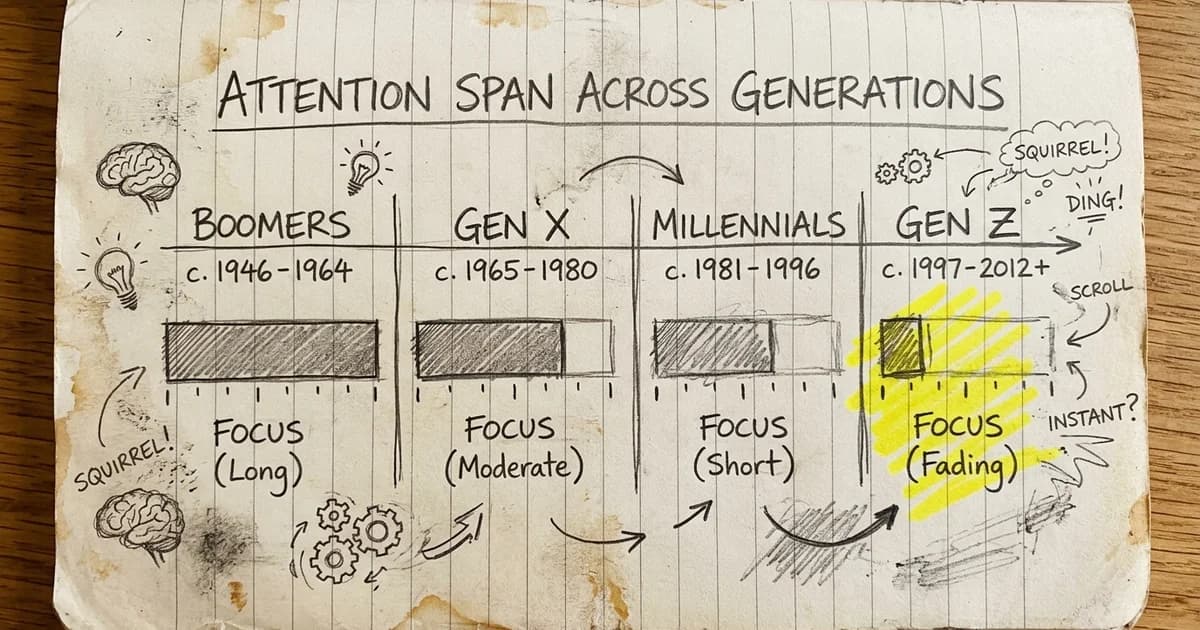
The short attention span meaning is straightforward: it's the persistent difficulty sustaining focus on a single task for a reasonable period of time. Not a clinical diagnosis on its own, but a real, measurable pattern that affects how you work, learn, and think.
And it's getting worse. A national survey of 1,000 American adults commissioned by The Ohio State University Wexner Medical Center found that 43% of respondents blamed stress and anxiety as the top contributor to their short attention span, followed by lack of sleep (39%) and digital devices (35%).
Key Takeaways
- The short attention span meaning refers to struggling to stay focused on one task for an expected duration, whether you're 2 years old or 35.
- The average time a person spends on a single screen before switching has dropped to 47 seconds, according to research from UC Irvine.
- Children's attention spans follow a rough formula: 2 to 3 minutes per year of age, so a 5 year old attention span tops out around 10 to 15 minutes.
- Stress, sleep deprivation, and constant digital stimulation are the primary drivers of short attention spans in adults.
Short Attention Span Meaning: What Does It Actually Look Like?
Let's get specific. The short attention span meaning boils down to this: your brain disengages from a task before the task is done, and often before you even realize it's happening.
This isn't about willpower. The prefrontal cortex, the brain region responsible for sustained attention, competes constantly with your brain's reward system. Every time a notification pings or a new thought surfaces, your mesolimbic dopamine pathway fires a small signal that says this might be more interesting. When that signal wins too often, you get a pattern: incomplete tasks, difficulty following conversations, and the vague sense that your brain won't cooperate.
Research from Harvard Health confirms that social media cues like "likes" trigger dopamine surges that reduce motivation to stay on task. This is the short attention span meaning in action: your neurochemistry pulling you away from what matters.
The result? According to Gloria Mark, PhD, a professor of informatics at UC Irvine who has tracked digital attention for nearly two decades, the average person now spends just 47 seconds on a single screen before switching. In 2004, that number was two and a half minutes.
Short Attention Span Meaning in Children: What's Normal by Age
Before you worry about your kid, know this: children are supposed to have short attention spans. Their prefrontal cortex is still developing, and their capacity for sustained focus grows in a predictable pattern. The short attention span meaning for a toddler is very different from what it means for an adult.
Childhood development experts generally agree on a simple formula: a child can focus for roughly 2 to 3 minutes per year of age.
Here's what that looks like in practice:
| Age | Expected Attention Span |
|---|---|
| 2 years old | 4–6 minutes |
| 3 years old | 6–9 minutes |
| 4 years old | 8–12 minutes |
| 5 years old | 10–15 minutes |
| 6 years old | 12–18 minutes |
The Attention Span of 2 Year Old Children
The attention span of 2 year old children tops out around 4 to 6 minutes for a single activity. That's normal. At this age, children are driven almost entirely by novelty. They explore, touch, move on. Expecting a toddler to sit still for a 20-minute activity isn't a reasonable ask; it's a misunderstanding of brain development. The attention span of 2 year old toddlers reflects a brain that is wired to sample the environment broadly, not focus deeply.
What About the Attention Span of 3 Year Old Children?
The attention span of 3 year old kids stretches to roughly 6 to 9 minutes. According to educational psychologist Natalie Hutton, children in this age group can hold attention for 3 to 8 minutes on a task, extending to around 15 minutes by age 3.5 if new options are introduced within the activity. The attention span of 3 year old children grows quickly during this period, but still falls well short of what adults might expect.
The 5 Year Old Attention Span
By age five, a child's focus window grows to about 10 to 15 minutes. A 5 year old attention span of this length is considered developmentally appropriate. Happiest Baby reports that children at ages 5 and 6 can sustain attention for roughly 12 to 18 minutes, depending on the activity and their level of interest.
If your child consistently falls well below these ranges across different activities and settings, that's worth discussing with a pediatrician. But a 5 year old attention span that can't handle a 45-minute lecture? Completely normal. That doesn't match the short attention span meaning parents should worry about.
Why Adults Lose Focus: The Three Main Culprits
A limited attention span in adults rarely has a single cause. The research points to three factors that reinforce each other, and each one reshapes the short attention span meaning for grown-ups.
1. Stress and Sleep Deprivation
The Ohio State survey found that stress, anxiety, and poor sleep were the top two reasons adults reported difficulty focusing. This tracks with neuroscience: cortisol (the stress hormone) impairs prefrontal cortex function, and sleep deprivation reduces your brain's ability to filter irrelevant stimuli.
You don't just feel foggy after a bad night's sleep. You are measurably worse at paying attention.
2. Digital Fragmentation
A 2025 report from Insightful found that 59% of employees can't go 30 minutes without encountering a distraction at work. Over 11% get distracted every 5 minutes.
The problem isn't that you're lazy. The problem is that modern digital environments are designed to interrupt you. Every app on your phone is competing for the same dopamine-driven attention system in your brain. And every interruption costs you: research shows it takes an average of 25 minutes to fully return your attention to a task after a single disruption. This is the short attention span meaning most working adults experience daily.
3. Adenosine Buildup and Neurochemical Fatigue
Here's one most people miss. Your brain runs on a neurochemical budget. Adenosine, a byproduct of neural activity, accumulates throughout the day and progressively dulls your alertness. It's the same molecule that caffeine blocks, which is why coffee temporarily helps.
But caffeine alone creates a spike-and-crash cycle. It floods adenosine receptors without addressing the downstream effects on GABA (your brain's calming neurotransmitter) or dopamine regulation. That's why your third cup of coffee at 3 PM makes you jittery but not focused.
How to Actually Improve a Short Attention Span
Knowing the short attention span meaning is useful. Fixing it requires targeting the right mechanisms.
Reduce context switching. Close tabs. Silence notifications. Give your prefrontal cortex a fighting chance by removing the competition. Even batching your email checks to twice per day can reduce the cognitive load of constant task-switching.
Protect your sleep. Seven to nine hours isn't optional if you want your attention system to work properly. Sleep is when your brain clears adenosine buildup and consolidates the neural pathways involved in focus.
Train sustained attention. Start small. Set a timer for 15 minutes and work on one task with zero interruptions. Build from there. Your brain adapts to what you practice, including focus.
Address the neurochemistry. A study published in Nutritional Neuroscience found that 97 mg of L-theanine combined with 40 mg of caffeine improved cognitive performance and subjective alertness during demanding tasks. The combination works because L-theanine modulates GABA activity and promotes alpha-wave output, improving attention-switching accuracy and calm focus when paired with caffeine.
Cut Through the Fog
Now that you understand the short attention span meaning, you know it isn't a personality flaw. It's a signal that your brain's neurochemistry, your environment, or both need adjustment.
That's the thinking behind Roon. It's a zero-nicotine sublingual pouch built around the same pathway science points to: caffeine (80 mg), L-theanine, theacrine, and methylliberine, working together to support sustained focus for 6 to 8 hours without the jitters, crash, or tolerance buildup that come with coffee or energy drinks. At 80 mg caffeine, the dose is comparable to a cup of coffee, but the L-theanine smooths the onset and the theacrine and methylliberine extend it.
No pills. No sugar. No waiting 30 minutes for something to kick in. Just clean, sustained attention when your brain needs it most.