3 Year Old Attention Span: What's Normal, What's Not
Roon Team
3 Year Old Attention Span: What's Normal, What's Not, and What Actually Helps
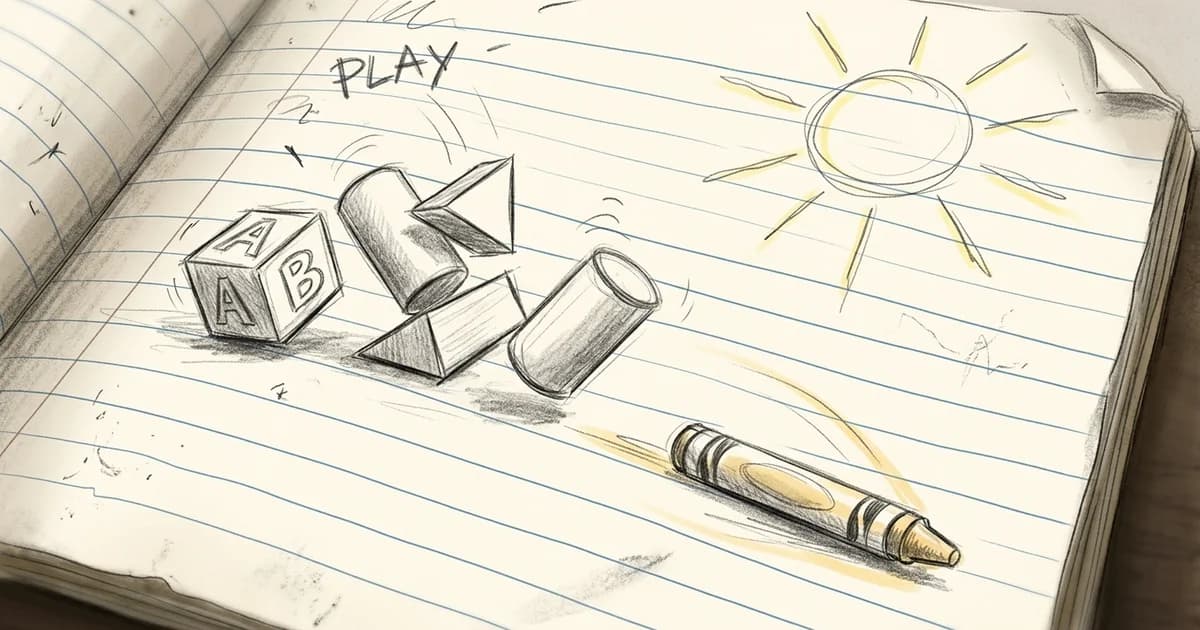
Your 3 year old just abandoned their third activity in ten minutes. Crayons, blocks, a puzzle, all touched and discarded like yesterday's snack. Before you start Googling "signs my kid has ADHD," take a breath. A 3 year old attention span is supposed to be short. Comically short, even. The real question is how short is too short, and what can you do about it.
This guide breaks down the science of a 3 year old attention span, what to expect at every age from 2 to 5, and when a short attention span actually signals something worth investigating.
Key Takeaways:
- The average 3 year old attention span for a single task is about 6 to 9 minutes
- A common rule of thumb: children can sustain attention for roughly 2 to 3 minutes per year of age
- Screen time, sleep, and environment all affect how long your child can focus
- Most "attention problems" in toddlers are completely normal developmental behavior
How Long Is a 3 Year Old Attention Span, Really?
The short answer: not very long. Childhood development experts generally say that an average attention span by age is about two to three minutes per year of age. For a typical 3 year old attention span, that works out to roughly 6 to 9 minutes of sustained focus on a single activity.
Some sources put the range slightly wider. According to Happiest Baby, the average attention span of a 3 year old falls between 6 and 8 minutes, while Brightwheel cites a similar 6 to 8 minute window.
But here's the thing most parents miss: these numbers describe sustained, uninterrupted focus on a task that isn't inherently exciting. If your 3 year old watches 20 minutes of their favorite show without blinking, that doesn't mean their 3 year old attention span is 20 minutes. Passive screen consumption and active, self-directed focus are two very different cognitive processes.
The Attention Span of a 3 Year Old vs. Other Ages
Attention develops on a predictable curve. Knowing where your child's 3 year old attention span sits on that curve helps you set realistic expectations and stop comparing them to their older cousin.
| Age | Expected Attention Span | What It Looks Like |
|---|---|---|
| 2 years | 4–6 minutes | Flits between toys rapidly; needs constant redirection |
| 3 years | 6–9 minutes | Can complete a short activity with some adult support |
| 4 years | 8–12 minutes | Begins to follow multi-step instructions independently |
| 5 years | 10–15 minutes | Can sit through a structured lesson or group activity |
The attention span of a 2 year old hovers around 4 to 6 minutes, which is why toddler playgroups rotate activities every few minutes. By the time a child reaches a 4 year old attention span of 8 to 12 minutes, they can handle preschool circle time without completely losing the plot. And the attention span of a 5 year old, roughly 10 to 15 minutes, is what kindergarten teachers build their lesson plans around.
These ranges come from the general "2 to 3 minutes per year of age" guideline that developmental psychologists use. Some researchers push the upper bound to 5 minutes per year of age, which would give a 3 year old attention span of up to 15 minutes. The reality for most kids falls somewhere in the middle.
If you're looking for a more detailed breakdown, searching for an average attention span by age PDF from your pediatrician's office or a developmental psychology textbook will give you a structured reference chart. The University of Pittsburgh's developmental milestones guide is one solid resource for understanding how the attention span of a 3 year old compares to older children.
Why Your 3 Year Old's Brain Works This Way
A 3 year old attention span isn't a flaw, and for children born in the smartphone era, understanding how the brain develops matters more than ever.
The Prefrontal Cortex Is Still Under Construction
The prefrontal cortex, the brain region responsible for executive functions like sustained attention, impulse control, and working memory, is one of the last areas to fully mature. According to research published in Frontiers in Human Neuroscience, executive function develops markedly in early childhood between ages 3 and 6, with the prefrontal cortex showing distinct activation patterns in 3 year olds compared to 4 year olds.
In plain terms: the typical 3 year old attention span is limited because the brain literally doesn't have the hardware yet to focus the way an older child can. The neural pathways that support sustained attention are still being built, synapse by synapse. This is also why the 4 year old attention span tends to be noticeably longer; even one year of prefrontal development makes a measurable difference.
Curiosity Is Doing Its Job
Young children are biologically wired to explore. A short 3 year old attention span isn't a deficit. It's an adaptation. Rapidly shifting between stimuli helps toddlers gather information about their environment. They're sampling the world, not studying it.
This is why a 3 year old can seem "distracted" while actually learning at an extraordinary rate. Their brain is prioritizing breadth of experience over depth of focus. That trade-off shifts as they age, but at 3, it's exactly where it should be. The same principle applies to the attention span of a 2 year old, which is even shorter because the drive to explore is even more dominant.
5 Factors That Affect Your 3 Year Old Attention Span
Not all attention spans are created equal. Several environmental and lifestyle factors can shrink or stretch your child's ability to focus.
1. Screen Time
This is the big one. A 2023 review published in PMC found that excessive screen time in early childhood is associated with worse executive functioning and academic performance. The rapid visual stimulation of screens trains the brain to expect constant novelty, making slower-paced activities (like building with blocks or listening to a story) feel boring by comparison. This effect is especially pronounced on a 3 year old attention span because the prefrontal cortex has fewer resources to override the craving for stimulation.
The American Academy of Pediatrics recommends limiting screen time to one hour per day of high-quality programming for children ages 2 to 5.
2. Sleep Quality
Tired kids can't focus. Period. A 3 year old typically needs 10 to 13 hours of sleep per day, including naps. When sleep is fragmented or insufficient, the 3 year old attention span is one of the first cognitive functions to suffer.
3. Physical Activity
Kids who move more focus better. Physical play doesn't just burn energy. It promotes blood flow to the brain and supports the development of the neural circuits involved in attention and self-regulation.
4. Environment
A room crammed with 50 toys is an attention killer. Too many options create decision fatigue, even in toddlers. Rotating toys and keeping the play space simple gives your child's brain fewer competing stimuli to filter out, which directly supports a longer 3 year old attention span.
5. Interest Level
This one seems obvious, but it matters more than parents realize. A 3 year old who "can't focus" on flashcards might sit with dinosaur figurines for 15 minutes straight. The attention span of a 3 year old is heavily driven by intrinsic motivation. If the activity doesn't interest them, their brain simply won't allocate resources to it.
How to Build a Longer 3 Year Old Attention Span
You can't force a 3 year old to focus, but learning how to improve attention span of a child can help you create conditions that make sustained attention easier and gradually stretch that 3 year old attention span over time.
Follow their lead. Research shows that engaging with a toy or activity alongside your child, even briefly and without speaking, makes it more likely they'll continue playing on their own. Joint attention is one of the strongest predictors of sustained independent focus.
Extend, don't redirect. When your child is engaged in something, resist the urge to introduce a new activity. Instead, add a layer to what they're already doing. If they're stacking blocks, ask "Can you make it taller?" This stretches the 3 year old attention span without breaking it.
Read together daily. Start with short picture books and gradually increase the length. Reading builds sustained attention, vocabulary, and the ability to follow a narrative, all skills that feed back into longer focus.
Reduce distractions. Turn off background TV. Keep the play area uncluttered. Give your child one or two activity options instead of ten. A simpler environment lets their developing prefrontal cortex do its job without fighting sensory overload.
Build in movement breaks. Expecting a 3 year old to sit still for extended periods is a losing strategy. Alternate between seated activities and physical play. A few minutes of running, jumping, or dancing resets their attention clock.
When to Be Concerned About Your 3 Year Old Attention Span
Most attention "issues" in 3 year olds are perfectly normal. But there are some signs worth discussing with your pediatrician.
According to the Kennedy Krieger Institute, early signs associated with a later ADHD diagnosis include: disliking or avoiding activities that require paying attention for more than one or two minutes, and losing interest almost immediately after engaging in a task.
Other flags to watch for:
- Inability to follow simple, one-step directions (like "pick up the ball") by age 3
- Constant, nonstop physical movement that goes well beyond typical toddler energy
- Difficulty engaging in any activity, even ones they enjoy, for more than a minute or two
- Significant regression in attention or behavior that was previously age-appropriate
Understanding what a short attention span means is important, because a short 3 year old attention span alone doesn't indicate ADHD or any other condition. CNLD Neuropsychology notes that a short attention span could be a sign of ADHD, but it's not the official deciding factor. Many other variables, from sleep deprivation to sensory processing differences, can mimic attention disorders in young children. Remember that the attention span of a 2 year old is even shorter, and most of those children develop perfectly typical focus as they grow.
If you're concerned about your child's 3 year old attention span, a developmental pediatrician or pediatric neuropsychologist can run a formal evaluation. Early identification leads to better outcomes, regardless of the diagnosis.
The 3 Year Old Attention Span Conversation Doesn't End at Age 5
Understanding your child's 3 year old attention span is just one chapter. Attention is a lifelong cognitive function, and the same principles that help a toddler focus (sleep, reduced screen time, the right environment, genuine interest in the task) apply just as much to adults. What starts as a 4 year old attention span of 8 to 12 minutes eventually grows into the sustained focus required for school, work, and daily life.
If you're a parent running on fumes, struggling with your own brain fog while trying to support your child's development, you're not alone. The same neurochemical systems that govern your 3 year old's attention, adenosine buildup, dopamine regulation, GABA signaling, are the ones running (or stalling) your own focus.
Roon was designed for exactly this. A zero-nicotine sublingual pouch with Caffeine, L-Theanine, Theacrine, and Methylliberine that targets the pathways behind brain fog. No jitters, no crash, just 6 to 8 hours of clean, sustained focus. Because helping your kid build a better 3 year old attention span starts with having enough of your own.