Saffron for Memory and Cognition: Separating the Mood Effect From a Brain-Performance Claim
Saffron has one of the more interesting research files in the supplement world, and most of the marketing around it gets the story backwards. The strongest evidence for saffron cognitive benefits does not come from healthy people sharpening their focus before a meeting. It comes from clinical populations, and a lot of the brain effect appears to run through mood, not raw processing speed.
That distinction matters if you are buying saffron to think faster today. A spice that gently lifts low mood over six weeks is a different product from something engineered to improve attention and reaction time in ten minutes.
This article walks through what saffron actually does to the brain, where the data is real, and where the claims outrun the science.
Key Takeaways
- The best human data on saffron for memory comes from people with mild-to-moderate Alzheimer's disease, not healthy adults looking for an edge.
- Much of saffron's cognitive signal is tied to its well-documented effect on mood, which makes the brain benefit indirect.
- Crocin and crocetin, saffron's active pigments, show antioxidant and anti-inflammatory activity in the lab, but lab activity is not the same as a focus benefit you can feel.
- Saffron works slowly over weeks. If you want acute, same-day focus, it is the wrong tool.
What Saffron Is and Why Researchers Care
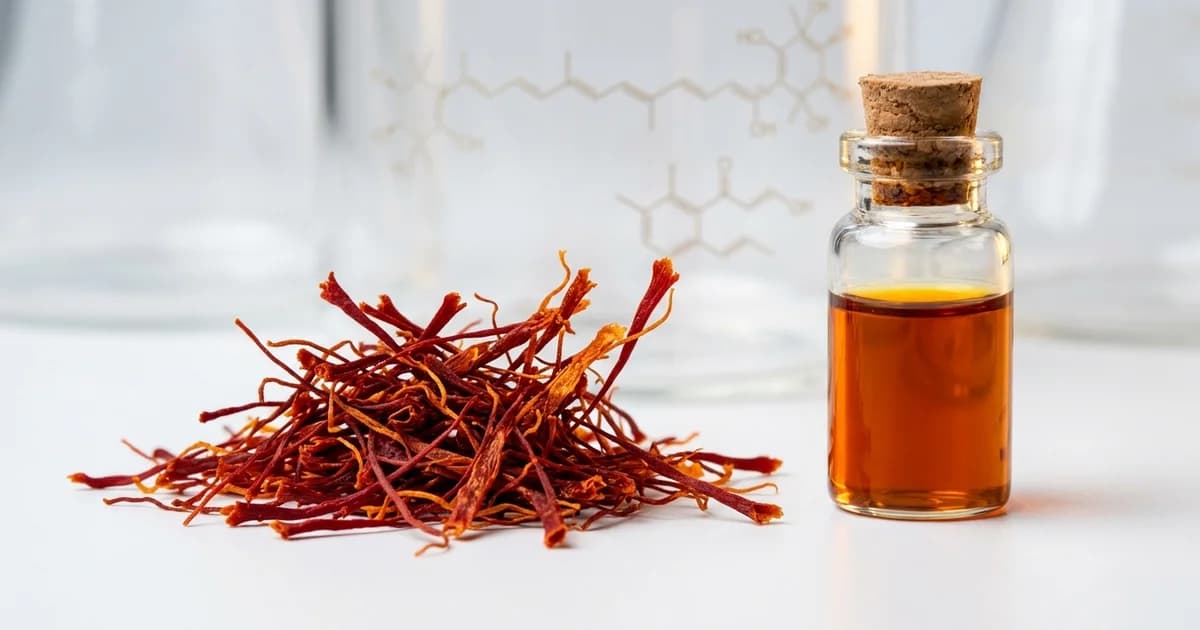
Saffron is the dried stigma of the Crocus sativus flower, the most expensive spice by weight on earth. Its color and bioactivity come mostly from a small group of compounds: crocin and crocetin (the carotenoid pigments), picrocrocin (the bitter taste), and safranal (the aroma).
Crocin is the molecule most studies point to when they talk about crocin cognition. In preclinical work, these apocarotenoids act as antioxidants and dampen neuroinflammation, two processes tied to age-related cognitive decline. A 2024 review in Food & Function examined how the human gut microbiota metabolizes crocins into crocetin, which is the form thought to actually cross into circulation.
Here is the honest caveat. A compound that reduces oxidative stress in a petri dish or a rodent brain has cleared a low bar. The real question is whether that translates into measurable cognition in humans, and that is where the evidence gets selective.
Saffron Cognitive Benefits: What the Human Trials Actually Show
The clearest saffron brain health signal comes from dementia research, not from healthy-brain optimization. In a 16-week randomized, placebo-controlled trial published in PubMed, patients with mild-to-moderate Alzheimer's disease who took 30 mg of saffron daily showed better cognitive scores than the placebo group.
Follow-up work compared saffron head-to-head against donepezil, a standard Alzheimer's drug, and reported similar cognitive outcomes over the study period. A separate randomized trial indexed on ScienceDirect found that adding saffron to donepezil reduced certain inflammation and oxidative stress markers in Alzheimer's patients.
That is a genuinely interesting result for a spice. It is also a narrow one.
These benefits showed up in people with active neurodegeneration, measured over months, at a fixed daily dose. None of it tells you that a healthy 30-year-old will read faster or remember a presentation better after taking saffron. The population, the timeline, and the endpoints are all different from what most buyers assume.
Saffron and Mild Cognitive Impairment
The story extends, cautiously, to earlier decline. Research on saffron mild cognitive impairment suggests possible support for older adults in the transition zone before dementia, and a systematic review in Phytotherapy Research catalogued saffron's effects across several neurological and psychiatric conditions.
The reviewers are consistent on one point: most trials are small, short, and clustered in clinical groups. The effect is plausible and worth more study. It is not settled, and it is not a general cognitive enhancer claim.
The Part Most Articles Skip: It Is Mostly a Mood Effect
Saffron's most reproducible benefit in humans is on mood, and that reframes the cognition conversation entirely. The spice has been studied repeatedly as a support for low mood, including a randomized controlled trial in the Journal of Nutrition that examined a standardized saffron extract in adults experiencing low mood.
Why does this matter for your brain? Because mood and cognition are tangled together. When mood lifts, people often report sharper attention, better memory recall, and more mental energy. Some of saffron's apparent cognitive lift may be a downstream effect of feeling better, not a direct action on the circuits that govern processing speed.
That is not a knock on saffron. A genuine mood benefit is valuable. But it does change what you should expect. A trial on cognition in coronary bypass patients, where saffron was studied alongside anxiety and depression, did not find a clear benefit, a reminder that cognition, mood, and stress are entangled and the evidence outside mood is far from settled.
If you want a direct hit to saffron attention in a healthy brain, the data does not strongly back that. If you want gentle mood support that may indirectly help how you think, the case is much better.
Saffron Versus Acute Focus Tools: An Honest Comparison
Saffron and fast-acting focus compounds solve different problems on different timelines. One works over weeks through mood and antioxidant pathways. The others work in minutes through alertness and attention systems.
| Compound | Primary mechanism | Onset | Best-evidence use case | Healthy-adult acute focus? |
|---|---|---|---|---|
| Saffron (crocin/crocetin) | Mood support, antioxidant, anti-inflammatory | Weeks | Mood, clinical cognitive decline | Weak |
| Caffeine | Adenosine blockade, alertness | 30-45 min | Acute alertness, reaction time | Strong |
| L-theanine | Calming alpha-wave activity, smooths caffeine | 30-60 min | Calm focus, fewer jitters | Strong (paired) |
| Methylliberine (Dynamine) | Fast-acting energy without long half-life | Fast | Quick, clean energy | Moderate-strong |
| Roon pouch (full stack) | Caffeine + L-theanine + Dynamine + TeaCrine, sublingual | 5-10 min | Sustained, jitter-free focus | Strong |
The point is not that saffron is weak. It is that saffron and acute focus tools are not interchangeable. Buying saffron for same-day attention is like buying a multivitamin for a headache. Reasonable ingredient, wrong job.
For more on how the caffeine and L-theanine pairing supports calm, sustained attention, that combination has a much deeper acute-performance literature than saffron does.
How to Think About Saffron If You Still Want to Try It
If your goal is mood support with a possible cognitive side benefit, saffron is a defensible choice. Most positive trials used a standardized extract at roughly 28 to 30 mg per day, taken consistently for weeks. Single doses do little.
Look for extracts standardized to crocin and safranal content, since raw spice quality varies wildly and adulteration is common. Give it time. The clinical effects were measured over weeks and months, not hours.
And keep the expectation honest. Saffron is a slow, mood-leaning ingredient with promising but early cognitive data. It is not an attention switch.
Conclusion
Saffron earns its place in the cognition conversation, but for narrower reasons than the marketing suggests. The strongest human evidence sits in clinical populations, the timeline runs in weeks, and a meaningful share of the brain benefit appears to flow through mood rather than direct cognitive action.
That makes saffron a reasonable mood-support ingredient with early, promising signals for memory in older or at-risk adults. It does not make it a same-day focus tool. Match the ingredient to the job, and saffron looks far more sensible than the hype around it.
Frequently Asked Questions
Does saffron actually improve memory?
The clearest evidence for saffron and memory comes from people with mild-to-moderate Alzheimer's disease, where a 30 mg daily dose improved cognitive scores over 16 weeks versus placebo. Evidence in healthy adults is thin. For most people, saffron is better understood as a mood-support ingredient that may indirectly help cognition, not as a direct memory enhancer.
How long does saffron take to work for cognition?
Weeks, not minutes. The positive cognitive and mood trials measured outcomes over roughly 6 to 22 weeks of daily use at a standardized dose. Saffron does not produce an acute, same-day focus effect, so a single dose before a task is unlikely to do much.
Is saffron's brain benefit really just a mood effect?
Partly, yes. Saffron's most reproducible human result is on mood, and mood and cognition are closely linked. When low mood lifts, attention and recall often improve as a side effect. That makes a meaningful portion of saffron's cognitive signal indirect rather than a direct action on processing speed.
What is crocin and why does it matter for cognition?
Crocin is one of saffron's carotenoid pigments and the compound most often credited in crocin cognition research. In lab and animal studies it shows antioxidant and anti-inflammatory activity. The human body converts crocins into crocetin, the form thought to reach the bloodstream. Lab activity is promising, but it does not guarantee a felt cognitive benefit.
Can saffron help with mild cognitive impairment?
Possibly. Early research on saffron and mild cognitive impairment suggests it may support older adults in the stage before dementia. The trials are small and short, so the finding is plausible rather than proven. Anyone with diagnosed cognitive decline should work with a clinician rather than self-treat.
What dose of saffron is used in studies?
Most positive trials used a standardized saffron extract at roughly 28 to 30 mg per day, taken consistently. Quality and standardization to crocin and safranal matter, because raw saffron varies widely and is frequently adulterated. Saffron is not a medical treatment and should not replace prescribed care.
Is saffron good for attention and focus during work?
Not directly. The data on saffron attention in healthy adults is weak. If you want acute, same-day focus, fast-acting compounds like caffeine paired with L-theanine have far stronger evidence for alertness and reaction time than saffron does.
If You Want Focus Today, Not Mood Support Over Weeks
Saffron is a slow, mood-leaning ingredient. That is its strength and its limit. If your actual problem is staying sharp through a long afternoon, you need something built for acute attention, and that is a different formula entirely.
Roon is a sublingual cognitive performance pouch engineered for exactly that job: 80 mg caffeine, 60 mg L-theanine, 25 mg methylliberine (Dynamine), and 5 mg theacrine (TeaCrine). The caffeine and L-theanine pairing supports calm, focused attention and reaction time, while the sublingual format delivers a 5 to 10 minute onset and a 6 to 8 hour window with no jitters, no crash, and no tolerance buildup.
To be clear about what it is not: Roon is not a mood treatment, and it is not a substitute for sleep, exercise, or care for a diagnosed condition. It is built for one thing, acute focus when you need it. If saffron is the slow lane, try Roon when you need to show up sharp the same day.
Written by Roon Team