Methylliberine (Dynamine) vs Paraxanthine (Enfinity): Which 'Clean Caffeine' Pouch Wins?
Roon Team
Methylliberine (Dynamine) vs Paraxanthine (Enfinity): Which 'Clean Caffeine' Pouch Wins?
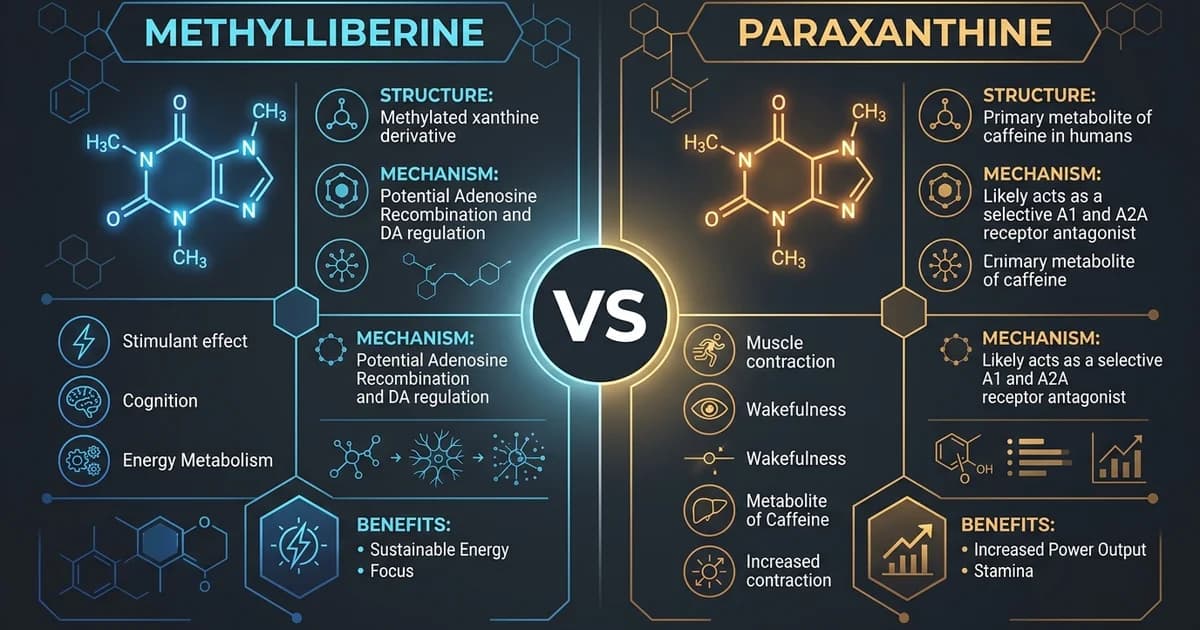
Two ingredients have taken over the "clean energy" aisle, and the paraxanthine vs caffeine debate sits at the center of both. On one side: paraxanthine, sold under the brand Enfinity, marketed as the smarter molecule your body already makes from coffee. On the other: methylliberine, sold as Dynamine, a fast-acting cousin of caffeine that promises lift without the jitters.
Both promise the same thing. Energy and focus minus the crash, the racing heart, and the 3 p.m. collapse.
So which one actually wins in a pouch? The honest answer is that they solve different problems, and neither one fixes everything on its own. Here is the breakdown, the science, and the gap nobody is talking about.
Key Takeaways
- Paraxanthine (Enfinity) is the main metabolite your liver makes from caffeine. Early research suggests it may deliver alertness with a cleaner side-effect profile, but most data is preclinical or industry-funded.
- Methylliberine (Dynamine) is a fast-onset purine alkaloid. It works best stacked with caffeine, not as a full replacement for it.
- Neither ingredient solves the two biggest problems with caffeine alone: the early jitter spike and the late crash.
- A smart stack uses caffeine for proven power, L-theanine to smooth it, and Dynamine plus theacrine to extend the curve.
What Is Paraxanthine, and Why the Hype?
Paraxanthine is the primary compound your body produces when it breaks down caffeine. Roughly 70 to 80 percent of the caffeine you drink gets converted into it. So when you feel "coffee energy," a large slice of that feeling is actually paraxanthine doing the work.
The pitch from brands like Enfinity is simple. Skip the parent molecule and take the active metabolite directly. In theory, you get the alertness while sidestepping the parts of caffeine metabolism linked to jitters and a pounding heart.
The early science is interesting. A preclinical study covered by PricePlow reported that paraxanthine outperformed caffeine on measures of memory and brain function in animal models. Separate rodent research published in Experimental Brain Research found paraxanthine enhanced memory and markers of neuroplasticity more than caffeine.
There is also a safety argument. A review on NCBI examined paraxanthine's profile relative to caffeine and supports its use as a caffeine alternative at studied doses.
Here is the catch I want you to hold onto. Much of the strongest data is in rats, not humans, and a good portion of the human-facing coverage traces back to the company that sells the ingredient. As mindbodygreen notes, the molecule is promising but still early in its human evidence base. Promising is not the same as proven.
What Is Dynamine? The Fast-Acting Alkaloid
Methylliberine, branded as Dynamine, is a purine alkaloid found naturally in the kucha tea leaf, prized for a quick onset and a short, clean lift. If you have searched what is Dynamine, the short version is that it behaves like a faster, lighter relative of caffeine.
Dynamine does not rely on the same slow metabolic conversion that caffeine does. That is why formulators reach for it when they want energy to arrive in minutes, not half an hour.
The most useful human data comes from a pharmacokinetic interaction study in the Journal of Exercise and Nutrition, which looked at how caffeine and methylliberine behave together in the body. The practical takeaway from formulators and reviewers, including a detailed Dynamine guide from The Optimizing Blog, is consistent: Dynamine shines as a partner to caffeine rather than a standalone swap.
On its own, a small dose of Dynamine is subtle. Stacked correctly, it sharpens the front end of the energy curve and helps round off the edges.
Paraxanthine vs Caffeine vs Dynamine: The Honest Comparison
Before the table, the one-line summary. Caffeine is the most studied stimulant on earth, paraxanthine is its cleaner-feeling metabolite, and Dynamine is the fast starter that needs a teammate.
| Ingredient | What it is | Onset | Best role | Evidence base | Main limitation |
|---|---|---|---|---|---|
| Caffeine | The classic stimulant | 30 to 45 min (swallowed) | Proven core driver of alertness | Decades of human trials | Jitters and crash at higher doses |
| Paraxanthine (Enfinity) | Caffeine's main metabolite | ~30 min | A potentially smoother caffeine alternative | Mostly preclinical; some industry-funded | Thin human data; sold mostly as capsules |
| Methylliberine (Dynamine) | Fast purine alkaloid from kucha | Fast | A front-loader that pairs with caffeine | Limited but growing human data | Weak as a standalone; short duration |
A few things stand out once you line them up.
Paraxanthine and Dynamine are often framed as rivals to caffeine. They are better understood as complements. Paraxanthine is literally what caffeine becomes inside you, and Dynamine works best in caffeine's company.
The format matters too. Most Enfinity paraxanthine products ship as capsules or powders you swallow, which means you wait on digestion. Dynamine usually appears inside multi-ingredient pre-workouts and powders rather than as a clean solo product.
The "What's Missing" Problem
Here is the gap analysis nobody selling a single ingredient wants to spell out.
Problem 1: The jitter spike. Caffeine and even its metabolites can hit hard at the front end. Paraxanthine may feel smoother, but a stimulant taken alone still lacks anything to actively calm the overstimulation. There is no built-in balancer.
Problem 2: The duration cliff. A single fast molecule like Dynamine fades. A single slow molecule like caffeine or paraxanthine eventually drops you off the back end into a crash. Neither one, alone, gives you a long, flat, controlled curve.
Problem 3: Delivery speed. Capsules and powders go through your gut. That means a 30-plus minute wait and energy that depends on whether you ate. For a focus tool, that lag is the enemy.
Problem 4: The single-lever trap. Every product above pulls one lever. Paraxanthine bets entirely on a cleaner stimulant. Dynamine bets on speed. Real focus is not one lever. It is a stimulant for power, a calming agent for smoothness, and secondary alkaloids to stretch the timeline.
So the winner of paraxanthine vs Dynamine is neither, if you are forced to pick just one. The winning approach is to combine the right molecules at the right doses, and to deliver them fast.
How a Four-Ingredient Stack Fills Those Gaps
A better answer to the "clean caffeine" question is not a single hero molecule. It is a small, deliberate team where each ingredient covers another's weakness.
- Caffeine stays in the formula because it is the most validated stimulant we have. You do not throw out the proven driver to chase a novel one.
- L-theanine, the amino acid in green tea, is the balancer the solo products lack. Paired with caffeine, it is associated with smoother focus and fewer jitters, which solves Problem 1.
- Methylliberine (Dynamine) front-loads the curve so energy arrives fast, addressing the onset lag in Problem 3.
- Theacrine (TeaCrine) extends the back end and is studied for resistance to the tolerance buildup that makes caffeine feel weaker over time, easing Problem 2.
This is also where the what is Dynamine answer comes full circle. It was never meant to fight caffeine. It was meant to ride alongside it.
If you want to go deeper on any single piece, our breakdowns of how caffeine and L-theanine work together and how to avoid the afternoon caffeine crash cover the mechanisms in plain language.
Conclusion
The honest verdict on paraxanthine versus methylliberine is that you are comparing two specialists and asking which one is a complete athlete. Neither is. Paraxanthine is a promising, cleaner-feeling caffeine metabolite with thin human data so far. Dynamine is a genuine fast starter that needs caffeine beside it to matter.
The real lesson is structural. Single-ingredient "clean caffeine" products force a trade-off. You either get the smooth feeling without proven duration, or fast onset without staying power, or a novel molecule without the decades of evidence behind plain caffeine.
The better question is not which molecule wins. It is which combination, delivered how fast, gives you focus that starts quickly, stays flat for hours, and lets you down gently. Pick the stack, not the single ingredient.
Frequently Asked Questions
Is paraxanthine better than caffeine?
Early research suggests paraxanthine may feel cleaner than caffeine and could support memory in animal models, but most of the strong data is preclinical or funded by the ingredient's maker. Caffeine still has decades of human evidence behind it. The fairest read today is that paraxanthine is a promising caffeine alternative, not a proven upgrade for everyone.
What is Dynamine, in simple terms?
Dynamine is the brand name for methylliberine, a purine alkaloid found in the kucha tea leaf. It acts like a faster, lighter relative of caffeine, delivering a quick lift that fades fairly fast. Most formulators use it alongside caffeine rather than as a full replacement, because it performs better as a front-loader than as a solo stimulant.
Is paraxanthine the same as Dynamine?
No. Paraxanthine is the main compound your liver produces when it breaks down caffeine. Methylliberine, or Dynamine, is a separate purine alkaloid sourced from kucha tea. They feel related because both are caffeine cousins, but they are different molecules with different roles. Paraxanthine acts as a cleaner stimulant, while Dynamine acts as a fast onset partner.
Does paraxanthine cause jitters or a crash?
Some research and user reports suggest paraxanthine produces fewer jitters than equivalent caffeine, partly because it is the metabolite your body normally works with. That said, it is still a stimulant. Taken alone at higher doses without a balancing ingredient like L-theanine, overstimulation is still possible. Cleaner is relative, not absolute.
Why combine caffeine with L-theanine, Dynamine, and theacrine?
Each ingredient covers a gap. Caffeine is the proven driver. L-theanine smooths the edge and supports calm focus. Dynamine speeds up onset. Theacrine extends the duration and is studied for resistance to tolerance buildup. Together they aim for a focus curve that starts fast, stays steady, and avoids the cliff that single ingredients leave behind.
Are these ingredients safe?
Caffeine is well studied at moderate doses. Reviews of paraxanthine and human research on methylliberine support their use at studied amounts, though the human evidence base is younger than caffeine's. As with any stimulant, your tolerance, health conditions, and other caffeine sources matter. If you are pregnant, sensitive to stimulants, or managing a medical condition, talk to a clinician first.
Where the Smart Stack Beats the Single Molecule
If this comparison made one thing clear, it is that betting on a lone "clean caffeine" molecule leaves gaps. The smooth feeling without the duration. The fast onset without the staying power. Roon was built around the combination instead of the single lever.
Each sublingual pouch holds 80 mg caffeine, 60 mg L-theanine, 25 mg methylliberine (Dynamine), and 5 mg theacrine (TeaCrine). The caffeine and L-theanine handle smooth, proven focus, the Dynamine speeds up the front end, and the theacrine stretches the back end. Because you take it sublingually, onset lands in about 5 to 10 minutes instead of waiting on digestion, and the curve is designed for 6 to 8 hours with no jitters, no crash, and no tolerance buildup.
Roon is not a magic fix, and it will not replace sleep or a real routine. What it does is put the full stack the single-ingredient products are missing into one fast pouch. If you have been weighing paraxanthine against Dynamine, the honest move is to try Roon and skip the trade-off entirely.
Written by Roon Team