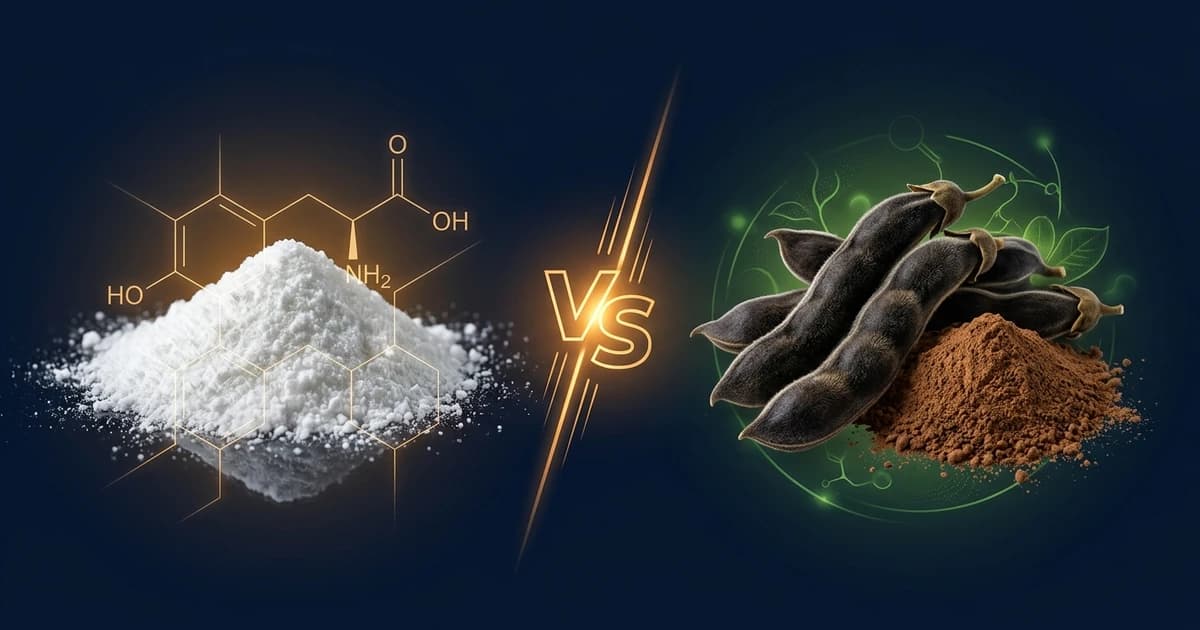
L-Tyrosine vs Mucuna Pruriens (L-DOPA): Precursor vs Direct Dopamine
Both supplements promise the same thing: more dopamine. They get there in completely different ways, and that difference matters more than the marketing suggests.
The l-tyrosine vs mucuna pruriens debate is really a debate about where you intervene in a tightly regulated chemical assembly line. L-tyrosine feeds the raw material in at the top and lets your brain decide how much dopamine to build. Mucuna pruriens delivers L-DOPA, the molecule that sits one step from dopamine itself, skipping your body's main control valve.
One respects the brake your biology installed for a reason. The other drives around it. Here is what the science actually says.
Key Takeaways
- L-tyrosine is a dopamine precursor that your brain converts only as needed, regulated by the rate-limiting enzyme tyrosine hydroxylase.
- Mucuna pruriens is a natural source of L-DOPA, the direct precursor used as the standard drug treatment for Parkinson's disease.
- L-tyrosine works best when you are stressed, sleep-deprived, or under heavy cognitive load, not as a daily mood lift.
- Mucuna's L-DOPA bypasses your body's main regulatory step, which is why it carries the same side-effect profile as the prescription drug.
- More direct does not mean safer. The "direct dopamine" approach is the higher-risk path for healthy people.
The Dopamine Assembly Line, Briefly
Dopamine is built in a fixed sequence: tyrosine becomes L-DOPA, and L-DOPA becomes dopamine. Each arrow is an enzyme.
The first arrow is the one that matters. According to ScienceDirect, tyrosine hydroxylase is the rate-limiting enzyme of catecholamine synthesis, catalyzing the conversion of tyrosine to L-DOPA. "Rate-limiting" means it sets the speed of the entire pathway. Your brain throttles this enzyme up or down based on demand, so dopamine production stays inside a healthy range.
This is the key to the whole comparison. L-tyrosine supplies the ingredient before the brake. Mucuna's L-DOPA arrives after it.
L-Tyrosine: The Regulated Precursor
L-tyrosine is an amino acid that sits at the very start of the dopamine pathway. Because tyrosine hydroxylase controls the next step, flooding your system with tyrosine does not force extra dopamine when you do not need it. Your brain pulls what it requires and leaves the rest.
That design makes tyrosine a depletion-correction tool rather than a stimulant. It shines when your dopamine raw materials are running low.
The research backs this narrow use case. A review in the Journal of Psychiatric Research concluded that tyrosine supplementation helps offset cognitive decline under stressors like cold, fatigue, and high mental workload, but does it not boost performance in people who are rested and unstressed. In other words, it refills a depleted tank. It does not overfill a full one.
Genetics also shape the response. A randomized controlled trial published in Neuropsychologia found that tyrosine's effects on working memory and inhibitory control depended on participants' DRD2 dopamine-receptor genotype. The same dose helped some people and did nothing for others.
A separate study in Cognitive, Affective, & Behavioral Neuroscience reinforced this, showing tyrosine's effect on working memory gating was baseline-dependent. The takeaway is consistent. Tyrosine works with your existing biology, not against it.
Where tyrosine fits
- Acute stress, cold exposure, or sleep loss
- Demanding cognitive sessions where dopamine turnover spikes
- Stacking with caffeine for sustained mental work
It is a quiet supporting actor, not the headliner.
Mucuna Pruriens: Direct L-DOPA Delivery
Mucuna pruriens, the velvet bean, is the most concentrated natural source of L-DOPA. Scientific Reports describes it as the best known natural source of L-dopa, the gold standard for treating Parkinsonism. That is not a wellness claim. It is the same molecule prescribed as a drug.
L-DOPA is one enzymatic step from dopamine, and that step is not rate-limited the way tyrosine hydroxylase is. So mucuna does what tyrosine cannot. It can raise dopamine directly, past your body's main control valve.
Dosing is where this gets serious. Per Examine, trials have used daily doses of prepared seed powder corresponding to roughly 200 mg to 1,500 mg of L-DOPA. Those are pharmacological amounts, and the L-DOPA content of commercial mucuna products varies widely between brands, so two tins labeled the same can deliver very different doses.
That variability is the practical problem. You often do not know how much active drug you are actually taking.
Tyrosine vs L-DOPA: The Head-to-Head
Here is the tyrosine vs l-dopa comparison stripped to essentials.
| Factor | L-Tyrosine | Mucuna Pruriens (L-DOPA) |
|---|---|---|
| Position in pathway | Before the rate-limiting step | After the rate-limiting step |
| Regulation | Controlled by tyrosine hydroxylase | Bypasses the main control valve |
| Best evidence for | Stress and cognitive-load support | Standard treatment for Parkinson's disease |
| Effect in healthy, rested people | Minimal | Direct dopamine increase |
| Dose consistency | High (single amino acid) | Variable across products |
| Side-effect profile | Generally mild | Mirrors the prescription drug |
| Tolerance / regulation concern | Low | Higher with sustained use |
This is the core of any honest natural dopamine precursor comparison. One ingredient cooperates with your regulatory system. The other steps over it.
"More Direct" Is Not "Safer"
The biggest myth in the mucuna vs tyrosine dopamine conversation is that bypassing a slow enzyme is a feature. For a healthy brain, it is the risk.
L-DOPA's side effects are well documented because it has been a medicine for decades. The Parkinson's Foundation lists common levodopa side effects including nausea, low blood pressure, confusion, and hallucinations. These are dose-related, and a healthy person self-dosing an unstandardized seed extract has no clinician adjusting the amount.
Long-term use brings its own pattern. A review in PMC describes levodopa-induced dyskinesia, the involuntary movements that develop with extended treatment, alongside neuropsychiatric and systemic reactions. That is the trade-off of pushing dopamine past its regulatory step over time.
Tyrosine carries no comparable profile, precisely because tyrosine hydroxylase refuses to overproduce. When you cannot use the precursor, your body simply does not convert it. That built-in ceiling is the safety mechanism mucuna sidesteps.
So the ranking for a healthy person seeking focus or stress resilience is straightforward. Tyrosine is the conservative, biology-respecting choice. Mucuna is a potent compound that behaves like the drug it is derived from, and it deserves that level of caution.
How to Choose
Choose l-tyrosine if your goal is cognitive support under stress, fatigue, or heavy mental load, and you want an ingredient your body can regulate. It is the safer everyday tool, with a modest, situation-dependent effect.
Treat mucuna pruriens as the pharmacological option it is. If you are considering an l-dopa supplement for a clinical reason, that is a conversation for a physician, not a supplement aisle. The dose variability and the drug-grade side-effect profile are not edge cases. They are the main story.
For most people chasing sharper focus, the smarter move is not maximizing dopamine. It is supporting the systems that sustain attention without overriding your own controls.
Conclusion
L-tyrosine and mucuna pruriens both touch the dopamine pathway, but they are not interchangeable. Tyrosine feeds the system before its main brake and lets your brain decide. Mucuna delivers L-DOPA past that brake, which is exactly why it works as a Parkinson's medication and why it carries that medication's risks.
The instinct to grab the "more direct" option is understandable and usually wrong. Bypassing a regulatory step your body built on purpose is not an upgrade for a healthy brain. It is a gamble with the dose and the long-term cost.
Match the tool to the goal, respect the biology, and remember that with dopamine, more access is not the same as more benefit.
Frequently Asked Questions
Is L-tyrosine or mucuna pruriens better for dopamine?
It depends on the goal. For healthy people seeking focus or stress resilience, L-tyrosine is the safer choice because your brain regulates how much of it becomes dopamine. Mucuna pruriens raises dopamine more directly through L-DOPA, but it bypasses that regulation and carries the side-effect profile of a prescription drug. More direct is not better for a healthy brain.
Does L-tyrosine actually raise dopamine?
L-tyrosine supplies the raw material for dopamine, but tyrosine hydroxylase, the rate-limiting enzyme, controls how much gets converted. Research shows tyrosine mainly helps when you are stressed, cold, sleep-deprived, or under heavy cognitive load. In rested, unstressed people, the effect is minimal. It refills a depleted system rather than forcing extra dopamine production.
Is mucuna pruriens the same as the Parkinson's drug levodopa?
Functionally, yes. Mucuna pruriens is the most concentrated natural source of L-DOPA, the same molecule used as the standard drug treatment for Parkinson's disease. The main difference is that prescription levodopa is precisely dosed and often combined with a carbidopa to limit side effects, while mucuna's L-DOPA content varies widely between products.
What are the side effects of mucuna pruriens?
Because mucuna delivers L-DOPA, it shares levodopa's side-effect profile. The Parkinson's Foundation lists nausea, low blood pressure, confusion, and hallucinations as common with levodopa, all dose-related. Long-term high-dose use is also associated with dyskinesia, or involuntary movements. The unpredictable L-DOPA content of supplements makes self-dosing especially risky.
Can I take L-tyrosine every day?
L-tyrosine is generally well tolerated, and its built-in regulation means your body converts only what it needs. It tends to help most on demanding or stressful days rather than as a constant daily lift. As with any supplement, talk to your doctor first, especially if you take medication or have a thyroid condition.
Which is safer for long-term use?
L-tyrosine is the more conservative long-term option because tyrosine hydroxylase prevents runaway dopamine production. Mucuna's L-DOPA works past that control step, and sustained high doses raise concerns mirrored in the levodopa literature, including dyskinesia. For healthy people, the regulated precursor is the lower-risk path.
Why the Smartest Dopamine Strategy Is Often the Indirect One
This article has made one argument throughout: respecting your body's regulatory steps usually beats overriding them. That principle is exactly how we think about focus at Roon.
Roon is not a dopamine drug and makes no claim to be one. It is a sublingual cognitive performance pouch built around four ingredients: 80 mg caffeine, 60 mg L-theanine, 25 mg methylliberine (Dynamine), and 5 mg theacrine (TeaCrine). The goal is sustained focus, roughly 6 to 8 hours, with a 5 to 10 minute onset, no jitters, and no crash, by working with your alertness systems rather than forcing a spike past them.
If you are weighing a natural dopamine precursor comparison for everyday focus, the lesson is the same one Roon is built on. Direct is not automatically better, and a clean, regulated approach tends to age well. Try Roon if you want focus that respects your biology, and treat any L-DOPA supplement as the pharmacological decision it really is.
Written by Roon Team