L-Theanine for ADHD & Focus: What the Science Actually Says
Roon Team
L-Theanine for ADHD & Focus: What the Science Actually Says
About 15.5 million adults in the U.S. currently carry an ADHD diagnosis, according to 2024 data from the National Center for Health Statistics. And that number is almost certainly an undercount. Whether you're one of them or you simply struggle with scattered attention, the question of how to support focus without a prescription pad comes up fast. L theanine ADHD research has become a popular topic in that conversation, and for good reason.
The amino acid, found naturally in green tea leaves, has a growing body of clinical evidence behind it. But the internet is full of oversimplified takes. So let's look at what l theanine ADHD science actually shows about brain function, what the research says about attention specifically, and where l theanine ADHD support fits in a realistic focus strategy.
Key Takeaways:
- L-theanine promotes alpha brain wave activity, which is linked to a state of calm, focused attention.
- A randomized, placebo-controlled trial found 400mg of daily L-theanine improved sleep quality in boys diagnosed with ADHD.
- L-theanine combined with caffeine has been shown to improve attention-switching speed, accuracy, and resistance to distraction.
- L theanine ADHD supplementation is not a replacement for medication, but it can support focus as part of a broader approach.
How L-Theanine Works in the ADHD Brain
L-theanine (technically γ-glutamylethylamide) is a non-protein amino acid found almost exclusively in Camellia sinensis, the tea plant. It crosses the blood-brain barrier and starts producing measurable effects within about 30 to 45 minutes of ingestion.
Here's what happens once it gets there.
Animal neurochemistry studies show that L-theanine increases brain levels of serotonin, dopamine, and GABA. Those three neurotransmitters play direct roles in mood regulation, reward processing, and inhibitory control, the exact systems that tend to be dysregulated in ADHD.
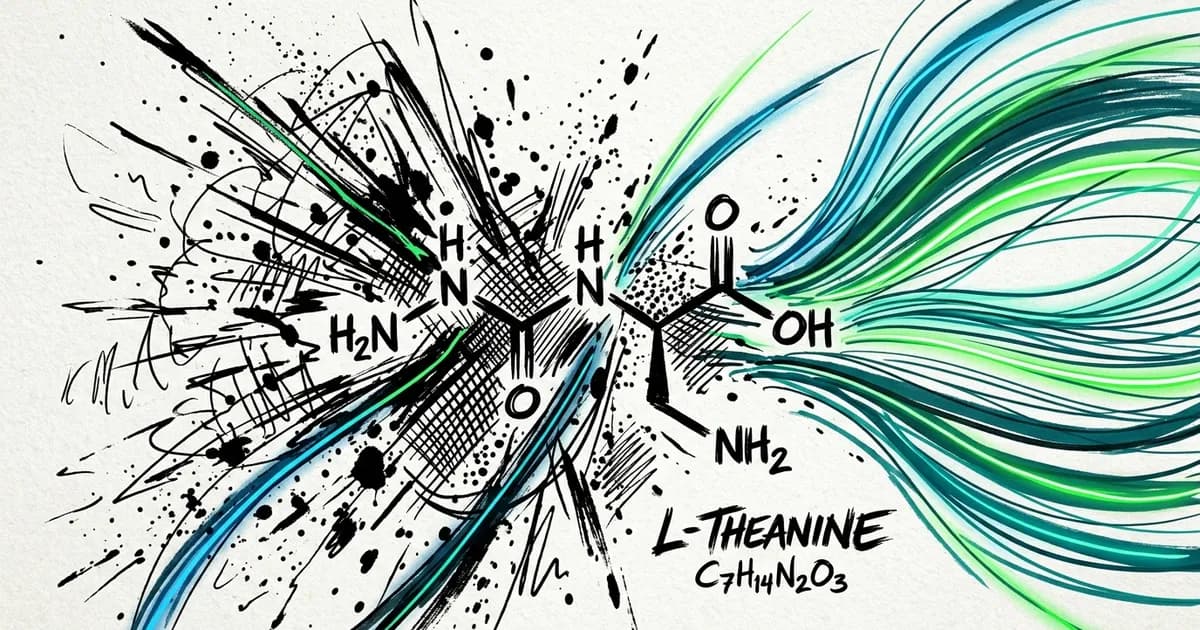
L-theanine is also a structural analog of glutamate, the brain's primary excitatory neurotransmitter. It may block excess glutamate activity while simultaneously increasing GABA, the brain's main inhibitory signal. Think of it as turning down the noise without turning off the signal.
The most well-documented effect? Alpha brain wave production. A study published in Brain Topography found that a 250mg dose of L-theanine modulated alpha-band oscillatory activity during a visual-spatial attention task. Alpha waves are the brain's signature of relaxed but alert focus, the mental state where you're engaged without being wired.
This is why l theanine ADHD interest keeps growing. It doesn't feel like a stimulant. It doesn't push you forward. It clears the path.
The speed of onset matters, too. Research published in Asia Pacific Journal of Clinical Nutrition detected measurable changes in alpha wave activity within 45 minutes of ingesting just 50mg of L-theanine in healthy young participants. That's a low dose producing a fast, quantifiable shift in brain state.
L Theanine ADHD Research: The Clinical Evidence
Let's be direct: there aren't dozens of large-scale trials testing l theanine ADHD applications specifically. The research base is small but promising, and it points in a consistent direction.
The ADHD Sleep Study
The most cited trial is a randomized, double-blind, placebo-controlled study published in Alternative Medicine Review (Lyon et al., 2011). Researchers gave 400mg of daily L-theanine to boys aged 8 to 12 who had been diagnosed with ADHD.
The results: boys taking L-theanine achieved higher sleep percentage and better sleep efficiency scores compared to the placebo group. The study concluded that 400mg daily was "safe and effective in improving some aspects of sleep quality in boys diagnosed with ADHD."
Why does sleep matter here? Because poor sleep and ADHD create a vicious feedback loop. Disrupted sleep worsens attention, impulsivity, and emotional regulation. Anything that improves sleep quality in this population has downstream effects on daytime cognitive performance.
Stress, Cognition, and Healthy Adults
A 2019 randomized controlled trial by Hidese et al. tested four weeks of L-theanine supplementation in healthy adults. The findings were specific: verbal fluency and executive function scores improved after L-theanine administration. Those are two cognitive domains that people with attention difficulties struggle with most.
The study also found reductions in stress-related symptoms, which matters because stress is one of the fastest ways to tank your working memory and focus.
Attention in Middle-Aged and Older Adults
A placebo-controlled study published in the Journal of Medicinal Food found that even a single dose of L-theanine improved attention, which in turn enhanced working memory and executive functions. The researchers concluded that L-theanine "may contribute to improving attention, thus enhancing working memory and executive functions."
The pattern across these l theanine ADHD-relevant studies is consistent. L-theanine supports the specific cognitive functions, attention, executive control, and sleep, that are most impaired in ADHD.
None of this means L-theanine is a clinical treatment for ADHD. It means the amino acid targets the same cognitive systems that ADHD disrupts. That's a meaningful distinction, and it's why researchers keep studying l theanine ADHD connections.
The L-Theanine + Caffeine Stack: Where ADHD Focus Gets Sharper
L-theanine on its own modulates brain chemistry in useful ways. But the research gets more interesting when you combine it with caffeine.
A study published in Nutritional Neuroscience tested 97mg of L-theanine with 40mg of caffeine and found that the combination improved cognitive performance and increased subjective alertness compared to placebo.
Another trial published in Appetite found that L-theanine and caffeine together improved both speed and accuracy on an attention-switching task at the 60-minute mark. The combination also reduced susceptibility to distracting information in a memory task at both 60 and 90 minutes.
A study in the Journal of Nutritional Neuroscience measured brain activity directly and found that the L-theanine plus caffeine combination increased target discriminability (the brain's ability to distinguish relevant from irrelevant stimuli) compared to placebo.
Here's what this means in plain terms:
| Effect | Caffeine Alone | L-Theanine Alone | L-Theanine + Caffeine |
|---|---|---|---|
| Alertness | ✅ Increases | Minimal effect | ✅ Increases |
| Attention accuracy | Modest | Modest | ✅ Strong improvement |
| Jitters/anxiety | ⚠️ Common | ✅ Reduces | ✅ Reduced vs. caffeine alone |
| Resistance to distraction | Minimal | Moderate | ✅ Strong improvement |
| Alpha brain wave activity | Decreases | ✅ Increases | ✅ Maintained |
Caffeine gives you energy. L-theanine gives you control over that energy. For l theanine ADHD purposes, the combination produces a focused, calm alertness that neither compound delivers on its own.
As the Cleveland Clinic notes, L-theanine "does seem to do better with coffee or a caffeinated beverage."
L Theanine ADHD Dosage for Focus and Support
Most clinical trials use doses between 100mg and 400mg of L-theanine per day, and the right L-theanine dosage by use case depends on your specific goal. Here's how the research breaks down by use case:
- General focus and calm alertness: 100 to 200mg, often paired with 40 to 100mg of caffeine
- Sleep quality support (ADHD-related): 400mg daily, based on the Lyon et al. trial
- Stress reduction and cognitive function: 200mg daily for four weeks, based on the Hidese et al. trial
The Cleveland Clinic recommends not exceeding 500mg per day. L-theanine is generally considered safe and well-tolerated at these doses, with no serious adverse events reported in the clinical trials reviewed here.
One thing to note: l theanine ADHD supplementation is not a replacement for prescribed medication. If you're currently taking stimulants or non-stimulant ADHD drugs, talk to your doctor before adding any supplement to your routine. L-theanine works best as part of a broader approach to attention and cognitive performance, not as a standalone fix.
Also worth knowing: unlike many stimulant compounds, L-theanine does not appear to produce tolerance. You don't need to keep increasing the dose to get the same effect. That makes l theanine ADHD use a practical option for daily, long-term support.
Why L-Theanine Fits the ADHD Brain
The ADHD brain isn't broken. It's differently tuned. The core challenge is often described as a regulation problem: too much noise, not enough signal. Attention drifts not because you can't focus, but because the brain's filtering system lets too much through.
L theanine ADHD benefits address this at a neurochemical level. By boosting GABA and modulating glutamate, L-theanine helps quiet background neural activity. By increasing dopamine, it supports the reward and motivation circuits that ADHD brains often find understimulated. And by promoting alpha wave activity, it nudges the brain toward a state of engaged, selective attention.
This isn't about sedation. It's about signal clarity.
That's also why the caffeine combination works so well for focus. Caffeine increases arousal and processing speed. L-theanine refines that arousal into something usable, filtering out the jittery overstimulation that makes caffeine counterproductive for many people with attention difficulties.
Getting L-Theanine Into Your Daily ADHD Routine
You could drink five cups of green tea a day, or explore L-theanine supplement forms like powder. A typical cup contains roughly 25mg of L-theanine, so you'd need quite a few to reach a clinically relevant dose. Capsules work, but they're easy to forget and slow to absorb through the gut.
Whatever form you use, the research points to a consistent range: 100 to 200mg for calm alertness, up to 400mg in the trial that looked at sleep, and no more than 500mg a day. Consistency matters more than the delivery method.