IQ Pouch Review: Four Ingredients, All at 75 mg, and the Dosing Questions That Follow
Roon Team
IQ Pouch Review: Four Ingredients, All at 75 mg, and the Dosing Questions That Follow
IQ Pouch is a zero-nicotine oral pouch built around paraxanthine (branded as Enfinity), Cognizin citicoline, L-theanine, and Rhodiola rosea. It launched in March 2026, sells for $9.99 per 15-pouch tin at iqpouch.com, and positions itself as a nootropic alternative to both caffeine and nicotine pouches. The ingredient list is interesting. The doses raise questions.
Every active ingredient in IQ Pouch is dosed at exactly 75 mg. That uniformity is the first thing a skeptical buyer should notice, because the clinical literature behind each of those four compounds studied them at very different amounts. Whether 75 mg is enough to move the needle for each one is the central question of this review.
Key Takeaways
- IQ Pouch uses paraxanthine instead of caffeine, a genuinely different stimulant mechanism. But published dose-response data tested 50, 100, and 200 mg; 75 mg sits below the range where the clearest cognitive benefits appeared.
- All four actives are dosed at exactly 75 mg per pouch. Clinical trials for citicoline used 250 to 500 mg daily. Rhodiola trials used 200 to 600 mg. A uniform 75 mg across all four reads more like a template than a formulation built against the research.
- Pricing is genuinely competitive, from $0.67 per pouch at the single-tin price down to roughly $0.53 at the 10-tin bulk tier.
- The founder narrative has inconsistencies between IQ Pouch's own press materials and TRUBAR's official acquisition announcement, which names a different person as founder and a different sale price.
What Is IQ Pouch?
IQ Pouch (also marketed as "IQ Smart Pouch") is a nicotine-free, tobacco-free oral pouch sold through its Shopify store at iqpouch.com and a Canadian storefront at iqpouch.ca. The brand launched publicly on March 6, 2026 via PR Newswire, positioning itself for athletes, entrepreneurs, gamers, and creators. It ships in three flavors: Mint Mode, Citrus, and Spiced, with 15 pouches per tin.
IQ Pouch's launch press release credits Brad Pyatt as the creator. Pyatt is a former NFL wide receiver who founded MusclePharm in 2008, a publicly traded sports nutrition company he led as CEO until his resignation in March 2016. MusclePharm's corporate history includes an SEC settlement over accounting and disclosure violations in 2015.
IQ Pouch's own MarketersMEDIA press release describes Pyatt as having a "$176M TRUBAR exit." But TRUBAR's official acquisition announcement on BusinessWire names Erica Groussman as TRUBAR's Founder and CEO and states the deal at $173 million. A Forbes profile also identifies Groussman as founder. Wikipedia lists Pyatt as a "co-founder" of TRUBAR, and a CPG Insider report describes the brand as founded by Pyatt and his wife. Pyatt was clearly involved, but describing the exit as solely his, at a figure $3 million above the official number, is company-supplied framing rather than independently confirmed fact.
IQ Pouch Ingredients: The Full Panel at 75 mg Each
Verified on iqpouch.com/products/iq-smartpouch and iqpouch.com/pages/iq-science-new:
| Ingredient | Dose per Pouch | Branded Form | Clinically Studied Range |
|---|---|---|---|
| Paraxanthine | 75 mg | Enfinity | 100 to 200 mg (Xing et al.) |
| L-Theanine | 75 mg | None listed | 100 to 200 mg (typical research doses) |
| Citicoline | 75 mg | Cognizin | 250 to 500 mg (Kyowa Hakko) |
| Rhodiola Rosea (3% std.) | 75 mg | None listed | 200 to 600 mg (clinical review) |
| Vitamin B6 | 2 mg (118% DV) | N/A | N/A |
| Vitamin B12 | 2 mcg (83% DV) | N/A | N/A |
Four different compounds, drawn from four different categories (xanthine derivative, amino acid, cholinergic, adaptogen), all landing on the same round 75 mg number. For context, a competing paraxanthine pouch (Ultra) is reported to dose its actives very differently: 100 mg paraxanthine, 30 mg Alpha GPC, 10 mg L-theanine, 1 mg ginseng. Those figures come from Ultra's Amazon supplement facts panel; takeultra.com itself publishes no milligram amount for any of its six actives. Different actives have different optimal doses because their molecular potencies and absorption profiles differ. Four identical doses reads more like a templated pattern than a formulation built against the literature for each compound individually.
That does not make the numbers false. They are what the brand's own site states. But it is worth noticing.
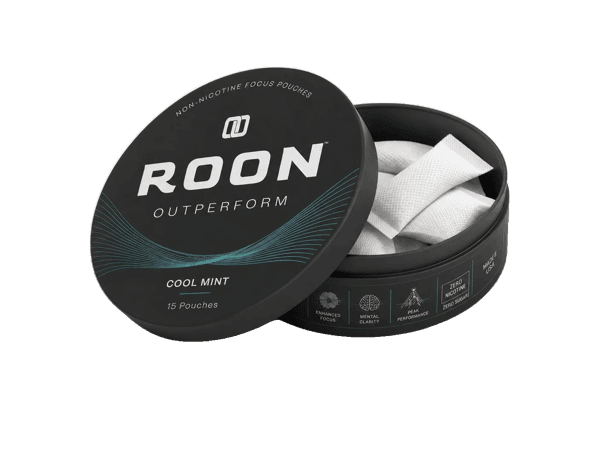 RoonOne pouch RoonOne pouch |  Coffee8 fl oz Coffee8 fl oz |  Energy drink8.4 fl oz can Energy drink8.4 fl oz can |  Nicotine pouchOne pouch Nicotine pouchOne pouch |  Other pouchesNon-nicotine Other pouchesNon-nicotine | |
|---|---|---|---|---|---|
| CaffeineCaffeine | 80 mg | ~95 mg | 200–300 mg | 0 mg | 100–200 mg |
| SynergistsSynergists (L-theanine, Dynamine®, TeaCrine®) | Yes | No | No | No | No |
| Fast onsetFast onset (5 to 10 min) | Yes | No | Sometimes | Yes | Yes |
| Lasts 6-8hLasts 6 to 8 hours | Yes | No | No | No | No |
| No crashNo crash or jitters | Yes | No | No | Sometimes | Sometimes |
| No nicotineNo nicotine | Yes | Yes | Yes | No | Yes |
| No sugarNo sugar | Yes | Yes | No | Yes | Yes |
Are the IQ Pouch Doses High Enough to Work?
The honest answer: probably yes for some ingredients, probably no for others.
Paraxanthine at 75 mg falls below the range where research found the strongest effects. A dose-response crossover trial (Xing et al., 2021, n=12) tested 50, 100, and 200 mg of Enfinity. The 100 and 200 mg doses produced the clearest improvements in memory, reasoning, and sustained attention. At 75 mg, IQ Pouch sits between the 50 mg dose that underperformed and the 100 mg dose that showed clear results. Enfinity's own FAQ states the ideal range is 100 to 200 mg.
Citicoline at 75 mg is the most obvious gap. Kyowa Hakko's own research tested 250 mg and 500 mg doses over 28 days and found both improved attention versus placebo. The lowest dose ever studied was 250 mg. IQ Pouch delivers less than one third of that. Branded Cognizin at a sub-clinical dose is still a sub-clinical dose.
Rhodiola rosea at 75 mg has a similar problem. Clinical doses are commonly 200 to 600 mg/day, with a multicenter burnout trial using 400 mg/day. At 75 mg, IQ Pouch delivers roughly a third of the lowest commonly studied dose.
L-theanine at 75 mg is closer to functional territory. While many studies use 100 to 200 mg, L-theanine has some evidence of effect at lower doses, especially when paired with a stimulant. This is the one dose that is not glaringly below published ranges.
IQ Pouch Pricing and Pack Sizes
| Quantity | Price | Per Pouch |
|---|---|---|
| 1 tin (15 pouches) | $9.99 | $0.67 |
| 5 tins (75 pouches) | $44.95 (10% off) | $0.60 |
| 10 tins (150 pouches) | $79.90 (20% off) | $0.53 |
The site advertises a "Subscribe and Save 20%" option, but the discounted subscription checkout price was not independently confirmed during our research. If the 20% discount applies to the single-tin price, that computes to roughly $8.00 per tin, but treat that as approximate.
At the bulk tier, IQ Pouch is competitively priced against most nootropic pouches. Whether that price reflects a genuine deal or lower ingredient doses is a question only your experience with the product can answer.
Three Gaps and Open Questions About IQ Pouch
1. Three of Four Actives Sit Below Their Clinical Floor
Paraxanthine, citicoline, and rhodiola all have real research behind them. But that research was conducted at doses two to five times higher than what IQ Pouch delivers. A product can list branded, clinically studied ingredients and still underdose them.
2. The Founder Narrative Does Not Match the Primary Source
IQ Pouch's press materials claim a "$176M TRUBAR exit" for Brad Pyatt. TRUBAR's own acquisition announcement names a different person as founder and a different price ($173 million). These are not huge discrepancies, but they suggest narrative embellishment that makes a careful buyer want to double-check other claims too.
3. No Duration or Onset Claims to Evaluate
IQ Pouch's marketing focuses on ingredient names and broad lifestyle positioning rather than measurable performance claims like onset time or effect duration. That makes it harder to evaluate what the product actually promises to do, and harder to compare against alternatives that state their expected window clearly.
IQ Pouch vs. Roon: A Side-by-Side Comparison
| Feature | IQ Pouch | Roon |
|---|---|---|
| Primary stimulant | Paraxanthine (75 mg) | Caffeine (80 mg) |
| Supporting nootropics | Cognizin citicoline (75 mg), Rhodiola (75 mg) | Methylliberine/Dynamine (25 mg), theacrine/TeaCrine (5 mg) |
| L-Theanine | 75 mg | 60 mg |
| Nicotine | Zero | Zero |
| Pouches per tin | 15 | 15 |
| Flavors | 3 (Mint Mode, Citrus, Spiced) | 1 (Cool Mint) |
| Per pouch (one-time) | $0.67 | $1.00 |
| Per pouch (best tier) | $0.53 (10-tin bulk) | $0.61 (12-tin subscription) |
| Stated onset | Not specified | 5 to 10 minutes |
| Stated duration | Not specified | 6 to 8 hours |
| Format | Oral pouch | Sublingual pouch |
IQ Pouch wins on price and flavor variety. It also offers a genuinely different stimulant in paraxanthine. Roon's advantage is a formulation built around a specific pharmacokinetic interaction: methylliberine (Dynamine) slows caffeine's oral clearance, extending the effect window to 6 to 8 hours from a moderate 80 mg dose, without increasing peak concentration. These are different product philosophies. IQ Pouch bets on ingredient breadth at a lower price. Roon bets on fewer ingredients at doses chosen to extend one compound's duration.
What 75 mg Buys, and What It Leaves on the Table
IQ Pouch deserves credit for assembling a genuine nootropic stack in a convenient format at a competitive price. Paraxanthine is a real and interesting alternative to caffeine. Cognizin citicoline and Rhodiola rosea have legitimate research behind them. The problem is not ingredient selection. The problem is that four ingredients at an identical 75 mg dose, when three of those four were clinically studied at two to five times that amount, raises a basic question: are you getting the ingredients, or the effect of the ingredients?
The value calculation depends on what you are optimizing for. If you want the broadest ingredient list at the lowest per-pouch cost, IQ Pouch delivers. If you care whether each ingredient hits the doses the published science actually used, the uniform 75 mg pattern is hard to defend for three of the four actives.
Frequently Asked Questions
Does IQ Pouch contain nicotine?
No. IQ Pouch is explicitly nicotine-free and tobacco-free. The brand's own site states: "Zero nicotine. Zero tobacco. This is not a nic pouch." It is positioned as a nootropic alternative, not a modified nicotine product.
What flavors does IQ Pouch come in?
Three: Mint Mode, Citrus, and Spiced. All are available through iqpouch.com and contain the same ingredient panel at the same doses.
Is 75 mg of paraxanthine enough to feel anything?
Possibly. The published dose-response research tested 50, 100, and 200 mg. The 50 mg dose showed some benefits, though fewer than higher doses. At 75 mg, IQ Pouch sits between the lowest tested dose and the lowest dose where clear effects were reported. Enfinity's own materials recommend 100 to 200 mg as ideal.
How much does IQ Pouch cost?
A single tin (15 pouches) costs $9.99 ($0.67 per pouch). Bulk pricing drops to $44.95 for five tins ($0.60 per pouch) or $79.90 for ten tins ($0.53 per pouch). A subscribe-and-save option is advertised but the exact subscription price was not independently confirmed.
Who founded IQ Pouch?
Brad Pyatt, a former NFL wide receiver who previously founded MusclePharm. His press materials also describe him as TRUBAR's founder, though TRUBAR's own acquisition announcement names Erica Groussman as founder and CEO. Wikipedia lists Pyatt as a co-founder of TRUBAR.
Does IQ Pouch contain caffeine?
No. IQ Pouch uses paraxanthine (Enfinity brand) instead of caffeine. Paraxanthine is caffeine's primary metabolite. Taking it directly bypasses the liver's conversion step, which may reduce individual variability in response.
How does paraxanthine differ from caffeine?
Paraxanthine is the compound your body produces when it metabolizes caffeine. It provides alertness through a similar adenosine-blocking mechanism, but published research suggests it may produce less anxiety and fewer jitters at comparable doses. It is a distinct compound, not rebranded caffeine.
Where can you buy IQ Pouch?
IQ Pouch sells direct-to-consumer at iqpouch.com and iqpouch.ca. As of mid-2026, it does not appear to be available through major third-party retailers like Amazon.
Where Duration Matters More Than Ingredient Count
If this IQ Pouch review highlights one tension in the nootropic pouch category, it is the trade-off between ingredient breadth and ingredient depth. Listing four actives at 75 mg each looks good on a label. But a pouch you feel for 90 minutes is a different product than one engineered to last a workday.
Roon takes the opposite approach: fewer ingredients, each chosen for a specific pharmacokinetic role. The core mechanism is methylliberine (Dynamine), which slows caffeine's oral clearance. In a randomized, double-blind crossover PK study (n=12), co-administration with caffeine cut oral clearance from 41.9 to 17.1 L/hr and extended half-life from 7.2 to 15 hours, with no increase in peak concentration. That is why 80 mg of caffeine (a small-coffee dose) can produce a felt window of 6 to 8 hours instead of 3 to 4. L-theanine (60 mg) smooths the subjective response. Theacrine (TeaCrine, 5 mg) does not build tolerance the way caffeine does, though caffeine itself still will.
Roon is not a substitute for a nootropic stack with cholinergic support or adaptogenic herbs. It does not contain citicoline, rhodiola, or paraxanthine. What it does is solve the duration problem: same peak, longer tail, no second dose mid-afternoon. If that matters more to you than ingredient count, try Roon. One note: a longer half-life means you should not take it late in the day. Roon's own guidance is to stop at least 8 hours before bed.
Written by Roon Team