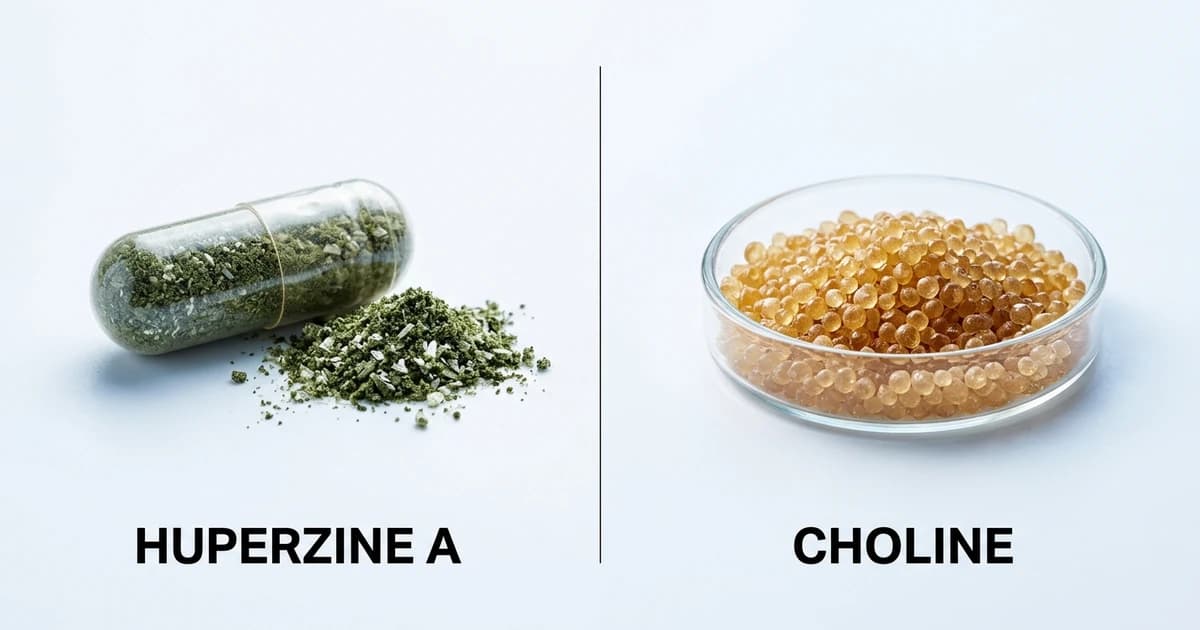
Huperzine A vs Choline Supplements: Block the Breakdown or Supply the Raw Material?
Two supplements promise to raise the same neurotransmitter, and they do it in completely opposite ways. The huperzine A vs choline debate is really a question about strategy: do you stop your brain from breaking down acetylcholine, or do you give it more raw material to build acetylcholine in the first place?
Acetylcholine drives memory, attention, and the speed at which your neurons talk to each other. Both approaches aim to push that signal higher. Only one of them lets you take it every day without the effect fading.
This is the ache inhibitor vs precursor distinction, and it changes everything about how you should use these compounds.
Key Takeaways
- Huperzine A blocks the enzyme (acetylcholinesterase) that clears acetylcholine, so existing signal lingers longer.
- Choline supplements supply the building block your brain converts into new acetylcholine.
- Huperzine A is potent and long-acting, which is exactly why most protocols cycle it rather than dose it daily.
- Citicoline and Alpha-GPC are the two precursors people actually compare, and they differ in dose, secondary effects, and cost.
- For everyday cognitive support, a precursor or a gentle stack tends to beat a strong enzyme blocker you have to keep cycling.
The Two Mechanisms, Side by Side
Your brain runs a constant cycle. Neurons release acetylcholine, it crosses the synapse, it fires the next cell, and then an enzyme called acetylcholinesterase chops it up so the signal resets. That cleanup happens fast, in roughly a tenth of a second.
A raise acetylcholine supplement can intervene at two points in that cycle.
The first point is the cleanup. Huperzine A is a reversible, selective acetylcholinesterase inhibitor. It parks itself on the enzyme's active site and slows the breakdown, so each molecule of acetylcholine stays active longer. According to a supplement review citing its pharmacology, huperzine A binds the enzyme with far greater affinity for acetylcholinesterase than for the related butyrylcholinesterase, which is part of why it acts so selectively in the brain.
The second point is supply. Choline precursors give your neurons more of the substrate they need to synthesize fresh acetylcholine. No enzyme inhibition involved. You are topping up the tank instead of slowing the drain.
That is the entire framing of cholinergic mechanisms compared: block the breakdown, or supply the raw material.
Huperzine A: The Enzyme Blocker
Huperzine A is the more aggressive lever of the two, and its pharmacology explains why.
It is long-acting. A pharmacokinetic study in human volunteers reported an elimination half-life in the 10 to 14 hour range, with sustained enzyme inhibition from a single dose. That sounds convenient, and for a single dose it is. The catch is that a long half-life paired with daily dosing creates a real accumulation effect over time.
Most cognitive protocols dose it in microgram amounts. A detailed huperzine A guide lists a standard cognitive dose of roughly 50 to 100 micrograms once daily, flags the same 10 to 14 hour half-life, and explicitly warns that daily accumulation risk is real. That is the reason cycling shows up in nearly every serious protocol.
The clinical interest in huperzine A is genuine. A phase II trial in mild to moderate Alzheimer disease studied it as a cognitive intervention, which tells you the compound has been taken seriously in research settings, not just in supplement marketing.
But potency cuts both ways. An enzyme blocker strong enough to matter is also strong enough that your system adapts to it, which is why "take it forever, every day" is rarely the recommendation.
Choline Precursors: The Supply Side
If huperzine A slows the drain, choline supplements refill the tank. This is the gentler, more daily-friendly side of the huperzine a vs choline comparison, and there are two precursors worth knowing.
Huperzine A vs Citicoline
Citicoline (CDP-choline) supplies choline plus cytidine, which your body uses for both acetylcholine production and cell-membrane repair. That dual role is its main selling point.
Citicoline has been tested in healthy people, not only patients. A randomized, double-blind, placebo-controlled trial in healthy older adults examined citicoline supplementation and memory function, the kind of study design that carries real weight. The huperzine a vs citicoline contrast is therefore a contrast between an enzyme blocker with accumulation concerns and a precursor with a cleaner daily-use profile.
Huperzine A vs Alpha GPC
Alpha-GPC is the other major choline precursor, valued for crossing into the brain efficiently and for a side effect athletes actually want: greater force production. A study in the Journal of the International Society of Sports Nutrition reported increased lower-body force production after six days of Alpha-GPC supplementation.
So the huperzine a vs alpha gpc question is less about "which raises acetylcholine more" and more about what else you want. Alpha-GPC leans toward physical performance and pre-workout use. Citicoline leans toward memory and membrane support.
The Comparison Table
| Compound | Mechanism | Typical Dose | Daily Use? | Best For |
|---|---|---|---|---|
| Huperzine A | AChE inhibitor (blocks breakdown) | ~50–100 mcg | Cycle it; accumulation risk | Short, targeted cognitive pushes |
| Citicoline | Precursor (supply + membrane repair) | ~250–500 mg | Yes | Memory, daily cognitive support |
| Alpha-GPC | Precursor (supply, brain-penetrant) | ~300–600 mg | Yes | Power output, pre-workout focus |
| Roon (pouch stack) | Caffeine + L-theanine + Dynamine + TeaCrine | 1 pouch | Yes, no-tolerance design | Sustained 6–8 hr focus, fast onset |
Roon does not sit on the choline axis at all, which is the honest point: it works on a different set of cognitive performance levers than acetylcholine supply. More on that below.
Which Approach Should You Choose?
Pick the precursor if you want something you can take every morning without watching the effect erode. Citicoline and Alpha-GPC are built for sustained, daily cholinergic support. They give your brain more material and let it self-regulate the rest.
Reach for huperzine A only when you understand the trade. It is a sharp tool with a long half-life and a documented accumulation concern, which is why responsible use means cycling, not set-and-forget dosing.
There is a broader principle here. The best daily cognitive ingredients are the ones your body does not adapt away from. Anything potent enough to demand a cycle is, by definition, not a true everyday compound.
Conclusion
The choice between blocking the breakdown and supplying the raw material is a choice about sustainability. Huperzine A is the stronger lever, and that strength is exactly what forces you to cycle it. Choline precursors like citicoline and Alpha-GPC trade peak potency for the ability to support your cholinergic system day after day.
If your goal is a single sharp session, the enzyme blocker has a case. If your goal is consistent cognition you can rely on for months, the precursor side wins on design. Match the mechanism to how often you actually want to take it, and the answer usually picks itself.
Frequently Asked Questions
Does huperzine A or choline raise acetylcholine more?
They raise it through different routes, so "more" depends on context. Huperzine A produces a larger acute effect because it slows acetylcholine breakdown across the whole brain. Choline precursors raise the available building blocks for new acetylcholine, which is gentler and steadier. For a single strong push, huperzine A is more potent. For sustained daily levels, a precursor is the more practical way to support acetylcholine.
Can I take huperzine A every day?
You can, but most protocols advise against it. With a half-life around 10 to 14 hours and a documented accumulation effect, daily dosing can build up and blunt the response over time. That is why cycling, such as a few days on followed by a break, is the common recommendation. If you want a compound for genuine daily use, a choline precursor is the easier fit.
What is the difference between citicoline and Alpha-GPC?
Both are choline precursors that supply raw material for acetylcholine. Citicoline (CDP-choline) also provides cytidine and supports cell-membrane health, which makes it popular for memory and general cognition. Alpha-GPC penetrates the brain efficiently and is associated with improved force production, which makes it a favorite in pre-workout formulas. Choose citicoline for memory-leaning support and Alpha-GPC for performance-leaning support.
Is an AChE inhibitor better than a precursor?
Neither is universally better; they solve different problems. An AChE inhibitor like huperzine A is the right tool for short, targeted cognitive demands where you accept cycling. A precursor is the right tool for steady, everyday support without tolerance concerns. The ache inhibitor vs precursor decision should follow your usage pattern, not a ranking of raw strength.
Can you combine huperzine A with choline supplements?
Some stacks pair them, with the idea that the precursor supplies material while the inhibitor preserves the signal. The logic is reasonable, but it stacks a long-acting enzyme blocker on top of daily supply, which raises the same accumulation and cycling concerns. If you combine them, treat the huperzine A component as something to cycle rather than run continuously.
Do these affect focus and energy like caffeine?
Not directly. Acetylcholine supports memory, learning, and signal speed, while caffeine works on the adenosine system to influence alertness and perceived energy. Choline precursors and huperzine A target a different pathway entirely. People often stack a cholinergic ingredient with a caffeine-based focus product because the two mechanisms do not overlap.
Where the No-Tolerance Principle Actually Lives
The thread running through this whole comparison is tolerance. The reason huperzine A gets cycled and precursors get taken daily comes down to a single design question: can you use this every day without the effect fading? That same question shaped how we built Roon.
Roon is not a choline supplement, and it is not a substitute for acetylcholine support. It works on a separate set of pathways. Each sublingual pouch pairs 80 mg caffeine and 60 mg L-theanine with 25 mg methylliberine (Dynamine) and 5 mg theacrine (TeaCrine), two compounds chosen specifically because they support clean energy without the rapid tolerance buildup that forces cycling. You feel it in 5 to 10 minutes, and it holds for 6 to 8 hours with no jitters and no crash.
If you like the idea of a cognitive tool built for daily use instead of one you have to keep pausing, try Roon and feel the difference a no-tolerance design makes.
Written by Roon Team