Clean Energy Without the Crash: What "Clean" Caffeine Actually Means at the Ingredient Level
Roon Team
Clean Energy Without the Crash: What "Clean" Caffeine Actually Means at the Ingredient Level
Most people use the phrase "clean caffeine" to mean caffeine that doesn't wreck them later. No 2 p.m. wall. No racing heart at your desk. No sense that you borrowed energy you'll have to pay back with interest.
That instinct is right, but the marketing has muddied it. "Clean caffeine" has become a label slapped on anything organic, sugar-free, or sourced from green tea, as if the plant of origin were the thing that mattered. It usually isn't.
What actually determines whether caffeine feels clean is the dose, the delivery, and what it's paired with. Below is what that looks like at the ingredient level, and why the crash you're trying to avoid is a chemistry problem with a chemistry solution.
Key Takeaways
- "Clean caffeine" is about dose, delivery speed, and supporting ingredients, not the plant it came from.
- The caffeine crash is driven by adenosine. When caffeine wears off, the backlog of adenosine binds at once.
- Pairing caffeine with L-theanine reduces the jittery edge while keeping the alertness.
- Compounds like theacrine and methylliberine extend the energy curve and resist the fast tolerance buildup caffeine alone causes.
- A smoother caffeine experience is engineered, not found in a "cleaner" bean.
What Is Clean Caffeine, Really?
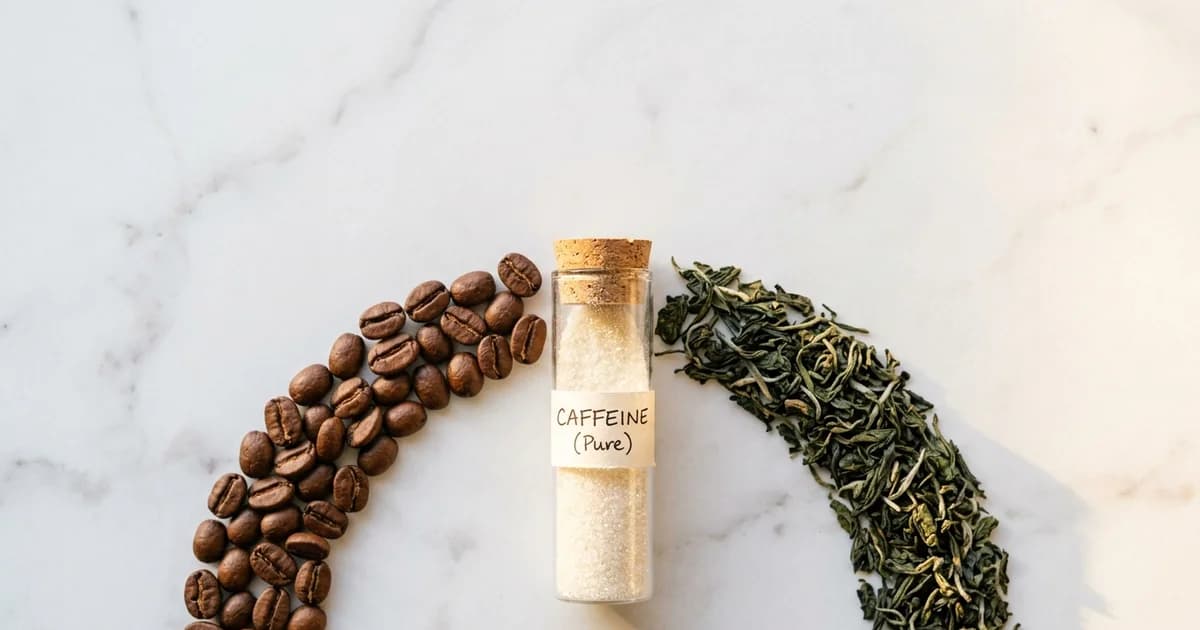
Clean caffeine is caffeine delivered in a way that gives you steady focus without the jitters, the anxiety spike, or the crash. The molecule itself is identical whether it comes from a coffee cherry, a tea leaf, or a lab. Caffeine is caffeine. Your bloodstream cannot tell the difference.
So when a product calls itself clean, the honest version of that claim points to four things: a sensible dose, a steady delivery, the absence of sugar and harsh fillers, and ingredients that round off caffeine's rough edges.
The dirty version is the one most energy products run on. A big slug of caffeine, often stacked with sugar, hits fast and drops fast. You get the spike, then the slump. Calling that "clean" because the can says organic is a sleight of hand.
The plant-source myth
Green tea caffeine and coffee caffeine are the same compound. The reason green tea feels gentler has little to do with the caffeine and a lot to do with what rides alongside it: L-theanine, an amino acid that takes the sharp edge off. More on that below.
So the next time you see "clean caffeine from green tea" on a label, read it as a hint about the supporting cast, not a different kind of caffeine.
Why Caffeine Crashes You in the First Place
The crash is an adenosine story. Adenosine is a molecule that builds up in your brain across the day and makes you feel sleepy. Caffeine works by blocking the receptors adenosine would normally dock into, so you feel alert while the adenosine keeps piling up in the background.
Then the caffeine wears off. The post-caffeine crash results from accumulated adenosine binding once caffeine dissociates. All that backlogged adenosine floods its receptors at once, and the sleepiness you postponed arrives in a single wave.
There's a second problem with relying on caffeine alone, day after day. According to Ultrahuman's breakdown of the science, chronic caffeine intake leads to upregulation of adenosine receptors, reducing its efficacy. Your brain builds more docking ports, so the same dose does less, and you start chasing the effect with more milligrams.
That's tolerance. It's why your two-cup morning quietly became four, and why "clean" has to mean something more than a better bean.
The Real Ingredients Behind Clean Caffeine
The smooth curve people want is built from a short list of compounds working together. Here's what each one does.
Caffeine, at a reasonable dose
Around 80 to 100 mg is the sweet spot for focus without the shakes. That's roughly a strong espresso. Push past 200 mg in one hit and you're in jitter and anxiety territory for most people. Dose discipline is the least glamorous part of clean caffeine and the most important.
L-theanine, the edge remover
L-theanine is the amino acid in green tea that gives it that calm-but-awake quality. Paired with caffeine, it blunts the nervous, wired feeling while leaving the alertness intact. The widely cited ratio is roughly 2:1, theanine to caffeine, though many focus formulas run closer to even. The point is simple: theanine is why a cup of tea rarely feels like a triple shot.
Theacrine, the slow-tolerance tail
Theacrine is structurally close to caffeine and hits similar receptors, but it behaves differently over time. The most interesting feature is that users tend not to build tolerance to it as quickly as they do to caffeine, which means its effect holds up across repeated days. It also tends to extend the energy window rather than spike it.
Methylliberine, the quick starter
Methylliberine is another caffeine relative that appears to come on fast and clear out without the long tail that keeps you up at night. Used in small amounts alongside caffeine and theacrine, it contributes to a quicker, cleaner onset.
Clean Caffeine Drinks vs. Powders vs. Pouches
The format matters as much as the formula, because delivery speed shapes how clean the experience feels. Here's how the common options compare.
| Format | Typical onset | Crash risk | Tolerance management | Notes |
|---|---|---|---|---|
| Coffee | 15–45 min | Moderate to high | Poor (caffeine only) | Familiar, but dose varies wildly cup to cup |
| Energy drinks | 10–30 min | High (sugar + caffeine) | Poor | Often spiked with sugar; the classic spike-and-slump |
| Clean caffeine drinks (tea-based / theanine) | 15–40 min | Lower | Fair | The theanine helps; still drink-volume dependent |
| Clean caffeine powder | 20–45 min | Depends on stack | Depends on stack | Flexible dosing; only as clean as what you mix in |
| Sublingual pouch (e.g., Roon) | 5–10 min | Low | Strong (multi-ingredient stack) | Fast absorption; fixed, dialed dose |
A few honest notes on this table.
Clean caffeine drinks are a real improvement over sugary energy drinks, mostly because tea-based options bring L-theanine along for free. The catch is consistency. You can't always tell how much caffeine is in a given cup, and brewed strength swings the dose around.
Clean caffeine powder gives you control. You decide the milligrams, and you can add L-theanine yourself. The downside is that a powder is only as clean as the person scooping it, and absorption through the gut is slower than other routes.
Sublingual pouches absorb through the tissue under your lip rather than waiting on digestion, which is why onset lands in the 5 to 10 minute range. Because the dose is fixed, you're not guessing. This is where a multi-ingredient stack earns its keep.
How to Build a Clean Caffeine Routine
You don't need a complicated system. A few rules cover most of the benefit.
- Cap your single dose. Stay near 80 to 100 mg of caffeine per serving for focus work.
- Always pair caffeine with L-theanine. This is the single highest-value move for reducing jitters.
- Set a caffeine curfew. Caffeine has a long half-life, so stop intake roughly 8 to 10 hours before bed to protect sleep.
- Watch the creep. If your dose keeps climbing, that's tolerance talking. Cycling or using slower-tolerance compounds helps.
- Mind the sugar. A sugar load on top of caffeine is the surest route to a crash.
If you want to go deeper, our wider library on clean energy and the no-crash approach pairs well with this piece.
Clean Is a Design Choice, Not a Bean
Clean caffeine isn't a special bean or a green-tea halo. It's a design choice. A moderate dose, paired with L-theanine to soften the edge and with slow-tolerance compounds to stretch the curve, gives you the steady focus people are actually chasing when they reach for "clean."
The crash was never really about caffeine being dirty. It was about caffeine being alone. Solve the adenosine backlog and the tolerance creep, and the energy stops feeling borrowed.
That's the standard worth holding any product to, whatever the label promises on the front.
Frequently Asked Questions
What is clean caffeine?
Clean caffeine is caffeine delivered to produce steady focus without jitters, anxiety, or a crash. It comes down to a moderate dose, fast and predictable delivery, no sugar or harsh fillers, and supporting ingredients like L-theanine. The plant the caffeine came from doesn't change the molecule. What changes the experience is the dose and what's paired with it.
Is caffeine from green tea cleaner than caffeine from coffee?
The caffeine molecule is identical in both. Green tea often feels gentler because it naturally contains L-theanine, an amino acid that reduces caffeine's nervous edge while keeping you alert. So the calmer feeling is about the company caffeine keeps, not the source. A coffee paired with L-theanine would feel similarly smooth.
Do clean caffeine drinks actually prevent a crash?
They lower the risk but don't guarantee it. Tea-based clean caffeine drinks help because they include L-theanine and usually skip the sugar that fuels a spike-and-slump. The remaining issue is dose consistency, since brewed strength varies. A crash still depends mostly on how much caffeine you took and whether anything was there to extend the curve.
Is clean caffeine powder a good option?
Clean caffeine powder is useful because you control the exact dose and can add L-theanine yourself. That flexibility is its strength and its weakness. A powder is only as clean as what you mix into it, and absorption through the gut is slower than sublingual delivery. It suits people who want full control over their stack.
Why does caffeine stop working over time?
Your brain adapts. With regular caffeine, it builds more adenosine receptors, so the same dose has less effect and you need more to feel it. That's tolerance. Compounds like theacrine are interesting here because users tend to build tolerance to them more slowly, which helps the effect hold up across repeated days.
How much caffeine is a "clean" dose?
For focus work, roughly 80 to 100 mg per serving hits steady alertness without pushing most people into jitters. That's about one strong espresso. Larger single doses past 200 mg raise the odds of anxiety and a harder comedown. Splitting caffeine into smaller, well-timed doses tends to feel cleaner than one large hit.
What pairs best with caffeine to reduce jitters?
L-theanine is the standout. It takes the wired edge off caffeine while preserving the alertness, which is why tea feels calmer than an equivalent dose of coffee. Beyond that, theacrine and methylliberine help by extending and smoothing the energy curve. Avoiding sugar matters too, since a sugar spike sets up its own crash.
Where Engineered Beats "Organic": The Smoothed Caffeine Curve
If the crash is an adenosine and tolerance problem, the fix isn't a cleaner bean. It's a better-built dose. That's the gap Roon was designed to close.
Each Roon pouch pairs 80 mg of caffeine with 60 mg of L-theanine for calm, focused energy, then adds 25 mg of methylliberine (Dynamine) and 5 mg of theacrine (TeaCrine) to extend the curve and resist the fast tolerance buildup that caffeine alone causes. Because it's sublingual, it absorbs in 5 to 10 minutes and holds a steady 6 to 8 hour window with no jitters and no crash.
To be clear about what it isn't: Roon is not a replacement for sleep, and no pouch fixes a routine built on four hours of rest. It's a cleaner way to get the focus you'd otherwise chase with a fourth coffee. If the afternoon slump is the thing you're trying to outrun, try Roon and see how the curve feels when caffeine isn't working alone.
Written by Roon Team