Does Caffeine Cancel Out Cocoa Flavanols? What Combination Trials Actually Show
Roon Team
Does Caffeine Cancel Out Cocoa Flavanols? What Combination Trials Actually Show
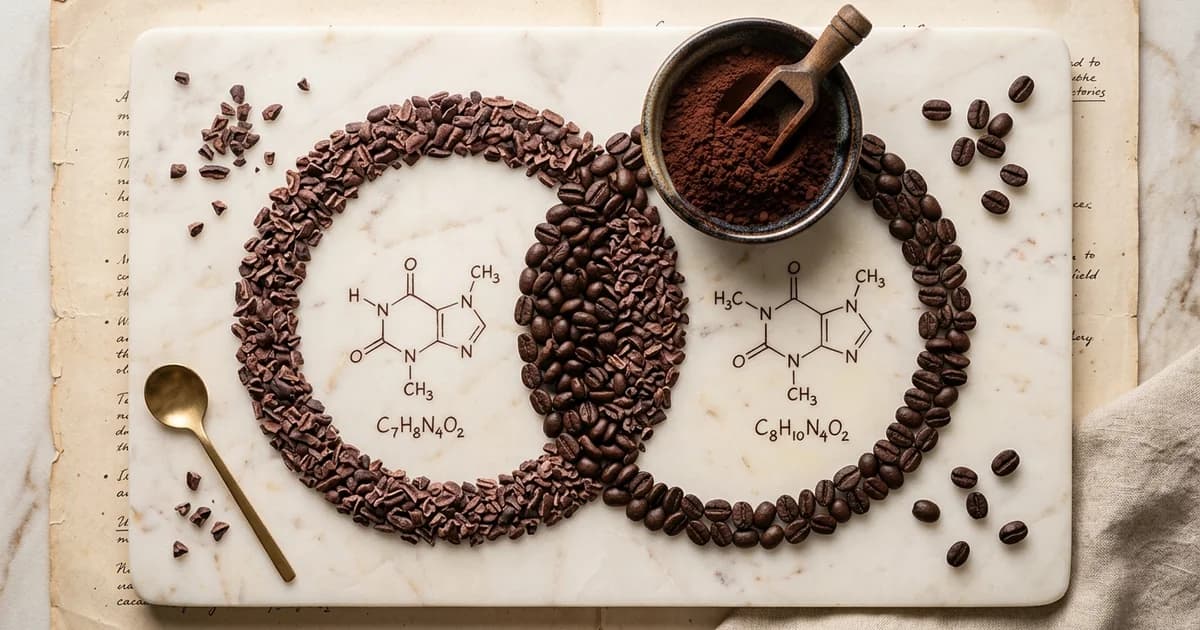
The internet loves a tidy story: caffeine narrows your blood vessels, cocoa flavanols open them up, so a mocha must be two ingredients fighting each other in your skull. It sounds clever. It is also mostly wrong.
The real relationship between caffeine and cocoa flavanols is more boring and more interesting than the cancellation myth. They act through different machinery, on different timelines, and the best human trial we have on the combination found something most people would not predict. Here is what the data actually says.
Key Takeaways
- Caffeine and cocoa flavanols work through separate mechanisms, so the "they cancel out" framing is a vascular oversimplification.
- A 2024 controlled trial gave 48 adults caffeine, cocoa flavanols, both, or placebo, and found no acute change in working memory or attention from any condition.
- Cocoa flavanols show their clearest cognitive effects when the brain is under heavy demand, not on easy tasks.
- The takeaway is not "avoid the combo." It is that pairing two compounds does not guarantee a combined benefit. You have to test it.
The Cancellation Myth, Explained
Start with where the myth comes from, because it is not pure nonsense. Caffeine blocks adenosine receptors, which keeps you alert but also triggers mild cerebral vasoconstriction, a slight narrowing of blood vessels in the brain. Cocoa flavanols do roughly the opposite. They boost nitric oxide availability, which relaxes vessel walls and promotes vasodilation.
So on paper, one tightens and one widens. People take that single overlap and conclude the two must neutralize each other.
The logic breaks down fast. Caffeine's main cognitive job is not vascular at all. It works by antagonizing adenosine, the molecule that builds up across your waking hours and makes you feel mentally foggy. That has nothing to do with vessel diameter.
Cocoa flavanols also do far more than open vessels. Their cognitive story is tied to sustained brain oxygenation during effortful thinking, which is a different process than a quick alertness bump. Two compounds touching the same blood vessels does not mean they erase each other, any more than a gas pedal and power steering cancel out because they both sit in a car.
What Cocoa Flavanols Actually Do to the Brain
Cocoa flavanols improve how efficiently your frontal cortex pulls in oxygenated blood, and that effect shows up most when a task is genuinely hard. This is the cleanest finding in the field, and it reframes the whole conversation about cocoa caffeine cognition.
In a 2020 study published in Scientific Reports, researchers at the Universities of Birmingham and Illinois had healthy young adults drink either a high-flavanol or low-flavanol cocoa, then challenged their brains with carbon dioxide-enriched air to force a blood flow response. The team, led by Catarina Rendeiro with Gabriele Gratton and Monica Fabiani, reported that flavanol intake produced faster and larger brain oxygenation responses in the frontal cortex.
The cognitive payoff came with a condition. As the University of Illinois summary notes, the benefit appeared mainly when the cognitive task was difficult and neuronal demand was high. On easy tasks, flavanols had little to add.
This matches earlier work. In a 2010 trial, Scholey and colleagues reported acute improvements in mood and cognitive performance when participants consumed cocoa flavanols during sustained mental effort, using demanding serial subtraction tasks. The pattern is consistent. Flavanols help the engine when you are climbing a hill, not when you are coasting.
Caffeine and Cocoa Flavanols Together: The Trial That Matters
When researchers tested caffeine and cocoa flavanols side by side and combined, neither one moved working memory or attention in healthy young adults, alone or together. That is the headline from the most direct test of the cocoa caffeine interaction we have.
The 2024 study, published in the European Journal of Nutrition by a University of Birmingham group, used a strong design. As described in the trial's methods, 48 young adults completed four sessions of a randomized, double-blind, placebo-controlled crossover, drinking a placebo, a 415 mg cocoa flavanols drink, a 215 mg caffeine drink, and a drink with both at once.
They tested three things: temporal attention with a rapid serial visual presentation task, spatial attention with a visual search task, and working memory with a delayed recall task. The result was clean and a little deflating. The researchers found no evidence that caffeine, cocoa flavanols, or the combination changed accuracy or reaction time.
Read that carefully, because it cuts both ways. The combination did not cancel anything out. There was nothing to cancel. In this particular set of tasks, in this population, neither compound produced an acute edge to begin with.
Why "No Effect" Is Not the Same as "They Fight"
This is the part the cancellation crowd misses. A null result for the combination is not evidence of interference. It is evidence that, under these specific conditions, neither ingredient flexed.
The flavanol literature predicts exactly this. Remember, flavanols tend to help on hard, sustained tasks, not the discrete attention tasks used here. And single doses of caffeine often produce their strongest effects in people who are fatigued or in withdrawal, not in rested young volunteers.
So the trial did not catch a clash. It caught two compounds quietly doing very little in a context that did not play to either one's strengths. The lesson for anyone interested in a caffeinated cocoa brain boost is humbling: context decides almost everything.
How the Two Compounds Compare
Here is a side-by-side view of how caffeine and cocoa flavanols actually behave, which is more useful than the cancellation cartoon.
| Feature | Caffeine | Cocoa Flavanols |
|---|---|---|
| Primary mechanism | Blocks adenosine receptors | Raises nitric oxide, supports blood flow |
| Effect on cerebral vessels | Mild narrowing | Relaxation, wider flow |
| Best-documented cognitive role | Alertness, reaction time when tired | Brain oxygenation during hard tasks |
| Onset | Fast (minutes to ~30 min) | Slower, often measured around 2 hours |
| Combination evidence | Null in the 2024 trial | Null in the 2024 trial |
The table makes the point visually. These are not opposites locked in combat. They are two different tools with different timelines, which is why predicting their combined effect from first principles is a trap.
The Real Lesson: A Combined Benefit Has to Be Earned
The deeper story is about how we reason about ingredient combinations. People assume that stacking two "good for the brain" compounds produces a bigger brain effect. Sometimes it does. Often it does not.
The honest position is that flavanols plus caffeine is a hypothesis, not a guarantee. The 2024 trial tested it directly and came back with a shrug, at least for attention and working memory in healthy adults. Harder tasks, older populations, or different doses might tell a different story, and the Birmingham group acknowledged the evidence base is mixed.
If you want the practical version: a cup of good cocoa with your coffee is a pleasant habit, and the flavanols carry real cardiovascular and cognitive credentials in the right conditions. Just do not expect the pairing to stack into a focus superpower. The biology does not promise that, and the cleanest trial we have does not show it.
For more on how stimulant timing shapes real-world focus, see our breakdown of caffeine onset and the no-crash window and our guide to how L-theanine smooths caffeine's rough edges.
Conclusion
Caffeine does not cancel out cocoa flavanols. The two act through separate systems, adenosine blockade versus nitric oxide and blood flow, and the most rigorous combination trial to date found no acute clash and no combined boost to attention or working memory in healthy young adults.
The useful insight is not about chocolate and coffee at all. It is about evidence. Two beneficial compounds do not automatically add up, and a slick mechanistic story is not the same as a measured outcome. Cocoa flavanols earn their keep on hard, sustained mental work. Caffeine earns its keep when you are tired. Whether any two ingredients truly work better together is a question you answer with a trial, not a hunch.
Frequently Asked Questions
Does caffeine block the benefits of cocoa flavanols?
There is no good evidence that it does. In a 2024 European Journal of Nutrition trial, caffeine, cocoa flavanols, and the two combined all failed to acutely change working memory or attention in healthy young adults. The combination did not reduce flavanol benefits, because in that task set the flavanols did not produce a measurable benefit to reduce in the first place.
Should I stop drinking coffee with chocolate?
No. The cancellation idea is a vascular oversimplification, and nothing in the combination research suggests harm to cognition. Caffeine causes mild cerebral vasoconstriction while flavanols support vasodilation, but those effects touch different parts of a much larger picture. Enjoy the pairing for taste and for the broader benefits each brings on its own.
When do cocoa flavanols actually help cognition?
Mostly during hard, sustained mental effort. The 2020 Scientific Reports study found flavanols improved frontal cortex oxygenation and helped performance specifically when cognitive demand was high. On easy tasks, the effect was minimal. This is a recurring theme in research on chocolate caffeine attention and flavanol cognition: difficulty matters.
How long do cocoa flavanols take to work?
Acute studies often measure cognitive and blood flow effects around two hours after intake, which is much slower than caffeine. Caffeine typically acts within minutes and peaks within roughly half an hour to an hour. That timing mismatch is one more reason the two compounds do not neatly combine into a single, predictable effect.
Is a mocha a good nootropic?
It is a nice drink, not a reliable focus tool. The caffeine may help if you are tired, and the cocoa flavanols carry real long-term cardiovascular and cognitive credentials. But the direct test of the cocoa caffeine cognition combination came back null for attention and working memory, so do not expect a stacked effect from the pairing alone.
Does more cocoa flavanol always mean more benefit?
Not necessarily. Dose, task difficulty, and who is being tested all shape the outcome. Higher flavanol doses have shown benefits in some demanding-task studies, but the relationship is not a simple "more is better" line. The takeaway is that effects depend heavily on context rather than dose alone.
Why Demonstrated Beats Assumed
The cocoa and caffeine story is a clean case study in a bigger problem: the supplement world assumes that two good compounds add up, and rarely proves it. Two appealing ingredients get blended, a mechanism is sketched on a napkin, and the label promises a combined effect that no trial ever tested. The cocoa flavanol research is a healthy correction to that habit.
That standard is the whole reason Roon points to its specific four-compound formula instead of a vague "proprietary blend." Each Roon pouch delivers 80 mg caffeine, 60 mg L-theanine, 25 mg methylliberine (Dynamine), and 5 mg theacrine (TeaCrine), chosen for compounds with individual evidence behind them and a sublingual format built for a 5 to 10 minute onset and 6 to 8 hours of steady focus without the jitters or crash.
To be clear, Roon is not a replacement for sleep, real food, or the flavanols in good cocoa, and no pouch will out-think a poorly designed task. It is a tool for the hours when you need clean, sustained attention. If you would rather trust a defined stack than a hopeful blend, try Roon and judge it on your own hardest work.
Written by Roon Team