Black Seed Oil: What the Research Actually Says
Roon Team
Black Seed Oil: What the Research Actually Says (And Where It Falls Short)
Black seed oil is everywhere right now, joining a wave of hyped traditional wellness extracts like shilajit that promise broad health benefits. Scroll through any wellness feed and you'll find influencers dripping it into smoothies, swallowing softgels on camera, and calling it a cure for everything from acne to autoimmune disease. The ingredient, extracted from the seeds of Nigella sativa, has a legitimate history in traditional medicine spanning over 2,000 years. But how much of the hype holds up under clinical scrutiny?
Here's what the science supports, what it doesn't, and where most black seed oil supplements leave gaps you should know about.
Key Takeaways
- Black seed oil's active compound, thymoquinone, has demonstrated anti-inflammatory and antioxidant properties in clinical research, but most studies are small or animal-based.
- Popular black seed supplement brands vary widely in thymoquinone concentration, dosage form, and price, making direct comparison difficult.
- Black seed oil is a general wellness supplement, not a cognitive performance tool. It doesn't deliver acute focus, energy, or mental clarity on demand.
- If cognitive performance is your goal, you need ingredients specifically studied for that purpose.
What Is Black Seed Oil?
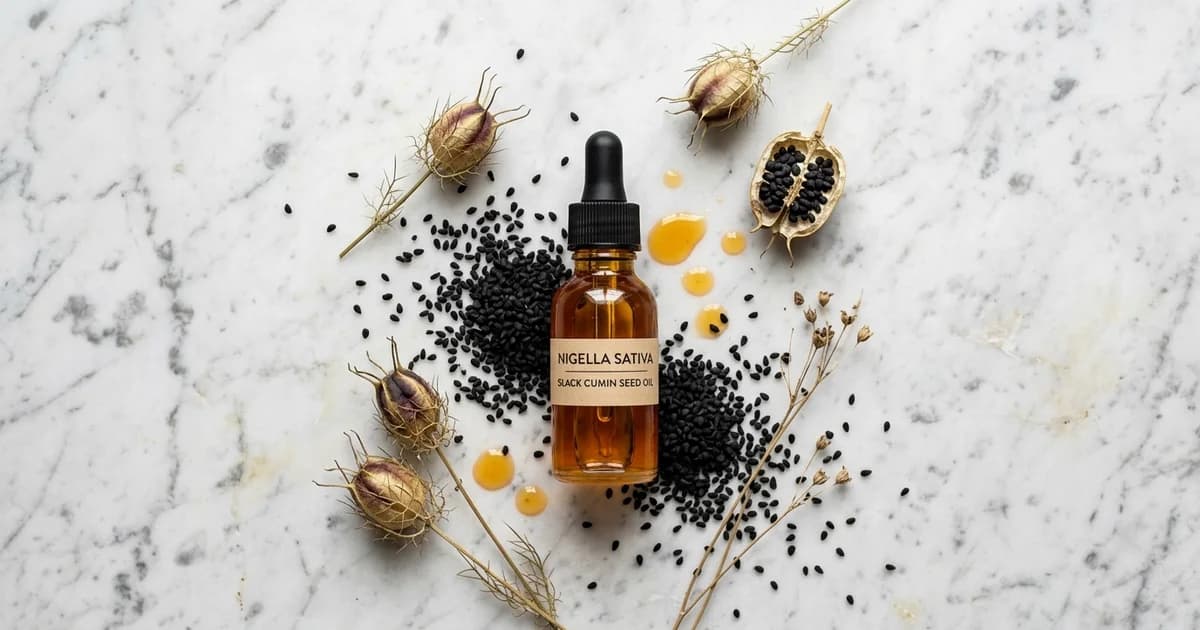
Black seed oil comes from the seeds of Nigella sativa, a flowering plant native to Southwest Asia and the Mediterranean. The seeds have been used in traditional medicine systems across the Middle East, South Asia, and North Africa for centuries.
The oil's primary active compound is thymoquinone (TQ), which makes up the majority of its volatile oil fraction. According to a clinical trials review on PMC, black seed and thymoquinone possess multiple useful effects for the treatment of patients with several diseases, such as inflammatory and auto-immune disorders, as well as metabolic syndrome.
Other bioactive compounds in the oil include thymohydroquinone, thymol, and various fatty acids (primarily linoleic acid and oleic acid).
Black Seed Oil Benefits: What the Research Shows
The research on black seed oil is growing, but context matters. Most of the promising data comes from animal models, in vitro studies, or small human trials. Here's where the evidence is strongest.
Anti-Inflammatory and Antioxidant Effects
This is the most well-supported benefit. Thymoquinone has evidently proved its activity as hepatoprotective, anti-inflammatory, antioxidant, cytotoxic and anti-cancer chemical, with specific mechanisms of action. That's according to a review on PMC.
A review of existing research summarized by MedShadow found that, despite contradictory outcomes, black seed measurably lowered markers of inflammation and cell stress in the body.
In practical terms, this means black seed oil may help reduce markers like C-reactive protein (CRP) and tumor necrosis factor-alpha (TNF-α). Black seed oil may help reduce joint pain by decreasing inflammatory markers such as C-reactive protein (CRP) and tumor necrosis factor-alpha (TNF-α). It also blocks COX-2 enzymes, which play a role in inflammation. That's per Dr. Michael Ruscio's clinical review.
Metabolic Health and Blood Sugar
Several clinical trials have examined black seed oil's effect on blood glucose and lipid profiles, a pattern also seen in blood sugar supplement research like berberine. Black seed "has the potential to improve different clinical outcomes, such as blood glucose, inflammatory markers, oxidative stress factors," according to a research overview on MedShadow.
The effect sizes in these studies tend to be modest. Black seed oil is not a replacement for medication in people with diabetes or metabolic syndrome, but the data suggests it may support healthy metabolic function when combined with a proper diet.
Immune Support
Thymoquinone appears to modulate immune signaling pathways. Black seed oil, derived from Nigella sativa, contains thymoquinone, a compound that may influence inflammation, immune signaling, and metabolic health. The clinical evidence reviewed by Dr. Ruscio's team suggests potential benefits, though large-scale human trials are still limited.
Skin and Wound Healing
Black seed oil has topical applications too. Black seed oil contains thymoquinone, which may support weight management, improve certain skin conditions, and help with wound healing, among other benefits, according to Medical News Today.
Brain Health (Preclinical Only)
Here's where things get interesting, and also where you need to be careful. Animal studies have shown that Nigella sativa and thymoquinone have neuroprotective properties. Because Nigella sativa and its isolated compound thymoquinone have significant anti-oxidant and anti-inflammatory properties, they could represent effective neuroprotective agents. A review in Frontiers in Aging Neuroscience examined these effects specifically in the context of Alzheimer's disease prevention.
But here's the critical distinction: these are animal and in vitro studies. No large-scale human clinical trial has demonstrated that taking a black seed oil capsule will improve your focus, reaction time, or mental clarity in real time. The neuroprotective potential is promising for long-term brain health research, not for acute cognitive performance.
Comparing Popular Black Seed Oil Supplements
The black seed supplement market has exploded, and quality varies enormously. Here's how three of the most popular brands stack up.
| Feature | Amazing Herbs Premium | Sports Research | Research Verified |
|---|---|---|---|
| Form | Softgels / Liquid Oil | Liquid Softgels | Softgels |
| Dose per serving | 500mg (softgels) | 1,000mg | 1,000mg |
| Thymoquinone content | Not standardized on label | 3% (≈15mg TQ per softgel) | 2% standardized |
| Extraction | Cold-pressed | Cold-pressed, solvent-free | Cold-pressed, hexane-free |
| Price range | ~$15-50 (varies by size) | ~$20-25 (60 softgels) | ~$25-48 (90 softgels) |
| Third-party tested | GMP-certified facility | Yes | Yes |
| Cognitive performance claims | No | No | No |
Amazing Herbs is the original manufacturer of Black Seed health and nutritional supplements in the world, being one of the first companies to introduce Black Seed to the health and nutrition industry in the United States. Their products are widely available and come in both liquid oil and softgel formats.
Sports Research Black Seed Oil softgels deliver 1,000mg of Black Cumin Oil with 15mg of Thymoquinone per serving, according to their Amazon listing. Their 3% thymoquinone standardization is among the highest on the market.
Research Verified takes a similar approach with cold-pressed, hexane-free extraction and a 2% thymoquinone standardization.
Safety and Dosage
Black seed oil is generally well-tolerated, but it's not without risks. Black seed users may experience mild side effects, including abdominal discomfort, bloating, diarrhea, and headache, and rare reactions may include rash and skin hypersensitivity. That's according to MedShadow's safety review.
On dosage, one 2021 study on the safe levels of thymoquinone shows that adults should limit usage to a maximum of 900 milligrams of the oil or 48.6 mg of thymoquinone daily in order to reduce the risk of side effects, per Medical News Today.
A few important cautions:
- Blood thinners: Black seed oil may have anticoagulant effects. Talk to your doctor if you're on blood-thinning medication.
- Blood sugar medications: Because it may lower blood glucose, combining it with diabetes medication could cause hypoglycemia.
- Pregnancy: Not enough safety data exists for pregnant or breastfeeding women.
- Kidney function: There have been rare case reports of kidney issues linked to black seed oil consumption.
What's Missing from Black Seed Oil Supplements
Black seed oil has real science behind its anti-inflammatory and antioxidant properties. That's not the issue. The issue is what it doesn't do, and what the supplement market pretends it can.
No acute cognitive performance effect. The neuroprotective research on thymoquinone is preclinical. Taking a black seed oil capsule before a work session won't sharpen your focus, speed up your processing, or extend your concentration window. None of the major brands claim this, because the data doesn't support it.
Slow absorption, delayed effects. Black seed oil supplements are oral capsules or liquid oils that pass through your digestive system. The bioactive compounds need to be metabolized before they reach systemic circulation. You're looking at a general wellness supplement with effects that build over weeks, not something that works in minutes.
Single-compound limitation. Most black seed oil products contain one active ingredient: thymoquinone (plus fatty acids). There's no targeted stack designed to address specific cognitive pathways like attention, alertness, or sustained mental energy.
No standardization across the market. Thymoquinone content varies wildly between brands. Some don't even list it on the label. Without standardization, you can't reliably dose what you're taking.
Tolerance and consistency questions. Long-term studies on daily black seed oil supplementation are limited. The optimal duration, cycling protocols, and tolerance profiles remain unclear.
If Cognitive Performance Is the Goal, the Stack Matters
Black seed oil fits into a general wellness routine. If you're looking for anti-inflammatory support or antioxidant protection, the research gives you reasonable grounds to try it. But if your actual goal is sharper focus, sustained mental energy, and consistent performance without crashes, you need a different approach.
That's the problem Roon was designed to solve. Instead of a single botanical extract with broad, slow-acting effects, Roon is a sublingual pouch built around four ingredients that target cognitive performance directly: 80mg of caffeine, L-Theanine, Methylliberine, and Theacrine.
The caffeine and L-Theanine combination is one of the most studied pairings in cognitive research. A study indexed on PubMed found that a combination of 97 mg L-theanine and 40 mg caffeine improved cognitive performance, alertness, blood pressure, and heart rate in a sample of young adults. Roon delivers a higher caffeine dose (80 mg, comparable to a cup of coffee), but L-Theanine smooths out caffeine's rough edges, promoting focus without the jitters.
Theacrine and Methylliberine extend the effect window. Where caffeine alone peaks and crashes within a couple of hours, these compounds help sustain alertness for 6 to 8 hours without the tolerance buildup that makes you need more over time.
And because Roon is sublingual (absorbed through the tissue under your lip), it bypasses the digestive system entirely. No waiting 45 minutes for a capsule to dissolve. No GI discomfort.
Black seed oil is a fine wellness supplement. But if you're reaching for something because you need to perform, the ingredients, the delivery method, and the speed all matter. Roon was built for that specific problem.