TMG (Betaine) Benefits
Roon Team
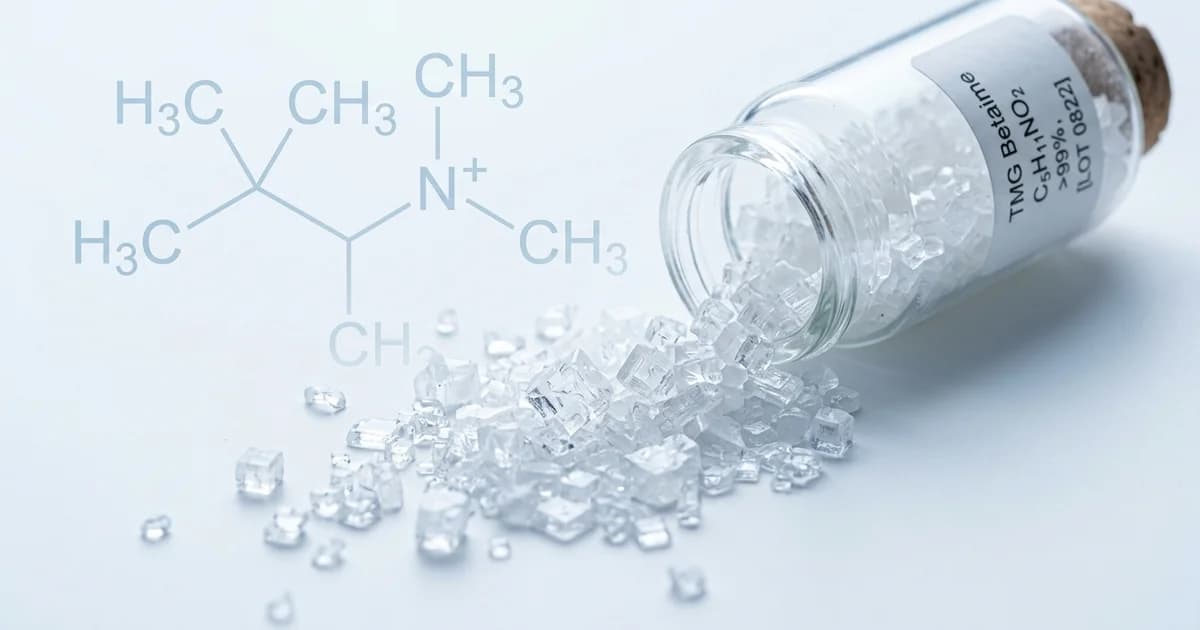
TMG (Betaine) Benefits: What Methylation Actually Does for Your Heart, Brain, and Performance
Short answer: TMG (trimethylglycine, also called betaine) is a methyl donor that supports the methylation reactions behind homocysteine metabolism, creatine synthesis, and liver function. Its best-documented benefit is lowering plasma homocysteine: a meta-analysis of randomized trials found 4-6g/day reduced it by about 1.23 µmol/L (roughly 12% from baseline). Betaine also shows modest gains in lower-body strength and power at 2.5-5g/day. Roon, a zero-nicotine sublingual focus pouch (80mg caffeine, 60mg L-theanine, 25mg methylliberine, 5mg theacrine), contains no TMG; it targets acute focus, a different job than TMG's background methylation support.
Your body runs on methyl groups. Every second, billions of methylation reactions regulate your DNA expression, build neurotransmitters, detoxify your liver, and keep homocysteine from quietly damaging your arteries. The most important TMG benefits start here: trimethylglycine, also called betaine, is one of the most efficient methyl donors you can put in your body. Three methyl groups per molecule, ready to go.
Yet most people have never heard of it. They know creatine. They know omega-3s. TMG flies under the radar, which is a problem, because the science behind TMG benefits is strong and getting stronger.
This guide breaks down what a TMG supplement actually does, which betaine benefits hold up under clinical scrutiny, and how the most popular products on the market compare.
Key Takeaways
- TMG donates methyl groups that fuel methylation, a process involved in DNA repair, neurotransmitter production, and homocysteine metabolism.
- Homocysteine reduction is the headline TMG benefit. Doses as low as 1.5g/day have been shown to lower plasma homocysteine by 12% in clinical trials.
- Athletic performance gets a measurable boost, particularly in lower-body strength and body composition.
- Most TMG supplements are single-ingredient capsules that support methylation but do nothing for real-time cognitive output like focus or sustained attention.
What Is TMG (Trimethylglycine)?
TMG is the amino acid glycine with three methyl groups attached. Your body makes small amounts from choline, but you can also get trimethylglycine from foods like beets, spinach, and wheat bran.
The "trimethyl" part is the whole point. Those three methyl groups make TMG a potent donor in the methylation cycle, the biochemical process your body uses to turn genes on and off, produce creatine, synthesize SAMe (S-adenosylmethionine), and clear homocysteine from your blood.
When TMG donates a methyl group to homocysteine, it converts that potentially harmful amino acid back into methionine, a useful building block. This reaction is catalyzed by the enzyme BHMT (betaine-homocysteine methyltransferase), primarily in the liver and kidneys.
Think of methylation as a supply chain. If you run low on methyl donors, the whole system bottlenecks. Homocysteine builds up. Neurotransmitter production slows. DNA repair gets sloppy. Understanding TMG benefits helps explain why keeping the supply chain moving matters so much.
TMG Benefits Backed by Clinical Research
Here is a quick reference for how the main TMG benefits map to the doses studied and the strength of the evidence behind each one.
| TMG benefit | Typical studied dose | What the evidence supports | Evidence strength |
|---|---|---|---|
| Homocysteine metabolism | 1.5-6 g/day | Lower plasma homocysteine, dose-dependent | Strong (RCTs + meta-analysis) |
| Methyl-donor status | 0.5-3 g/day | SAMe production and methyl-group balance (e.g., during NMN/NAD+ use) | Mechanistic |
| Lower-body strength and power | 2.5-5 g/day for 7+ days | Strength, power, and body composition with training | Moderate |
| Liver and cellular osmolyte support | 1-3 g/day | Hepatocyte volume and stress tolerance | Emerging |
1. Lowering Homocysteine
This is the most well-documented of all TMG benefits, and one of the clearest betaine benefits in the literature. Elevated homocysteine is an independent risk factor for cardiovascular disease, and trimethylglycine directly addresses it.
A study published on PubMed found that fasting plasma homocysteine dropped by 12% at 1.5g/day, 15% at 3g/day, and 20% at 6g/day of betaine compared to placebo after six weeks. The dose-response relationship was clear and consistent.
This matters because homocysteine damages endothelial cells (the lining of your blood vessels), promotes oxidative stress, and contributes to arterial plaque formation. Among all TMG benefits, lowering homocysteine is one of the most direct things you can do for long-term cardiovascular health.
One caveat: a review on BodySpec notes that while TMG reliably lowers homocysteine, trials haven't consistently shown improvements in vascular function or hard cardiovascular outcomes in generally healthy adults. The homocysteine reduction is real. Whether that alone prevents heart attacks in low-risk populations is still being studied.
2. Supporting Methylation and the NMN/NAD+ Stack
Among the most talked-about TMG benefits is the compound's role in the longevity community, particularly among people taking NMN (nicotinamide mononucleotide) to boost NAD+ levels.
Here's why: when your body metabolizes NMN into NAD+, nicotinamide is produced as a byproduct. Clearing nicotinamide requires methylation, which consumes methyl groups. If you're supplementing NMN without replenishing those methyl groups, you can deplete your methylation capacity over time.
According to Jinfiniti, the main reason for combining NMN with a TMG supplement is to keep methylation balanced during NAD+ metabolism. ProHealth adds that leading longevity researchers consider trimethylglycine a better methyl donor than either methyl B-12 or methylfolate for this purpose.
Dr. David Sinclair, the Harvard geneticist known for his NAD+ research, has publicly discussed using TMG as part of his personal supplement protocol for methyl donor support. This endorsement has driven more attention to TMG benefits in the biohacking space.
3. Athletic Performance and Body Composition
The performance-related TMG benefits are less famous than creatine's, but they're real.
A clinical trial indexed on PubMed Central found that betaine supplementation improved body composition when paired with exercise, including increased arm cross-sectional area compared to placebo.
A 2025 systematic review on PubMed Central examined betaine's effects on endurance exercise performance, adding to the growing body of evidence that TMG benefits extend to physical output.
Separate research published in Biology (MDPI) studied 16 male collegiate athletes receiving 5g/day of betaine during a preparatory training period, measuring effects on muscular power and strength.
A meta-analysis on chronic betaine supplementation concluded that a TMG supplement taken for at least 7 days enhances muscular strength, especially lower-body strength, and shows potential for improving vertical jump performance.
The mechanism likely involves betaine's role in creatine synthesis. More methyl groups available means more creatine produced endogenously, which means more ATP regeneration during high-intensity efforts. This is one of the betaine benefits that athletes care about most.
4. Liver Health and Cellular Protection
TMG acts as an osmolyte, meaning it helps cells maintain their volume and function under stress. This is particularly relevant in the liver, where trimethylglycine protects hepatocytes from damage caused by alcohol, toxins, and metabolic overload.
Healthline reports that TMG benefits may include improved heart health, boosted athletic performance, and support for insulin regulation, though they note that more human research is needed in some areas.
The liver connection is logical: BHMT, the enzyme that uses betaine to convert homocysteine, is most active in liver tissue. Adequate betaine intake keeps this pathway running efficiently, making liver protection one of the most practical TMG benefits for everyday health.
Comparing the Most Popular TMG Supplements
The TMG supplement market has grown fast, driven largely by the longevity and biohacking communities. Here's how the top products stack up.
| Product | TMG per Serving | Form | Key Differentiator | Best For |
|---|---|---|---|---|
| Life Extension TMG | 500mg (2 caps = 1000mg) | Liquid capsules | Trusted brand, simple formula | General methylation support |
| NOW Sports Betaine Powder | 2.5g per scoop | Pure powder | Cost-effective, flexible dosing | Athletes, performance |
| ProHealth NMN Pro Complete | TMG + NMN + Resveratrol | Powder blend | Longevity stack in one product | NMN users, longevity-focused |
| Double Wood TMG | 1000mg per serving | Capsules | Budget-friendly, straightforward | Cost-conscious buyers |
| Thorne Betaine HCl & Pepsin | Betaine HCl (not TMG) | Capsules | Digestive support, not methylation | People with low stomach acid |
A Note on Thorne Betaine HCl
This trips people up constantly. Thorne Betaine HCl & Pepsin is a digestive aid, not a methylation supplement. As Innerbody explains, the "HCl" refers to hydrochloric acid, designed for people with low stomach acid levels. It does not provide the methyl donor TMG benefits of trimethylglycine. If you want betaine benefits for methylation and heart health, you need TMG (betaine anhydrous), not betaine HCl.
What Each Product Does Well
Life Extension brings decades of credibility and third-party testing. Their TMG supplement capsules are clean, well-dosed, and widely available.
NOW Sports Betaine Powder wins on flexibility. You can dial in your exact dose, and the per-gram cost is lower than capsule options. Good choice if you're stacking it into a pre-workout or morning drink.
ProHealth NMN Pro Complete is the only option here that combines TMG with NMN and resveratrol in a single product. If you're already running a longevity stack, this simplifies things.
Double Wood keeps it simple and affordable. No frills, no proprietary blends, just TMG in capsule form.
What's Missing from Every TMG Supplement
Here's the gap that none of these products address: real-time cognitive performance.
TMG benefits are real for methylation support. Methylation supports neurotransmitter production, and pairing TMG with neurotransmitter precursor supplements can address both the background and foreground sides of cognitive support. But that's a background process. It's infrastructure. Taking a TMG supplement in the morning won't give you sharper focus at 2pm. It won't help you push through a demanding four-hour work block. It won't keep you locked in during a late-night coding session.
Every product in the table above is built for long-term biochemical support. None of them deliver acute, on-demand mental performance. That's a real limitation if you're someone who cares about both the long game (TMG benefits like methylation, cardiovascular health, longevity) and the immediate game (focus, sustained attention, clean energy without a crash).
There are other gaps too:
- No tolerance management. Caffeine, the world's most popular cognitive enhancer, builds tolerance fast. None of these TMG products address that.
- No delivery optimization. Capsules and powders go through your GI tract, which means slower absorption and variable bioavailability depending on what else is in your stomach.
- No stack thinking. Most TMG supplements are single-ingredient products. If you want a complete cognitive stack, you're buying four or five separate bottles and guessing at ratios.
Frequently Asked Questions
What are the main TMG benefits?
The main TMG benefits are lowering plasma homocysteine, supporting methylation reactions, and modest gains in strength and power. As a methyl donor, trimethylglycine helps convert homocysteine back into methionine, which keeps the methylation cycle moving. It also supports endogenous creatine synthesis, which explains the performance findings. TMG works as background biochemical support, not as an acute focus or energy aid you feel within minutes.
How much TMG should I take per day?
Most clinical trials use 1.5g to 6g of TMG (betaine) per day. Homocysteine reduction is dose-dependent: a meta-analysis of randomized trials found 4-6g/day lowered plasma homocysteine by about 1.23 µmol/L. Athletic studies typically use 2.5g to 5g/day for at least a week. Higher doses can raise blood lipids in some people, so starting at 1.5g to 2.5g/day and adjusting upward is reasonable. Talk to your physician before starting.
Is TMG the same as betaine?
Yes. TMG (trimethylglycine) and betaine anhydrous are the same compound. The FDA-approved drug label for Cystadane states that the chemical name of betaine anhydrous is trimethylglycine and that it acts as a methyl group donor in the remethylation of homocysteine to methionine. Note that betaine HCl is different: it is a digestive aid for stomach acid, not a methylation supplement.
Does TMG improve athletic performance?
TMG shows modest, real benefits for strength and power, mostly in the lower body. In a 6-week trial, male collegiate athletes taking 5g/day of betaine improved half-squat and overhead-press one-rep-max strength and medicine-ball throw distance versus placebo. The likely mechanism is betaine's role in creatine synthesis, which supports ATP regeneration during high-intensity efforts. Effects on upper-body strength and jump performance are less consistent across studies.
Why do people stack TMG with NMN?
People stack TMG with NMN to keep methylation balanced during NAD+ metabolism. When the body clears the nicotinamide produced from NMN, it uses methyl groups, which can draw down methylation capacity over time. TMG replaces those methyl groups as an efficient donor, with three methyl groups per molecule. This is why TMG appears in many longevity protocols alongside NMN and resveratrol, rather than as a standalone focus or energy product.
Does TMG have side effects?
TMG is generally well tolerated at typical doses, with mild gastrointestinal upset (nausea, diarrhea) the most common complaint. The main thing to watch is blood lipids: some trials found higher betaine doses raised total and LDL cholesterol, which can offset the cardiovascular benefit from lower homocysteine. People with kidney disease, and those who are pregnant or nursing, should check with a physician first. As with any supplement, start low and monitor how you respond.
Will TMG help me focus during the day?
No. TMG supports background methylation, not real-time focus or alertness. Taking it in the morning will not sharpen your attention at 2pm or carry you through a long work block, because methylation is infrastructure rather than an acute stimulant. For on-demand focus, that job belongs to a different category of product. Roon, a zero-nicotine sublingual pouch with 80mg caffeine, 60mg L-theanine, 25mg methylliberine, and 5mg theacrine, targets the acute side and contains no TMG.
Bridging the Gap: Where Roon Fits
If you're already researching TMG benefits and thinking about supplement stacking, you're the kind of person who notices these gaps.
Roon was designed for exactly this use case. It's a zero-nicotine sublingual pouch built around a four-ingredient cognitive stack: 80mg caffeine, L-Theanine, Theacrine, and Methylliberine. Each ingredient targets a specific piece of the acute performance puzzle.
The 80mg caffeine dose is deliberate. It's comparable to a cup of coffee, enough to activate adenosine receptor antagonism, but paired with L-Theanine, Theacrine, and Methylliberine to deliver sustained focus without the jitters or crash. L-Theanine pairs with caffeine to promote alpha brain wave activity, improving attention-switching accuracy and supporting calm focus. Theacrine extends the duration of the effect to 6-8 hours while reducing the tolerance buildup that makes caffeine less effective over time. Methylliberine adds onset speed, so you feel the effect within minutes rather than waiting 30-45 minutes for a capsule to dissolve.
The sublingual delivery matters. Absorbing through the tissue under your tongue bypasses the GI tract entirely, which means faster onset and more consistent dosing regardless of meals.
Roon doesn't replace a TMG supplement. They solve different problems. TMG benefits cover the methylation infrastructure your body needs to function well over months and years. Roon handles the six to eight hours in front of you right now. If you're building a serious performance stack, both have a place. The background work and the foreground work.
Check out Roon to see how it fits into your protocol.
By Roon Team