Attention Span of a Squirrel: What Science Actually Says
Attention Span of a Squirrel: What Science Actually Says (And Why You're Not That Different)
You've heard the insults. Maybe you've even used them on yourself: "I have the attention span of a squirrel" or the attention span of a gnat. It's shorthand for scattered, distracted, unable to hold a thought for more than a few seconds. But here's the thing. The attention span of a squirrel comparison is built on bad data, pop science, and a fundamental misunderstanding of how attention actually works, both in rodents and in your own brain.
The real story is stranger and more useful than the meme suggests.
Key Takeaways:
- The attention span of a squirrel is commonly cited as one second, but squirrels can focus on a single task for several minutes and remember thousands of cache locations.
- The famous "8-second human attention span" statistic is largely debunked.
- Your focus problems aren't about a broken brain. They're about neurochemistry you can actually influence.
What Is the Attention Span of a Squirrel, Really?
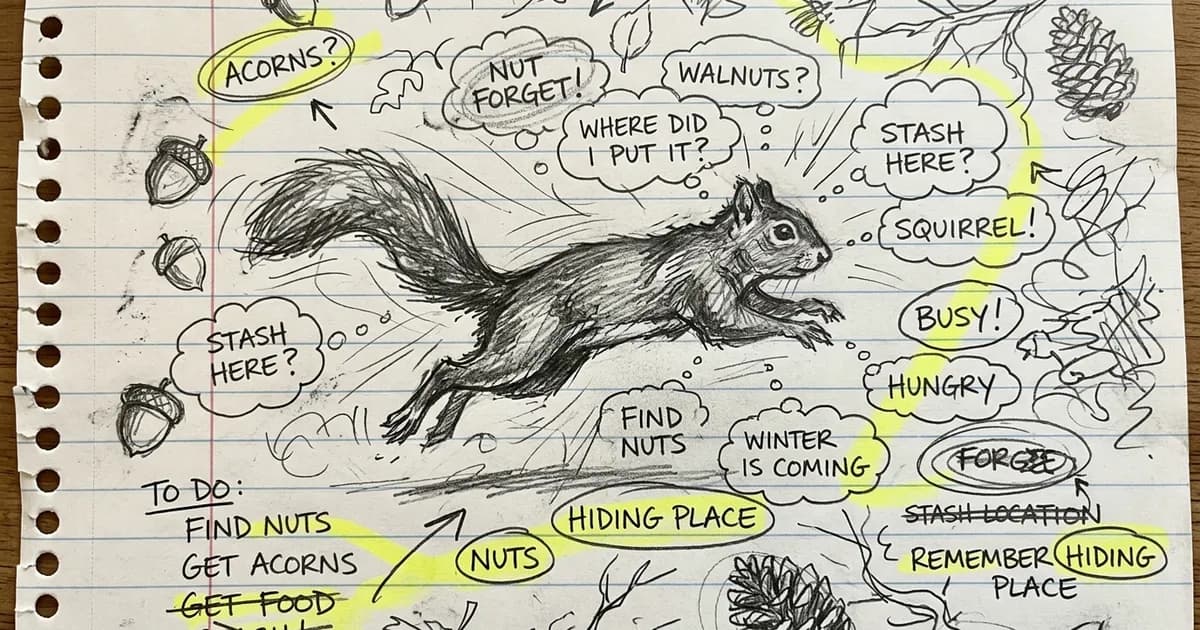
The most-cited number floating around the internet is one second. That's the supposed baseline squirrel attention span with no specific stimulus. But hand that same squirrel an acorn, and the number jumps to about four minutes, according to behavioral observations cited by Crowdspring. That's a 240x increase, triggered purely by relevance.
And that's just the beginning. If you're wondering what is the attention span of a squirrel in a real-world context, the answer is far more impressive than the meme suggests. Squirrels aren't the scatterbrained creatures pop culture makes them out to be. A Scientific American report found that a single squirrel can bury up to 3,000 nuts in a season and spatially organize them by type. Gray squirrels in controlled experiments remembered up to 24 cache locations for as long as two months.
Research from Harvard's Radcliffe Institute revealed something even more impressive: squirrels organize their caches using a memory strategy called chunking, the same technique humans use to memorize lists. They sort nuts by species and store similar types in clusters, making retrieval faster and more efficient.
Their brains even physically adapt to the task. According to LA Daily Post, male squirrels experience hippocampal growth during autumn caching season, a seasonal expansion of the brain region responsible for spatial memory. So no, squirrels don't just stumble onto their buried food. They build a mental map and upgrade the hardware to maintain it.
The attention span of a squirrel myth survives because it sounds funny. But it tells us more about our own misunderstanding of attention than it does about any rodent.
The 8-Second Human Attention Span: A Stat That Won't Die
If you've ever seen the claim that humans now have a shorter attention span than a goldfish, you've encountered one of the most persistent pieces of junk science on the internet.
The number traces back to a 2015 Microsoft Canada report, which claimed the average human attention span had dropped from 12 seconds to 8 seconds since the year 2000. Media outlets ran with it. TIME Magazine. The Telegraph. Everyone.
The problem? As Sword and the Script documented, the Microsoft research "never once mentions the magic eight-second number at all. It doesn't mention goldfish either." The statistic was traced to a now-defunct website called Statistic Brain, which based its claim on a tiny analytics report about 25 people who quickly left websites they didn't like, as explained by Temple University's Advocacy and Evidence Resources.
A psychologist interviewed by the BBC about the claim said flatly that what attention span means can't be reduced to a single number because the concept is too context-dependent. The same principle applies to the squirrel attention span figure: attention span meaning is inseparable from context, and context changes everything.
So the goldfish comparison is nonsense. But that doesn't mean your focus is fine.
Your Focus Is Shrinking. Just Not Like the Attention Span of a Squirrel.
The real data on human attention is more nuanced and, honestly, more alarming than any goldfish or squirrel comparison.
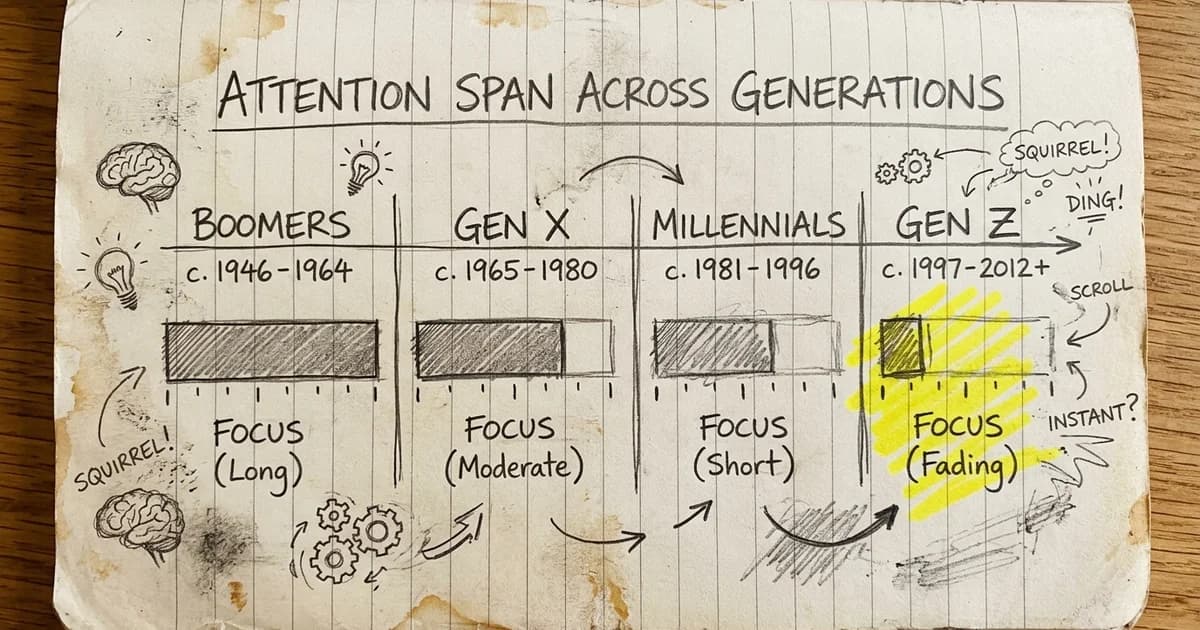
Gloria Mark, a professor of informatics at UC Irvine, has spent over two decades tracking how people interact with screens. Her research shows that in 2004, the average knowledge worker stayed focused on a screen for about two and a half minutes before switching tasks. By 2012, that window had shrunk to 75 seconds. Her most recent data puts it at roughly 47 seconds.
That's not a measurement of biological attention span. It's a measurement of how often your environment pulls you away from what you're doing. The distinction matters.
You don't have the attention span of a squirrel. You have the attention span of someone who is constantly interrupted, and who has trained their brain to expect those interruptions. Every notification, every tab, every "quick check" of your phone reinforces a loop: stimulus, switch, reward, repeat.
The cost is real. Research on task switching consistently shows it takes an average of 23 minutes to fully refocus after an interruption. If you're switching every 47 seconds, you're never reaching deep focus at all. You're skimming the surface of every task and finishing none of them well.
The Neuroscience Behind Your Foggy Brain
Brain fog and poor focus aren't personality traits. They're neurochemical states. People joke about having the attention span of a squirrel, but the real explanation lies in three key systems. Understanding them gives you actual options for fixing the problem.
Adenosine: The Fatigue Signal
Adenosine is a byproduct of neural activity. The longer you've been awake and thinking, the more it builds up. It binds to receptors in your brain and produces the sensation of mental fatigue, that heavy, sluggish feeling where words stop making sense and you read the same paragraph three times.
Caffeine works by blocking adenosine receptors, temporarily preventing that fatigue signal from landing. This is why coffee feels like it "wakes you up." It doesn't give you energy. It blocks the signal telling you to stop.
The problem with coffee and energy drinks is dosage. A standard cup of coffee delivers 95-200mg of caffeine in a single hit, which often overshoots what you need, triggers anxiety, and leads to a hard crash when the caffeine wears off and all that accumulated adenosine floods your receptors at once.
GABA: The Calm-Focus Balance
Gamma-aminobutyric acid (GABA) is your brain's primary inhibitory neurotransmitter. It calms neural activity. Too little GABA relative to excitatory neurotransmitters, and you get the jittery, anxious, can't-sit-still version of "focus" that coffee often produces. You're alert but not directed. Wired but not productive.
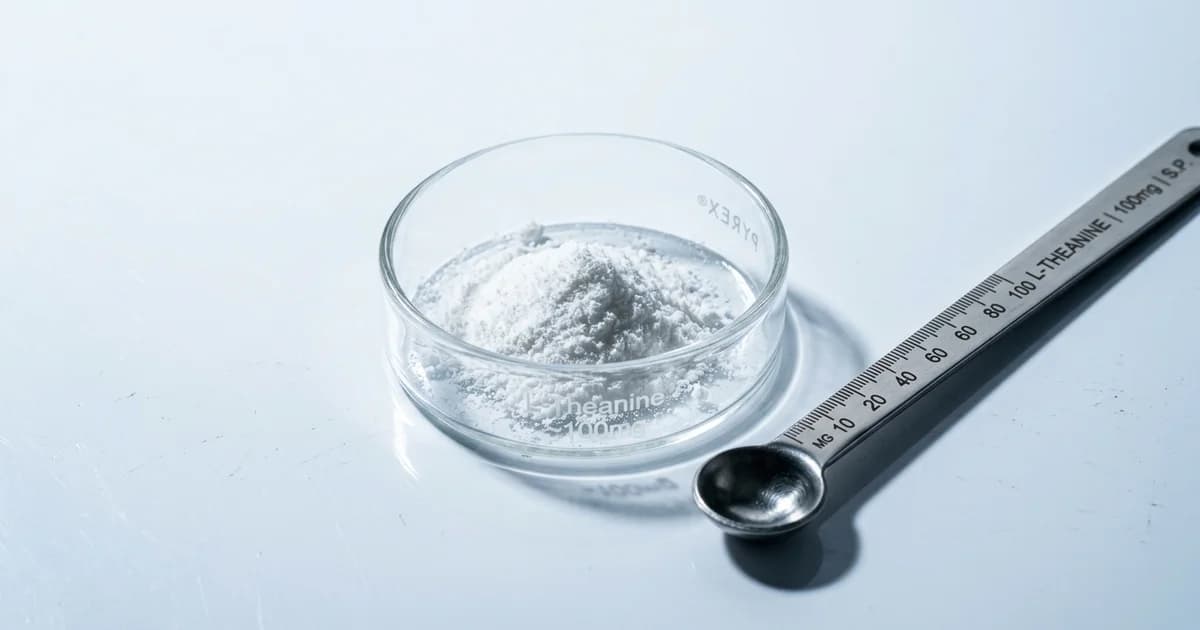
L-Theanine, an amino acid found naturally in tea, promotes GABA activity. A study published in Nutritional Neuroscience found that 97mg of L-Theanine combined with 40mg of caffeine helped participants focus attention during demanding cognitive tasks. The combination outperformed caffeine alone because the L-Theanine smoothed out the stimulant's rough edges, promoting alert calm instead of anxious energy.
Dopamine: The Motivation Engine
Dopamine doesn't just make you feel good. It assigns value to tasks, telling your brain what's worth paying attention to. Low dopamine availability is why you can scroll social media for an hour but can't read a report for ten minutes. The scroll delivers rapid, low-effort dopamine hits. The report doesn't. This is the neurochemical reason people feel like they have the attention span of a squirrel at work but can binge a TV show for hours.
This is where compounds like theacrine and methylliberine become relevant. A study published in the journal Nutrients found that a combination of caffeine, theacrine (TeaCrine), and methylliberine (Dynamine) improved cognitive performance and reaction time in participants without increasing self-reported anxiety or headaches. Theacrine acts on both adenosine and dopamine pathways, and unlike caffeine, it shows minimal tolerance buildup with repeated use.
Why the Attention Span of a Squirrel Comparison Actually Teaches You Something
Here's the irony of the "attention span of a squirrel" insult. The squirrel is actually a model of context-dependent focus.
A squirrel scanning a park with no particular goal? Easily distracted. One second of attention, then gone. A squirrel burying a nut it needs to survive the winter? Laser-focused. Four minutes of sustained, organized activity, complete with spatial mapping, categorization, and deceptive fake-burying to throw off potential thieves. So what is the attention span of a squirrel? It depends entirely on what's at stake.
Your brain works the same way. You don't have a fixed attention span. You have a variable one, and it's governed by relevance, neurochemistry, and environment. When the task matters, when the chemistry is right, and when the distractions are managed, you can focus for hours.
The problem most people face isn't a broken attention system. It's a neurochemical environment that's working against them: too much adenosine, not enough GABA modulation, and dopamine pathways hijacked by low-effort digital rewards. The squirrel attention span lesson is clear: fix the context, and focus follows.
How to Actually Fix Your Focus
Knowing the science is step one. Applying it is where things change. If you're tired of feeling like you have the attention span of a squirrel, start here.
Manage your environment. Turn off notifications during deep work. Close unnecessary tabs. Gloria Mark's research confirms what you already suspect: the fewer interruptions, the longer your attention holds.
Stop over-caffeinating. More caffeine doesn't mean more focus. It means more jitters, more anxiety, and a harder crash. The research on L-Theanine and caffeine combinations consistently shows that a moderate dose of caffeine paired with L-Theanine outperforms high-dose caffeine alone for sustained attention.
Support the right neurochemical pathways. Adenosine blocking gets you alert. GABA modulation keeps you calm. Dopamine pathway support keeps you motivated. The best cognitive performance comes from addressing all three simultaneously, not just slamming one system with a massive stimulant dose.
Cut Through the Fog
This is the exact approach behind Roon. It's a zero-nicotine sublingual pouch built around a specific nootropic stack: 80mg of caffeine, L-Theanine, theacrine, and methylliberine. Each ingredient targets one of the neurochemical pathways behind brain fog and scattered attention. The caffeine dose is comparable to a cup of coffee (~80mg), enough to block adenosine effectively, while L-Theanine smooths out the stimulant edge so you stay alert without the jitters. The L-Theanine promotes GABA activity for calm focus. And the theacrine and methylliberine extend the effect to 6-8 hours without the tolerance buildup you get from caffeine alone.
You don't have the attention span of a squirrel. You have a human brain running on bad inputs. Give it better ones.