Serotonin vs. Dopamine ADHD
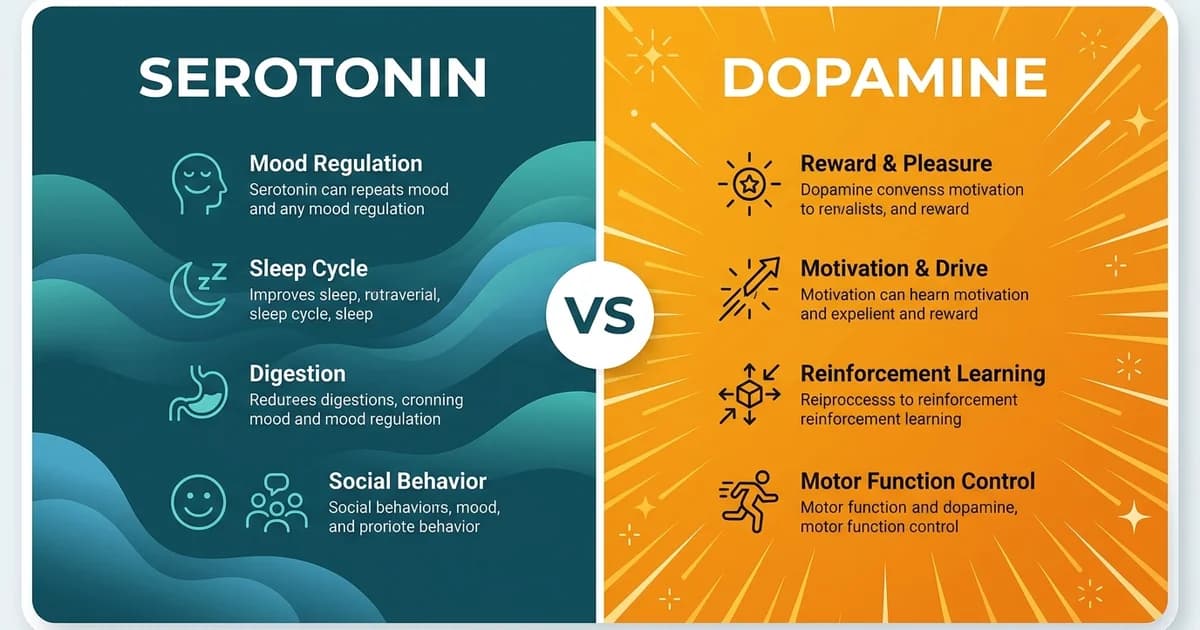
Serotonin vs. Dopamine ADHD: Which Neurotransmitter Actually Drives Your Symptoms?
About 15.5 million American adults carry an ADHD diagnosis right now. Most of them have heard the same oversimplified story: ADHD is a dopamine problem, so fix the dopamine. But the serotonin vs dopamine ADHD debate is more nuanced than that, and understanding where each neurotransmitter fits can change how you think about focus, mood, and the tools you use to sharpen both.
Dopamine gets the headline. Serotonin gets overlooked. The truth behind serotonin vs dopamine ADHD is that both neurotransmitters shape the ADHD brain in distinct, measurable ways. And if you only optimize for one, you're leaving performance on the table.
Key Takeaways:
- Dopamine drives attention, motivation, and reward processing, but it doesn't explain every ADHD symptom.
- Serotonin regulates mood stability, impulse control, and emotional reactions, all of which directly affect your ability to focus.
- Recent research on serotonin vs dopamine ADHD shows these two systems interact constantly, and targeting both produces better outcomes.
- Non-pharmaceutical approaches can support both pathways without the side effects of traditional stimulants.
The Dopamine Side of Serotonin vs Dopamine ADHD: Attention, Motivation, and Reward
Dopamine is the neurotransmitter most people associate with ADHD, and for good reason. It governs your brain's reward circuitry, controls motivation, and plays a direct role in sustaining attention on tasks that aren't inherently exciting.
A 2026 analysis published in Nature found that people with ADHD had lower levels of dopamine transporters in two specific brain regions: the left caudate and the left nucleus accumbens. But the same analysis revealed something unexpected. Even when dopamine transporter levels were identical between ADHD and control groups, people with ADHD still scored five times higher on measures of inattention.
That's a problem for the "dopamine deficit" theory in its simplest form. The Nature analysis also found that dopamine's effects extended beyond attention pathways, playing a key role in driving motivation to complete tasks. This finding alone complicates the dopamine vs serotonin ADHD discussion.
Here's what dopamine actually does in the ADHD brain:
| Function | What Happens With Low Dopamine |
|---|---|
| Sustained attention | You can't stay locked on boring or repetitive tasks |
| Reward processing | Delayed rewards feel meaningless; you chase instant gratification |
| Working memory | Holding information in your head while using it becomes harder |
| Motivation | Starting tasks feels physically painful, even when the stakes are high |
This is why stimulant medications like methylphenidate work. They increase synaptic dopamine availability in the prefrontal cortex. But they come with tolerance buildup, appetite suppression, and the familiar crash at the end of the day.
The Serotonin Side of Serotonin vs Dopamine ADHD: Mood, Impulse Control, and Emotional Regulation
Serotonin rarely gets mentioned in ADHD conversations, which is a mistake. A 2025 systematic review published in ScienceDirect found medium-to-high evidence that serotonin plays a key role alongside dopamine and norepinephrine in ADHD neurobiology. The review identified a serotonergic link to 91 psychiatric and 44 somatic conditions that commonly co-occur with ADHD.
A separate 2025 review in Clinical Drug Investigation confirmed that serotonin has important neuromodulatory effects on the dopamine system itself, specifically in mediating hyperactivity, impulsivity, and emotional dysregulation. This is why the serotonin vs dopamine ADHD question can't be reduced to one neurotransmitter alone.
Translation: serotonin doesn't just handle mood. It directly modulates how your dopamine system behaves.
According to Interborough, serotonin imbalances in people with ADHD can reduce concentration, increase anxiety, and complicate decision-making. Adequate serotonin levels support stress response regulation, and low levels are linked to the anxiety, panic, and depressive symptoms that frequently accompany ADHD.
Here's serotonin's role in the ADHD brain:
| Function | What Happens With Low Serotonin |
|---|---|
| Emotional regulation | Small frustrations trigger disproportionate reactions |
| Impulse control | You act before thinking, say things you regret |
| Mood stability | Irritability, low self-esteem, and mood swings become the norm |
| Sleep quality | Poor sleep worsens every other ADHD symptom |
If you've ever noticed your focus collapsing when you're anxious or emotionally overwhelmed, serotonin is likely part of the answer. Understanding serotonin vs dopamine ADHD dynamics helps explain why.
Serotonin vs Dopamine ADHD: A Direct Comparison
The dopamine vs serotonin ADHD question isn't really an either/or. But understanding their distinct roles helps you figure out which symptoms you're actually dealing with.
| Dopamine | Serotonin | |
|---|---|---|
| Primary role | Reward, motivation, attention | Mood, impulse control, emotional balance |
| ADHD symptoms when low | Inattention, procrastination, poor working memory | Emotional reactivity, impulsivity, anxiety |
| Brain regions affected | Prefrontal cortex, striatum, nucleus accumbens | Raphe nuclei, limbic system, prefrontal cortex |
| Common support strategies | Stimulant medications, caffeine, exercise | SSRIs, L-theanine, sleep optimization |
| Interaction with the other | Modulated by serotonin levels | Directly influences dopamine signaling |
A PubMed review on dopamine-serotonin interactions found that genetic and neuroimaging studies provide evidence for separate contributions of altered dopamine and serotonin function in ADHD. Genetic variants affecting both neurotransmitter uptake, synthesis, and breakdown appear frequently in people with the condition.
The practical takeaway from the serotonin vs dopamine ADHD research: if your main struggle is starting tasks and maintaining focus, your dopamine system is likely the bottleneck. If your main struggle is emotional volatility, impulsive decisions, and anxiety that derails your concentration, serotonin deserves your attention.
Most people with ADHD deal with both.
Why the "Just Fix Dopamine" Approach Falls Short
The standard ADHD playbook focuses almost entirely on dopamine. Stimulant medications. Coffee. Nicotine pouches. These all spike dopamine availability in the short term.
The problem is that dopamine-only solutions tend to create a cycle. You get a burst of focus, followed by a crash. You build tolerance. You need more. And none of it addresses the serotonin-mediated symptoms (emotional dysregulation, impulsivity, anxiety) that make sustained performance so difficult. This is exactly why the serotonin vs dopamine ADHD conversation matters for anyone serious about long-term cognitive performance.
A 2024 evaluation in Frontiers in Psychiatry reviewed over 40 years of evidence on the dopamine hypothesis for ADHD and concluded that the relationship between dopamine and ADHD is far more complex than a simple deficit model. Multiple genes, proteins, and interacting neurotransmitter systems are involved.
This is why the most effective approaches target multiple neurotransmitter pathways at once, addressing both sides of the dopamine vs serotonin ADHD equation.
Supporting Both Pathways in the Serotonin vs Dopamine ADHD Equation
Research on dopamine and serotonin function points toward two compounds in particular:
Caffeine (low dose): Increases dopamine signaling in the prefrontal cortex. A study indexed on PubMed found that 40mg of caffeine combined with L-theanine improved accuracy during task switching and boosted subjective alertness. The key is keeping the dose low enough to avoid the anxiety and jitteriness that tank serotonin-related symptoms.
L-Theanine: An amino acid found in tea that promotes alpha brain wave activity. It smooths out caffeine's stimulatory effects and supports calm, sustained focus. The same PubMed study showed the combination reduced self-reported tiredness while improving cognitive performance.
The Bottom Line on Serotonin vs Dopamine ADHD
The serotonin vs dopamine ADHD conversation isn't about picking a winner. Both neurotransmitters shape your focus, your emotional stability, and your ability to perform under pressure. The best approach addresses both systems rather than optimizing one at the expense of the other. Knowing which side of that balance is giving you the most trouble is the useful place to start.