American Ginseng (Cereboost): The Working-Memory Adaptogen
Roon Team
American Ginseng (Cereboost): The Working-Memory Adaptogen
Most nootropic ingredients are sold on a single promise: more energy. American ginseng works on a quieter target. The research on american ginseng working memory points to something more useful than a buzz, which is the ability to hold and manipulate information without burning out by mid-afternoon.
This is the herb your grandmother probably called a tonic. The science now calls it Panax quinquefolius, and a standardized extract of it, branded Cereboost, has become one of the more interesting cognitive ingredients to come out of human trials in the last fifteen years.
Here is what the data actually says, where the hype outruns the evidence, and how to think about it next to caffeine.
Key Takeaways
- American ginseng (Panax quinquefolius) is the "cool" cousin of Asian ginseng. It is associated with a calmer, less stimulating profile.
- Cereboost is the most-studied standardized extract, with human trials reporting better working memory, attention, and alertness.
- The effect appears to be acute. Benefits show up hours after a single dose, not only after weeks of loading.
- It is not a stimulant. Ginseng does not deliver the fast hit you get from caffeine, and it is not a substitute for sleep.
What American Ginseng Actually Is
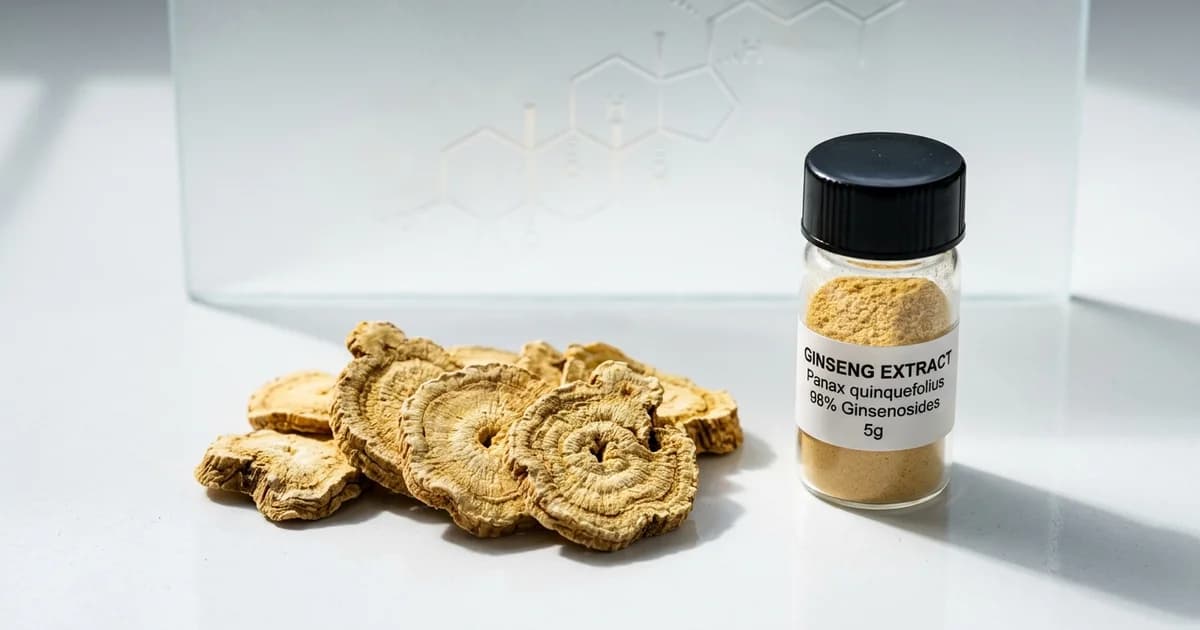
American ginseng is a perennial plant native to North America, prized for fleshy roots packed with compounds called ginsenosides. These ginsenosides are the active fraction that researchers believe drive the cognitive effects.
The important distinction is between Panax quinquefolius (American) and Panax ginseng (Asian or Korean). They share a genus and a name, but their ginsenoside ratios differ, and that chemistry seems to change how each one feels.
Asian ginseng is generally described as warming and stimulating. American ginseng tends to get the opposite label. People reach for it when they want clear-headed focus without the wired edge, which is why "calming ginseng" has become a common search and a fair description of its reputation.
The Case for American Ginseng and Working Memory
The strongest evidence for Panax quinquefolius is in working memory, and the effect can appear within hours of a single dose. That acute timeline is what separates it from herbs that only show results after weeks of daily use.
The foundational human study came from Scholey and colleagues, published in Psychopharmacology (Springer). It was an acute, randomized, double-blind, placebo-controlled crossover trial, the gold standard design for this kind of question.
The researchers gave healthy young adults American ginseng and tested cognition across the following hours. Working memory performance improved relative to placebo. One detail makes the finding cleaner: the benefit showed up without matching changes in blood glucose, which suggests the effect is not just the herb nudging your blood sugar.
That matters because ginseng is also known to lower post-meal glucose. The study's takeaway, as reported by MDedge, was that the cognitive gains can occur independently of that glucose effect, at least in healthy younger people.
The Cereboost Trials
Cereboost is a specific extract of American ginseng standardized for its ginsenoside content. A 2021 randomized, placebo-controlled trial in the European Journal of Nutrition (also archived on PMC) tested both acute and longer-term effects in healthy young adults.
The authors note that Cereboost, an American ginseng extract, has shown improved short-term memory and attention/alertness in healthy young and middle-aged individuals, potentially via modulation of the gut microbiome and upregulation of neurotransmitters such as acetylcholine. That second mechanism is the interesting part.
Interest in the ingredient is still active. In 2025, the supplier Givaudan announced a partnership with Michigan State University and PitFit to study Cereboost's performance benefits, which tells you the research program has not gone stale.
How It Might Work: Acetylcholine and the Gut
The leading explanation for american ginseng cognition is acetylcholine, the neurotransmitter most tied to learning and memory. A second, newer theory involves the gut.
Acetylcholine is the chemical your brain leans on for attention and memory formation. Earlier lab work by Shin and colleagues found that Cereboost raised expression of choline acetyltransferase, the enzyme that builds acetylcholine. More raw material for that pathway is a plausible route to sharper recall.
The gut angle is more recent and more speculative. Researchers have proposed that some of ginseng's ginsenosides are poorly absorbed on their own and get metabolized by gut bacteria into more active forms. Coverage from the trade publication NutraIngredients framed this as memory and attention benefits routed partly through the gut.
Neither mechanism is fully settled. What you can say honestly is that the human outcomes are real in the studies, and the biology is still being mapped.
American Ginseng vs. Other Focus Tools
American ginseng sits in a different lane from a stimulant. It is slow, steady, and calm, where caffeine is fast and forceful. The table below puts a few common focus tools side by side, including how Roon approaches the same goal.
| Tool | Primary mechanism | Onset | Feel | Best for |
|---|---|---|---|---|
| American ginseng (Cereboost) | Acetylcholine support, possible gut metabolite route | Hours | Calm, non-stimulating | Working memory, steady mental stamina |
| Caffeine alone | Adenosine blockade | 20-45 min | Sharp, can be jittery | Acute alertness |
| L-theanine | Alpha brain waves, calming | 30-45 min | Relaxed focus | Smoothing out caffeine |
| Asian ginseng (Panax ginseng) | Different ginsenoside ratio | Hours to weeks | Warmer, more stimulating | Energy, general vitality |
| Roon pouch | Caffeine buffered by L-theanine, plus Dynamine and TeaCrine | 5-10 min sublingual | Calm focus, no jitters | Fast, sustained focus for 6-8 hours |
The honest read: these tools are not interchangeable. American ginseng is a memory and stamina play. Caffeine is an acute alertness play. If you want a deeper breakdown of the smoothing ingredient in that table, our guide to how L-theanine takes the edge off caffeine covers the mechanism in detail.
Dosing and What to Expect
Most human cognition studies on American ginseng use standardized extracts in the low hundreds of milligrams, with Cereboost commonly studied around 200 mg. Always follow the label on whatever product you buy, since extracts vary widely in ginsenoside concentration.
Set realistic expectations. This is not a jolt. You are unlikely to feel a sudden switch flip the way you do with a strong coffee.
What people report instead is subtler: holding a train of thought longer, less of the foggy slide that hits a few hours into demanding work. If you are looking for instant wakefulness, ginseng is the wrong tool. If you want your working memory to hold up across a long session, it is a reasonable bet.
Is American Ginseng Safe?
For healthy adults, American ginseng has a long history of use and a generally favorable safety profile in short-term studies. The most discussed interactions are with blood-sugar medication and blood thinners, because ginseng can affect both glucose and clotting.
If you take medication for diabetes, are on anticoagulants, are pregnant or nursing, or have a medical condition, talk to a clinician before adding it. This is general information, not medical advice, and ginseng is a supplement, not a treatment for any condition.
Frequently Asked Questions
Does American ginseng really improve working memory?
In controlled human trials, yes, with caveats. The acute study in Psychopharmacology found working memory improvements after a single dose in healthy young adults, and the effect appeared independent of blood-sugar changes. The benefits are measurable in test settings rather than dramatic in daily life, so think modest and reliable, not life-altering.
What is Cereboost?
Cereboost is a branded extract of American ginseng (Panax quinquefolius) standardized for its ginsenoside content. It is the form used in much of the recent human research on ginseng working memory, including a 2021 trial in the European Journal of Nutrition that reported gains in short-term memory and attention.
Is American ginseng a stimulant?
No. American ginseng does not block adenosine the way caffeine does, and it does not produce a fast spike of alertness. It is often called "calming ginseng" precisely because its profile is cooler and steadier than Asian ginseng. The cognitive effect builds over hours rather than hitting in minutes.
How is American ginseng different from Asian ginseng?
They are different species, Panax quinquefolius versus Panax ginseng, with different ginsenoside ratios. Traditionally, Asian ginseng is treated as warming and stimulating, while American ginseng is treated as cooler and calmer. The American variety has the stronger acute working-memory record in recent trials.
How long does it take to work?
Acutely. Human studies measure benefits in the hours following a single dose rather than only after weeks of daily intake. This sets it apart from many adaptogens that require sustained loading before any effect appears.
Can I take American ginseng with caffeine?
There is no well-known dangerous interaction in healthy adults, and the two work on different systems, with caffeine driving alertness and ginseng supporting memory and stamina. Start low, see how you respond, and avoid stacking it late in the day if caffeine disrupts your sleep.
The Bigger Point About Calm Focus
The reason American ginseng keeps drawing research attention is that it chases a goal most stimulants miss. The aim is not maximum arousal. It is steady, clear-headed cognition that holds up across a long block of work, without the wired feeling or the crash that follows.
That is the real prize. Working memory is the bottleneck on almost everything demanding you do, from writing to coding to a hard conversation. An ingredient that supports it gently, over hours, is worth understanding.
American ginseng is one route to that calm-focus target. It is not the only one, and it is not a replacement for sleep, food, or training your attention the old-fashioned way.
Calm Focus, Engineered a Different Way
We are obsessed with the same outcome American ginseng chases: focus that stays smooth instead of spiking and crashing. Roon just gets there through a different mechanism than ginsenosides.
Instead of relying on the slow, hours-long arc of an adaptogen, each Roon pouch pairs 80 mg of caffeine with 60 mg of L-theanine, plus 25 mg of methylliberine (Dynamine) and 5 mg of theacrine (TeaCrine). The L-theanine is the deliberate buffer on caffeine, the part that takes the jitter out of the alertness. The sublingual format means onset in 5 to 10 minutes and a no-crash window of 6 to 8 hours.
To be clear about what Roon is not: it is not an adaptogen, it does not contain ginseng, and it is no substitute for sleep or a real recovery routine. If the calm-focus idea behind American ginseng appeals to you and you want it fast rather than gradual, try Roon and feel the difference a proper L-theanine buffer makes.
Written by Roon Team