You picked up a tin of caffeine pouches, flipped it over, and found a wall of ingredient names you half-recognize. Microcrystalline cellulose. Sodium gluconate. WS-3. The actives sound simple enough, but the "other ingredients" list reads like it belongs in a lab supply catalog. You want to know what you are putting against your gums, and the brand's website gave you a marketing paragraph instead of a straight answer.
This is the straight answer. Below is every ingredient in a Roon caffeine pouch, active and inactive, explained in plain language: what it is, what it does in the pouch, and whether there is real safety data behind it. Caffeine pouch ingredients are not complicated once someone walks you through them honestly.
If you want the deep science on how the four active nootropics work together, the companion piece on the synergistic nootropic stack covers that in detail. This article covers the full label, including the parts most brands skip.
Key takeaways
- A Roon focus pouch contains four actives (caffeine, L-theanine, Dynamine®, TeaCrine®) plus roughly a dozen inactive ingredients that control texture, moisture, flavor, and shelf stability.
- 80mg of caffeine is about one small cup of coffee. That is the base, not a megadose.
- The pouch format absorbs through the lining of the mouth, bypassing the stomach and gut entirely, which is why onset is faster than drinking coffee.
- Focus pouches contain sucralose (an artificial sweetener) and artificial flavoring. Any brand that calls a sucralose-containing pouch "all natural" is not being straight with you.
The four active ingredients in a focus pouch
These are the compounds that actually do something in your body. Each one has a specific role, and the doses matter.
Caffeine, 80mg
The backbone of every focus pouch. Caffeine blocks adenosine receptors in the brain, which reduces the "time to feel tired" signal and keeps you alert. An average 8-ounce cup of coffee contains around 80 to 100mg of caffeine, so 80mg lands at the low end of a standard cup. It is enough to produce a real effect without the racing heart that comes from 200mg+ energy drinks.
The difference here is delivery. A drink has to survive your stomach, move into your small intestine, and absorb through the gut wall before caffeine reaches your blood. That process typically takes 30 to 45 minutes, and food in the stomach slows gastric emptying, which delays how quickly caffeine reaches the bloodstream. An oral pouch bypasses all of that. Caffeine is absorbed through the oral mucosa, allowing it to enter the bloodstream directly, which is why pouch users report feeling it in 5 to 10 minutes.
L-theanine, 60mg
L-theanine is an amino acid found naturally in tea leaves. It does not cancel caffeine. It refines it: it takes the edge off the jitter and the scattered feeling while leaving the alertness intact. The combination has been studied repeatedly. A double-blind, placebo-controlled crossover study found that the L-theanine and caffeine combination improved both accuracy and reaction time on attentional tasks significantly more than placebo.
Think of L-theanine as a filter. It smooths the caffeine response so you get focus without the physical agitation.
Dynamine®, 25mg
This is the ingredient that turns a 3-to-4-hour caffeine window into a longer one. Dynamine® is a purine alkaloid, structurally similar to caffeine, and it slows caffeine's clearance from your body.
A randomized, double-blind, crossover pharmacokinetic study (n=12) tested 100mg of Dynamine® with 150mg of caffeine and found that Dynamine® cut caffeine's oral clearance from 41.9 to 17.1 L/hr and extended its half-life from 7.2 to 15 hours, with no increase in peak concentration. Same peak, longer tail. That is the core mechanism: Dynamine® slows the rate at which your body clears caffeine.
A Roon pouch uses 25mg of Dynamine® with 80mg of caffeine, roughly a quarter of the Dynamine® and half the caffeine tested in that study arm. The same mechanism is at work at a lower dose. Roon's reported felt duration of 6 to 8 hours is the company's own figure based on user experience, not a direct endpoint of the study. You do not get more stimulation; you get the same amount spread over more time.
One trade-off to carry honestly: a longer half-life means the caffeine stays in your system longer. Do not take a focus pouch late in the day. At least 8 hours before bed is the standard guidance.
TeaCrine®, 5mg
TeaCrine® is another purine alkaloid, found naturally in kucha tea. Its most interesting property is that, unlike caffeine, it does not appear to lose its effect with repeated use. A randomized safety trial in 60 adults taking TeaCrine® daily for eight weeks found no habituation and no tachyphylaxis, the falling-off response typical of caffeine and other stimulants. Two honest caveats. That trial dosed 200 to 300 mg per day, far more TeaCrine® than a single pouch contains, so read the finding as a property of the compound rather than a promise about this product. And it does not make the pouch tolerance-proof either way, because the caffeine sitting next to it produces tolerance exactly as caffeine always does.
The 5mg dose here comes from material standardized to 40%. TeaCrine® supports alertness and mood through both adenosine and dopamine pathways, giving it a slightly different profile than caffeine alone.
How focus pouch ingredients compare to coffee
| Factor | Focus pouch (oral) | Brewed coffee (swallowed) |
|---|---|---|
| Caffeine dose | 80mg | 80-100mg per 8 oz cup |
| Absorption route | Oral mucosa (mouth lining) | Stomach and small intestine |
| Typical onset | 5-10 minutes | 30-45 minutes |
| Felt duration | 6-8 hours (with Dynamine®) | 3-4 hours |
| L-theanine | 60mg included | None (unless you add it) |
| Sugar | Zero | Zero (black), variable with additions |
| Liquid required | No | Yes |
The duration difference is not from more caffeine. It is from the Dynamine® extending the same dose.
The inactive ingredients, explained one by one
These are the "other ingredients" on the label. None of them are active in the nootropic sense. They exist to make the pouch hold together, feel right in your mouth, taste decent, and stay stable on a shelf. Here is what each one does.
Microcrystalline cellulose is the pouch filler. It is purified plant fiber (derived from wood pulp) that gives the pouch its structure and bulk. It is listed in the FDA's own food substances database and appears in thousands of supplements and food products. It is pharmacologically inert. It passes through you.
Bitterness masker is exactly what it sounds like. Caffeine, Dynamine®, and TeaCrine® are all bitter compounds. Without a masking agent, a pouch containing all three would taste like chewing on an aspirin.
Sodium gluconate is a sodium salt of gluconic acid. In food products, it functions as a sequestrant, preventing metal ions from affecting the color, flavor, or stability of the product. It helps keep the pouch tasting consistent from the first one in the tin to the last.
Natural and artificial flavoring provides the Cool Mint taste. "Natural flavoring" means the flavor compounds are derived from a plant or animal source. "Artificial flavoring" means some flavor compounds are synthesized. Both are standard, regulated categories. Any pouch containing artificial flavoring cannot honestly describe itself as all natural. A brand that owns that fact earns more trust than one that hides it.
MCT oil (medium-chain triglyceride oil) is a carrier fat, typically derived from coconut. In a pouch, it acts as a vehicle that helps the active ingredients distribute evenly and absorb efficiently through the oral mucosa.
Sucralose deserves its own moment. Sucralose is an artificial sweetener, roughly 600 times sweeter than sugar by weight. A zero-sugar pouch needs a sweetener because the active ingredients taste bitter. Without one, nobody would keep the pouch in for 20 minutes.
Sucralose is FDA-approved under 21 CFR 172.831. The FDA has established an acceptable daily intake of 5mg per kilogram of body weight per day. For a 150-pound person, that works out to roughly 340mg per day. The trace amount in a single pouch is a fraction of that ceiling.
This is the ingredient that generates the most questions, and rightly so. People have read the headlines. Here is what the data actually shows: the FDA approval process indicated that consuming sucralose in typical amounts as a sweetener was safe, and the safety margin between the ADI and the dose at which adverse effects appear in animal studies is large. Sucralose is not metabolized for energy, and most ingested sucralose is directly excreted. That is why a well-labeled pouch says "zero sugar" rather than "all natural." Those are different claims, and conflating them is where brands lose your trust.
Vegetable glycerin is a thick, slightly sweet liquid derived from vegetable oils. In pouches, it acts as a humectant, keeping the pouch moist so it does not dry out in the tin.
Sodium bicarbonate is baking soda. It buffers pH in the pouch, creating a slightly alkaline environment that supports absorption of the active ingredients through the oral mucosa. If you have baked anything, you already know this ingredient.
Zinc gluconate is a bioavailable form of zinc, a trace mineral. Zinc is a cofactor for several enzymes and is involved in immune function and tissue maintenance. In a pouch, it also contributes to oral comfort.
Water is water. It sets the moisture level during manufacturing.
WS-3 is a synthetic cooling agent. It activates the same cold-sensing receptors as menthol while carrying much less of menthol's own flavor, which is why a pouch can feel cool without tasting strongly of mint. Worth being precise about its regulatory status, because it is widely stated incorrectly: GRAS status for flavoring substances like this one is determined by the Flavor and Extract Manufacturers Association's independent expert panel, not classified by the FDA itself. WS-3 is a FEMA GRAS flavor ingredient used in foods and personal care products. WS-3 is what gives the pouch a clean cooling sensation rather than an overpowering mint blast.
Sodium chloride is table salt. Trace amounts balance flavor.
Silicon dioxide is a mineral anti-caking agent. The FDA permits it in food as an anticaking agent under 21 CFR Part 172, Subpart E, and it is listed in the agency's food substances database. It keeps the powdered ingredients inside the pouch from clumping.
What is NOT in a focus pouch
Some questions come up often enough that they deserve direct answers.
Nicotine: Zero. None. Not reduced nicotine, not synthetic nicotine, not tobacco-derived nicotine. A focus pouch is not a nicotine product. There is no nicotine of any kind in the formulation.
Sugar: Zero. The sweet taste comes from sucralose, which has no caloric value and does not raise blood sugar.
Tobacco: None. The pouch material is plant-based cellulose fiber, not tobacco leaf.
What Roon puts in the pouch, and why it matters
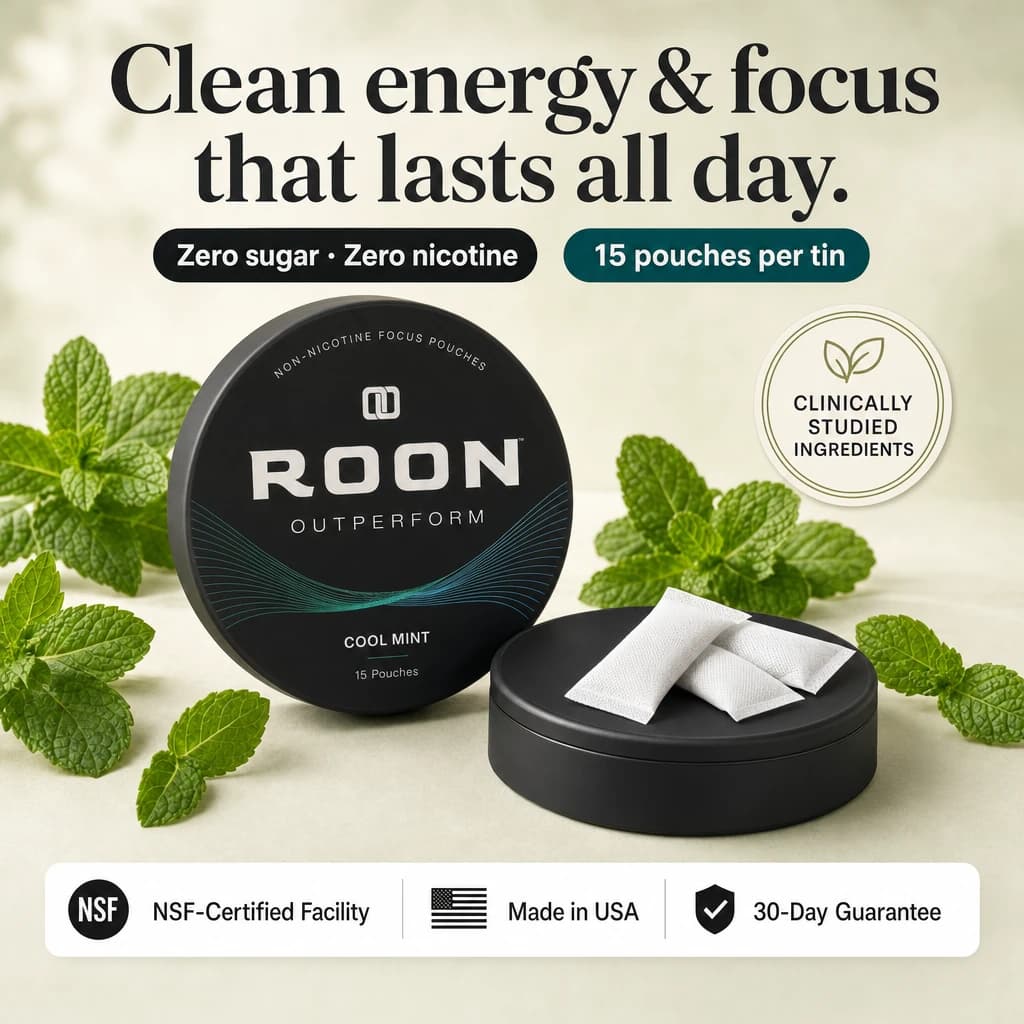
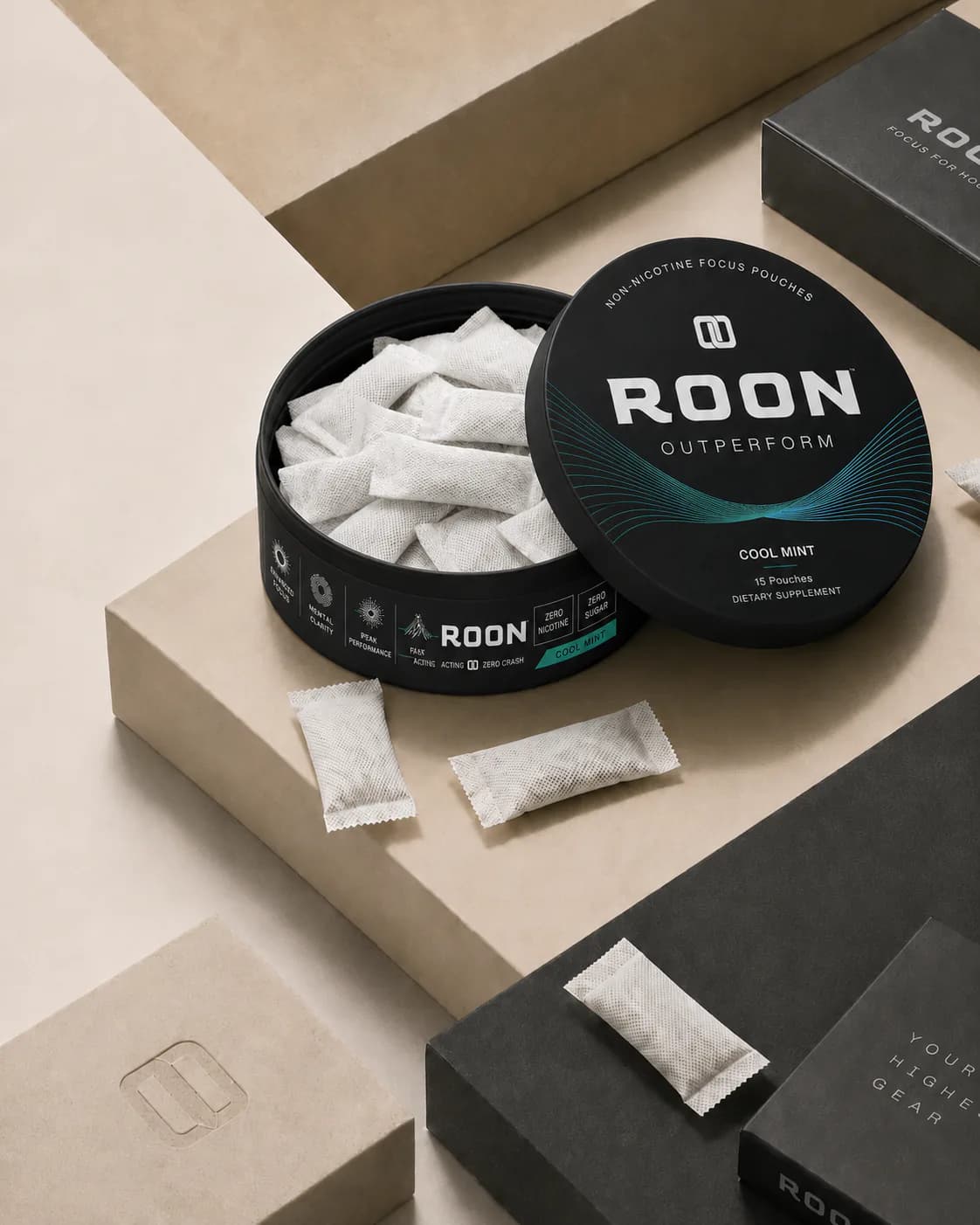
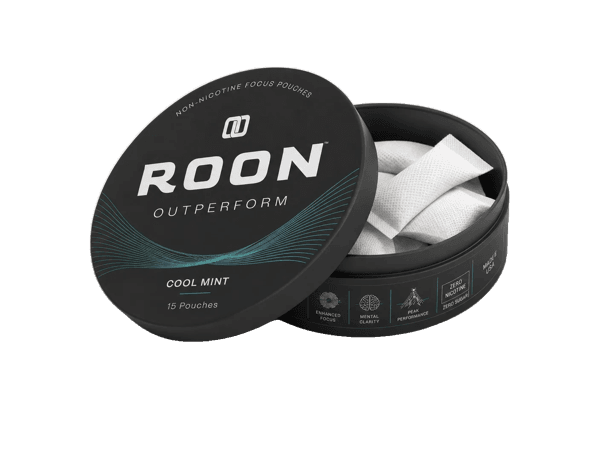
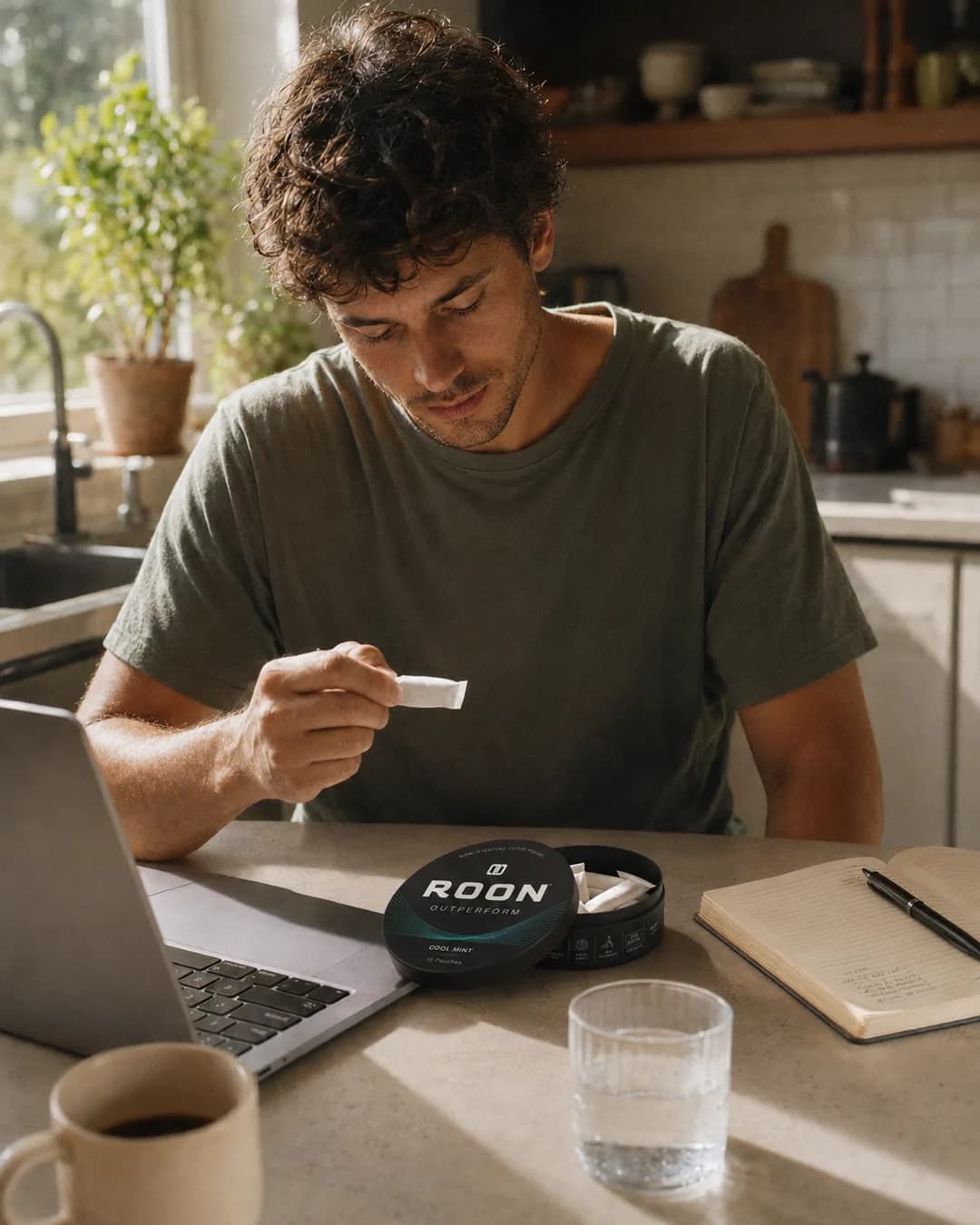
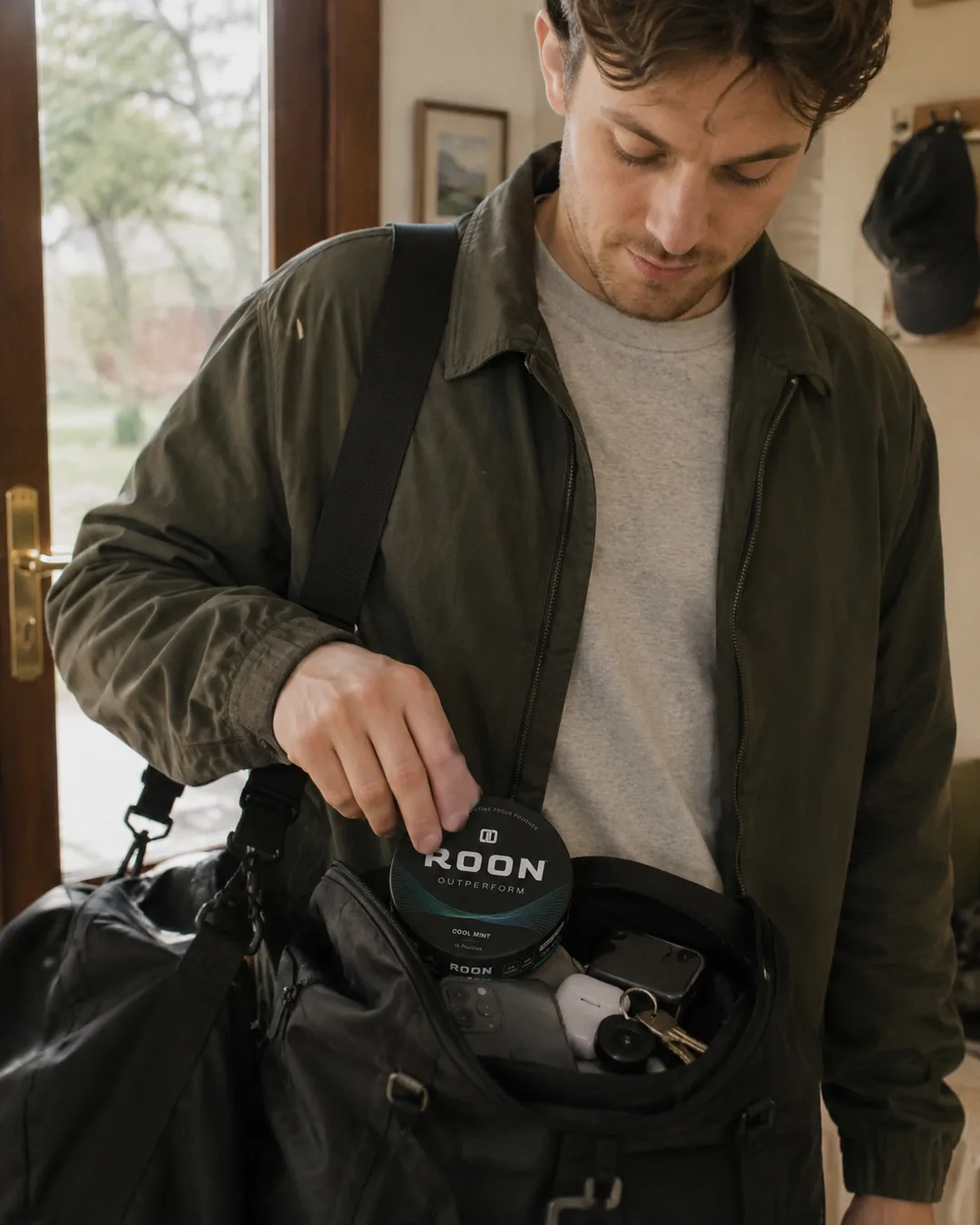
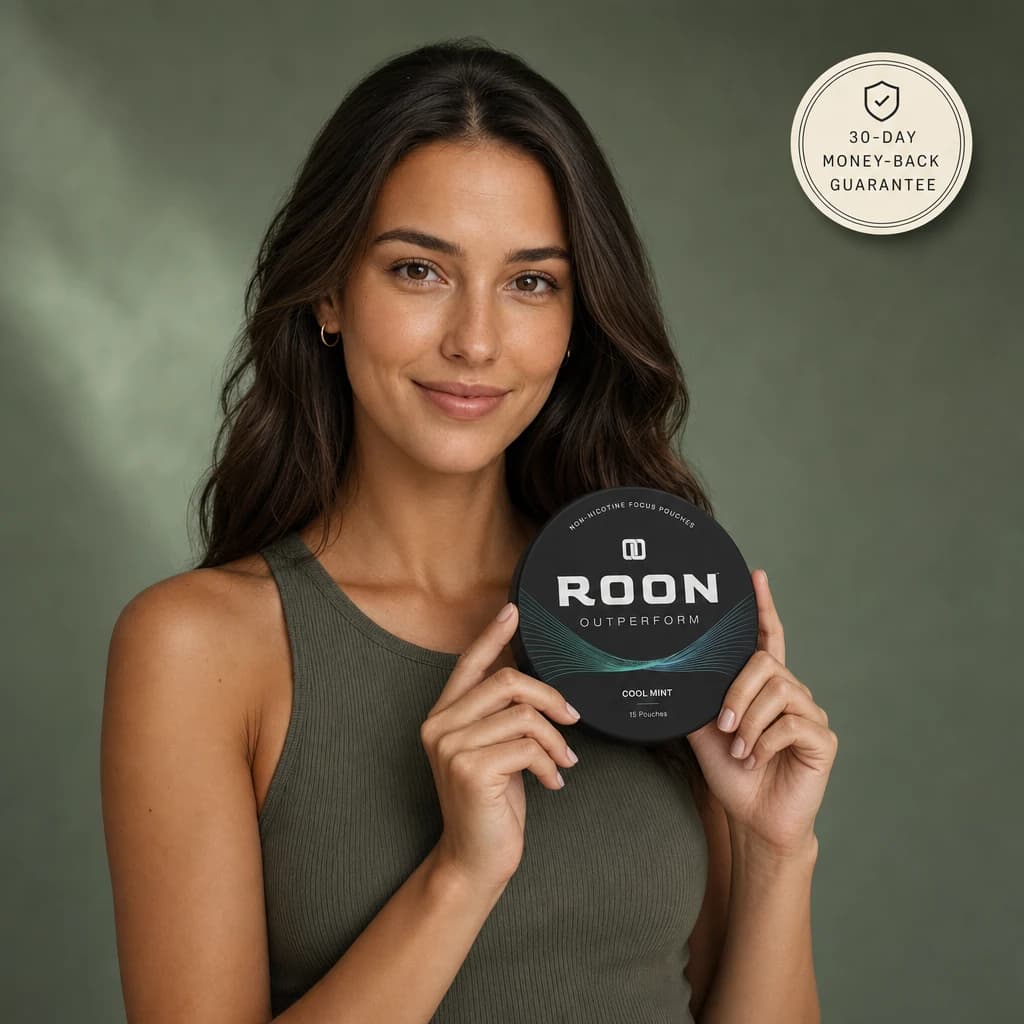
The label above is Roon's label. Every ingredient listed in this article is printed on the tin of Roon, a zero-nicotine, zero-tobacco oral pouch in Cool Mint, 15 pouches per tin.
The four-ingredient active stack is 80mg caffeine, 60mg L-theanine, 25mg Dynamine®, and 5mg TeaCrine® from material standardized to 40%. Together, Roon characterizes this combination as producing roughly a 2.5x caffeine effect, meaning the felt impact of 80mg caffeine is stretched and smoothed well beyond what 80mg would do on its own. The onset is 5 to 10 minutes, with peak effect at 30 to 60 minutes. The felt duration is 6 to 8 hours. Users report minimal jitters at peak and no sharp crash at the end, just a slow taper as the caffeine clears.
Roon starts from $9.16 per tin (as little as $0.61 per pouch) when you subscribe to the 12-tin bundle. The one-time 4-tin bundle is $15.00 per tin ($1.00 per pouch). A single tin is $19.99. No liquid, no brewing, no sugar, no tobacco, no nicotine.
The inactive ingredients exist to make the format work: cellulose for structure, glycerin for moisture, sucralose for taste, sodium bicarbonate for absorption, and the rest for stability and flavor. None of them are hidden. Roon lists every one on the tin and on the product page.
What Roon is not: it is not a substitute for sleep, food, or medical care. It is a caffeine-based focus tool with a delivery format and ingredient stack designed to make a small dose go further and feel smoother. If you know what is in it, you can make an informed decision about whether that is what you need. That is the point of this page.